Published on
September 2, 2026


A VC term sheet can leave you with most of the common stock and still less control than you think. If I were reviewing one on September 2, 2026, I’d focus on four things first: board seats, stockholder voting rules, investor veto rights, and the ownership cutoffs that shift power after dilution.
Here’s the short version:
If I had to boil it down to one test, it would be this: who can block a sale, a new financing, debt, board changes, or the annual budget? That tells me more than the headline valuation.
| Control area | What I’d check first | Main founder risk |
|---|---|---|
| Board | Seats, quorum, independent pick | Investor seat gets a meeting-level veto |
| Voting | Class votes, supermajority rules, drag-along terms | Founders get outvoted on a sale |
| Consent rights | Reserved matters list, dollar thresholds, who approves | One investor can block routine moves |
| Ownership | Post-round cap table, option pool, future dilution | Control slips round by round |
Below, I’d use this lens to review the term sheet fast and spot where control can shift before the deal closes.
Once a financing closes, control usually splits across three approval layers: the board of directors, the stockholders, and investor-only consent rights. These layers overlap, but they don't do the same job. One approval may move a deal forward, while another can still stop it cold. That's why you need to map all three before you sign.
The board handles day-to-day big-picture calls like hiring, budgets, strategy, and oversight. So the makeup of that board matters a lot.
In early rounds, companies often start with a 3-seat board. By Series A, a 2-2-1 setup is common. That usually means two founder seats, two investor seats, and one independent. In practice, that independent seat can decide the outcome when the two sides split. Founders should make sure the independent director is picked by mutual agreement and brings solid operating experience.
Not every investor gets a voting seat. Some get a board observer role instead. Observers can attend meetings and see what's happening, but they don't get a vote. That gives investors visibility without handing them direct board control.
Quorum rules deserve a close look too. If the company can't hold a valid board meeting unless an investor-appointed director is present, that seat may carry a pocket veto.
Board seats shape operating control. Stockholder votes deal with major company actions.
Stockholder approval is usually needed for major corporate actions like mergers, charter amendments, dissolution, and director appointments. But these votes don't always work the same way. The key issue is whether preferred and common stock vote together as one class or vote separately by class.
When preferred and common vote together, a large preferred investor block may outvote common shareholders, including the founders, on major decisions. Class voting changes that setup because each class must approve the action on its own. Founders should press for class votes on major actions that affect ownership or control.
Supermajority thresholds add one more gate. Some actions need more than a simple majority. That means investors may still block them if they hold enough voting power, even when founders control the common stock.
And even if both the board and the stockholders approve something, investor consent rights may still stop it.
Protective provisions are contract-based veto rights tied to preferred stock. They sit outside the board vote and outside the general stockholder vote. So even if the board approves an action unanimously and the common shareholders back it, preferred stockholders may still block it if the action falls inside their consent rights.
These provisions are common in venture deals. They usually cover things like:
The main problem for founders starts when investors try to pull these veto rights into routine operating decisions, like approving the annual budget or signing commercial leases. That's where things can get sticky fast.
A better setup is to use financial thresholds so consent rights apply only when the stakes are high enough. For example, requiring investor approval only for debt above $500,000 keeps the veto focused without turning it into a day-to-day roadblock.
| Control Layer | Who Holds Authority | Key Decisions Covered |
|---|---|---|
| Board of Directors | Founder + investor directors | Executive hiring, budget approval, strategic pivots |
| Stockholder Vote | All shareholders (common + preferred) | Mergers, charter amendments, dissolution, director appointments |
| Investor Consent | Preferred shareholders only | New senior stock, debt above thresholds, board size changes |
Use this framework to test ownership bands, dilution, and control in future rounds.
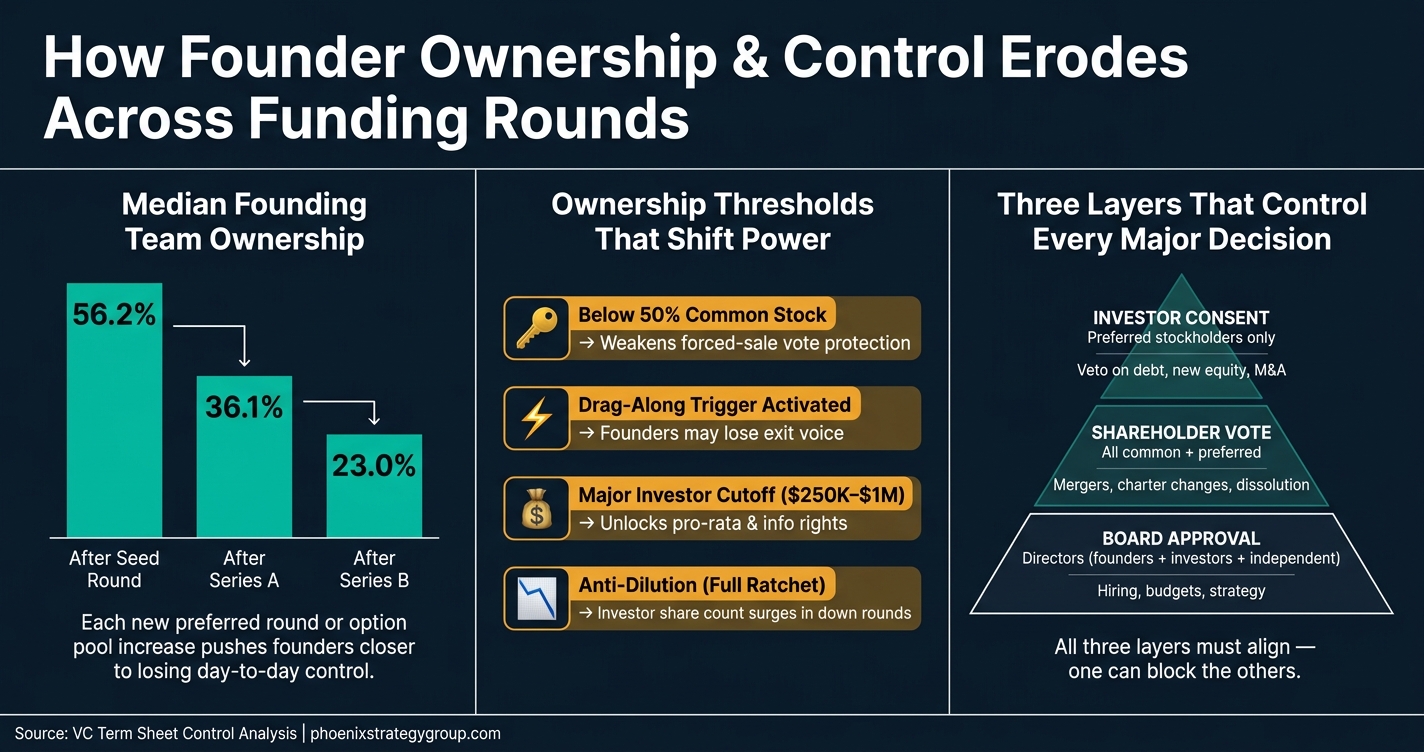
Founder Ownership & Control Thresholds Across Funding Rounds
Before you sign, run the numbers on the thresholds that can change who has the upper hand: 50% ownership, drag-along triggers, class-vote thresholds, and "Major Investor" cutoffs.
Falling below 50% of the common stock doesn't automatically strip founders of control. But it can weaken their hand in a forced-sale vote. If a simple majority of preferred stock can activate drag-along rights, founders may have almost no voice in the outcome. If the deal requires a majority of each class voting separately, founders keep a meaningful veto over an exit. That difference can shape the whole company, so it's worth pushing on during negotiations.
"Major Investor" thresholds matter too. Many term sheets define a "Major Investor" as someone who put in more than a set amount, usually between $250,000 and $1,000,000. Investors who cross that line often get pro-rata rights and information rights, which can squeeze future rounds. The more investors who qualify, the harder later financings can become.[2][3]
And these thresholds don't stay still. Dilution and new financing terms keep moving the cap table, which means control can shift even when no one is paying close attention.
Control usually slips away bit by bit. On paper, the mechanics can look routine. In practice, option pool increases, preferred stock conversions, and new preferred rounds keep cutting into founder influence.
A pre-money option pool puts the dilution on founders. A post-money pool spreads that dilution more evenly.[1]
Preferred stockholders usually have the right to convert into common stock. They’ll do that when their share of a sale is worth more than their 1x liquidation preference. In a down round, anti-dilution terms - especially full ratchet - can increase investor share counts almost overnight, which pushes founder ownership down even more.[2]
The numbers show how fast this stacks up. The median founding team owns 56.2% after a Seed round, 36.1% at Series A, and 23% by Series B.[4] Each new preferred round, or each option pool increase, pushes founders closer to the points where they lose day-to-day control over big calls.
Once you've mapped the thresholds that can move, check them against each approval layer.
These three approval layers govern different actions, and each one carries a different risk. The practical move before signing is simple: know which threshold applies to which decision, and spot where your room to maneuver can disappear.
| Approval Type | Who Approves | Decisions Covered | Typical Threshold | Biggest Founder Risk |
|---|---|---|---|---|
| Board Approval | Board of Directors (founders, investor directors, independents) | C-suite hiring, budgets, strategic pivots, M&A | Simple majority of directors | Losing the independent tie-breaker vote |
| Shareholder Approval | All common and preferred holders | Sale of the company, charter amendments, board size changes, dissolution | Simple majority of voting power, sometimes by separate class | Drag-along rights forcing a sale founders oppose |
| Investor Consent | Preferred stockholders, often as a separate class | New equity issuance, debt above limits, dividends, M&A | Majority or supermajority of preferred stock | Veto over fundraising or a sale even with board support |
Use this map as a pre-signing checklist. It helps you see where control can bend long before it breaks.
Once you’ve mapped the approval layers and ownership thresholds, it’s time to review the term sheet line by line. The point is simple: find any hidden veto or approval choke point before it slows down day-to-day decisions or gets in the way of your next round.
Start with the board itself. Check the total number of seats, who gets to appoint them, what counts as quorum, and whether the independent director is actually chosen by both sides. If one investor director can miss a meeting and stop the board from acting, that’s a problem.
Also watch for supermajority thresholds or class-vote requirements tied to normal strategic decisions. Routine company actions should not need anything more than a simple board majority. If they do, the board can become slow and hard to manage.
After that, move to the veto rights that can still block action even if the board approves it.
Go through every item in the reserved matters list and ask a blunt question: is this a major company decision, or is it part of normal operations?
Consent rights over things like routine budgets, non-C-suite hiring, or standard lease decisions are red flags. If those items show up, mark them right away.
Then look at who has to approve. That detail matters a lot. Some term sheets ask for approval from a majority of all preferred holders. Others give that power to one named investor. If one named investor can block action on their own, that’s a unilateral veto. A better setup is approval by a majority of preferred holders voting as a class, not one party holding the keys.
Once the control terms make sense on paper, test them against your cap table and likely future rounds. This is the point where outside help can save you from a bad surprise later.
Bring in counsel and a financial advisor before you sign:
The term sheet sets the governance rules for every round that comes after this one. And those rules don’t stay theoretical. FanDuel’s sale showed what can happen when founders don’t have enough protection: liquidation preferences and drag-along rights left founders and employees with nothing. [2]
Once you’ve looked at board rights, voting rights, and consent rights, zero in on the thresholds that actually decide what happens. Equity ownership is only one piece of the puzzle. A minority investor can still have blocking power through board seats, class votes, and protective provisions, even without majority ownership. The thresholds that matter most are usually tied to financing, debt, budgets, and exits.
When liquidation preferences and drag-along rights start stacking up, founders can lose both the money side and the decision-making side.
Look closely at who controls the board, which decisions need a class vote, and whether any investor has a one-person veto. Then map out how future dilution could move those thresholds over time. The biggest danger is hidden control, not headline ownership. If a consent right extends into day-to-day budgets or hiring, push back. In venture term sheets, control terms decide who gets to make the big calls.
In venture capital, control rights often matter more than ownership percentage. Why? Because they decide who gets to run the company, set direction, and approve an exit.
The big ones are board composition, investor veto rights over major decisions, and drag-along rights. A founder can still hold most of the equity and lose control if those terms give investors the power to call the shots.
An investor can block a sale or new financing through protective provisions. These are veto rights written into venture term sheets. They can require that investor’s separate approval before the company takes big actions, such as a sale, merger, or new equity issuance.
If drag-along rights kick in, investors may also be able to force a sale. That’s why founders often push for higher approval thresholds. For example, they may ask for separate approval from each stock class so they keep some veto power over a forced exit.
Before signing a term sheet, founders need to look past valuation. The headline number gets attention, but it’s often the fine print that shapes long-term control, ownership, and room to maneuver.
Pay close attention to board structure, protective provisions, liquidation and anti-dilution terms, founder vesting and acceleration, pro-rata rights, and drag-along rights. These terms can quietly shift power to investors if you’re not careful.
For example, a weak board setup can leave founders outnumbered. Broad protective provisions can give investors a say over day-to-day moves that should stay with the company. Liquidation and anti-dilution terms can change how money and ownership are split later on. Founder vesting and acceleration affect what happens if a founder leaves or the company is sold. Pro-rata rights shape who gets to keep buying in during future rounds. And drag-along rights can make it easier to force a sale.
Read each of these with care so you don’t give investors too much control over routine decisions, future dilution, or a forced exit.