Published on
September 24, 2026


The short answer: the best refinance model depends on how your company turns revenue into cash. A SaaS company with recurring subscriptions will not refinance the same way as a medical group waiting on insurer payments, a legal tech firm with services revenue, a home services operator with seasonal swings, or a renewable project tied to a long-term contract.
If I boil the article down, these are the main points:
The article’s core message is simple: rate matters, but cash timing matters more. Lenders care about things like DSCR, churn, collections speed, payer mix, collateral, contract life, and downside risk. In many cases, a deal that looks cheap can still be a poor fit if cash flow is uneven or covenants are too tight.
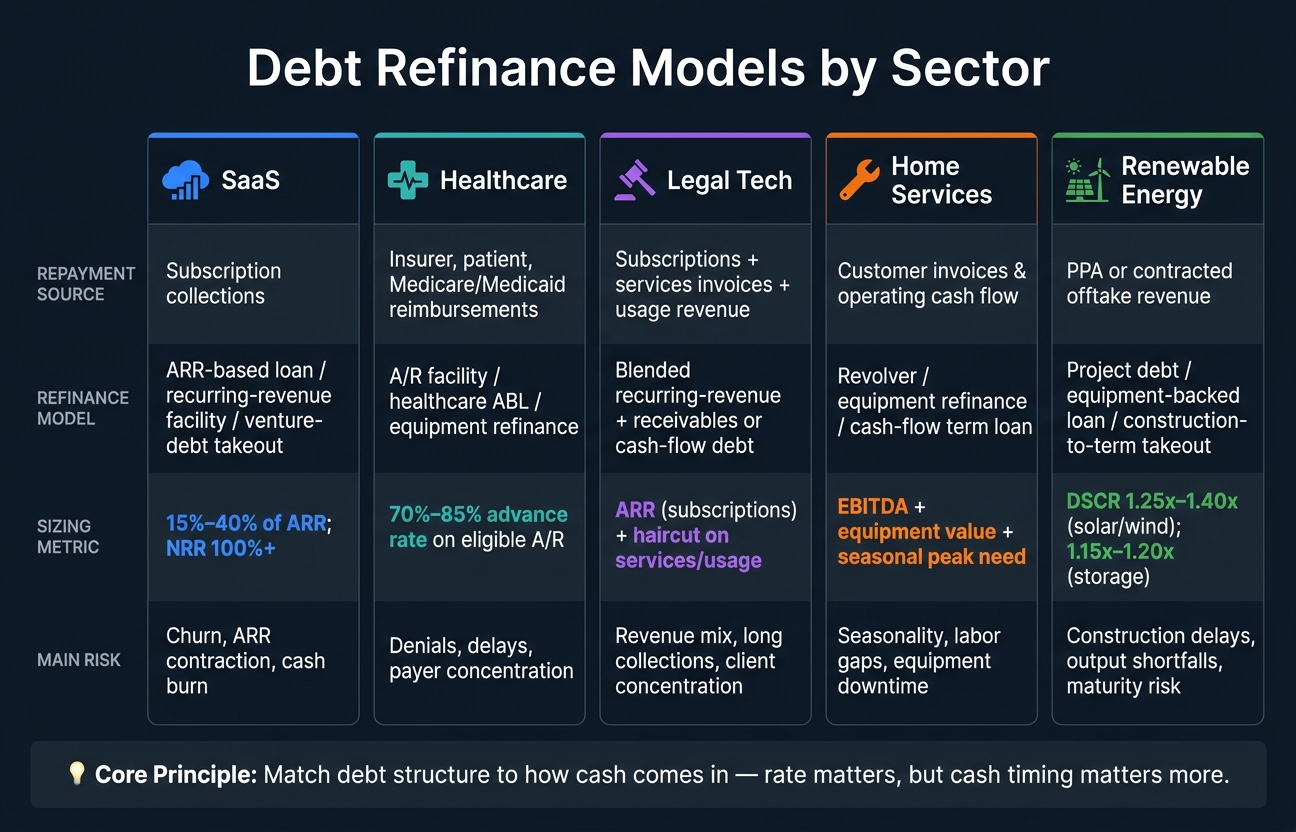
Debt Refinance Models by Sector: SaaS, Healthcare & More
| Sector | Main repayment source | Common refinance model | Main risk |
|---|---|---|---|
| SaaS | Subscription collections | ARR-based loan, recurring-revenue facility, venture-debt takeout | Churn, contraction, cash burn |
| Healthcare | Insurer, patient, Medicare, or Medicaid reimbursements | A/R facility, healthcare ABL, equipment refinance | Denials, delays, payer concentration |
| Legal tech | Subscriptions, services invoices, usage revenue | Blended recurring-revenue + receivables or cash-flow debt | Revenue mix, long collections, client concentration |
| Home services | Job cash flow and invoices | Revolver, equipment refinance, cash-flow term loan | Seasonality, labor gaps, downtime |
| Renewable energy | PPA or other contracted project revenue | Project debt, equipment-backed loan, construction-to-term takeout | Construction delays, output shortfalls, maturity risk |
What I’d keep top of mind: lenders are not just looking at revenue totals. They are looking at cash quality, timing, and collateral. A company with $2,000,000 in revenue can support very different debt structures depending on whether that money is recurring, billed fast, collected late, or tied to a few customers.
So before you refinance, I’d test three things:
That is the frame for the rest of the piece.
SaaS and legal tech deals refinance best when a lender can point to revenue that is contracted and collectible. But that doesn't mean every dollar gets treated the same way. The big issue is simple: How predictable is the revenue, and how likely is it to turn into cash?
For SaaS companies that aren't profitable yet, ARR-based facilities are often the clearest path. Instead of lending against EBITDA, lenders look at the strength and staying power of subscription revenue. ARR is generally calculated as MRR × 12, excluding one-time implementation fees, unpredictable usage charges, and professional services revenue.[2][3]
Indicative advance rates on ARR-based products often fall between 15% and 40% of ARR, though actual sizing depends on retention, margins, concentration, and the lender's risk tolerance.[4] MRR-based facilities may size availability at about 3×–12× MRR. That's a big spread, and for good reason. Churn, gross margin, and customer quality can change the deal a lot.[2][3]
Lenders usually want to see low churn, NRR of 100% or more, solid subscription margins, and manageable CAC payback. If those numbers slip, advance rates can shrink and terms can get tighter.[1] If NRR drops below 100% or a major customer fails to renew, the lender may cut the borrowing base, ask for more liquidity, or tighten the deal in other ways.[1]
As the company gets closer to profitability, a senior secured cash-flow loan starts to make more sense. That kind of loan is sized against normalized EBITDA instead of ARR. It can support more debt, but there's usually a trade-off: tighter financial covenants and less room on amortization.[5]
| Structure | Borrowing-base metric | Repayment method | Equity dilution | Best-fit stage | Key refinance risks |
|---|---|---|---|---|---|
| ARR/MRR term loan | Eligible contracted ARR or MRR | Fixed principal and interest, usually monthly or quarterly | None; warrants possible | Growth-stage SaaS with predictable subscriptions but developing EBITDA | ARR contraction, covenant breach, refinancing at maturity |
| Recurring-revenue revolver | Eligible recurring revenue and sometimes cash collections | Draws and repayments based on availability; interest on drawn balance | Usually none; fees or warrants may apply | Businesses with fluctuating working-capital needs | Availability can fall quickly after churn or customer loss |
| Venture-debt takeout | Investor support, cash runway, and operating metrics | Scheduled amortization, final payment, and interest; warrants may remain or be negotiated | Usually limited, but warrants or equity-linked rights may apply | Venture-backed companies refinancing an earlier venture loan | Balloon payments, warrant costs, and dependence on future funding |
| RBF takeout | MRR, cash receipts, churn, and gross margin | A fixed percentage of monthly cash receipts until a repayment cap is reached (typically 1.3×–1.5× principal)[6] | None; warrants possible | Bootstrapped or lightly funded SaaS with reliable collections | High effective cost, slower payoff when growth weakens, and cash-flow pressure |
| Senior secured cash-flow loan | EBITDA, leverage, fixed-charge coverage, and free cash flow | Scheduled amortization plus interest | No direct dilution, subject to negotiated warrants or fees | SaaS approaching or achieving consistent profitability | Insufficient EBITDA, restrictive covenants, and collateral liens |
Before refinancing venture debt or RBF, compare the full payoff, fees, prepayment costs, warrant effects, and legal expenses against the new facility's total cost. A refinance can look cheaper at first glance and still end up costing more once every line item shows up.
When revenue is less uniform, lenders stop relying on pure ARR underwriting. At that point, they shift to a blended review of recurring revenue, receivables, and backlog.
Legal tech is a different animal because revenue often comes from a mix of subscription, usage, and services. Lenders don't underwrite those streams in the same way. Only the subscription base behaves like SaaS. Services revenue acts more like working capital.
Subscription ARR may support recurring-revenue debt. Billed receivables from services may support a receivables facility. Services revenue is underwritten through backlog, margins, billing milestones, and collections, not treated as recurring ARR. So if a legal tech company has $10,000,000 in total revenue, made up of $5,000,000 in subscription ARR, $3,000,000 in services contracts, and $2,000,000 in variable usage revenue, the lender may apply ARR methodology only to the subscription piece, review the services side through backlog and receivables, and apply a heavy haircut to the variable piece.
| Legal-tech operating profile | Debt capacity effect | More suitable structures | Primary lender concern |
|---|---|---|---|
| High subscription mix, strong GRR and NRR | Higher capacity and longer tenor because revenue is more predictable | ARR facility, recurring-revenue revolver, senior secured loan if profitable | Churn, customer concentration, and contract cancellation rights |
| High services and implementation mix | Lower ARR-based capacity; greater reliance on receivables and backlog | Receivables facility, cash-flow loan, equipment or venture debt | Project delays, margin volatility, and collection timing |
| Large enterprise customers | Capacity may be strong if contracts are investment-grade and diversified by end market | ARR facility or receivables-backed facility | Concentration, termination rights, and slow payment |
| Long implementation cycles | Borrowing may be limited until milestones are billed or accepted | Revolver against eligible receivables, milestone-based draws, venture debt | Revenue recognition, unbilled receivables, and working-capital gaps |
| Declining retention or frequent downgrades | Capacity, advance rate, and covenant headroom may fall | Smaller secured facility, amendment, or equity-supported refinance | Whether recurring revenue will continue after refinancing |
A drop in NRR from 110% to 95% is a warning sign. It shows that the current customer base is shrinking before new sales are even counted. That kind of shift can lead to lower leverage limits, tighter covenants, or a demand for added liquidity, even when total reported revenue hasn't changed yet.
Before closing a recurring-revenue refinance, management may benefit from fractional CFO services to get the basics right. Lenders will dig into the details, and the most common closing problems are usually pretty plain: a weak ARR bridge, an incomplete payoff, or lien releases that haven't been nailed down.
Start with the existing lender's payoff amount in full. That means principal, accrued interest, exit fees, prepayment premiums, unused commitment fees, and any warrant or equity effects. Then build an ARR bridge that clearly separates beginning ARR, new business, expansion, contraction, churn, and ending ARR, and reconcile it to billing records, the general ledger, and bank deposits. For legal tech, keep separate schedules for subscription ARR, usage revenue, services backlog, billed receivables, unbilled receivables, and deferred revenue.
It's also smart to pressure-test the deal before terms are final. Model cases with higher logo churn, loss of a major customer at renewal, lower NRR, delayed implementations, slower collections, and a later path to EBITDA. Then calculate pro forma leverage, fixed-charge coverage, minimum liquidity, and covenant headroom under each case. On the legal side, confirm lien searches, UCC termination requirements, and the order of payoff and funding so the current lender gets cleared funds before, or at the same time as, collateral is released. After closing, give clear ownership for monthly KPI reporting, covenant certificates, borrowing-base reports, and customer concentration schedules.
When collections rely on invoices, claims, or milestones instead of subscriptions, refinance capacity shifts away from ARR and toward receivables and cash conversion.
When repayment hinges on reimbursements, finished jobs, or invoices, lenders don't underwrite ARR. They underwrite collections. Billing speed, payer mix, and collateral shape the deal. So the focus moves away from recurring revenue and toward receivables and cash coming in.
For medical practices and service companies, the main refinance tool is often an accounts-receivable-backed facility. The lender advances against eligible receivables that flow through a lockbox. But the borrowing base comes from eligible receivables, not total billings. Advance rates on eligible receivables usually land in the 70%–85% range.[7] Self-pay balances, denials, adjustments, and concentration caps can all shrink that base.
Payer mix is one of the biggest drivers of borrowing capacity. Commercial insurance receivables are usually easier to finance than government-program or self-pay balances. And when denial rates climb, both short-term cash flow and collateral value take a hit. Days in A/R matter too. One benchmark put median healthcare A/R at 52.6 days, while best-in-class groups were around 35–40 days.[8] Receivables under 60 days are usually easier to finance. Balances from 60–120 days get more scrutiny. Amounts over 120 days are often excluded or discounted hard.[9]
| Healthcare debt structure | Best-fit scenario | Key lender focus | Primary refinancing risk |
|---|---|---|---|
| A/R-backed revolving facility | Sizable insurance receivables with uneven payment timing | Payer mix, aging, denial rates, lockbox controls | Borrowing-base compression from denials, recoupments, or aged claims |
| Asset-based revolver | Receivables plus equipment or other working-capital assets | Eligible collateral pool, advance rates, concentration limits | Collateral shrinkage after payer disputes or equipment obsolescence |
| Cash-flow term loan | Mature providers with predictable adjusted EBITDA | Debt-service coverage, leverage, collections stability | Insufficient EBITDA, covenant breach, payer-rate reductions |
| Equipment financing | Imaging, surgical, dental, or lab equipment | Asset identification, appraisal, lien position, useful life | Specialized equipment with limited resale value |
| Real-estate-backed debt | Owned clinics, surgery centers, or medical offices | Appraisal, LTV, property use, title | Property-use restrictions, concentration, environmental issues |
Lenders also dig into licensure, billing audits, overpayment risk, and open investigations. That part can matter more than it first appears. A refinance might cut interest cost, but if it also adds tight borrowing-base triggers tied to denial rates, liquidity can dry up fast when a payer dispute temporarily knocks down eligible receivables.
That same basic setup shows up in home services too, but the pressure points are different. Seasonal labor swings and collections on completed jobs matter more than payer aging.
Home-services companies - HVAC, plumbing, electrical, roofing, pest control - bring in real revenue, but the pattern is often uneven. Cash flow can swing with the season, and payment depends on completed work, not subscription contracts.
The usual refinance stack blends a seasonal working-capital revolver for payroll, materials, and fuel during busy months, fixed-rate equipment and vehicle loans matched to fleet life, and a cash-flow term loan for operators with steady EBITDA. Acquisitions can add seller notes or term debt. These setups tend to work well for commercial accounts, property managers, builders, or warranty programs where payment duties have already been invoiced and spelled out by contract.
Lenders care less about the job pipeline and more about work that is done, billed, and collectible. Booked work helps with forecasting, sure. But debt sizing comes down to cash timing.
| Financing structure | Seasonal borrowing needs | Collateral availability | Amortization burden | Fixed-rate versus floating-rate exposure | Acquisition flexibility | Covenant sensitivity |
|---|---|---|---|---|---|---|
| Working-capital revolver | Strong fit for peak-season payroll, materials, and fuel | Eligible A/R or inventory, depending on the structure | Usually limited amortization | Commonly floating rate | Can support post-acquisition working capital with lender approval | Availability floor, minimum liquidity |
| A/R-backed line | Best for commercial, property-management, or warranty accounts | Invoiced, collectible receivables | Usually minimal | Commonly floating rate | Limited without amendment | A/R aging, concentration, cancellation rates |
| Equipment and vehicle loans | Good for service vans, trucks, trailers, and specialized machinery | Specific assets with clear liens | Matches useful life | Often fixed rate or fixed payment | Can free up cash for fleet needs | LTV, maintenance, asset condition |
| Cash-flow term loan | Works when EBITDA is stable across seasons | Business cash flow; sometimes a blanket lien | Scheduled; can strain slow months | May be fixed or floating | Supports acquisitions if EBITDA covers service | Leverage, fixed-charge coverage, EBITDA floor |
Technician utilization is often the line between a strong credit and a weak one. High utilization and tight scheduling turn revenue into debt service. Low utilization does the opposite.
In both sectors, lenders care more about cash left after adjustments, payroll, materials, and capex than they do about reported revenue. Companies that can show 12 to 24 months of monthly collections data usually get cleaner underwriting. And when you model the business, don't lean only on the trailing-twelve-month average. Stress-test the weakest months too.
When repayment comes from collateral rather than collections, the refinance model shifts again.
When repayment depends on long-life assets and contracted output, refinance models look a lot more like project finance than collections work. In this setup, repayment comes from contracted project cash flow, backed by project assets and long-term PPAs.[11]
Most utility-scale renewable projects sit inside a special-purpose vehicle, or SPV. The SPV borrows against its own contracted revenue and assets instead of leaning on the parent company's balance sheet. Lenders look closely at forecast production, degradation, curtailment, operating costs, and reserves. The main issue isn't just whether the project looks profitable in a model. It's whether the project can repay the debt before the contract runs out.[11]
Debt capacity is tied closely to the PPA. In many cases, lenders want the debt fully amortized before the contract expires so they aren't left relying on post-PPA merchant pricing.[13] Indicative DSCRs are around 1.25x–1.30x for solar at P50 production and 1.35x–1.40x for wind. Storage projects may land closer to 1.15x–1.20x.[10] First-of-a-kind projects may need 1.5x–2.0x or higher DSCR.[14] Those figures are guideposts, not promises. Actual terms move with contract strength, technology, and lender appetite.
A common route for new projects is construction-to-permanent financing. A short-term construction loan covers the build phase. After the project reaches commercial operation and clears performance tests, that debt converts into long-term amortizing debt.[12]
Equipment-backed loans are more straightforward, but they cover less ground. They're secured by specific equipment - such as inverters, modules, turbines, or batteries - rather than the full project. That can help when a borrower wants capital without pledging the whole business. Still, lenders will dig into resale value, useful life, and obsolescence risk. A solar inverter that's tough to remove and redeploy may not be worth much as collateral, even if the project itself is doing fine.
The big refinance decision is whether the debt sits at the project level or the sponsor level. That one choice shapes almost everything: collateral, covenants, tenor, and how much risk stays with the parent company.[11]
With project debt, lenders control project cash through managed accounts and move it through a waterfall. Operating costs come first, then debt service, then reserve funding, and only after that do distributions flow to the sponsor. The collateral package usually includes physical assets, project contracts, project accounts, permits, insurance proceeds, and the sponsor's equity interest in the SPV.[11] Once the project clears completion tests, recourse to the parent is often limited or gone.
Corporate debt is a different animal. Here, the sponsor borrows against its consolidated cash flow and assets. That gives more flexibility, which can be useful for acquisitions, development pipelines, or projects that are still too early-stage or too exposed to merchant pricing for stand-alone project finance. The tradeoff is plain: the broader balance sheet is now at risk, and lenders usually want tighter leverage and liquidity covenants.
A renewable project can still get financing even if its sponsor is not investment grade, as long as the project itself has steady, contract-backed cash flow and a strong collateral package.[11]
| Structure | Primary repayment source | Typical collateral | Indicative tenor | Pre-completion risk | Refinancing risk |
|---|---|---|---|---|---|
| Project finance | Contracted PPA, capacity, or offtake cash flow | Project assets, contracts, accounts, permits, and SPV equity | Matched to contracted revenue; amortizes before PPA expiry | High pre-completion; lower after performance tests | Moderate if contracted; higher with merchant tail or balloon |
| Equipment-backed debt | Equipment-generated cash flow or borrower payments | Turbines, modules, inverters, batteries, and related equipment | Tied to equipment useful life; scheduled amortization | Moderate during installation; lower for operating assets | Higher when equipment has short useful life or weak resale value |
| Corporate-level term debt | Consolidated sponsor cash flow | Corporate assets, guarantees, subsidiary equity | Commonly shorter than project life | Depends on sponsor's development pipeline | Higher if maturity depends on asset sales or merchant cash flow |
| Portfolio refinancing | Combined cash flow from multiple operating projects | Pooled project assets, contracts, accounts, and equity interests | Can extend tenor across diversified assets | Lower after projects are operating | Moderate; cross-defaults and underperformance raise risk |
| Construction-to-permanent | Permanent project cash flow after completion | Construction-stage assets, project contracts, completed facility, and SPV equity | Short-term construction converts to long-term amortizing debt | High until completion, testing, and interconnection are done | Moderate if takeout is committed; high if arranged post-construction |
These are indicative structures, not fixed terms. Actual leverage, pricing, DSCR, tenor, reserve requirements, and recourse change based on technology, contract quality, merchant exposure, tax-credit timing, and sponsor support.[11][13][14]
For renewables, the best refinance structure is the one that matches contract life, production certainty, and asset durability.
Across these sectors, the best refinance model follows the source of cash, not the headline interest rate. That’s the thread connecting the SaaS, healthcare, legal tech, home services, and renewable energy cases from Sections 2–4.
| Business profile | Sizing base | Repayment source | Main collateral | Most important KPI | Main refinance risk | Stress case |
|---|---|---|---|---|---|---|
| Predictable B2B SaaS subscriptions | ARR or MRR, adjusted for retention and margin | Subscription collections | Recurring contracts and cash collections | Gross revenue retention, NRR, gross margin, ARR growth | ARR decline, customer concentration, covenant flip to EBITDA testing | 10%–20% ARR decline, higher churn, slower growth, reduced liquidity |
| Legal tech (subscriptions + services) | Subscription ARR plus normalized EBITDA or eligible receivables | Subscription receipts and services collections | Subscription receipts and collectible A/R | Revenue mix, collections, utilization, gross margin, retention | Services revenue may be less predictable or less financeable than subscriptions | Delayed projects, lower utilization, slower collections, shift toward lower-margin services |
| Healthcare provider or platform | Eligible receivables, borrowing base, cash flow, or equipment value | Insurance, government, and patient collections | Eligible receivables and equipment | Days sales outstanding, denial rate, clean-claim rate, payer concentration | Reimbursement delays, ineligible receivables, payer changes, or borrowing-base reductions | Longer collection cycles, higher denials, payer concentration, reduced advance rates |
| Seasonal home services | Peak working-capital need, EBITDA, and equipment value | Customer invoices and operating cash flow | Receivables, vehicles, and tools | Bookings, backlog, conversion to cash, seasonal utilization, fixed-charge coverage | Seasonal liquidity gap, equipment downtime, insufficient off-season cash flow | Weather disruption, demand decline, repair costs, weaker collateral liquidation value |
| Renewable-energy project | DSCR, contracted revenue, and asset value | Power-purchase agreement or other contracted offtake revenue | Project assets and contracted cash flow | Production, availability, contracted price, DSCR, and offtaker credit | Construction delays, performance shortfalls, contract expiration, refinancing-rate changes | Lower generation, curtailment, cost overruns, weaker offtaker credit, or merchant-price exposure |
One point deserves extra attention: ARR facilities may later convert to EBITDA-based testing, so founders should model that shift before signing.[15][16][17] Renewable lenders, meanwhile, underwrite contracted revenue, execution risk, and project durability.
Once the structure fits the cash profile, the next step is lender-ready forecasting and covenant testing. Refinancing is as much a modeling and reporting job as it is a financing decision.
Phoenix Strategy Group works with growth-stage companies to build lender-ready reporting, including:
For a SaaS company, that usually means tying ARR and retention metrics back to recognized revenue and cash collections. For a healthcare company, it means modeling receivables eligibility, payer timing, and borrowing-base availability. The payoff is simple: the model needs to match how lenders underwrite the business, not just how the company tracks it internally.
Before signing, test the structure against downside cash flow. In practice, that comes down to three checks.
First, match the debt structure to your cash-flow durability, billing cycle, and collateral. Recurring revenue fits ARR-based facilities. Receivables fit borrowing-base structures. Physical assets fit equipment debt. Contracted infrastructure revenue fits project financing.
Second, stress-test the downside. Model churn, collection delays, reimbursement pressure, seasonality, production shortfalls, and higher interest rates before you commit. A refinance can look fine on paper and still break under pressure.
Third, the best refinance is not always the one with the lowest rate. A structure that improves liquidity runway, covenant flexibility, and long-term strategic options - while still staying serviceable under adverse conditions - can be worth more than a slightly cheaper facility with no room for error.
Choose a refinance model that fits your cash flow, stage of growth, and comfort with risk.
Use a monthly 3-statement cash flow model with a debt service schedule and covenant tests. The goal is simple: make sure you can cover fixed payments even in a downside case, not just when things go well.
You should also look at the numbers behind the business, including:
If revenue is steady, debt may make sense. If cash flow is uneven or burn is still high, equity may be the better path. And if the answer isn't clear-cut, a hybrid structure can help balance dilution with repayment pressure.
Lenders don’t assess every business the same way. They zoom in on the revenue engine and day-to-day operating drivers of each sector.
In SaaS, that usually means a close look at recurring revenue quality and unit economics. They want to see gross retention above 80%, NRR in the 95%–110% range, and gross margins above 70%. They also look at CAC payback, with under 12–18 months as a common benchmark, along with net debt-to-ARR and a DSCR of at least 1.25x.
In healthcare, the lens shifts. Lenders tend to focus on debt-to-equity, interest coverage of 2.5x or higher, EBITDA margins, working capital per revenue, and the cash conversion cycle.
In renewable energy, the main concern is how well each project throws off cash. That’s why lenders pay close attention to project cash flow, DSCR of 1.20x–1.25x, PPA strength, merchant tail exposure, tax-credit eligibility, and O&M revenue.
Build a 3-statement monthly cash flow model that ties together revenue timing, debt service, covenant checks, and dilution scenarios. The goal is simple: see how cash moves month by month, not just on paper, and spot pressure points before they turn into a problem.
Run three quarterly cases:
For each case, layer in interest-rate shocks of +100, +300, and +500 basis points. That gives you a clearer view of how the structure holds up if rates move against you.
Your model should track at least these two metrics:
This matters because revenue timing can make a deal look fine in one quarter and tight in the next. A business may book sales, but if cash comes in late while debt payments stay fixed, the squeeze shows up fast.
If the downside case points to a covenant breach or a cash shortfall, revisit the structure before signing. That could mean adjusting amortization, changing the size of the cash buffer, reworking covenants, or looking again at how much dilution risk you're willing to take.