Published on
September 24, 2026

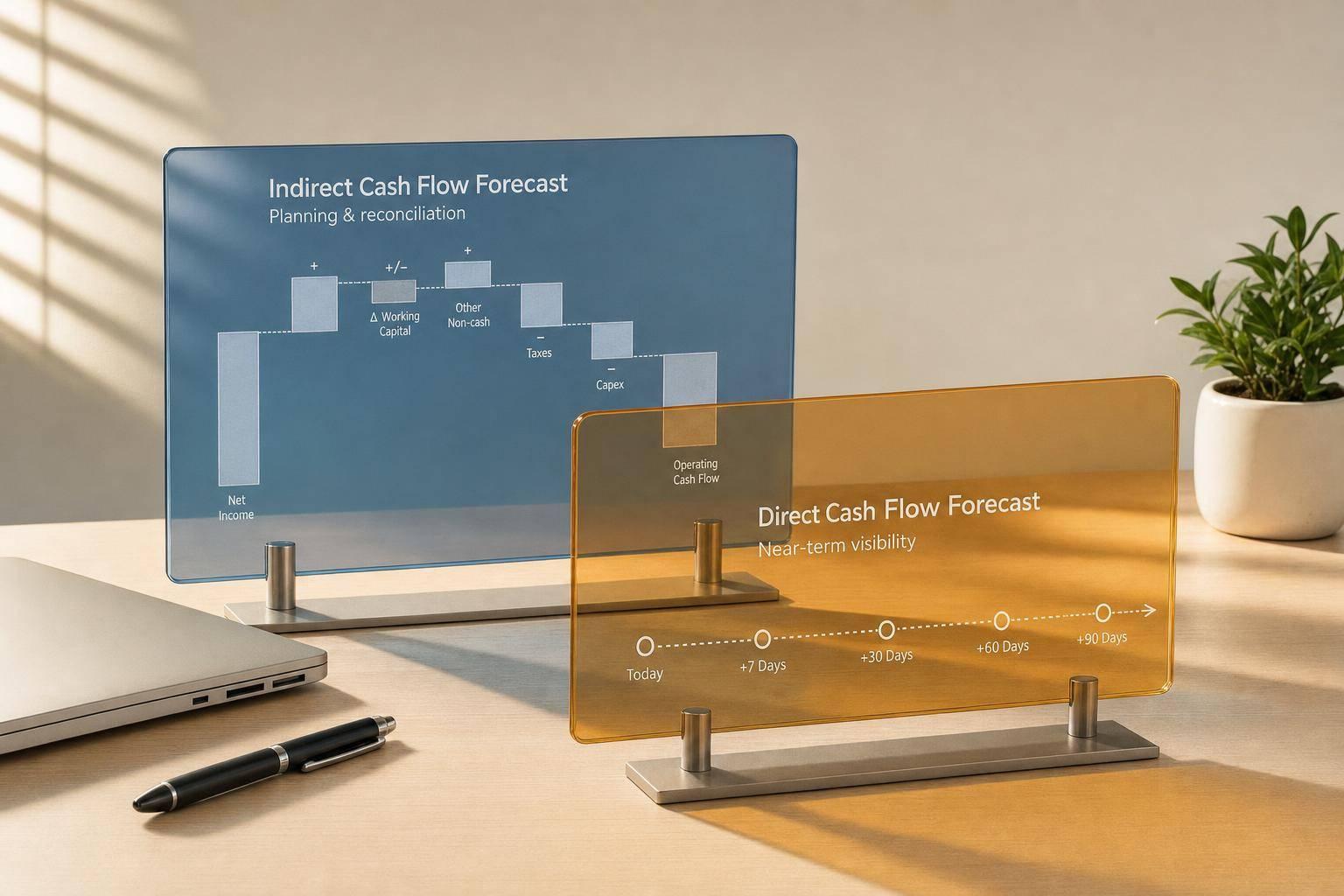
If I need to know whether cash will cover payroll next week, I use a direct forecast. If I need to explain why profit does not match cash over the next few months or years, I use an indirect forecast.
That is the whole decision in plain English.
Here’s the short version:
If I had to reduce the article to one line, it would be this: use direct for cash control, and use indirect for planning.
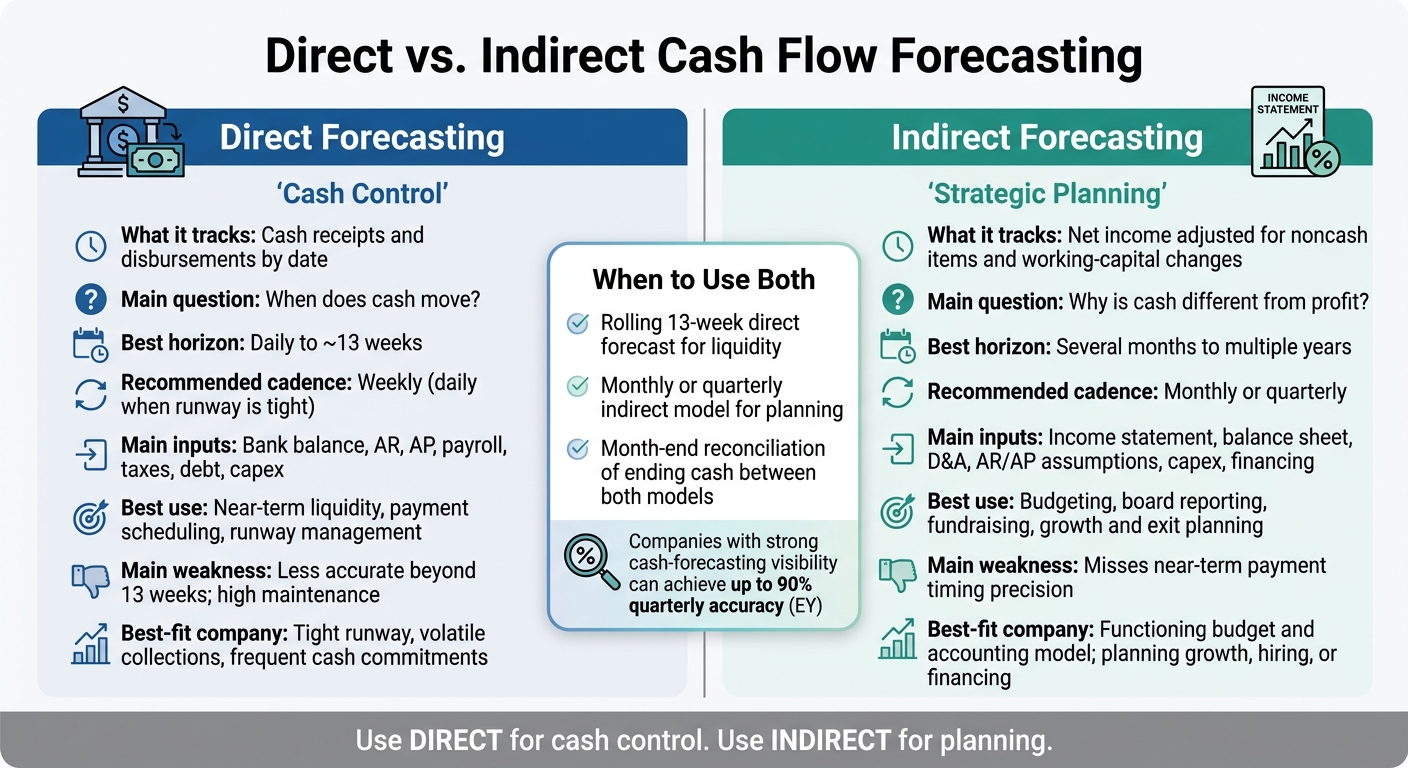
Direct vs Indirect Cash Flow Forecasting: Side-by-Side Comparison
| Point | Direct Forecasting | Indirect Forecasting |
|---|---|---|
| What it tracks | Cash in and cash out by date | Profit adjusted into cash flow |
| Main question | When does cash move? | Why is cash different from profit? |
| Best horizon | Daily to about 13 weeks | Monthly to multi-year |
| Main inputs | Bank balance, AR, AP, payroll, taxes, debt, capex | Income statement, balance sheet, D&A, working-capital assumptions |
| Best use | Near-term liquidity and payment timing | Budgeting, board reporting, fundraising, growth planning |
| Main weak point | More upkeep and lower accuracy farther out | Less precise on exact payment dates |
A simple way to think about it: direct tells me what hits the bank; indirect tells me what drives the gap.
That’s the lens for the rest of the article.
The direct method tracks cash based on when money actually moves. The formula is simple: opening cash + receipts − disbursements = projected ending cash.
That gives you a date-specific view of cash on hand. And because it follows payment dates instead of accounting profit, the direct method is most useful when timing is the main issue.
Start with a reconciled bank balance plus current schedules for AR, AP, payroll, debt, and capex. Then build the forecast around two sides of the ledger: receipts and disbursements.
On the receipts side, use open invoices and expected collection dates, along with recurring customer payments, loan proceeds, investment funding, grants, tax refunds, and other inflows. For large customers, forecast collections at the invoice level instead of relying only on the due date. If a customer is on net-30 terms but usually pays 10 days late, the forecast should show that pattern. Historical accounts receivable aging and collection behavior help keep the model grounded in what usually happens, not what should happen.
On the disbursements side, include every material payment expected during the forecast period: vendor invoices, payroll and benefits, rent, utilities, insurance, software subscriptions, taxes, debt service, and capital expenditures. Payroll is often the most predictable line because it follows the payroll calendar. Unapproved capex should use probability-adjusted timing.
Update the forecast daily when cash is tight or when large payments are coming up. Weekly updates work for most growth-stage companies. Monthly updates, on the other hand, can miss timing gaps inside the month.
A useful rule of thumb is to keep the forecast to about 8–12 major line items, such as collections, payroll, AP, rent, debt service, taxes, and capex. [2]
| Attribute | Strength | Limitation |
|---|---|---|
| Short-term cash visibility | Shows expected balances by day, week, or month and can surface an upcoming shortfall early | Accuracy declines as the forecast horizon extends and assumptions become less certain |
| Payment and collection timing | Models when customers are expected to pay and when the company expects to make payments | Late customers, disputed invoices, or changed vendor timing can quickly make projections stale |
| Transaction detail | Connects forecast lines to invoices, payroll dates, tax deadlines, debt service, and planned capex | Maintaining transaction-level detail can require substantial manual review |
| Update burden and data accuracy | Supports frequent operational decisions and rapid scenario updates when bank and transaction data are current and reconciled | Requires recurring updates to bank balances, AR, AP, payroll, and financing data; missing or misclassified transactions can materially distort the result |
| Scalability | Works well for a short-term rolling forecast and a manageable number of accounts | May require automation or system integration as transaction volume grows |
Use the direct method for near-term liquidity and cash flow management. The indirect method, by contrast, starts with projected earnings instead of transaction activity.
The indirect method turns projected net income into operating cash flow by adding back noncash items and adjusting for working-capital changes. The core formula is: Cash Flow from Operations = Net Income + Noncash Expenses − Noncash Gains ± Working-Capital Changes. [3][4]
The tradeoff is pretty simple: you get a forecast that ties neatly to accounting statements, but you lose some precision around exact payment timing.
This model starts with a projected income statement, a projected balance sheet, and supporting schedules that connect the two. If those records are weak, incomplete, or out of sync, the cash forecast can point you in the wrong direction. [5][1]
Here’s the big idea: profit is not the same as cash.
A business can post $250,000 in net income and $30,000 in depreciation, then still end up with less cash than those earnings seem to imply if working capital increases. If receivables grow because customers pay late, cash can drop even while profit moves up. That’s why working-capital assumptions carry so much weight.
The main inputs usually include:
These inputs are accounting-based, not payment-date based. [7][1] That’s one of the biggest differences from the direct method.
Capex also needs to be handled the right way. It should sit in investing cash outflows, while the related depreciation gets added back within operating cash flow. [6][1]
The indirect method is often used for monthly management reporting, quarterly reforecasting, annual budgeting, multi-year planning, fundraising models, lender reporting, and exit-readiness analysis. In practice, it fits reporting and planning far better than payment-date management.
| Attribute | Strength | Limitation |
|---|---|---|
| Link to income statement | Directly reconciles projected net income to operating cash flow | Profitability can appear healthy even when cash timing is deteriorating |
| Treatment of noncash expenses | Clearly identifies depreciation, amortization, and stock compensation that reduce earnings without immediate cash outflow | Requires accurate noncash-expense schedules and correct treatment of non-operating gains and losses |
| Working-capital visibility | Shows how receivables, inventory, payables, accrued liabilities, and deferred revenue affect cash | Usually shows period totals rather than payment dates |
| Forecast horizon | Works well for monthly, quarterly, annual, and multi-year planning | Less suitable for daily or weekly cash management |
| Reconciliation to financial statements | Can reconcile beginning cash, cash-flow movements, and ending cash to the projected balance sheet | A balance-sheet error can flow through the entire forecast and create a false cash balance |
| Dependence on accounting assumptions | Uses an existing accrual model and can incorporate DSO, DPO, inventory turns, and deferred-revenue rates | Results are only as reliable as the underlying accounting records and assumptions |
| Planning usefulness | Supports budgets, fundraising, debt planning, scenario analysis, and exit-readiness work | Does not replace a detailed payment schedule when management must manage near-term cash commitments |
Those tradeoffs are what decide whether the indirect method is the right fit. It’s also the main line between this method and a direct cash forecast for day-to-day cash management.
Direct forecasting tracks when cash actually moves. Indirect forecasting shows how earnings turn into cash. That gap matters most in three places: the data each model uses, how far out it works well, and how often you should update it.
| Comparison Point | Direct Forecasting | Indirect Forecasting |
|---|---|---|
| Model basis | Cash receipts and disbursements by date | Projected net income adjusted for noncash items and working-capital changes |
| Typical forecast horizon | Immediate through approximately 13 weeks [9][8] | Several months through multiple years |
| Recommended cadence | Weekly, or daily when runway is tight | Monthly or quarterly as part of budgeting and planning |
| Best use | Short-term liquidity control, runway management, and payment scheduling | Budgeting, board reporting, fundraising, and transaction planning |
| Main limitation | Requires detailed, reliable transaction-level data and becomes less reliable as the horizon extends | Can miss near-term payment timing and depends on assumptions about margins, working capital, and noncash items |
| Best-fit situation | A company facing tight runway, volatile collections, or frequent cash commitments | A company with a functioning budget and accounting model that needs to plan growth, hiring, capital expenditures, financing, or an exit |
That’s the core split. Use direct forecasting for cash control. Use indirect forecasting for planning.
Use direct forecasting when timing is the main problem. If you need to know whether payroll clears next week, this is the model that helps. The indirect method is not built to answer that with much precision.
Use indirect forecasting for budgeting, board reporting, fundraising, and scenario planning. It gives you a view of where the business is headed, not just what clears the bank account in the next few days.
For most growth-stage companies, the best setup is to use both:
That last part matters more than it may seem. If the two models show different ending cash balances, dig into the reason. Maybe a customer payment came in late. Maybe an accrual was missed. Maybe capex shows up in one model but not the other. Don’t just make the numbers line up by hand. Trace the gap.
That habit is what keeps both forecasts dependable over time.
Indirect forecasting supports the plan. Direct forecasting shows where the cash risk is.
Direct and indirect forecasts stay accurate only if you keep rolling them forward with actuals.
Start each update with reconciled actuals. Pull the latest reconciled cash balance, plus accounts receivable aging and payroll obligations, before you touch any forward-looking assumptions. If your opening balance is stale, the rest of the forecast can drift fast. Then move the horizon forward: close the period, swap in actuals, and extend the forecast into the next period.[10][11]
Separate recurring cash flows from nonrecurring items. Monthly payroll, rent, and subscription collections should sit in your baseline. A $75,000 equipment purchase, an annual insurance premium, or a legal settlement should be labeled and tracked on its own. If you lump those together, your run rate gets muddy and unusual activity is harder to spot. A simple tagging system helps:
It also helps to track timing, amount, owner, and status for each line where needed.
Keep an assumption log and track variance. Your log should record the amount or rate, effective date, timing, owner, source, confidence level, and next review date for every material input. That includes collection timing, billing terms, hiring start dates, pricing changes, vendor terms, taxes, capital expenditures, debt repayments, and financing proceeds. The moment something material shifts - billing terms, pricing, a new hire’s start date, or a financing close - update the model.
Then compare forecasted cash movement against actual bank activity on a set schedule. Track both dollar variance and percentage variance by category and by period. That’s where the forecast gets sharper over time.
Once the forecast is rolling, variance review is what keeps it dependable. For both direct and indirect models, record the variance, find the cause, and update the model. In a direct forecast, a gap in collections usually points to timing or customer payment behavior. In an indirect forecast, it can point to a working-capital assumption that needs to change. EY found that companies with strong cross-functional cash-forecasting visibility can achieve up to an estimated 90% quarterly accuracy against enterprise-level cash-flow targets.[12] That level of accuracy comes from treating every variance like a signal, not a side note. For businesses scaling rapidly, fractional CFO services can provide the expertise needed to maintain this level of forecasting rigor.
Start with a 13-week direct cash flow forecast. It’s the main short-term tool for managing liquidity, tracking payroll, and spotting cash gaps before they turn into crises.
Use actual bank balances as your single source of truth. Then layer in bottom-up inputs for the next six weeks, including aged accounts receivable, scheduled vendor payments, and confirmed payroll dates.
Update the forecast based on how fast decisions happen and how volatile the business is.
A rolling 13-week cash flow forecast should usually be updated weekly. If cash is moving fast or the business is under acute financial stress, update it daily or twice a week.
For 12- to 18-month projections, monthly updates are the standard approach. You should also revise your assumptions right away after major business events or when actual results differ from the forecast in a material way.
A company can look profitable on paper and still run low on cash. That’s because accounting profit and cash in the bank are not the same thing.
Profit can include non-cash items, like credit sales, even when the money hasn’t come in yet. At the same time, it leaves out cash going out the door for things like capital expenditures, loan principal repayments, tax payments, and owner distributions.
Cash problems usually show up when a business earns revenue before it collects the cash. If the company spends on inventory, hiring, or marketing before that money arrives, it can burn through its reserves fast.