Published on
September 24, 2026


The short answer: GAAP and IFRS can turn the same inventory into different reported profit, working capital, and balance sheet values.
If I had to boil the article down, I’d focus on 4 rules that change the numbers most:
That means two companies with the same raw materials, WIP, and finished goods can report different inventory balances, gross margin, current ratio, and even lender covenant results. In a deal, audit, or bank review, those gaps can change EBITDA adjustments, borrowing-base support, and working-capital targets.
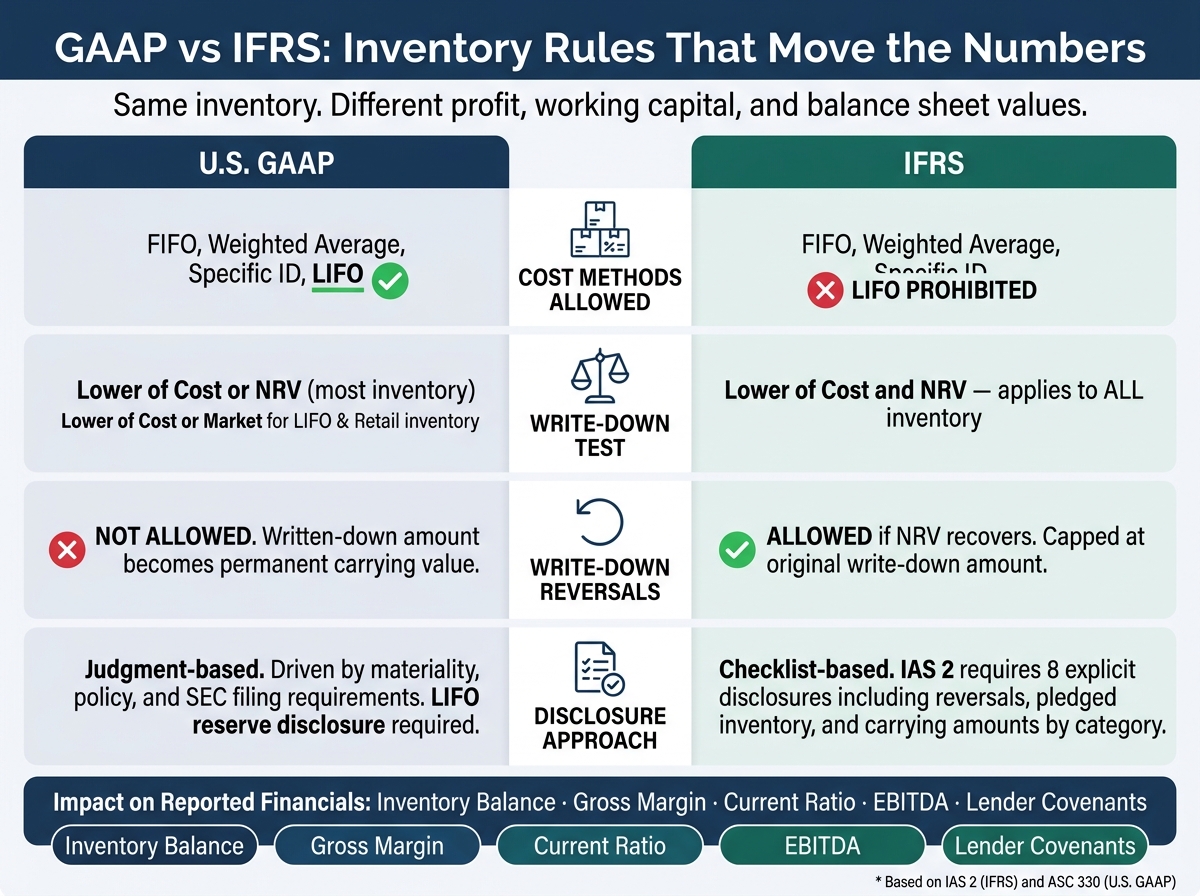
GAAP vs IFRS Inventory Rules: Key Differences at a Glance
| Area | IFRS | U.S. GAAP |
|---|---|---|
| Cost formulas | FIFO, weighted average, specific ID | FIFO, weighted average, specific ID, LIFO |
| LIFO allowed? | No | Yes |
| Main write-down test | Lower of cost and NRV | Lower of cost and NRV for most inventory |
| Special GAAP test | None | Lower of cost or market for LIFO/retail |
| Write-down reversal | Allowed if value recovers, up to prior write-down | Not allowed in most cases |
| Disclosure style | More direct IAS 2 requirements | More judgment-based |
Here’s the practical takeaway: if you report under both systems, I’d keep separate support for cost method, NRV testing, write-down history, and IFRS-only reversals. That alone can prevent year-end surprises.
The rest of the article explains how those rules affect manufacturing inventory, income statement presentation, current asset classification, and footnote disclosures.
Cost formulas create one of the clearest GAAP vs. IFRS splits.
| Topic | IFRS | U.S. GAAP |
|---|---|---|
| FIFO | Permitted | Permitted |
| LIFO | Prohibited | Permitted |
| Weighted average | Permitted | Permitted |
| Specific identification | Used for noninterchangeable or specific-project items | Permitted when appropriate |
| Consistency requirement | Apply the chosen formula consistently from period to period | Apply the chosen formula consistently from period to period |
| Write-down trigger | Cost exceeds NRV | Cost exceeds NRV (most inventory) or market (LIFO/retail) |
| Income-statement effect | Reduces inventory and current-period earnings | Classified within cost of sales or as a separate loss |
U.S. GAAP permits FIFO, LIFO, weighted-average cost, and specific identification. IFRS permits FIFO, weighted-average cost, and specific identification. Under IFRS, specific identification is used for noninterchangeable or project-specific items. LIFO is prohibited under IAS 2.[4]
For companies that report across borders, this is often the biggest gap. When input costs are rising, LIFO moves newer, higher costs into cost of goods sold. That usually leads to lower reported income and lower inventory balances than FIFO. So if a U.S. parent uses LIFO, it may need a separate FIFO or weighted-average calculation for IFRS reporting.
IFRS also requires companies to use the same formula for inventories with a similar nature and use. If a company uses different formulas, it needs a documented business reason.[4]
Once cost is set, the next step is testing whether inventory is still recorded at the right amount.
IFRS uses lower of cost and NRV for all inventory.[3] U.S. GAAP uses that same lower-of-cost-and-NRV test for inventory measured under FIFO, weighted-average cost, or specific identification.[1]
The split shows up again with LIFO and retail-method inventory under U.S. GAAP. For those items, GAAP still uses the lower-of-cost-or-market model. Under GAAP, market means replacement cost, but it cannot go above NRV and cannot go below NRV less a normal profit margin.[2]
If inventory is written down, the asset balance goes down and the hit runs through current-period earnings. Companies usually show that in cost of sales or as a separate inventory loss.[3][2]
Manufacturing rules also shape what gets included in inventory.
Both frameworks include the same core cost buckets: purchase costs, conversion costs, and other costs incurred to bring inventory to its present location and condition.[3]
A common trouble spot is overhead allocation. Fixed production overhead should be allocated based on normal capacity. If output drops below that level, unallocated overhead should be expensed.[3]
Companies should also expense abnormal waste, idle-capacity costs, general administrative costs, abnormal storage costs, and selling costs.[3] In day-to-day reporting, that usually means reconciling standard costs to actual costs and checking major production-volume variances before they skew inventory balances.
These measurement rules set up the write-down and disclosure rules that come next.
After measurement, the next step is presentation. That means dealing with reversal rules, asset classification, and where inventory losses show up in the income statement.
| Topic | IFRS | U.S. GAAP |
|---|---|---|
| NRV reassessment and reversal | IFRS reassesses NRV each reporting period and reverses prior write-downs when the loss no longer exists; reversal is capped at the original write-down amount.[3] | GAAP does not reverse ordinary write-downs; the written-down amount becomes the carrying amount.[4] |
| Carrying-amount impact | A qualifying recovery increases inventory and reduces inventory expense in the reversal period.[3] | A later NRV recovery does not increase inventory carrying value.[4] |
| Balance-sheet classification | Current asset when sold or consumed in the normal operating cycle, even if that cycle exceeds 12 months. | Same operating-cycle principle generally applies. |
| Write-down presentation | Recognized in the period incurred; typically included in cost of sales.[3][5] | Recognized in cost of sales or another inventory expense line per entity policy. |
| Reversal presentation | Reduces inventory expense in the reversal period.[3] | No reversal entry is recorded. |
Under IFRS, a write-down does not have to stay in place forever. If the conditions behind it no longer exist, or if there is clear evidence that NRV has gone up, IAS 2 requires a reversal.[3] But there is a cap: the reversal cannot exceed the original write-down amount. In plain English, inventory still cannot be carried above original cost.
U.S. GAAP takes a different path. Once inventory is written down, that lower amount becomes the carrying amount going forward, and no later recovery is recorded.[4]
That difference can create problems for cross-border manufacturers. If a company relies on one inventory valuation report for both frameworks, it could post an IFRS reversal into its U.S. GAAP books by mistake. That's why the subledger should track:
Presentation is not only about valuation. Classification matters too.
Inventory is shown as a current asset when it is expected to be sold or consumed during the normal operating cycle, even if that cycle is longer than 12 months. For example, a manufacturer building large industrial equipment may keep work in process on the books for 18 months or more and still present it as current.
Manufacturing inventory often includes raw materials, WIP, finished goods, supplies, spare parts, and goods in transit, depending on title transfer terms. The accounting policy should spell out how those categories are classified and how unusual items or long-cycle inventory are handled.
Once the balance-sheet amount is set, the next issue is where the loss lands in profit or loss.
Inventory write-downs are recognized in the period incurred. They are usually included in cost of sales or in a separate inventory-valuation line, based on the company's presentation policy.[3][5] Under IFRS, a reversal of a prior write-down reduces inventory expense in the reversal period. That can lead to different gross margins across periods when compared with U.S. GAAP, even if the inventory is later sold at the same price.[3]
A period-by-period check of both the balance-sheet carrying amount and the income-statement classification is the clearest way to spot and explain those differences before they show up in an audit or financing review.
The gap shows up in the footnotes too. IAS 2 gives manufacturers a clear disclosure checklist, while U.S. GAAP leans more on judgment, materiality, and SEC filing needs. For manufacturers, that usually comes back to raw materials, work in process, and finished goods. After inventory is measured, the footnotes become the next big reporting difference.
| Disclosure area | IFRS (IAS 2) | U.S. GAAP | Status |
|---|---|---|---|
| Measurement policy and cost formula | Required | Required for significant policies | Required under both; IFRS is more explicit |
| Total carrying amount | Required | Presented on the balance sheet; material components disclosed as appropriate | Required under both |
| Carrying amounts by classification | Required by appropriate category | Materiality-dependent | Explicit under IFRS; judgment-based under GAAP |
| Inventory recognized as expense | Required | Disclose when required or material to understanding results | Explicit under IAS 2; less prescribed under GAAP |
| Write-downs recognized as expense | Required | Materiality-dependent | Required under IFRS; conditional under GAAP |
| Reversals of write-downs and causes | Required when applicable | Generally not applicable | IFRS-only disclosure; GAAP prohibits reversals |
| Inventory at fair value less costs to sell | Required when applicable | No direct equivalent | IFRS-specific |
| Inventory pledged as collateral | Required | Disclose when material or necessary to explain restrictions, liens, collateral arrangements, or liquidity risks | Explicit under IFRS; fact-specific under GAAP |
| LIFO reserve and liquidation effects | Not applicable (LIFO prohibited) | Required or materiality-dependent | GAAP-only disclosure |
IAS 2 requires eight inventory disclosures when applicable.[3] For a manufacturer, the carrying amount breakdown usually covers raw materials, work in process, and finished goods. Those amounts should be shown in the reporting currency and tied back to the balance sheet total. The note should also say whether amounts are stated at cost, net realizable value, or fair value less costs to sell.
Two items often slip through the cracks in cross-border reporting: the reversal narrative and the pledged-inventory amount. If a reversal happens, disclose both the amount and the reason.[3] If inventory is used to secure debt, disclose the pledged amount and its carrying value.
For cross-border manufacturers, these disclosures need to tie cleanly to the inventory subledger.
U.S. GAAP inventory disclosures rely more on materiality and judgment than on one set checklist. The note should clearly state the cost-flow assumption, such as FIFO, LIFO, weighted average, or standard cost, and explain how variances or reserves are handled when the amounts matter. In practice, a manufacturer’s note often shows raw materials, work in process, and finished goods, along with a description of the excess-and-obsolete reserve and the amount charged to expense during the period.
LIFO users have extra disclosure items that do not exist under IFRS. When LIFO is material, the note should disclose the LIFO reserve or the excess of current replacement cost over LIFO carrying value, the portion of inventory carried under LIFO, and the income effect of any LIFO liquidation. For SEC registrants, material LIFO liquidation effects must appear in the notes or parenthetically on the face of the financial statements.[6]
A good way to build the inventory note is from a source-backed disclosure schedule with a clear owner for each item and a written materiality conclusion. That setup makes dual reporting and audit support much easier.
Those note disclosures don’t stand on their own. They need schedules, approvals, reconciliations, and clear ownership behind them.
If you’re handling dual GAAP/IFRS inventory reporting, the goal is simple: document the rule, reconcile the numbers, and assign one person to own each control. For many organizations, a fractional CFO provides the necessary oversight to manage these complex reporting requirements. That’s what helps protect the inventory balance, cost of sales, gross margin, working capital, and footnote disclosures.
| Difference | Required documentation | Reconciliation step | Primary owner |
|---|---|---|---|
| Cost method | Policy register; LIFO layer support; FIFO or weighted-average calculation | Bridge frameworks at the entity level | Technical accounting and controller |
| Measurement basis | NRV testing schedule by product group; selling price, completion cost, and disposal cost evidence | Document valuation reserve movements under each framework | Controller and operations |
| Write-down | SKU-level reserve memo with assumptions, journal entry, and approvals | Maintain a SKU-level reserve rollforward | Controller |
| Reversal | IFRS reversal tracker linked to original write-down date, item population, and current NRV evidence | Record IFRS-only adjustment and assess deferred tax effect | Technical accounting |
| Classification | Inventory-category map and operating-cycle test by entity | Tie subledger categories to balance sheet, notes, and cost-of-sales presentation | Controller and financial reporting |
| Disclosure | GAAP and IFRS disclosure checklist with trial-balance tie-outs | Tie every note amount to the ledger and supporting schedules | Financial reporting |
One more point matters here: assign one owner per control. When ownership is split too loosely, things fall through the cracks.
The four differences that move the numbers most are cost method - especially LIFO vs. FIFO - measurement test - lower of cost/market vs. lower of cost/NRV - reversal treatment, and disclosure depth.
Each of these can change reported inventory balances, cost of sales, gross profit, working capital, deferred taxes, and retained earnings.
For manufacturers with U.S. and international reporting duties, this work shouldn’t wait until the audit starts or a lender asks for support. Finalize the policy register, reconciliation model, NRV testing schedules, and disclosure support for cross-border inventory reporting before audit, financing, or diligence requests begin.
LIFO assumes the most recently acquired inventory is sold first. When prices are rising, the newest inventory usually costs more. That means LIFO leads to higher COGS.
Higher COGS reduces reported profit and taxable income when compared with methods like FIFO. LIFO is allowed under U.S. GAAP, but IFRS does not allow it.
Under IFRS, you can reverse an inventory write-down if the issue that caused it has gone away, or if there’s clear evidence that net realizable value has gone up due to changes in economic conditions.
There’s one hard limit: the reversal can’t be more than the original write-down. So even after the reversal, inventory can’t be recorded above its original cost.
The most important disclosures center on using the same valuation method over time and explaining any change. Companies should state, in plain terms, whether they use FIFO, LIFO, or weighted average, and they should formally note any switch from one method to another.
Manufacturers should also disclose: