Published on
July 27, 2026


A deferred sales trust is not IRS-approved by name. If I were reviewing one, I’d focus on 7 checks before signing: Section 453 eligibility, trustee independence, document order, valuation, note terms, tax reporting, and audit risk.
Here’s the short version: if you or your money touch the sale proceeds too soon, if the trustee is not independent, or if the paperwork is out of order, the IRS may treat the gain as taxable now, not later. That can wipe out the point of the deal. And even when the setup is done the right way, fees can be steep - often $10,000 to $30,000 up front, plus 0.5% to 1.5% of assets each year.
Before moving ahead, I’d check these points:
| Check | What I’d ask |
|---|---|
| Eligibility | Does the sale qualify under IRC Section 453? |
| Trust setup | Is the trustee an independent third party? |
| Timing | Was the trust formed and funded before closing? |
| Price | Is there support for fair market value? |
| Note | Do the payment terms look commercial? |
| Reporting | Do the tax returns match the note and trust records? |
| IRS risk | Do the facts match the story told on paper? |
If those 7 checks hold up, the structure has a better shot. If one breaks, the tax deferral may break with it.
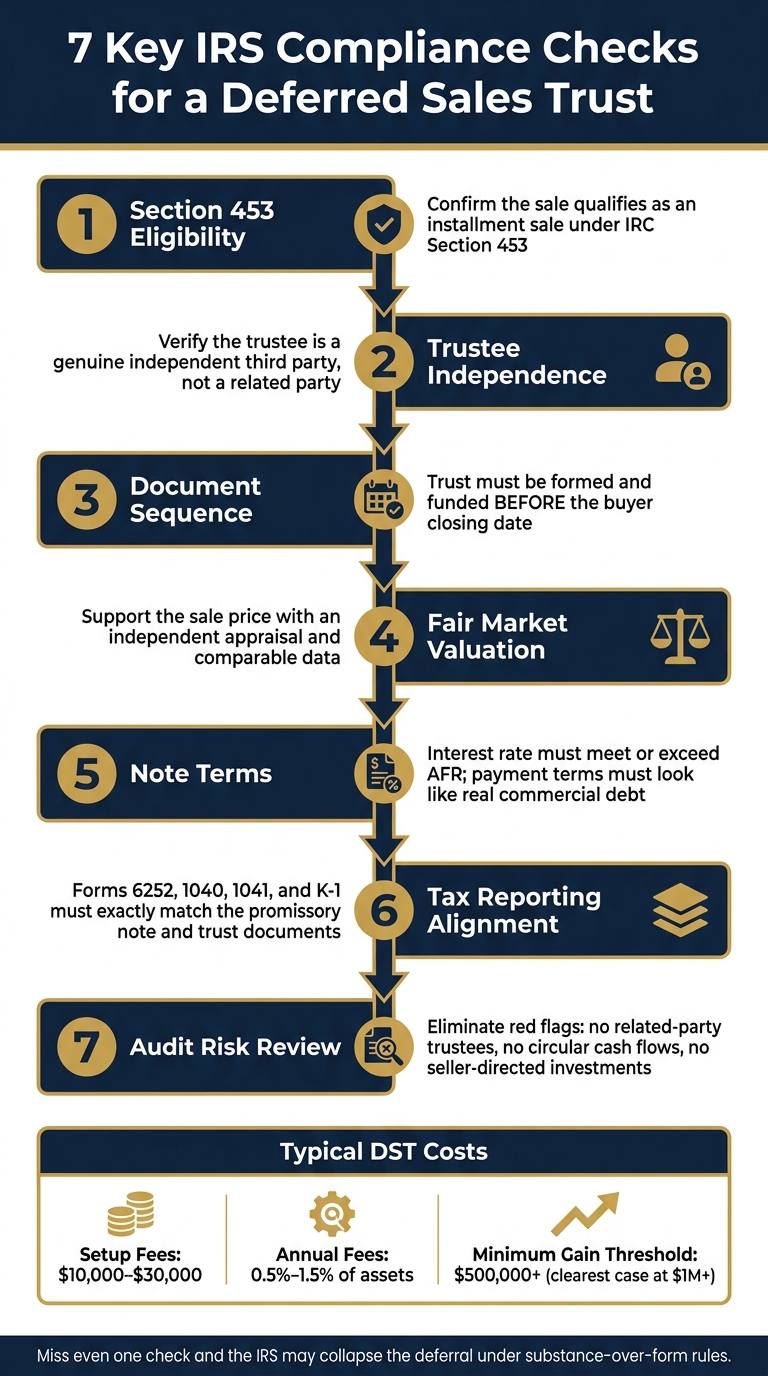
7 Key IRS Compliance Checks for a Deferred Sales Trust
These first two checks come before any tax modeling or financial planning. If the asset doesn't qualify, or if the trust is set up the wrong way, the deferral plan can fall apart.

A DST only works if the sale qualifies for installment treatment under IRC Section 453. Section 453 can apply to certain appreciated assets, though some exceptions apply. Start here, because every other DST check rests on this one.
The big risk is constructive receipt. The trust must take title, sell to the buyer, and issue a valid installment note at closing. If the seller has any access to the sale proceeds, that can trigger constructive receipt.[2]
Next, make sure the trustee is independent and the trust uses a non-grantor structure.
The trustee must be a genuinely independent third party with fiduciary duties. If a related party is in control, or if the seller controls the investments, audit risk goes up fast. After the asset is transferred to the trust, the seller becomes an unsecured creditor. The trustee has discretionary authority over how the proceeds are invested, and the seller can't step in and overrule those choices.[2]
Put simply, control is the real test. If the seller can direct the trust, the setup is weak.
The trust also needs to be formed and funded before closing. It should be treated as a non-grantor complex trust with its own separate Form 1041 filing duties.[1]
A few points matter most:
Recent IRS and DOJ enforcement shows more scrutiny of monetized installment sale structures.[2]
"Once you sell your asset to the trust, you no longer own it and you no longer control how the proceeds are invested." - Jeff Barnes, MBA, Author [2]
If both checks pass, move to documents, valuation, and payment terms.
With eligibility and trust structure confirmed, the next three checks move to the nuts and bolts: the paperwork, the sale price, and the note terms. These are the spots most likely to decide whether the setup stands up if the IRS takes a hard look.
Order matters here. The trust has to receive the asset before the buyer closes. If the steps happen in the wrong order, the deferral can fail. [3]
The flow should look like this: the seller transfers the asset to the trust in exchange for a promissory note. Then the trust sells the asset to the buyer and receives the cash. [3][1]
| Document | Compliance Purpose | Key Fields to Verify |
|---|---|---|
| Trust Agreement | Establishes the independent entity and trustee authority | Trustee independence, non-grantor status |
| Sale Agreement (Seller to Trust) | Transfers asset ownership to the trust before the third-party sale | Asset description, fair market value price, date of transfer |
| Promissory Note | Defines the debt obligation and deferral terms | Interest rate (AFR), maturity date, payment frequency |
| Sale Agreement (Trust to Buyer) | Completes the final sale to the external buyer | Buyer identity, cash proceeds, closing date |
Before anyone signs, check that the trust agreement and the seller-to-trust sale agreement are executed before the third-party sale closes. The documents need to match what actually happened, step by step.
Once the sequence is clean, the next issue is price. If the transfer price looks shaky, that's where pressure starts.
For closely held businesses, the sale price between the seller and the trust needs to hold up. The IRS may question the valuation if it isn't backed by appraisal work and comparable data. [1][3]
That usually means getting an independent appraisal before closing, not relying on an internal estimate. The appraisal should rest on financial projections, comparable transactions, and clear support for any discounts or premiums used. [3]
After the valuation is set, the note still has to read like actual debt.
The promissory note issued to the seller must work as real debt, with an interest rate that meets or exceeds the Applicable Federal Rate (AFR). The term should fit the economics of the deal and the expected payment capacity. [1][2][3]
Three payment setups show up most often, and each comes with its own trade-offs:
| Payment Structure | Cash-Flow Impact | Compliance Considerations | Audit Risk |
|---|---|---|---|
| Level Payments | Steady, predictable income | Standard installment sale treatment under IRC 453 | Low; matches commercial lending norms |
| Interest-Only with Balloon | Maximizes capital deferral; lower initial cash flow | Must ensure the note is bona fide debt | Moderate; needs strong commercial support |
| Variable Schedule | Flexible; can match business performance or needs | High if the seller can trigger or speed payments | High; needs strict adherence to pre-set contractual terms |
The IRS pays closest attention to setups that give the seller control over when cash shows up. Circular cash flows and seller-controlled acceleration rights are trouble spots because they can trigger constructive receipt risk. [2][3]
Once the structure, documents, and note terms are set, the job changes. Now it's about keeping everything in sync every single year and being ready to back it up if the IRS asks questions.
After the note is signed, each annual return needs to follow its terms. At this stage, the deal stands or falls on reporting that lines up with the signed documents. Your tax forms need to match the promissory note and trust documents exactly.
Four forms usually drive reporting for a deferred sales trust:
| Form | Who Files | Filing Timing | Key Data Points to Keep Consistent |
|---|---|---|---|
| Form 6252 | Seller | Annually | Gross profit ratio, principal payments received, and basis recovery must match the note exactly |
| Form 1040 | Seller | Annually | Interest income reported must match the interest rate specified in the promissory note |
| Form 1041 | Trustee | Annually (April 15, or Sept. 30 with extension) | Must match trust income, deductions, and note payments |
| Schedule K-1 | Trustee | Annually | Must match Form 1041 amounts and character |
This isn't the place for rough estimates or "close enough" reporting. If the note says one thing and the return says another, that gap can draw attention fast.
State filing rules depend on where the beneficiary lives and where the asset sits. Get state-specific guidance before filing year one. [1]
If the filings and records drift apart, the next step is often a closer look at the facts behind the deal.
The last check comes down to consistency. The trust, note, tax filings, and cash flow all need to tell the same story. The IRS can challenge a DST under substance over form rules. In plain English, that means examiners can look past the paperwork and ask whether the seller actually gave up control of the asset and the proceeds. [3] If the facts point the other way, the structure can face audit pressure or lose its tax-deferral treatment.
The common audit red flags are pretty straightforward:
| Risk Factor | Risk Level | Mitigation Step |
|---|---|---|
| Related-party trustee | High | Appoint an independent, third-party professional trustee with no prior ties to the seller |
| Last-minute trust formation | Medium/High | Execute all trust and transfer documents well before the buyer's closing date |
| No independent valuation | High | Obtain a formal appraisal or valuation report |
| Seller directing investments | High | Ensure the trustee has discretionary authority over trust assets |
| Circular cash flow | High | Confirm sale proceeds go directly to the trust - never through the seller's personal accounts |
| Inconsistent annual reporting | High | Reconcile bank statements, the promissory note, and tax filings every year |
Think of it like this: if the money path looks messy, the IRS may assume the deal itself is messy too.
Keep these records ready before any filing or IRS inquiry:
Those documents should line up with one another, without gaps, missing dates, or payment details that don't match.
A deferred sales trust works ONLY when all seven checks are in place before closing. Put them together, and they decide whether the deferral stands.
Miss just one, and the IRS can knock down the structure under substance-over-form review.
And even if the setup follows the rules, fees can eat up the tax upside. Setup fees often run $10,000 to $30,000, annual fees usually land between 0.5% and 1.5% of assets, and the structure tends to make the most sense when gains are above $500,000, with the clearest case at $1 million or more. [3] That means DSTs are usually a tool for exit planning, not your default tax move.
Run the numbers, review the documents, and go through all seven checks before signing.
A deferred sales trust is usually a good fit for founders or other sellers with highly appreciated assets - like a business, stock, or real estate - who are staring down a large capital gains tax bill.
In most cases, people look at this setup when the deal involves at least $500,000 in capital gains. The upside often becomes easier to see at $1 million or more.
It tends to work best for sellers who:
This kind of trust is less about getting cash fast and more about giving the seller room to spread out how and when they receive the money.
Constructive receipt can happen if you get the sale proceeds yourself, or if you don’t move all rights to the asset into the trust before the sale closes.
Here’s the big issue: if that happens, the IRS can treat the money as if you received it directly. And once constructive receipt applies, the tax deferral option is gone.
To help avoid that problem, the trustee needs to take legal ownership of the asset at least 24 to 48 hours before the sale.
Keep complete records that back up the figures you report. That includes:
You should also keep records that show how each payment was split between principal and interest, along with any changes made to the original agreement.