Published on
September 25, 2026


Commodity ETFs can help diversify a portfolio, but I’d treat them as a small side position, not a core holding. The main idea is simple: they may move differently from stocks and bonds, but fund structure, taxes, roll costs, and position size can change the result more than many investors expect.
If I were sizing this type of holding, I’d keep four points in mind right away:
A few points stand out.
Broad commodity funds can spread risk across energy, metals, and agriculture. Single-commodity funds are more concentrated and can swing more. Futures-based ETFs can also lag or beat spot prices because of contango, backwardation, roll yield, and collateral income. And for U.S. investors, taxes and account type can affect what you keep after fees and tax drag.
| Area | What I’d watch |
|---|---|
| Portfolio role | Small satellite position, not a stock/bond replacement |
| Broad-basket funds | Better spread across commodity markets, but check concentration |
| Single-commodity funds | More focused, more volatile, tighter limits needed |
| Physical-backed funds | Closer link to the commodity price |
| Futures-based funds | Returns shaped by futures pricing and roll results |
| Costs | Expense ratio, bid-ask spread, roll costs, commissions |
| Taxes | Tax drag can matter; IRA placement may help |
| Position size | Keep total real assets near 5%–15% and rebalance by rule |
In other words: if I use commodity ETFs at all, I want a clear job for them, a hard cap on size, and a plan for rebalancing before markets move.
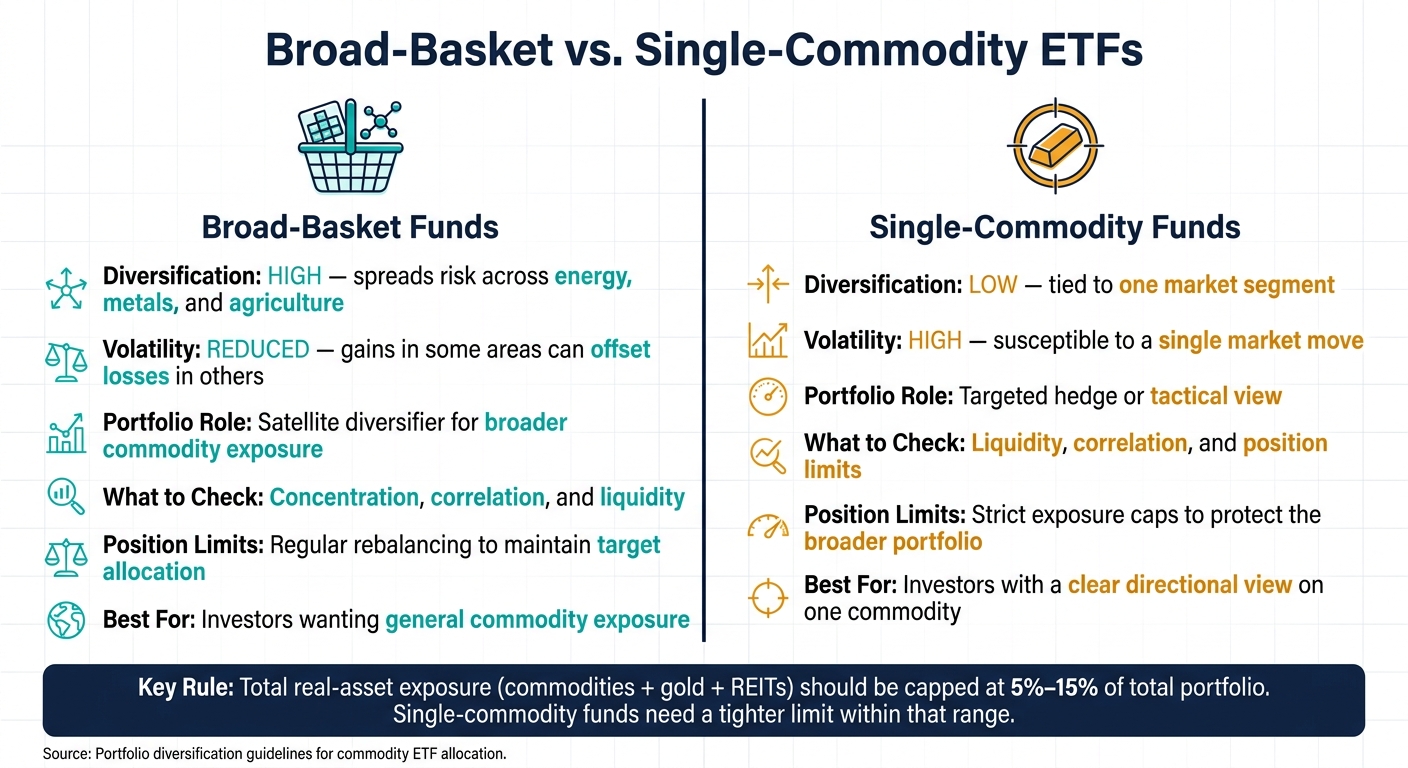
Broad-Basket vs. Single-Commodity ETFs: Key Differences at a Glance
Once commodity exposure is part of the plan, the next call is simple: do you want broad exposure or a focused bet? Both can make sense. They just do different jobs, and the risks are not the same.
Broad-basket commodity ETFs spread money across several commodity markets inside one fund. That means one weak market doesn't always drag down the entire position. If energy struggles but metals or agriculture hold up, the hit may be less severe.
That said, don't stop at the word broad. A fund can sound diversified on paper and still lean hard on just a handful of contracts. Check whether the exposure is spread across many positions or bunched into a few. If a small group of holdings drives most of the returns, the fund is less diversified than it looks.
Single-commodity funds are for investors who want exposure to one specific commodity. That's useful when you have a clear view on one market or want a hedge tied to a single input or risk.
But this is where concentration risk shows up fast. One sharp move in that market can send the fund up or down in a big way. That's why single-commodity positions usually need tighter limits. The goal is simple: one bad trade shouldn't hurt the whole portfolio.
| Feature | Broad-Basket Funds | Single-Commodity Funds |
|---|---|---|
| Diversification | High; spreads risk across multiple commodity cycles | Low; tied to one market segment |
| Volatility | Reduced; gains in some areas can offset losses in others | High; susceptible to a single market move |
| Portfolio Role | Satellite diversifier for broader commodity exposure | Targeted hedge or tactical view |
| What to Check | Concentration, correlation, and liquidity | Liquidity, correlation, and position limits |
| Position Limits | Regular rebalancing to maintain target allocation | Strict exposure caps to protect the broader portfolio |
After you decide between broad exposure and a focused position, the next thing to look at is how these funds track their markets - and where that tracking can drift.
Commodity ETFs don’t all work the same way. And that matters, because the fund’s setup can change the return you get.
Most commodity ETFs use futures. That sounds simple enough, but it also means returns can drift away from spot prices over time. So even if the commodity itself moves one way, the ETF may not match it point for point.
| Structure | How It Works | What It Tracks |
|---|---|---|
| Physical-backed | Fund buys and stores the actual commodity | The commodity price |
| Futures-based | Fund holds futures contracts and rolls them forward | Futures-linked returns |
For most commodity ETFs, the futures roll is the main reason tracking differences show up. In plain English: structure shapes behavior. One ETF may act like a clean diversifier, while another feels more like a noisy stand-in.
A futures-based ETF holds futures contracts instead of the commodity itself. Before those contracts expire, the fund sells them and buys later-dated contracts. That step is called the roll.
Returns from this setup usually come from three places:
That mix is why a futures-based ETF doesn’t move in the same way as the cash, or spot, price.
The roll can help or hurt, depending on the shape of the futures curve.
When a market is in contango, later-dated contracts cost more than near-term contracts. The fund then sells a cheaper expiring contract and buys a more expensive one. That creates a drag on returns.
In backwardation, the reverse happens. Near-term contracts cost more than later-dated ones, so the fund may sell a higher-priced contract and buy a cheaper one. That can help returns.
This is the key point: a futures ETF can lag the spot price or beat it without any fund error. The gap often comes from the mechanics of the roll itself.
Those tracking gaps flow straight into cost and holding-period decisions.
After you look at mechanics, the next issue is simpler and more important: what do you get to keep after costs and taxes? A commodity ETF can look fine on paper and still deliver less than expected once taxes take their cut. That’s why account placement matters just as much as fund choice. The diversification payoff comes from net results, not just the kind of exposure you bought.
Don’t stop at the headline expense ratio. Focus on net return.
That means you need to factor in bid-ask spreads, roll costs, and any trading commissions. Those items can chip away at returns quietly, even if the underlying commodity does well. In plain English: the commodity might go up, but your actual result can still lag because of the costs wrapped around the trade.
Once you’ve got a handle on trading costs, check the account type next.
For U.S. investors, a tax-advantaged account such as an IRA can help cut the tax drag on commodity ETF exposure. When possible, hold commodity ETF exposure in a tax-advantaged account.
After costs and taxes, the last step is position sizing so the allocation stays small enough to support the rest of the portfolio.
Once costs and taxes are clear, the next step is position size. The goal isn't to pick some random percentage and call it done. Start with the job this holding is supposed to do.
Sizing a commodity ETF position starts with the objective, not a fixed percentage.
Define the job first: diversification, inflation hedge, or tactical exposure.
That sounds simple, but it changes everything. If you already own REITs, TIPS, or gold, you may already have plenty of inflation-linked exposure. Adding a commodity ETF on top can pile into the same theme instead of giving you a different source of returns.
A good guardrail is to cap total real-asset exposure - commodities, gold, and REITs combined - at 5% to 15% of the portfolio [1]. Single-commodity funds come with more concentrated risk, so they need a tighter limit inside that range.
Use this checklist before you buy:
| Step | Question to Answer | Practical Limit |
|---|---|---|
| Define objective | Diversification, inflation hedge, or tactical view? | Determines fund type |
| Check existing exposure | Do you already hold REITs, TIPS, or gold? | Avoid stacking similar risk |
| Set maximum allocation | What's your total real asset cap? | 5–15% of total portfolio [1] |
| Match fund type to objective | Broad-basket or single-commodity? | Single-commodity needs a tighter cap |
| Set rebalancing rule | Threshold-based or calendar-based? | Write it into an IPS and review regularly |
Rebalancing matters just as much as the starting size. You can do it on a calendar basis or by using a drift threshold. Either way, write the rule into your IPS before market swings force an emotional call.
With the cap and rebalance rule in place, the position stays small enough to support the rest of the portfolio instead of throwing it off balance.
Commodity ETFs can add another return driver to a portfolio, but the position still has to fit inside a defined risk budget. If the stake gets too big, the fund can add more volatility than diversification.
For founders and operators, that discipline matters even more. Business cash flow and personal liquidity needs can collide at the worst time. That's why it makes sense to stress test the allocation against drawdowns and near-term cash needs, especially if business income is uneven.
Commodity ETFs can make sense in a long-term portfolio, mainly for diversification and some help during inflationary periods. Since they often move differently from stocks and bonds - and in some cases even in the opposite direction - they can help smooth out overall portfolio swings.
A lot of investors put 5% to 15% of their portfolio into real assets, including commodities. That said, commodities don’t behave like stocks or bonds. They react to different parts of the economy, which is why they work best when you give them a clear job in your portfolio and rebalance with discipline.
It comes down to your investment thesis and how much risk you’re willing to take.
Broad-basket ETFs are often the better place to start. They spread your money across several commodities, which can lower single-market risk. That can make them a solid fit if your goal is general inflation hedging or broad market exposure.
Single-commodity ETFs make more sense when you have a specific market view. But there’s a trade-off: they need closer monitoring and usually carry more risk.
One middle-ground option is a core-satellite approach. Use a broad fund as the core of your position, then add single-commodity ETFs around it for more targeted bets.
It comes down to your goals, your comfort with risk, and how the fund is taxed. Commodity ETFs can add diversification and may help hedge against inflation. But some hold futures contracts, and that can lead to more complicated tax reporting.
Before you put one in an IRA, talk with a financial advisor to make sure the fund lines up with your long-term plan.