Published on
September 25, 2026


If you miss transfer pricing before signing, you can misprice the deal. In a cross-border M&A deal, related-party charges can shift profit, distort EBITDA, change cash taxes, and leave the buyer with audit risk after close.
Here’s the short version: I’d review 3 to 5 years of intercompany activity, test whether contracts match what people actually do, check for audits and penalties, and build transfer pricing into the deal model instead of hiding it in a blended tax rate. I’d also treat stock deals, asset deals, mergers, and staged acquisitions differently because each one shifts tax risk in a different way.
What this article covers:
A few points matter most:
If I were buying a foreign target, I’d want transfer pricing tied to the full deal path: diligence, valuation, purchase agreement terms, post-close setup, and annual filings.
| Area | What to check | Why it matters |
|---|---|---|
| Diligence | Intercompany flows, files, contracts, audit history | Finds tax exposure before price is set |
| Earnings | Service fees, royalties, interest, true-ups | Helps clean up EBITDA |
| Deal structure | Stock vs. asset vs. merger vs. staged deal | Changes liability and future pricing needs |
| Post-close | New agreements, method selection, reporting calendar | Keeps records and filings aligned |
| Controls | Reconciliations, dashboards, owner roles | Helps stop drift after close |
The core message is simple: transfer pricing is not just a tax memo item - it can change value, deal terms, and post-close reporting from day one.
Start with a transaction map, then trace it back to the records that support it. Ask for at least three to five fiscal years of related-party transaction history, plus the current year-to-date period. That history should tie back to the general ledger, audited financial statements, tax returns, intercompany accounts, and cash movements.
Your inventory should include all major related-party flows, such as:
Once you have that map, use it to check a simple but important point: do the target's margins, contracts, and tax filings line up with how the business actually works?
For each transaction category, request the backup documents: intercompany agreements, invoices, debit and credit notes, transfer-pricing policies, benchmarking studies, and entity-level financial statements. Under BEPS Action 13, determine whether the group must keep a master file, a local file, and a Country-by-Country Report (CbCR), based on the rules and thresholds in each relevant jurisdiction.[6][2][7]
| Document | What It Covers | Why It Matters in Diligence |
|---|---|---|
| Master file | Group-wide business, value chain, intangibles, financing, and transfer-pricing policies | Shows the broader framework behind the group's profit allocation |
| Local file | Material related-party transactions for the local entity, the parties involved, transaction amounts, functional analysis, method used, comparables, and financial support | The most transaction-specific document; reconcile it to the general ledger, tax returns, and intercompany agreements |
| CbCR | Jurisdiction-level revenue, profit, taxes, employees, and assets | A high-level risk screen that can prompt questions when profitability, taxes, employees, or assets vary sharply across countries |
For U.S. targets, confirm that contemporaneous best-method documentation can be produced to the IRS within 30 days of a request.[4] If studies are missing or out of date, treat that as a red flag.
This file set gives you the starting point for testing whether reported margins fit the actual operating model.
A signed agreement, by itself, does not prove arm's-length pricing. The IRS specifically tells examiners to test whether actual conduct matches the contract.[5] So don't stop at the paper. Map the functions, assets, and risks, then compare them with the contracts, decision rights, system access, and financial results.
Here’s where problems often show up. A "limited-risk distributor" may be labeled as routine on paper, but what if that entity sets prices, negotiates contracts, or controls inventory? In that case, it may deserve more profit than the contract gives it. And that gap can turn straight into a tax adjustment, which can then become a purchase-price issue. Engaging fractional CFO services can help identify these discrepancies before they impact the deal valuation.
Before signing, ask for all tax audit notices, proposed adjustments, settlement agreements, penalty assessments, Advance Pricing Agreement (APA) documentation, and any Mutual Agreement Procedure (MAP) filings. These are not box-checking items. Open disputes can follow the business long after closing.
Model each open matter under base, downside, and severe cases. Include additional tax, interest, penalties, withholding taxes, and the chance of a corresponding adjustment in the other jurisdiction.
Then feed those amounts into the deal terms, including:
Use what you find to shape price, protections, and reporting needs after close.
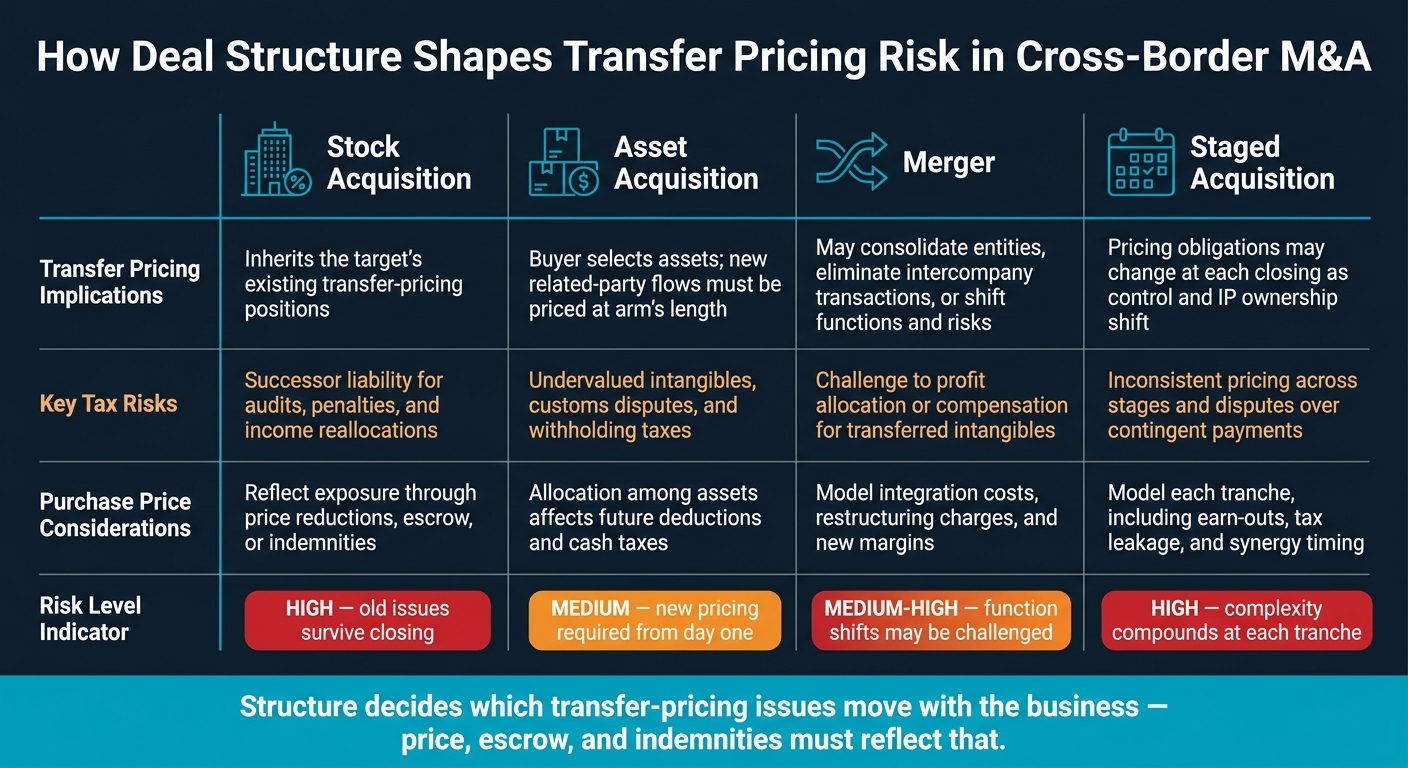
Deal Structure & Transfer Pricing Risk: Stock vs. Asset vs. Merger vs. Staged Acquisition
Once diligence brings the exposure to light, the next issue is simple: who ends up carrying it? That answer usually comes from the deal structure. Structure decides which transfer-pricing issues move with the business, which intercompany arrangements need to be redone, and how profit gets split after closing. And those points shouldn't sit in a memo somewhere. They need to show up in price, escrow, indemnities, and closing terms.
Structure drives liability, and valuation should reflect what that does to earnings.
| Structure | Transfer Pricing Implications | Key Tax Risks | Purchase Price Considerations |
|---|---|---|---|
| Stock acquisition | Inherits the target's existing transfer-pricing positions | Successor liability for audits, penalties, and income reallocations | Reflect exposure through price reductions, escrow, or indemnities |
| Asset acquisition | Buyer selects assets; new related-party flows must be priced at arm's length | Undervalued intangibles, customs disputes, and withholding taxes | Allocation among assets affects future deductions and cash taxes |
| Merger | May consolidate entities, eliminate intercompany transactions, or shift functions and risks | Challenge to profit allocation or compensation for transferred intangibles | Model integration costs, restructuring charges, and new margins |
| Staged acquisition | Pricing obligations may change at each closing as control and IP ownership shift | Inconsistent pricing across stages and disputes over contingent payments | Model each tranche, including earn-outs, tax leakage, and synergy timing |
A stock deal, for example, can leave the buyer holding past transfer-pricing positions, even if the issue started years before signing. An asset deal can cut off part of that history, but it also creates a new problem: the buyer now has to price new related-party flows at arm's length. A merger can wipe out some intercompany transactions, but it can also move functions, assets, or risk in ways that tax authorities may challenge. And with a staged acquisition, things can get messy fast because pricing may need to change at each step.
This part hits valuation right where it matters. Non-arm's-length service charges, royalties, and interest can push EBITDA too high or too low. If the target has been overcharging or undercharging within the group, normalized earnings may not be normal at all.
Year-end true-ups add another wrinkle. They can move earnings from one jurisdiction to another, which makes it harder to tell what recurring EBITDA should look like. The same goes for working capital. On paper, the numbers may look clean. In practice, they may be carrying transfer-pricing noise.
After closing, these assumptions should flow into the intercompany agreements and the reporting package. That means transfer pricing needs its own place in the model. It shouldn't be buried inside a blended tax rate or tucked into general operating costs.
At a minimum, model these items separately:
It also helps to run base, downside, and upside cases for each assumption. Then tag each item clearly: is it recurring, one-time, backed by legal documents, or dependent on a tax authority challenge?
One more point matters a lot here: model cash taxes, not just the effective tax rate. A neat tax rate can hide a very ugly cash outcome.
When a transfer-pricing issue can't be fixed before closing, the remedy should match the risk. Use a valuation adjustment when the issue changes recurring economics. Use a specific tax indemnity for pre-closing periods. Use an escrow or holdback when the amount is material but still uncertain.
After closing, transfer pricing stops being a model on a spreadsheet. It turns into contracts, journal entries, invoices, and tax filings. The line from assumption to execution is pretty direct: model assumptions shape intercompany agreements, those agreements support method selection, and all of that feeds recurring reporting.
This is where a lot of companies slip. Not because the plan itself was off, but because the documents never matched what the business was actually doing.
The deal model should set the pricing terms that the legal documents need to support. Start by mapping each intercompany transaction in the new group. For each one, identify:
The operating model should drive the agreements, not the other way around.
A common mistake is taking the target's old contracts and just swapping in new party names. That sounds easy, but it often creates problems. Legacy agreements may describe services that were never performed, assign IP rights in ways that don't match how the business runs, or rely on allocation keys that worked under the old ownership setup but no longer fit. Each agreement needs to match the new group's actual operating model so invoices, journal entries, and tax filings line up.
Each new agreement should clearly address the goods or services being provided, who owns and may use the intellectual property, how costs are defined and allocated, the pricing method and markup, invoicing frequency, currency and withholding-tax treatment, year-end true-up mechanics, audit rights, dispute procedures, and record-retention periods. IP rights, risk allocation, and compensation should be stated plainly in the contract. The accounting workflow should match that setup so invoices and journal entries trace back to the written policy.
The OECD recognizes five principal methods. The right choice depends on the facts, the data available, and the functions of the entities involved. Use the post-close operating model - not the legacy structure - when picking the method. No single method works for every fact pattern. [1]
| Method | Suitable Transaction Type | Required Data | Principal Strength | Common Limitation |
|---|---|---|---|---|
| CUP | Identical or highly comparable goods, loans, licenses, or services | Internal or external prices, contractual terms, volume, market, currency, and timing data | Directly tests the price; highly precise when comparability is strong | Sensitive to differences in product quality, markets, and contractual terms |
| Resale price | Routine distribution or reselling where the distributor purchases from an affiliate | Third-party resale revenue, distributor functions, and gross margins of comparable distributors | Useful when the reseller adds limited value and reliable gross-margin data exists | Gross margins can differ due to accounting classifications or marketing activities |
| Cost plus | Routine manufacturing, contract R&D, back-office, or support services | Direct and indirect costs, cost-allocation policy, and comparable markups | Transparent and practical for routine activities with a stable cost base | Results depend heavily on how the cost base is defined |
| TNMM | Routine distributors, manufacturers, or service providers | Segmented revenue, operating costs, balance-sheet data, and comparable operating margins | Workable when product-level price data is unavailable | Net margins are affected by many factors unrelated to transfer pricing |
| Profit split | Highly integrated operations or transactions where both parties make significant non-routine contributions | Combined financial results, intangible ownership, valuation data, and allocation factors | Reflects the economics of jointly created value | Complex, data-intensive, and sensitive to judgments about contribution allocation |
The write-up should also explain why other methods were not used, not just why the selected method fits. [1][8]
Next comes documentation and filing deadlines under each country's local rules. After closing, update the master file, local files, and CbCR to reflect the new structure. The OECD's general CbCR threshold is EUR 750 million in consolidated group revenue for the prior fiscal year, although each country applies its own rules. [9][10][11]
Local law - not OECD guidance by itself - sets the filing rules, language, deadlines, and penalties. [6][2] A post-close calendar helps keep this under control. It should cover immediate entity and IP updates, first-cycle filings with billing codes and confirmed allocation keys, monthly or quarterly margin checks, and annual pre-return updates.
For audit support, keep dated proof that services were actually performed. That includes deliverables, meeting notes, project plans, and time records. [4][3]
Growth-stage companies often expand across borders faster than their legal and accounting controls can keep up. When that happens, the fallout doesn't stay in tax. It can change EBITDA, affect reps, and add post-close cleanup costs.
The most common gaps tend to be pretty straightforward on paper, but messy in practice: undocumented management fees, cross-border founder or executive services, unsecured intercompany loans, and IP ownership that doesn't line up with where value was created.
A simple diligence test helps cut through the noise. Compare the general ledger, invoices, bank records, payroll, employee locations, and legal agreements against the stated transfer pricing policy. If those items don't match, treat that gap as a diligence exception.
This matters because policies drift over time. A subsidiary that was once labeled a routine distributor may now handle marketing, localization, support, and pricing. That's not a small labeling issue. It can change normalized earnings, purchase agreement representations, and post-close restructuring plans.
Closing these gaps takes clear ownership across tax, finance, legal, and operations.
Tax should own policy and documentation. Finance and controllership should own ledgers and reconciliations. FP&A should own assumptions. Legal should own agreements and IP records. Operations should confirm what's happening on the ground. Without that split, intercompany pricing usually falls apart after closing.
The financial model also needs to do more than sit in a spreadsheet. It should connect transaction volumes, cost pools, allocation keys, pricing formulas, tested-party margins, and tax adjustments. Just as important, it should reconcile to the general ledger.
Useful controls include:
Use the structure below to assign ownership and escalation.
| Timing | Action | Responsible Function | Required Evidence | Escalation Trigger |
|---|---|---|---|---|
| Pre-signing | Map entities, controlled transactions, functions, assets, risks, IP, loans, and historical disputes | Tax, finance, legal, operations | Entity chart, general ledger, contracts, invoices, payroll and employee-location data, IP records, audits | Missing agreements, unexplained margins, undocumented loans, or material tax exposures |
| Pre-signing | Quantify normalized earnings and transfer pricing adjustments | FP&A, finance, tax | Adjusted EBITDA bridge, intercompany revenue and expense analysis, benchmarking, true-up history | Earnings depend on unsupported fees, unusual margins, or unpriced services |
| Signing-to-closing | Allocate representations, covenants, indemnities, and remediation obligations | Legal, tax, deal team | Disclosure schedules, tax diligence report, purchase agreement, closing checklist | Seller will not remediate, exposure is unquantified, or a consent is required |
| Signing-to-closing | Finalize the post-close entity and operating model | Executive leadership, tax, finance, operations | Future-state org chart, functional analysis, integration plan, draft agreements | Functions, IP ownership, personnel, or risk allocation will change materially |
| First 100 days | Execute intercompany agreements and implement pricing, invoicing, accounting, and settlement controls | Legal, tax, controllership, operations | Signed agreements, pricing files, invoice templates, journal-entry procedures, reconciliations | Actual conduct cannot follow the agreement or systems cannot produce required data |
| First 100 days | Establish reporting dashboards and owner certifications | Finance, FP&A, data engineering, tax | Entity-level P&L, margin dashboard, transaction register, exception log, certification checklist | Missing data, unexplained variances, overdue balances, or out-of-range results |
| Annual compliance | Refresh functional analysis, benchmarks, agreements, calculations, and documentation | Tax, finance, legal, business owners | Local files, master file where applicable, calculations, filings, board or management approvals | Business model, jurisdictions, IP, financing, or material transaction terms changed |
| Annual compliance | Review audits, disputes, settlements, and policy changes | Tax leadership, legal, executive management | Notices, correspondence, settlement records, mutual-agreement-procedure analysis | Audit adjustment, penalty risk, double taxation, or unresolved jurisdictional conflict |
Once ownership and controls are in place, the program becomes repeatable.
Transfer pricing runs through the full cross-border deal lifecycle, not just year-end tax work. Local rules still govern filing deadlines, documentation thresholds, penalties, and language requirements.
Founders should revisit the analysis whenever functions, assets, risks, personnel, intellectual property, financing, jurisdictions, or revenue flows change. The strongest post-close program documents commercial reality, matches actual conduct, and escalates exceptions early.
Transfer pricing can shape deal value in a few direct ways: it changes reported profit, cash flow, and tax exposure. When intercompany pricing drifts away from the arm's length principle, the numbers can start to look off. That can skew valuation, put buyers on edge, and trigger purchase price adjustments or indemnification terms.
There’s also the tax risk. Tax authorities may reallocate profits retroactively, which can create unexpected taxes and penalties that eat into deal value. And if the documentation is weak, the deal can slow down at closing and become more expensive to sort out after the acquisition.
Transfer pricing risk doesn’t end when the deal closes. Tax authorities look at what the business actually does, not just what the contracts say.
That’s where problems tend to stick around.
Some of the most common risks that survive closing include double taxation, penalties tied to weak substance, disputes over intangible asset valuation, and post-acquisition changes that create permanent establishment exposure or change treaty benefits.
Weak or outdated documentation can make things worse. It can trigger audits, retroactive profit reallocations, and interest charges.
In the first 100 days after an acquisition, buyers should focus on stabilizing the target’s tax and compliance framework. The goal is simple: reduce risk and support smoother operational alignment while the business settles into new ownership.
That usually starts with a close review of the basics that can trip teams up fast if they’re ignored. Key steps include:
Think of this as getting the plumbing in order before turning up the pressure. If these pieces aren’t lined up early, small reporting gaps can turn into bigger tax and compliance issues.