Published on
August 12, 2026

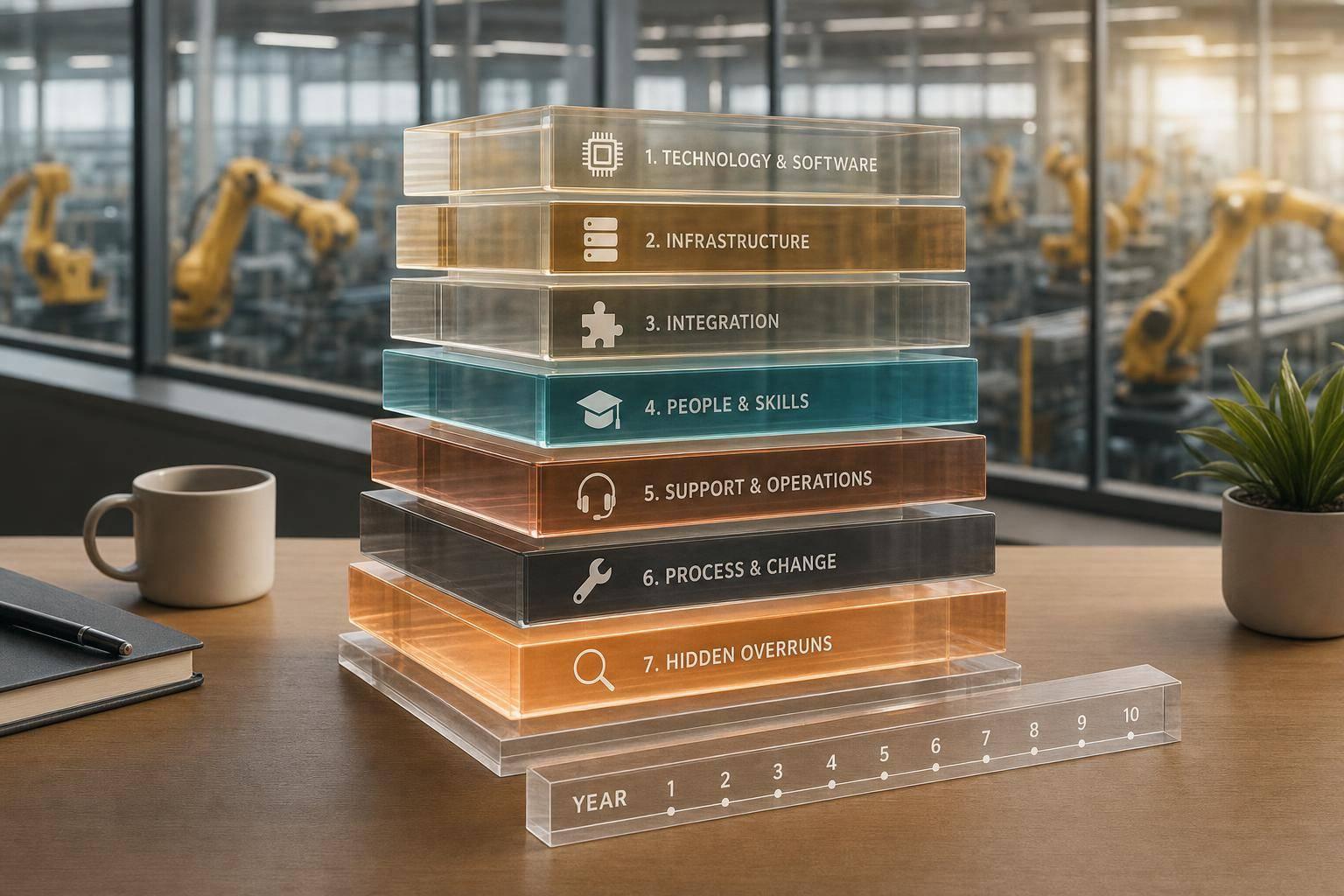
Most manufacturing digital projects cost more than the vendor quote. If I were scoping one, I’d plan for software, hardware, integration, data cleanup, training, support, and a reserve for surprise costs.
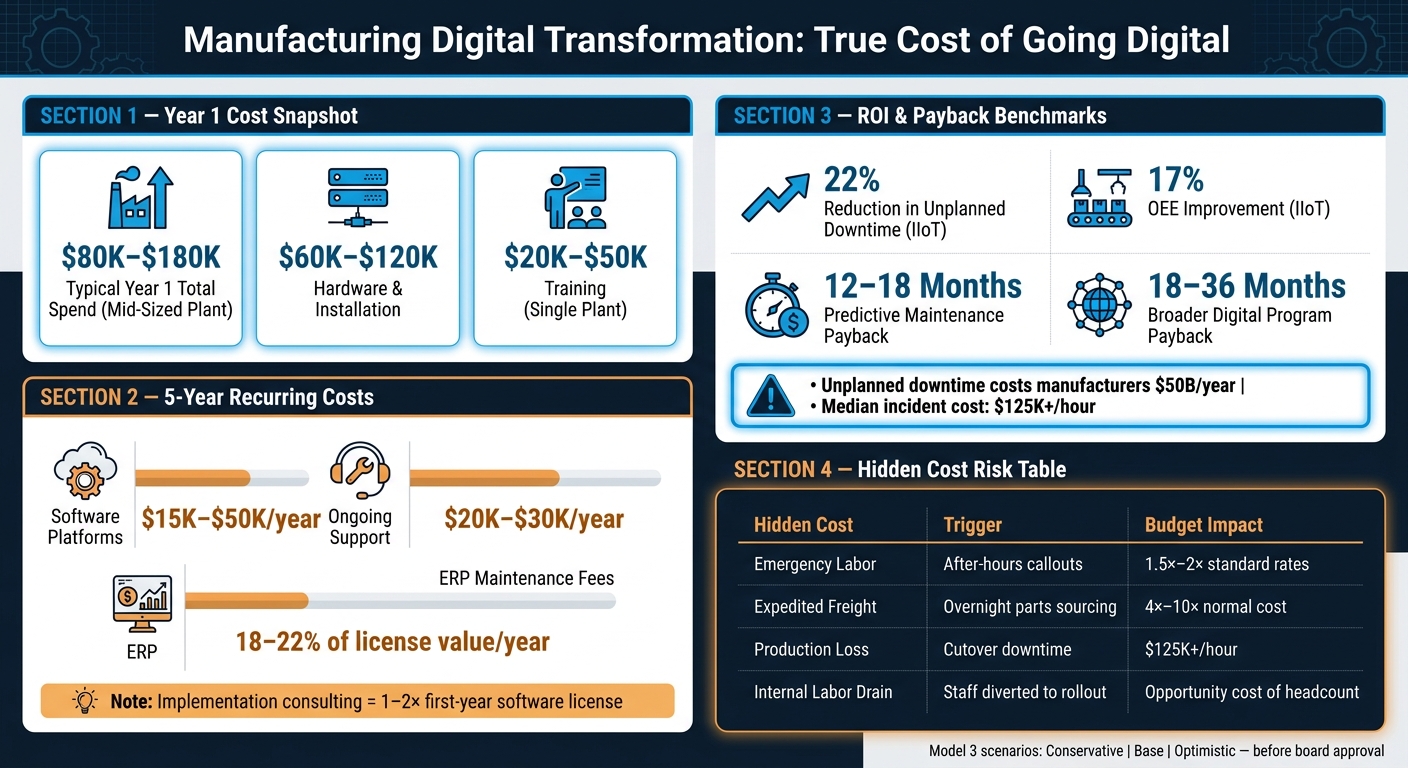
For a mid-sized plant, Year 1 often lands around $80,000 to $180,000, but that number can move fast once legacy equipment, cutover downtime, and internal labor are added. Over 5 to 10 years, software can add $15,000 to $50,000 per year, support can add $20,000 to $30,000 per year, and implementation can run 1x to 2x first-year software cost.
Here’s the short version:
A few numbers stand out:
If I were building the budget, I’d treat downtime risk, adoption issues, emergency labor, and staff time as separate cost lines - not as footnotes. That’s what turns a rough estimate into a model finance teams can review with confidence.
Manufacturing Digital Transformation: Key Costs, ROI & Hidden Budget Risks
This is the cost structure used in the 5- to 10-year model. It helps split one-time spend from recurring spend. Keep the same categories across plants, then adjust the weight of each one based on legacy systems and plant connectivity.
| Cost Category | What It Includes | Upfront, Recurring, or Both |
|---|---|---|
| Software | MES, ERP manufacturing modules, IIoT platforms, analytics tools, CMMS, cloud subscriptions, support and maintenance fees | Both |
| Hardware & Connectivity | Sensors, edge devices, gateways, industrial PCs, servers, storage, networking gear, machine retrofit components, cellular/private 5G connectivity | Both (mostly upfront; connectivity is recurring) |
| Implementation & Integration | Consulting, configuration, PLC/SCADA/ERP integrations, custom development, testing, validation | Upfront |
| Data Work | Data migration, cleansing, master data setup, data modeling, reporting layers, manufacturing data engineering | Both |
| Training & Change Management | Operator and supervisor training, SOP updates, internal project management, stakeholder communications | Upfront |
| Ongoing Support & Operations | Internal IT/OT staffing, managed support, software maintenance, cloud hosting, monitoring, periodic upgrades | Recurring |
| Contingency & Risk Reserve | Buffer for scope creep, unplanned integration work, hardware additions | Upfront |
Software costs can swing a lot because each vendor prices things in its own way. MES platforms are often sold as per-site or per-asset SaaS subscriptions. ERP manufacturing modules usually come with user-based or module-based pricing, plus annual maintenance fees that often land at 18–22% of the license value each year [5]. IIoT and smart factory analytics tools are commonly priced by data volume, asset count, or message throughput. So as more machines come online, the bill tends to climb with them.
For a mid-sized MES-style deployment, software licensing usually makes up 15–25% of 5-year TCO, or about $50,000–$300,000, depending on plant size and platform choice [4]. Legacy controls, network maturity, and machine age all change that mix.
Hardware looks like a one-time buy, but that’s only part of the story. A $1,200 industrial sensor rarely stays a $1,200 line item after deployment. Add the gateway, edge controller, connectivity, and cloud platform, and the full cost of one deployed node can hit $3,200–$4,800 in Year 1 [10]. Hardware and infrastructure usually account for 10–20% of 5-year TCO, or about $25,000–$200,000 for a mid-sized plant [4].
It also helps to leave room for surprises. A 10–20% hardware contingency is a smart budget line for spare devices, extra gateways, and retrofit work that tends to show up only after implementation starts.
This is where many budgets get knocked off course.
Implementation services - consulting, configuration, testing, and validation - typically run $150–$300+ per hour for experienced U.S. integrators, and a single-plant MES deployment usually costs $150,000 to $400,000 [5][6]. A useful rule of thumb: implementation consulting often equals 1–2× the first-year software license [3].
Data work should sit in its own budget line, not get buried under implementation. Data migration, cleansing, master data setup - like item masters, BOMs, routings, and equipment hierarchies - and building the reporting layer can eat up 20–40% of total implementation effort [4][8]. That number catches teams off guard because early proposals often assume the data is clean and documented. In most plants, it isn’t.
Integration work adds another big chunk. ERP connectors, PLC/SCADA interfaces, and data mapping usually make up 15–30% of 5-year TCO, or around $75,000–$350,000 [4]. If the plant has older equipment or messy interfaces, this part can get expensive fast.
Training and change management are easy to shortchange on paper. In practice, they matter a lot. A realistic training budget for a single-plant MES project is $20,000–$50,000 [6]. That usually covers operator and supervisor sessions, SOP updates, and train-the-trainer programs. A solid planning rule is to budget change management at 5–15% of total project cost for major transformations [6].
Ongoing support is a lifecycle cost, not something to think about only after go-live. This is also where the 5- to 10-year model starts to pay off, because it forces you to look past launch costs.
On-prem deployments usually need 0.5–2 internal IT FTEs per plant for patching, monitoring, backups, and upgrades [9]. That cost is easy to miss when comparing deployment options. Cloud-hosted platforms move some of that work to the vendor, but they also push up recurring OPEX. Over five years, operations and maintenance represent 25–35% of cloud TCO versus 15–25% for on-prem [7].
The safest way to model this is simple: treat support and operations as annual expenses, then test both base and downside cases.
These buckets shift by use case; the next section shows how the mix changes for MES, ERP, IIoT, and cloud projects.
In IIoT projects, the spending pattern looks different from a standard software replacement. Instead of putting most of the budget into licenses and setup, companies usually spend more on sensors, edge devices, connectivity, and recurring analytics.
That change matters because the return works differently too. In most IIoT programs, ROI comes less from replacing old software and more from day-to-day operating savings. The biggest driver is avoided downtime. Typical payback lands in the 12 to 18 month range [2].
Predictive maintenance is often the main reason the math works. It can cut maintenance costs by 18% to 25% and reduce unplanned downtime by 30% to 50% [2]. That has a big financial effect when you look at the scale of the problem: unplanned downtime costs industrial manufacturers about $50 billion per year, and the median cost of a single incident is more than $125,000 per hour across industries [2]. On some automotive lines, that figure can climb past $2.3 million per hour [2].
One thing to watch: avoided cost is not the same as cash savings. That sounds obvious, but it trips people up all the time. If a plant avoids a shutdown, that can be a major win, but it doesn't always show up as cash in the bank in a simple, direct way.
It also helps to count the recurring work that comes with these systems. Alert review, maintenance coordination, and data work should be treated as labor costs that continue over time, not one-time setup items.
MES and ERP projects shift the cost mix again. In those cases, integration work and data cleanup usually take up a larger share.
The direct line items in a rollout budget rarely tell the whole story. A second layer of spend often shows up once the project is in motion. That's where budget overruns start. Actual spend usually comes in higher when legacy integration, downtime, compliance, and internal labor surface late.
Older equipment often needs custom work to connect with newer platforms. Middleware, custom API work, and extra testing cycles can pile up fast. And cutovers? That's often where the money starts leaking.
Even short downtime during go-live can be expensive. For a facility generating $40,000 per hour in output, a 6-hour cutover window costs $240,000 in lost production before repair costs are counted [2]. That isn't just a line-item surprise. It changes the payback period and shifts reserve assumptions in the financial model.
Plants in food, pharma, and aerospace may also need validation, cybersecurity hardening, access controls, and audit trails. Those items are often only partly scoped at the start. On top of that, emergency labor usually costs 1.5x to 2x standard rates, and expedited freight can cost 4x to 10x normal shipping rates [2].
Low adoption creates its own kind of drag. Teams end up doing rework, running extra training, and spending more time in stabilization. When adoption falls short, timelines stretch and support spend climbs. Those costs belong in the cost model, not just the implementation plan.
Internal labor is another common blind spot. Moving existing staff onto the project still has a cost, even if no new hires are added. People pulled into rollout admin, testing, reporting, or issue handling aren't doing their usual work, and that opportunity cost should be counted [2].
Treat these costs as separate from planned project spend.
| Hidden Cost | How It Appears | Likely Budget Impact | Mitigation |
|---|---|---|---|
| Emergency labor | Callouts outside standard hours | 1.5x–2x standard labor rates [2] | Schedule repairs during planned windows |
| Expedited freight | Overnight parts sourcing during cutover | 4x–10x premium on parts cost [2] | Maintain critical spares inventory |
| Collateral damage | One failure cascading to adjacent components | Multiples of the original repair cost [2] | Real-time condition monitoring |
| Production loss | Idle lines during cutovers or failures | $125,000+/hour median [2] | Model hourly output value before approval |
| Internal labor drain | Staff diverted from normal duties during rollout | Opportunity cost of existing headcount [2] | Budget explicitly for admin labor or analysts |
| Contractual penalties | Missed delivery commitments to customers | Direct cash outflows [2] | Include penalty avoidance as a line item in the ROI model |
Also, don't lump avoided costs in with realized cash savings. Keep them separate. Then carry these items into the multi-year model as contingency, downtime, and adoption assumptions.
Build a 5- to 10-year cash flow model that splits upfront spend from recurring costs and benefits. Use the cost buckets above as the line items in the model.
Year 1 usually carries the biggest cash hit. That’s when hardware, integration, training, and setup all land at once. In Year 2 and beyond, the mix changes. Costs shift toward software, support, and maintenance, while operating gains start to stack up.
| Model Layer | Year 1 | Year 2+ |
|---|---|---|
| Primary costs | Hardware, installation, integration, training | Software licensing, maintenance, analyst time |
| Key benefits tracked | Initial downtime and scrap reduction | Optimized maintenance cycles, OEE gains |
| Financial focus | Payback tracking | Realized ROI and TCO stabilization |
Tie each benefit line to a specific operating metric. U.S. manufacturers with fully deployed IIoT infrastructure report an average 22% reduction in unplanned downtime and a 17% improvement in OEE [1]. Use those figures as model inputs, not promises. Then map them to your plant’s current scrap rate, maintenance cost per unit, energy consumption per unit, and MTBF.
Also, keep avoided costs and realized cash savings in separate columns. They are not the same thing. Avoided costs may look good on paper, but realized savings - like lower overtime, fewer parts orders, and less emergency labor - are what hit the P&L.
Broader digital programs often pay back in 18 to 36 months, depending on scope and adoption [1]. That’s why it helps to build three scenarios:
That gives you a range to work from before you bring the model to the board.
Once the model is built, lock the assumptions with plant-level baseline data.
Start with the plant’s biggest cost drivers: downtime, maintenance, and quality loss. That audit becomes the base for every benefit assumption in the model [1]. Downtime, scrap, MTBF, OEE, and energy use aren’t just shop-floor metrics. They’re the variables that shape your cash flow assumptions.
Next, inventory the full OT environment - PLCs, SCADA systems, and legacy equipment - so integration difficulty is priced in from day one instead of showing up halfway through the project [1]. Then lock in three to five KPIs before deployment, such as OEE, MTBF, scrap rate, and energy consumption per unit, so you have a clean baseline for the post-launch review [1]. Conduct a formal review at the six-month mark against those pre-defined KPIs to guide any scale-up decisions [1].
It also helps to split direct project costs from the hidden cost categories covered earlier in this guide - emergency labor, downtime risk, adoption failure, and internal labor costs. Carry those into the model as clear contingency line items. That’s the difference between a rough project estimate and something a board can actually review with confidence.
Phoenix Strategy Group can help structure the cash flow model, scenarios, and ROI assumptions for board review.
Include all direct and indirect costs, not just the upfront price. That means software licenses, hardware, implementation, maintenance, support, updates, performance tuning, and infrastructure upgrades.
You should also account for internal time spent on training, data migration, validation, and onboarding. Then add the less obvious costs that often get missed, like productivity loss, customization, and switching costs.
For the financial model, use a 10%–15% discount rate when calculating net present value.
Cash savings are direct cuts in money going out or direct gains in money coming in that improve your bank balance. Think lower material costs or getting paid faster.
Avoided costs are expenses you no longer need to take on. That can mean future maintenance fees, extra manual labor hours, or losses tied to downtime. The main difference comes down to this: one improves cash flow now, while the other helps you sidestep future spending.
The biggest overruns usually come from scope creep, weak master data, and change-management gaps between finance and operations. Those three issues can snowball fast.
Implementation, data migration, and integrations often cost 1.5 to 3 times the initial software fee. That’s the part many teams underestimate. The software price may look fine on paper, but the work around it is where budgets often start to slip.
Other hidden costs tend to show up during the move itself. These often include:
Put simply, the bill isn’t just for the system. It also covers the time, fixes, and extra effort needed to get people, data, and connected tools working the way they should.