Published on
September 24, 2026

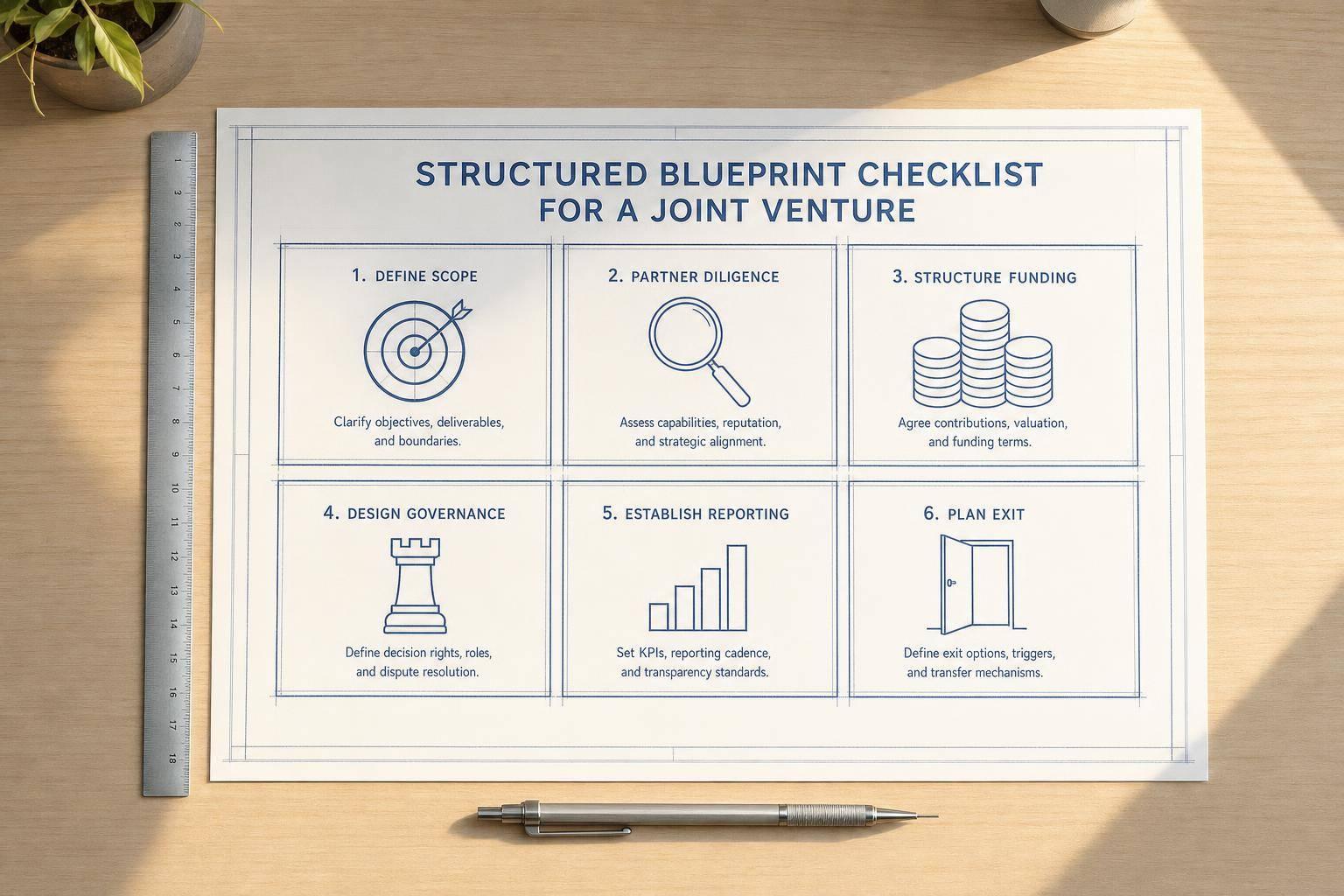
If I want a contractual JV to work, I need to get 6 things right from day one: scope, partner checks, money rules, control rules, reporting, and exit terms.
A contractual joint venture is just that: a JV built by contract, not by a new company. That can cut setup work, but it also means I need to write the rules with care. If I leave gaps, disputes often show up around money, decision power, or who owns what at the end.
Here’s the whole playbook in plain English:
One tax point stands out: in the U.S., if an unincorporated venture shares profits, it is often treated as a partnership for federal tax purposes. That can affect filings, allocations, withholding, and exit tax results.
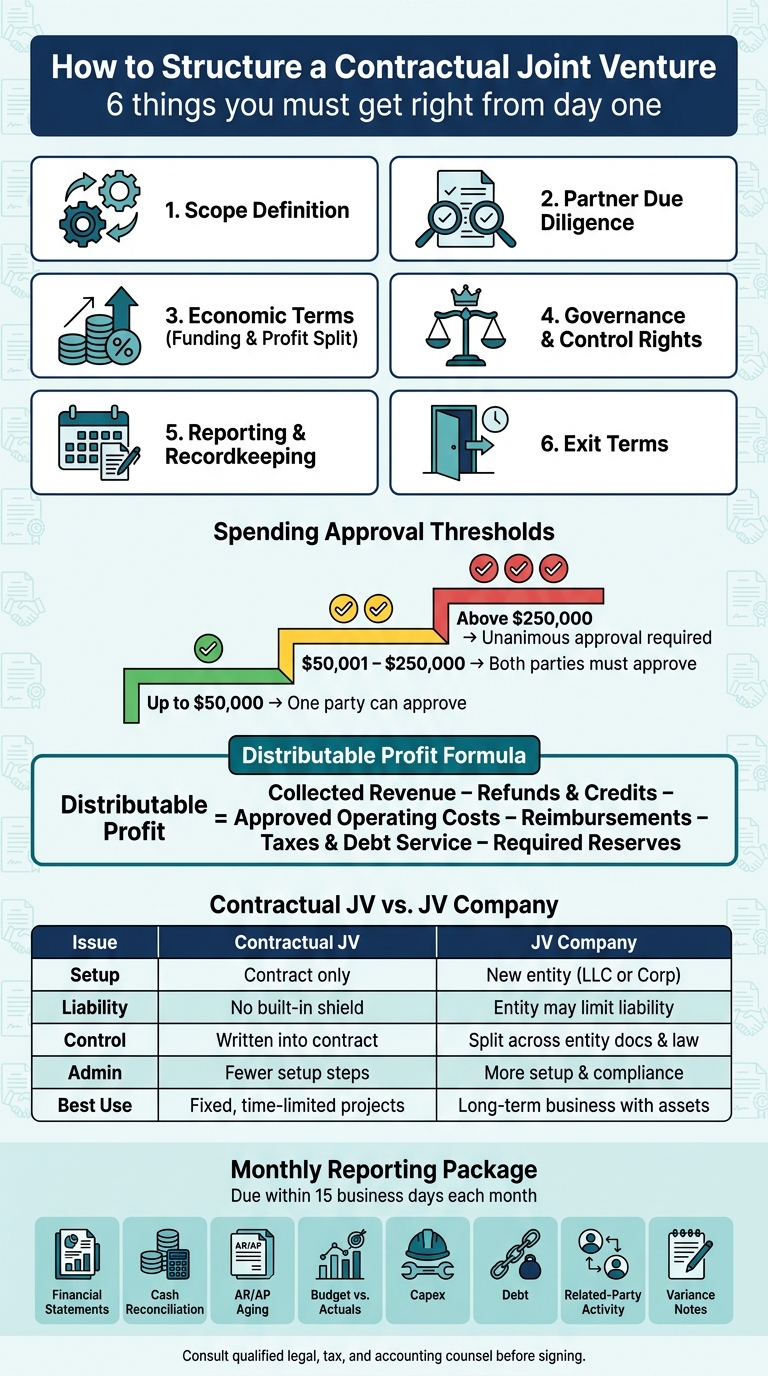
Contractual JV vs. JV Company: Key Differences at a Glance
| Issue | Contractual JV | JV company |
|---|---|---|
| Setup | Contract only | New entity, such as an LLC or corporation |
| Liability | No built-in shield | Entity may separate some liabilities |
| Control | Must be written into the contract | Split across entity docs, JV agreement, and state law |
| Admin | Fewer setup steps, but records and filings may still apply | More setup and compliance work |
| Best use | Fixed project, pilot, or time-limited deal | Longer-term business with assets, staff, or financing |
My short take: if the goal is narrow and time-bound, a contractual JV can fit well. But the contract has to work like an instruction manual, not a handshake with a few legal words added in.
Before you draft anything, pin down the venture in one clear business goal. Something like: “develop and sell a cloud-based inventory platform to U.S. mid-market manufacturers.” That kind of plain scope language does a lot of work. It helps stop later fights over who owns new deals, side products, or spin-off ideas. Once the scope is set, the next step is simple: check whether the partner can actually deliver.
After the goal is clear, build a scope schedule that spells out what the venture is allowed to do. Cover the products or services, target customers, geographic territory, and sales channels. Just as important, spell out what the venture does not include.
For example, an agreement might allow marketing cybersecurity services to U.S. community banks, while excluding government contracts, consumer customers, and any services outside cybersecurity. You should also state whether the territory or customer segment is exclusive or shared. If you skip that point, trouble tends to show up later.
Contributions need the same level of detail. A contribution schedule should cover cash, personnel, equipment, facilities, technology, IP, licenses, data, and customer or distribution access. Give each item its own row. For each one, identify:
It also helps to split preexisting IP and data from assets made by the venture. Then spell out the license scope, improvement rights, and what happens after termination.
| Contribution Type | Weak Formulation | Stronger Formulation |
|---|---|---|
| Staff | "Provide personnel as needed." | Named function, headcount or hours, qualifications, start date, service level, and replacement process. |
| Technology / IP | "Make technology available." | Specific IP identified, license scope, territory, term, improvement ownership, and revocation consequences. |
| Customer access | "Provide sales support." | Named accounts or channels, introduction obligations, assignment rights, data permissions, and measurable activity targets. |
| Success metrics | "Operate profitably." | Revenue, margin, customer count, and retention targets with a defined measurement period. |
Use that contribution schedule to set the economics next.
For a U.S. mid-market company, due diligence should match the venture’s risk and investment. The goal is to test whether the partner can do what it says it can do. Review financial capacity, legal standing, operating ability, and compliance history. Also verify any promised customer access or capacity.
One point matters more than many teams expect: make sure promised customer access can actually be transferred. Contract-assignment rights, customer consent rules, and data-sharing limits can make a claimed customer base far less useful than it first seems.[5]
If a partner says it has manufacturing capacity, ask for production records and quality certifications. If it says it can fund the venture, ask for proof of cash on hand or a financing commitment. Gaps in risk tolerance, decision speed, or exclusivity duties are much easier to fix before signing than after.
Use what you learn in diligence to tighten the term sheet before you move into the final agreement.
A term sheet is a tool for business alignment. It is not a stand-in for the final agreement. Its main job is to flush out disagreements on scope, economics, control, and timing before both sides spend weeks negotiating long-form documents. It should cover scope, contributions, economics, control, timing, term, and exit basics.[2][3]
Label what is binding and what is not. In the U.S., term sheets are usually nonbinding on the main deal terms. But confidentiality, governing law, negotiation costs, and a short exclusivity period can be binding if the drafting says so in clear terms.[3]
If the term sheet says one party will provide technical resources, the final agreement should not leave that vague. It should name the functions, staffing levels, deliverables, service levels, deadlines, and the result if those items are not delivered. Use the term sheet to settle the business points before the final drafting begins.
Once the term sheet locks in the business points, the next job is to turn them into numbers you can enforce. Keep revenue share, profit share, reimbursement, and cost sharing separate. If those ideas blur together, payment fights tend to follow.
A clean draft usually sets the economics in this sequence: revenue period, reimbursable expenses, funding duties, profit calculation, distribution formula, payment timing, reserves, and true-ups.
Start with a funding schedule that lists each contribution, its agreed value, the date, and how it will be treated: capital, loan, license, or reimbursable service. Those labels matter.
A capital contribution increases a party's agreed funding balance or economic interest. A loan creates a repayment duty and should spell out principal, interest, maturity, security, and priority. A reimbursement pays back an approved expense and usually should not affect ownership. A distribution transfers available cash after expenses, reserves, taxes, and required debt payments. These buckets should not overlap.
If Party A pays a $20,000 vendor invoice on the venture's behalf, the agreement should state whether the amount is reimbursable within 30 days or treated as a capital contribution.[7]
For future funding, say whether capital calls are mandatory or need approval. Also set the minimum notice period, the payment deadline, and what happens if a party does not pay. Common fixes include interest, a default loan from the paying party, dilution, suspension of rights, or termination.[8] Tie joint approval to the approved budget so there is a clear line for when extra consent is needed.
Noncash assets need the same level of detail. Spell out the value, whether the asset is transferred or licensed, who maintains it, who may use it, and what happens to it if the deal unwinds.[6]
Before writing any formula, define gross revenue, approved costs, distributable cash, and profit in the definitions section. If those terms are vague, the math won't save you.
A usable profit formula looks like this:
Distributable Profit = Collected Revenue − Refunds and Credits − Approved Operating Costs − Reimbursements − Taxes and Debt Service − Required Reserves
Here is the basic math in practice: under a 60/40 split, $250,000 of distributable profit pays $150,000 to Party A and $100,000 to Party B.
You should also say whether costs are recorded on a cash basis or an accrual basis. And if a party charges an affiliate or related company, state whether those charges need market benchmarking or joint approval.
The table below lays out the main allocation models and where each one tends to fit.
| Model | Allocation basis | Advantages | Risks | Required records | Best-use situation |
|---|---|---|---|---|---|
| Gross-revenue share | A percentage of collected revenue, such as 70%/30% | Simple and predictable | Can overpay a party when margins are low | Invoices, collections, refunds, credits | Sales, distribution, or licensing arrangements where expenses are limited |
| Net-profit share | A percentage of defined distributable profit, such as 60%/40% | Reflects economics after agreed costs | Disputes over allowable expenses and timing | Separate ledger, approved budget, accrued expenses, expense support | Operating ventures with shared costs and meaningful margin variability |
| Contribution-based split | Allocation based on agreed cash, asset, personnel, or IP values | Links economics to documented inputs | Valuation disputes and changing contribution levels | Contribution schedule, time records, asset valuations | Ventures with materially different noncash contributions |
| Preferred-return waterfall | Return of capital or a preferred amount before residual profit split | Protects larger or earlier funders | More complex calculations and cash-flow pressure | Funding ledger, payment priority, cash-flow statements | Capital-intensive ventures or unequal funding risk |
| Performance-based allocation | Percentages change when specified milestones, volume, margin, or quality targets are met | Aligns incentives | Requires objective measurement and dispute procedures | KPI reports, audit trail, independent verification | Ventures dependent on sales, delivery, or operational milestones |
For cost sharing, classify each expense and state how it will be handled. That includes fixed costs, variable costs, party-specific costs, shared overhead, capital expenditures, taxes, and extraordinary expenses. For each category, include:
Also state whether reimbursement is at actual cost, cost plus a stated markup, or a predetermined rate. Do not allow markups unless the agreement says so in plain terms. Each shared cost category should add up to 100%, and the agreement should include a true-up process if actual usage ends up different from the estimate.
Have finance advisers model the cash waterfall and budget-to-actual reporting. Have legal and tax counsel check the final formulas before signing, especially if contributed property has a tax basis that differs from its agreed value.[9] Once those economics are locked down, the next step is to set the control and reporting rules.
Governance turns the term sheet into the rules people actually use day to day. If those rules are vague, small issues can turn into big fights fast. Just as important, the same rules need to line up with the reporting package so approvals, spending, and records all tell the same story.
Start by naming the party that handles day-to-day operations and spell out what that role can do. That should cover purchases, vendors, customer contracts, invoicing, bank access, and contact with regulators. It usually works better to tie authority to a role instead of a specific person. A written delegation matrix and a current list of authorized signers help cut down confusion and stop unauthorized commitments. The agreement should also say that neither party can bind the venture outside its delegated authority.
For spending, use clear thresholds instead of fuzzy judgment calls:
Then draw a line around the decisions that need both parties to agree. These reserved matters usually include borrowing or granting liens, capital expenditures above an agreed threshold, contracts outside the ordinary course, hiring or dismissing senior personnel, related-party transactions, material IP licenses, and changes to the venture’s scope or business plan.
Use this decision matrix:
| Decision type | Day-to-day authority | Reserved approval required |
|---|---|---|
| Ordinary operating expenses (within budget) | Designated manager, up to $50,000 | Both parties if above cap or outside budget |
| Bank account access and payment releases | Named authorized signers; dual approval for larger payments | Both parties to open, close, or change account control |
| Capital expenditures | Operating manager within approved capital budget | Both parties above threshold or for unbudgeted items |
| Customer and supplier contracts | Commercial lead for ordinary-course agreements | Both parties for long-term, exclusive, or above-threshold contracts |
| Borrowing, guarantees, or liens | No unilateral authority unless expressly granted | Both parties, in writing |
| IP licenses or jointly owned IP | Technical or legal lead for approved licenses | Both parties for exclusive, perpetual, or sublicensed rights |
| Related-party transactions | No automatic approval by an interested party | Disinterested party approval plus disclosure and commercially reasonable terms |
| Changes to scope, territory, or pricing model | No unilateral authority | Both parties, preferably unanimous |
Every approval should be recorded in resolutions, minutes, or an approved electronic workflow. If a related-party transaction is on the table, disclose it in advance and get approval from the non-interested party.[1] The agreement should also say whether the interested party must abstain from voting on its own related-party transaction.
A set meeting rhythm keeps governance from turning into a last-minute scramble. A practical setup is a monthly operating review, a quarterly governance meeting, and special meetings on at least 5 business days' notice unless there’s an emergency. Each notice should include the agenda, supporting materials, and any proposed resolutions.
Quorum should mean at least one authorized representative from each party. On reserved matters, no quorum should mean no approval. That keeps one side from pushing through a major decision while the other is absent.
Deadlock rules matter too. Define deadlock clearly. For example, it can mean failure to approve the same reserved matter at two properly noticed meetings or within 15 business days after escalation. Once that happens, the agreement should move through set stages: first the operating managers meet within 5 business days, then senior executives step in, then a neutral mediator joins, and then a final mechanism applies. That final step might be baseball arbitration, a buy-sell process, or termination and wind-down. During the process, keep the status quo in place except for steps needed to protect employees, customers, safety, or compliance.
For disputes, match the tool to the problem. Use mediation for commercial disputes, expert determination for accounting or valuation issues, arbitration for binding decisions, and court action only for injunctions, confidentiality, IP, or enforcement.[4]
Control rules fall apart if the books don’t match them. The venture should keep separate books, use a separate bank account, and follow a written expense-approval process. If one partner pays an approved expense directly, the agreement should require an invoice or receipt, proof of payment, a description of the expense, and prompt reimbursement or booking as a documented capital contribution or intercompany payable. The contract should also ban undocumented withdrawals, personal expenses, unapproved management fees, and transfers to affiliates. The IRS requires separate books and records.[12]
If the venture is treated as a partnership for federal tax purposes, it must file an annual information return reporting income, deductions, gains, and losses, even though the venture itself generally does not pay federal income tax.[13]
A monthly reporting package due within 15 business days should include:
That monthly package should also show approvals, reimbursements, and related-party transactions. A quarterly package can go a step further with forecasts, tax estimates, covenant compliance, project profitability, and risk updates.
Before signing, both parties should agree on the chart of accounts, accounting basis, fiscal year, and the schedule for delivering information each party needs for consolidation, equity-method accounting, tax provision work, and lender reporting.[10][11]
Once scope, money, and decision rights are set, the next step is simple: nail down how long the venture lasts, how it can end, and what happens when it does.
State the venture’s term in plain English. If it’s a fixed-term deal, include the exact end date, such as December 31, 2028, along with the renewal notice deadline and the approvals needed to extend it. If it’s tied to a project, spell out clear completion markers, like delivery acceptance or final regulatory approval. Wording like “until the project is complete” sounds harmless, but it’s the kind of phrase that starts arguments later.
Exit terms should separate termination for cause, termination for convenience, and automatic termination. Common triggers include a material breach, failure to fund an approved contribution, insolvency or bankruptcy, a banned change of control, loss of a needed license, illegality or regulatory action, repeated reporting failures, and force majeure. For breaches that can be fixed, set written notice and a cure period - for example, 10 business days for a payment default and 30 days for another material breach. Some events, such as illegality or insolvency, may allow immediate termination with no cure period.
Here’s how the usual exit scenarios line up with the matching mechanism:
| Exit mechanism | Typical trigger | Valuation approach | Notice requirement | Operational consequence |
|---|---|---|---|---|
| Project completion and wind-down | Defined deliverables completed or assets sold | Final asset-and-liability reconciliation | Notice under the completion schedule, often 30–60 days | Stop new commitments; collect receivables, settle liabilities, distribute remaining value |
| Termination for cause | Uncured material breach, failure to fund, or repeated reporting failure | Contractual damages, setoff, or fair-market-value buyout; state the method expressly | Written notice plus cure period, unless immediate termination is permitted | Nondefaulting party may restrict authority, replace personnel, or pursue a buyout |
| Buyout or call right | Insolvency, prohibited change of control, or specified default | Independent appraisal, formula price, or fair market value less agreed discounts | Commonly 20–60 days after trigger or valuation notice | One party assumes assets, contracts, employees, and specified liabilities |
| Right of first refusal or first offer | Voluntary transfer or withdrawal | Bona fide third-party offer or negotiated price | Advance transfer notice, often 30–45 days | Remaining party may acquire the interest before an outside sale |
| Sale of the venture or assets | Deadlock, strategic exit, or inability to continue | Competitive sale process or independent valuation | Notice followed by a defined sale process | Assets or business are marketed, sold, and proceeds distributed |
| Forced liquidation | Illegality, failed regulatory approval, or unresolvable deadlock | Liquidation value, with explicit treatment of wind-down costs | Immediate or short notice when continuation is unlawful | Operations cease except for preservation, collection, compliance, and liquidation |
When the venture ends, the unwind schedule should deal with cash, receivables, inventory, equipment, prepaid expenses, intellectual property, data, contracts, people-related obligations, taxes, and liabilities. The payment order should also be spelled out. Third-party creditors and taxes come first. Wind-down costs come next. Returned contributed funds come third. Whatever is left gets divided under the agreed economics.
IP and data rules matter here too. The agreement should say who keeps preexisting materials, who owns newly developed work product, and whether customer communications need joint approval before they go out. If that part is fuzzy, the breakup can get messy fast.
Before anyone signs, do one last review across legal, tax, and finance. The goal is to make sure the contract and the day-to-day plan say the same thing.
This final pass often catches small mismatches that turn into big headaches later. Legal counsel should confirm that each party has authority to sign, that the agreement does not accidentally create a partnership or agency relationship, and that indemnities, liability caps, insurance terms, and IP ownership are fully covered. Antitrust review matters as well. If the parties compete with each other, take a hard look at information sharing, pricing, and market allocation. Some deals may also need Hart-Scott-Rodino notice to the FTC and DOJ before implementation.[16][17]
Tax counsel should pin down whether the arrangement is a cost-sharing contract or a partnership for federal tax purposes. Under IRS guidance, an unincorporated business that shares profits is generally treated as a partnership.[14][15] That label affects filing duties, income allocations, withholding, and the tax result of a buyout or liquidation.
Finance should make sure the opening budget, bank mandates, chart of accounts, reporting templates, and approval thresholds are ready before day one. Not after the first disagreement. Before day one.
A contractual JV works when the written deal lines up with how the venture will actually run. Choose the right partner through real due diligence. Define scope and contributions with precision. Put profit and cost formulas into plain numbers. Assign control rights with clear thresholds. Require separate books and regular reporting. Build the exit terms before anyone wants out.
That’s what cuts down ambiguity. And ambiguity is usually where small issues turn into expensive disputes.
Before signing, get qualified legal, tax, and accounting advice for your specific arrangement.
Use a contractual joint venture for short-term projects like outsourcing deals or shared ownership of specific assets when the partners want to skip the cost and red tape that come with setting up a formal company.
Because this setup does not create a separate legal entity, it gives the parties more flexibility and usually means fewer compliance requirements. For longer-term ventures with room to grow, an LLC or corporation will often offer more stability and better liability protection.
Set a clear agreement before operations begin. Spell out what each party is putting in, when they’re putting it in, and how you’ll value it. That includes non-cash contributions like expertise, relationships, software, or intellectual property.
A contribution-based profit-sharing model usually works best because it ties payouts to what each side actually brings to the table. Just make sure the agreement also explains how cost overruns and savings will be treated, so no one is left guessing if the budget shifts.
It also helps to require regular financial reporting. That way, both sides can see where the money is going and whether the project is on track.
For disputes, set the process upfront:
The agreement should spell out what happens to assets, intellectual property, data, and cash. That cuts down the risk of disputes later.
In most cases, background IP goes back to the party that owned it before the JV began. Foreground IP created during the JV can be sold, licensed, or held jointly, depending on what the parties agree to.
The agreement should also say who keeps access to operational and historical data. On the financial side, cash and liabilities should be sorted through outstanding debts, inter-company balances, working capital adjustments, and any payout or buyout formulas set in advance.