Published on
July 23, 2026


A customer marked low risk on 07/24/2026 can look high risk tomorrow. That’s why I’d treat risk scoring as a live process, not a box checked at onboarding.
Here’s the short version:
This matters because static scorecards can go stale fast. A business that looked low risk at account opening may later send many small wires to high-risk countries, show unusual cash activity, or gain a new owner. If the score stays frozen until the next review, the institution may miss AML risk.
A simple setup often uses point bands like 0–25 for Low, 26–50 for Medium, and 51+ for High. Some firms also use trigger rules such as a 300% or more jump in monthly outbound volume versus the prior three-month average. Those triggers can force an immediate rescore instead of waiting for an annual or quarterly review.
| Area | Static scoring | Dynamic scoring |
|---|---|---|
| When scores change | At onboarding and scheduled reviews | When events happen |
| Main inputs | KYC profile data | KYC plus transactions, alerts, screening hits, and profile updates |
| Main weakness | Old context | More model and data control work |
| Main use | Starting risk view | Current risk view |
| Typical actions | Set review schedule | Change review timing, monitoring, and case routing |
If I had to reduce the whole topic to one point, it would be this: static scoring gives the starting view, while dynamic scoring keeps that view tied to what the customer is doing now.
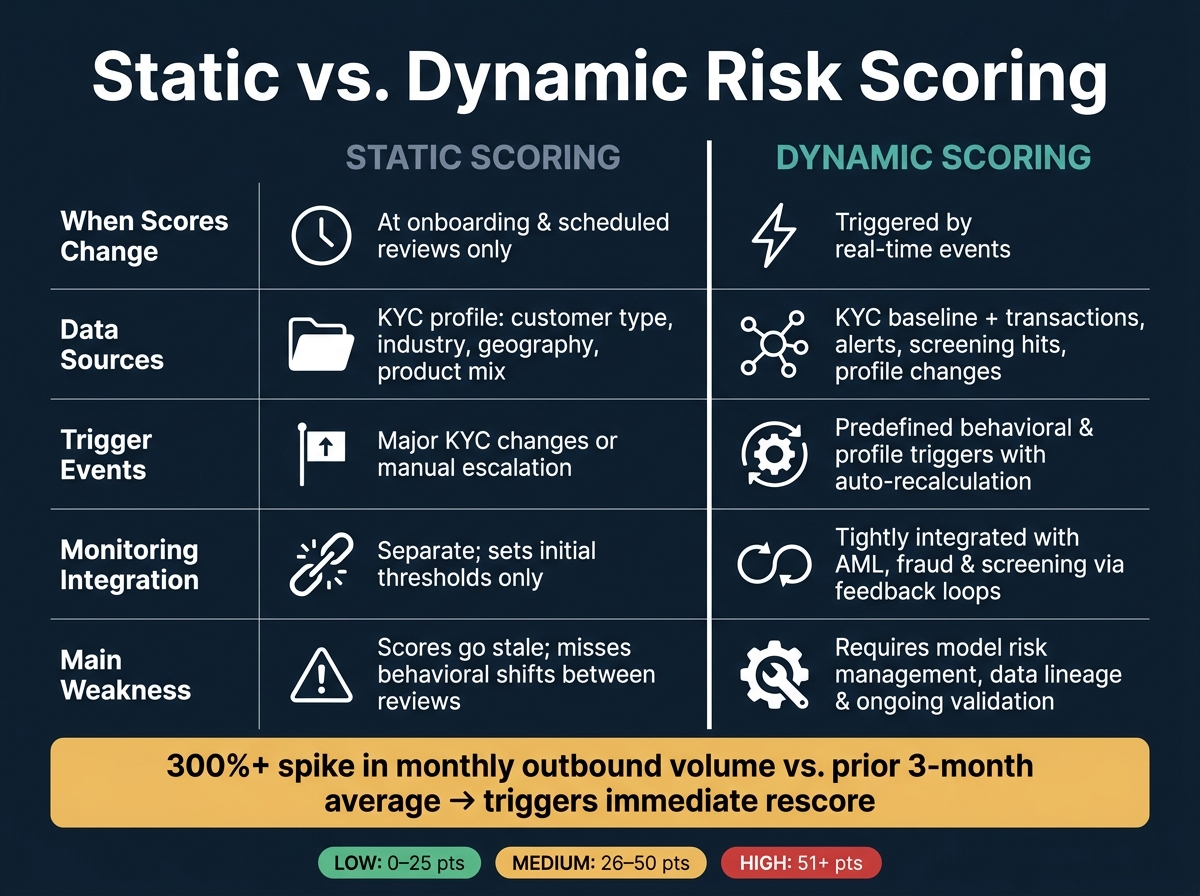
Static vs. Dynamic Risk Scoring: Key Differences at a Glance
Static scorecards give you the starting line. Dynamic models keep watching after that. You can see the difference fast when the two are put side by side.
A static scorecard assigns an opening risk rating based on KYC factors like customer type, industry, geography, product mix, channel, and expected activity. Each factor gets a point value, and the total places the customer in a low-, medium-, or high-risk tier. After that, the rating usually stays the same until the next scheduled review.[1][3]
That review cycle is the main weakness. A static score can sit unchanged even when customer behavior shifts. Still, static models matter. They set the inherent-risk baseline before any behavior is seen, which helps teams decide on opening due diligence steps and onboarding approvals. In a dynamic setup, that baseline stays in place as the starting score, and current activity data adjusts it over time.[2]
Dynamic models keep the static inherent-risk score and add live transaction and alert data on top of it. Transaction volumes, new counterparties, sanctions screening hits, fraud alerts, and KYC profile updates flow into the model as events happen. If a trigger fires, like a spike in wires, a new beneficial owner, or an adverse media hit, the system recalculates the score right away.[4][5]
That recalculation does more than update a dashboard. It can move a customer into enhanced due diligence, shorten the review cycle, tighten transaction monitoring thresholds, or send future alerts to more experienced investigators.[2] That's where the day-to-day gap shows up: review timing, data inputs, and the way alerts change the score.
| Dimension | Static Scorecards | Dynamic Scorecards |
|---|---|---|
| Review frequency | Onboarding plus periodic reviews | Event-driven and near-real-time rescoring |
| Data sources | KYC, product type, industry, geography | KYC baseline plus transactions, alerts, screening hits, profile changes |
| Trigger events | Major KYC changes, manual escalation | Predefined behavioral and profile triggers with automated recalculation |
| Monitoring integration | Separate; mainly used to set initial thresholds | Tightly integrated with AML, fraud, and screening tools via feedback loops |
| Change management | Simpler documentation and change management | Model risk management, data lineage, explainability, and ongoing performance validation |
Dynamic risk scoring runs on four main data groups: customer, transaction, geographic, and relationship data. Each one helps the model adjust risk when a customer's behavior shifts.
| Domain | Static Inputs | Dynamic Inputs |
|---|---|---|
| Customer | Legal name, SSN/EIN, legal structure, customer type, industry/NAICS code, onboarding channel, initial product set | Employment or business changes, new products added, beneficial ownership updates, address or contact changes |
| Transaction | Expected monthly volume, average ticket size, stated cash usage, expected counterparties | Actual volume and frequency, velocity spikes, cash intensity relative to expected activity, new counterparties, cross-border flows |
| Geographic | Legal residence or business registration address, primary operating jurisdictions, booking channel | IP geolocation, logins from unexpected or sanctioned jurisdictions, new cross-border routes |
| Relationship | Initial beneficial ownership structure, parent-subsidiary links, introducer or referral source | New related accounts found via graph analysis, links to known bad actors, ownership or control changes |
Static fields create the starting point. Behavioral and external fields show when that starting point no longer fits reality.
Static KYC data sets a customer's inherent risk before a single transaction happens. The core baseline fields include customer type, legal structure, industry, onboarding channel, product mix, PEP status, and sanctions flags.
One thing matters a lot here: this data needs to live in structured fields, not buried in PDFs. If a beneficial owner changes or a sanctions flag appears, the dynamic model should be able to rescore the customer right away.
The strongest signals usually come from changes in behavior, not from fixed thresholds alone. Useful metrics include rolling z-scores on transaction volume, velocity indices that compare current hourly activity to past norms, and cash-to-total-volume ratios checked against peer groups and stated expectations.
That’s why context matters so much. A restaurant processing three times its usual cash deposits in a single quarter tells you more than any flat dollar rule ever could.
Cross-border flows add another layer. A U.S.-based business that suddenly starts sending repetitive small wires to multiple high-risk jurisdictions should trigger an immediate risk-score recalculation. Geographic data works best when institutions keep a jurisdiction risk matrix that weights flows by destination-country risk, with higher scores for jurisdictions on FATF lists or places with weak AML controls.
IP geolocation and device location push this even further. They can flag transaction initiations from unexpected or sanctioned regions even when the customer's registered address stays the same.
External feeds fill in the rest of the picture. That includes OFAC sanctions lists, PEP databases, adverse media tools, corporate registries, and country risk indicators. For sanctions, daily or near-real-time refresh is the standard expectation. If a new hit appears, the system should automatically apply a score uplift and create a case instead of waiting for the next review cycle.
Graph analysis can also spot risk that looks invisible at first glance. By connecting customers, beneficial owners, and counterparties, it can surface hidden concentrations, like a group of accounts that seem unrelated but share beneficial owners or move funds through the same shell entity.
Data quality is where many programs quietly fall apart. Stale beneficial ownership records, inconsistent country codes across systems, and duplicate customer records can skew scores and lead to compliance decisions that won't stand up to regulator review.
So this isn't just an IT cleanup job. Validation, standardization, deduplication, and provenance tracking belong inside model risk management.
The next step is deciding when these inputs should trigger a score change and who can override it.
Once the data inputs are set, the next step is simple: when should the score change?
A common U.S. setup uses two layers. The first is an inherent-risk score assigned at onboarding. The second is a behavioral score that updates when new events happen. Each layer pulls from weighted factors such as customer type, product and channel mix, transaction patterns, and alerts. Those factors roll up into one score, which then maps to Low, Medium, or High risk tiers.
A common tier model uses 0–25 points for Low risk, 26–50 for Medium, and 51+ for High[6]. Those tiers usually connect to different review schedules:
That said, the score shouldn't sit still until the next scheduled review. If a customer starts using new products, moves into new jurisdictions, or shows a sharp shift in volume, the system should update the score as soon as a trigger fires.
Use clear triggers for that re-scoring. For example, rescore right away when there are new high-risk products, jurisdiction changes, or 300%+ increases in monthly outbound volume compared with the prior three-month average.
Some events shouldn't just nudge the score. They should override it. That includes confirmed PEP status, sanctioned jurisdictions, and business lines already known to carry high risk. When a customer crosses one of those lines, the system should automatically send the case to enhanced due diligence or manual review.
After triggers are in place, the program needs calibration and override controls.
A scoring model that never gets checked against actual outcomes will drift over time. The main fix is back-testing. Take the current scoring rules, apply them to historical customer data, and see whether High-risk customers in fact produced more alerts and SAR filings than Medium- or Low-risk customers. If that pattern doesn't show up, the weights or thresholds need to change. It's also smart to track sample-test results and SAR rates by tier so drift shows up early[6].
Analyst overrides matter because people catch context that models can miss. But they need rules. An override should include a standard reason code, a free-text explanation, an approver ID, and a timestamp. A downgrade, like moving a customer from High to Medium, should need dual approval. Over time, override trends can tell you a lot. If analysts keep overriding the same factor, that's often a sign the model is off - not that the analysts are.
For models that use machine learning, explainability is non-negotiable in regulated settings[1][8]. Every score change needs to tie back to specific inputs in plain language a compliance officer can read and defend to an examiner. Logging inputs, outputs, and the reason for each score change builds the audit trail regulators expect[7]. Auditors should be able to see what changed, when it changed, and why. That's the trail that allows the score to feed KYC, monitoring, fraud, and credit workflows.

Once the score is calibrated, it should shape how onboarding works, how often reviews happen, and when a case gets pushed up for more scrutiny. In practice, dynamic scores route applicants into auto-approval, manual review, or EDD based on current risk.
Documentation requests should follow that same logic. A moderate score might lead to a request for a second ID or income verification. A high score on a business account will often trigger a detailed beneficial ownership chart, plus support for unusual transactions.
The score should also guide what happens after onboarding. Higher-risk customers need shorter review cycles, and the system can move a case from standard CDD to enhanced due diligence on its own. That can mean deeper source-of-wealth checks, beneficial ownership verification, or senior-level approval before the relationship moves forward.[9][10]
The same score can also adjust alert thresholds and real-time controls after onboarding. This helps with a major AML problem: treating every customer the same. Dynamic scoring lets institutions segment customers and set thresholds that match actual risk and transaction history.
Take a simple example. A one-time $9,500 cash deposit from a stable, low-risk retail customer would likely create a low-priority alert. That same deposit from a high-risk customer with fast volume growth and exposure to high-risk jurisdictions should move straight to high-priority review.
In fraud management, dynamic scores support real-time controls. A fintech platform can let long-tenured customers move through payments with little friction if their device and login patterns stay stable. But if an account suddenly shows a new geolocation, a new device fingerprint, or sharp velocity shifts, the platform can trigger step-up authentication or place a temporary hold.
For credit and counterparty risk, dynamic signals can feed internal risk ratings and early-warning systems. Those signals may include repayment behavior, cash-flow changes, collateral valuations, and counterparty financial health, all within fair-lending and model-governance rules.
None of this works if the data lives in silos. KYC, transaction, device, and watchlist data need to flow into one governed system. Dynamic scoring depends on data pipelines that connect those signals in near real time.
The table below shows how major compliance and risk functions use dynamic risk scores in day-to-day decisions:
| Function | Decisions Influenced by Dynamic Risk Scores |
|---|---|
| KYC & Onboarding | Auto-approve vs. manual review; documentation type required; rejection or EDD escalation based on risk tier |
| CDD & Periodic Reviews | Review frequency; depth of review; triggers for moving from standard CDD to EDD |
| Enhanced Due Diligence (EDD) | Scope of investigations; team assignment; senior approval requirements for high-risk relationships |
| Transaction Monitoring (AML/BSA) | Alert thresholds and prioritization; case routing; SAR filing support and narrative focus |
| Fraud Risk Management | Step-up authentication; transaction limits and real-time blocking; escalation to fraud operations |
| Credit Risk | Credit line adjustments; early-warning triggers; enhanced monitoring of vulnerable borrowers |
| Counterparty & Correspondent Risk | Exposure limits; collateral and margin requirements; decisions to maintain or exit relationships |
| Risk & Compliance Analytics | KPI/KRI design and tracking; model performance evaluation; staffing and technology resource allocation |
In practice, strong programs bring together four parts: baseline scoring, live data, governance, and review.
Static scorecards set the starting point. Dynamic models keep that picture up to date. Put simply, static scoring sets the floor, while dynamic scoring updates the view as new information comes in.
Data quality can make or break the model. If the inputs are weak, the output can point teams in the wrong direction.
Trigger-based rescoring helps keep scores in line with new risk signals. At the same time, formal model governance gives teams a clear way to support changes over time. Regulators need to see the score, the trigger, and the approval trail.
When those pieces work together, compliance teams can make faster, more proportionate decisions. They can route higher-risk cases to the right analysts and cut unnecessary friction for lower-risk customers. That is the difference between a score that labels risk and a program that manages it.
Risk scores should be recalculated on a continuous basis as new data comes in. That helps models stay accurate when conditions shift.
Real-time updates are only part of the job. The risk register should also be refreshed at least once a year and any time a major change hits, like launching a new product, entering a new state, or seeing changes in fraud threats.
Model validation should happen at least twice a year. And if you need to change thresholds, do it in small steps with about one week between each adjustment.
The most important data is real-time transactional information. It shows a business’s or customer’s current condition, not a stale snapshot from months ago.
That’s why these models look at high-frequency signals like payment history, cash flow trends, and transaction volumes instead of leaning on static or outdated annual reports.
They also use other inputs that help fill in the picture, including geographic location, business type, account age, cross-border activity, links to high-risk entities, and alternative data such as utility payments, trade credit records, and supply-chain interactions.
Institutions manage changes to dynamic risk scores with constant monitoring, clear records, and layered review. They recalibrate models using recent data and carry out at least annual independent validation to check performance, fit with current risk, and regulatory compliance.
They also keep a centralized model inventory with audit trails. On top of that, they use controls such as version pinning and change notifications, and they add human review to high-stakes decisions to catch bias or model drift.