Published on
August 8, 2026


Cross-border earnouts can trigger double tax, payroll withholding, treaty problems, FX tax issues, and filing mistakes fast. If I were reviewing one, I’d lock down five things first: how the earnout is structured, whether it is purchase price or compensation, which country can withhold, who the legal payer is, and what must be filed after closing.
Here’s the short version:
One data point stands out: 26% of earnouts were disputed overall, and 32% of gross profit earnouts were disputed. That alone is a good reason to set the tax position early and document it well.
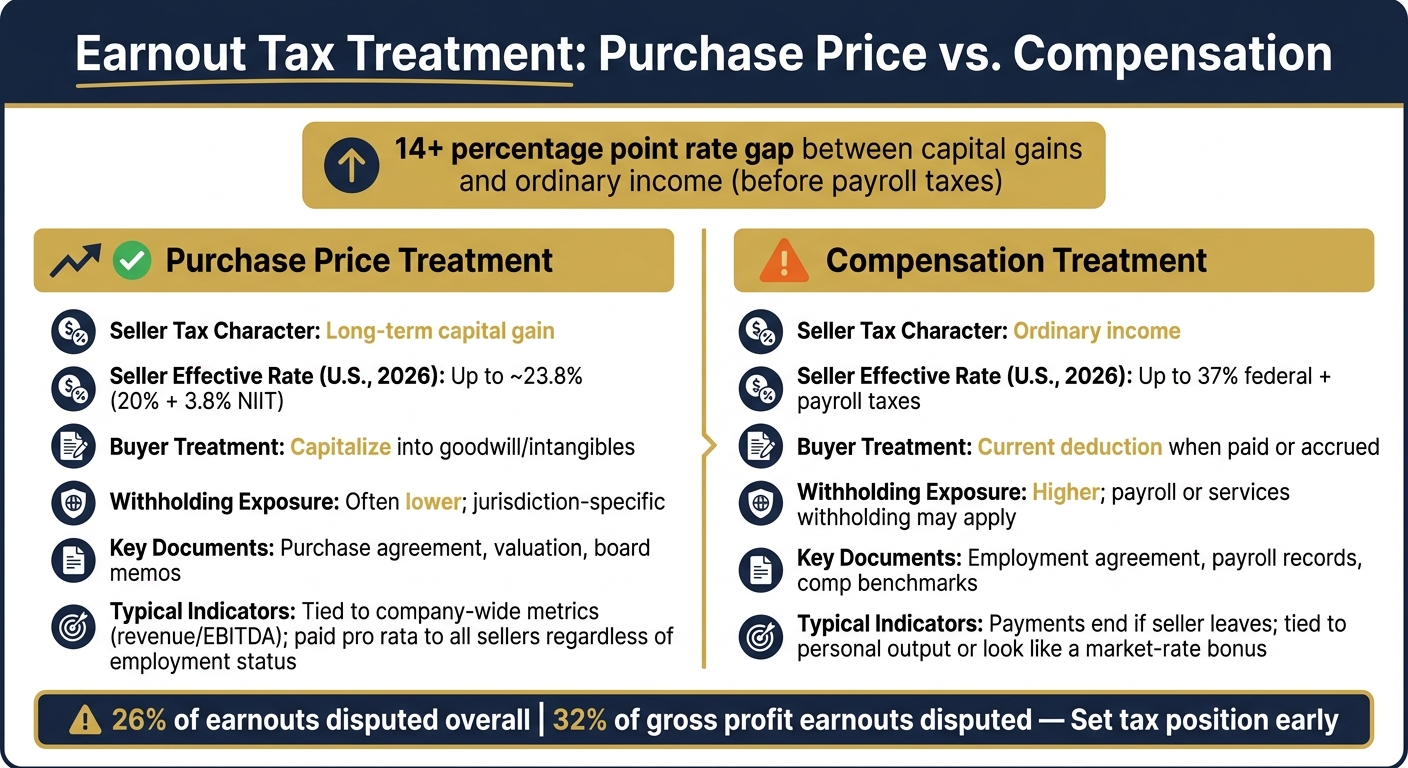
Earnout Tax Treatment: Purchase Price vs. Compensation Comparison
| Area | What I’d check | Main risk if missed |
|---|---|---|
| Structure | Deal form, parties, countries, formula, payment path | Wrong tax treatment from day one |
| Character | Purchase price vs. compensation | Capital gain flips to ordinary income or payroll treatment |
| Timing | Installment rules, imputed interest, payment dates | Tax due earlier than expected |
| Withholding | Domestic rules, treaty article, forms | Over-withholding or missed tax deposits |
| Payment flow | Payer entity, escrow, offsets, FX, intercompany charges | Mismatch between legal setup and tax reporting |
| Post-close | Calendar, forms, proof files, calculation support | Audit issues and filing errors |
If you’re dealing with a global earnout, this checklist is less about theory and more about one goal: make each payment match the tax position you planned at signing.
Start with the earnout structure. Then look at tax. The deal terms set the path for characterization, withholding, treaty relief, and FX treatment.
The deal form shapes the tax analysis and the buyer's basis treatment.
After that, identify every entity in the payment chain. That includes the legal entity that must pay the earnout, the entity or individual that receives it, and any middle party - like a holding company, escrow agent, or local subsidiary. Each step in that chain can affect withholding and treaty analysis.[10][12][1]
Build a jurisdiction map that shows residence, payor, payee, and the withholding rules that may apply. In plain English, you want a clear picture of where each party is tax-resident and which country's rules govern the earnout for characterization, withholding, timing of recognition, and possible treaty relief.[10][1][3] That map becomes the working file for the tax character, withholding, and treaty checks that come next.
The fine print matters here. Not just the top-line amount.
Revenue or EBITDA metrics often point toward purchase price treatment. But if the earnout is tied to employment, personal performance, or noncompete terms, part of the payment may shift into compensation.[14][1][16]
The checklist should also capture the terms that tend to decide the issue when an auditor digs in:
These details often make the difference when a tax authority asks whether the payment is capital consideration or disguised compensation.[5][8][13][14][16] This is the fact pattern you will use for the characterization test in Section 2.
Accounting doesn't decide tax treatment, but the two should line up. Under ASC 805 (U.S. GAAP) and IFRS 3, earnouts treated as contingent consideration liabilities are recorded at fair value at closing and then remeasured through earnings in each reporting period. Earnouts treated as compensation expense follow a different path and are not part of the purchase price allocation.[7][9][15]
At closing, the tax team should confirm how the earnout is being booked: as contingent consideration or as compensation expense. They should also confirm the fair value assigned to it and whether the tax position matches that accounting classification. If tax and accounting do not match, write down the reason.[6][7][9][11][15][16] That record matters even more in cross-border deals, where the same payment can be treated in different ways under different domestic rules.
Use this fact sheet to test characterization, timing, and deductibility.
Next, test how each jurisdiction treats earnouts in M&A deals and what that means for tax, timing, and withholding.
This is where the tax result usually swings. If the earnout is treated as purchase price, the seller will often get capital gain treatment and the buyer will usually add the amount to tax basis. If it's treated as compensation, the seller will often face ordinary income, the buyer may get a current deduction, and payroll withholding can come into play.
In the U.S., that gap matters a lot. The spread between capital gains and ordinary income can be more than 14 percentage points before payroll taxes.[25]
Labels alone won't save you. Most tax authorities look at substance. The main question is simple: does the earnout pay for past ownership risk, or is it paying for future services or performance?
A few patterns tend to stand out:
Tax authorities in India, Germany, and the U.K. have followed this line of thinking. U.S. guidance also shows that employment conditions can override the label used in the purchase agreement.[21][22][24][27]
That call then shapes the timing and withholding review.
After character is sorted out, timing is next. For U.S. sellers, earnouts may fit the contingent payment installment sale rules under IRC §453. In plain English, that often means gain is recognized as payments come in, not all at closing. Principal and interest are then taxed separately.[17][18][28]
Two timing points need close review.
First, §453A can add an interest charge on deferred tax if contingent obligations go over $5 million.[17]
Second, if the earnout agreement doesn't state interest, the IRS may impute it under §483 or §1274 using the Applicable Federal Rate (AFR). When that happens, the imputed interest is ordinary income to the seller and a current deduction for the buyer, even if the contract says nothing about interest.[17][19][20][28]
Other countries may handle timing in a different way. Some may tax the right to receive the earnout at closing. Others may wait and tax the cash when it's paid under local rules.
Once timing is set, it helps to compare seller and buyer treatment side by side.
The table below shows how the two main outcomes usually work for each side.
| Factor | Purchase Price Treatment | Compensation Treatment |
|---|---|---|
| Seller tax character | Long-term capital gain | Ordinary income |
| Seller effective rate (U.S., 2026) | Up to ~23.8% (20% + 3.8% NIIT) | Up to 37% federal + payroll taxes |
| Buyer treatment | Capitalize into goodwill/intangibles | Current deduction when paid or accrued |
| Withholding exposure | Often lower, but jurisdiction-specific | Higher; payroll or services withholding may apply |
| Key supporting documents | Purchase agreement, valuation, board memos | Employment agreement, payroll records, comp benchmarks |
From the seller's side, purchase price treatment is usually the better deal because the rate is lower. From the buyer's side, compensation treatment can look better because it may produce a current deduction instead of pushing the amount into a long amortization period. Put numbers on both outcomes in the deal model before signing.[23][25][26]
Once you've nailed down the tax character, move straight to withholding and treaty relief. This is one of those areas where timing matters. If the paperwork isn't in place before the first payment goes out, the payer may have to withhold at the full domestic rate.
Start with the buyer's domestic rules first. Don't jump to treaty relief right away.
In the U.S., the default withholding rate on many payments to foreign persons is 30% unless a treaty or statutory exception applies.[29][32] Other countries have their own statutory rates and income buckets that can trigger withholding, including capital gains, services or fees, interest, royalties, and other income.
For each payor-payee pair, document the basics up front:
Then add the domestic withholding category, the statutory rate, and the filing and remittance deadline. Put all of that into a withholding matrix before layering in treaty analysis. It saves time later and cuts down on mistakes when payments start moving.
Then test treaty relief.
The treaty article drives the result. It tells you whether withholding still applies, drops to a lower rate, or falls away.
The usual places to start are capital gains, business profits, employment income, and other income. If the earnout comes from the sale of equity or assets and there is no continuing service duty, start with the capital gains article. For U.S.-source payments, capital gains are generally not subject to withholding if taxable, though reporting may still be required.[8]
If the seller keeps providing services or is, in substance, acting like an employee, the employment income article may fit better. If the seller works through an independent business and does not have a permanent establishment in the buyer's jurisdiction, the business profits article may apply.
Treaty relief also turns on residency, beneficial ownership, and any limitation-on-benefits rules.[4][34] This is where deals can get tripped up. A conduit or nominee may fail the beneficial-ownership test, and LOB rules may block treaty relief.[30]
A lower treaty rate is available only if the payer has the right documents before the payment is made.[34] No form, no relief. That's the practical rule.
For U.S. withholding, that usually means a completed Form W-8BEN or W-8BEN-E, along with the needed residency certification and any beneficial ownership or LOB statements.[4][31][33] Other countries use their own treaty-claim forms or local equivalents. Some also require pre-clearance or registration before relief can be used.
The table below shows the kind of withholding matrix the payment team should keep for each payor-payee pair.
| Buyer Country | Seller Country | Tax Character | Domestic Withholding Treatment | Treaty Article | Treaty Documentation |
|---|---|---|---|---|---|
| U.S. | Germany (corporate) | Capital gains | Often no withholding, but reporting may still apply[8] | Capital gains article | Residency certificate, W-8BEN-E |
| U.S. | U.K. (individual) | Employment income | Payroll withholding may apply | Employment income article | W-8BEN or Form 8233, residency certificate |
| Canada | U.S. | Service income | Local domestic rules apply | Business profits or employment income, depending on the facts | Treaty claim form, residency certificate |
Track document deadlines in the payment calendar so treaty relief is in place before each payment. Residency certificates and similar documents often expire after a set period, so if earnout payments run across several years, build renewal dates into the calendar from day one.
If a certificate lapses, the buyer may need to use the full domestic withholding rate until updated paperwork comes in.
After withholding is set, review transfer pricing, FX treatment, and payment mechanics.
Once withholding is set, the next risk is the payment flow itself. Who pays, which entity bears the cost, and how the money moves can all affect tax. In some cases, the payment setup can even change which entity is treated as the payer.
The legal payer matters because IRC Section 482 lets tax authorities reallocate income and deductions to reflect income clearly.[35]
Pick the payer that fits the economics of the deal: the acquirer that books the transaction and bears the earnout risk. That payer should also line up with the entity whose performance drives the earnout metric. If costs are recharged across the group, back that up with intercompany agreements and arm’s-length transfer pricing documentation.[36][37]
A limited-risk distributor, for example, should not be stuck with a large earnout that swings up and down unless its role and risk profile support that result.
If the earnout metric covers more than one jurisdiction, review your transfer pricing policies closely. The goal is simple: make sure profits are not being pushed away from the entities whose performance actually drives the earnout number.
FX on earnouts needs its own tax review. Even if the earnout is fixed in USD, a non-USD seller can still have taxable or deductible FX gains or losses between signing and payment.
Start by mapping each entity’s:
That should feed into a short tax memo covering whether FX movements are ordinary or capital, realized or unrealized, and which entity reports them. Many tax systems draw a line between FX tied to revenue items, which is often taxable or deductible, and FX tied to capital items, which is often left out of tax. That line matters a lot on a multi-year earnout, where even small timing gaps can change the after-tax result in a big way.
If FX volatility is a live issue, think about using forward contracts or options to hedge expected earnout cash flows. But don’t treat the hedge as an afterthought. Document it from day one. Hedges bring their own tax effects, and without contemporaneous documentation, you can end up with a mismatch between the hedge and the underlying earnout exposure.[38]
How the money moves affects when tax is triggered and who owes what. The table below shows common payment structures and the main tax risks tied to each one.
| Payment Channel | Key Tax Risks | Controls Needed |
|---|---|---|
| Direct wire (buyer to seller) | Immediate recognition; withholding triggered at payment date | Payment instructions match the withholding matrix |
| Escrow holdback | Recognition may be delayed; interest on escrowed funds taxed separately | Escrow agreement addresses beneficial ownership, FX, and interest allocation |
| Offset against indemnity claims | Can change purchase price versus compensation character and complicate FX tracking | Written netting schedule; tax sign-off on each offset |
| Equity-settled earnout | May trigger different withholding rules and different tax treatment under local law | Valuation memo; confirm treaty treatment for equity consideration |
| Parent or affiliate guarantee | May shift which entity is treated as the legal payer or bearer of the liability | Guarantee terms aligned with intercompany agreements and transfer pricing documentation |
Escrow setups, in particular, need tight drafting. Three points often get left blurry: whether the seller is treated as owning the escrowed amount at closing or only when the funds are released, who reports any interest or investment income earned while the money sits in escrow, and which party bears FX risk between deposit and release.[39][40]
Take a simple example. If $3,000,000 of a $15,000,000 earnout sits in a USD escrow for 18 months, both buyer and seller need a clear answer on whether gain is recognized on the full amount at closing or only as funds are released.[39][40] Those answers should then flow straight into the reporting calendar and the audit file in the next section.
Before each payment is made, tax should sign off on the payment instructions to confirm they match the intended legal and tax structure. Treasury handles cash. Tax handles withholding and reporting. Legal handles escrow releases and disputes. Clear ownership of each step makes the earnout file much easier to defend in an audit. It also helps each payment get reported the same way every time.
Closing doesn’t end earnout tax compliance. It just changes the job.
After close, the main risk moves away from deal drafting and into day-to-day execution. In practice, post-close work usually comes down to three things: calendar, filing, and audit trail.
The most useful post-close tool is a deadline calendar that tracks every earnout step from the end of a measurement period through the final filing. It should line up each deadline with the payment mechanics already set in the deal documents.
For each measurement period, include:
A single quarter can create a tight cluster of deadlines. For example, a 03/31/2027 quarter may require calculation, review, payment, withholding, and filing deadlines within that same month. If the installment method applies, file Form 6252 each year the earnout remains outstanding.[42]
In U.S. asset deals, buyer and seller will usually file a Supplemental Form 8594 in the year each contingency is resolved. Those filings need to match exactly. The IRS treats mismatches as a common audit trigger.[41][43] That’s why each calendar item should have a clear owner: tax handles withholding and filings, treasury handles payment execution, and legal handles seller notices and dispute windows.
The calendar should drive the file, and the file should show that the calendar was followed.
Keep a clear audit trail from the contract formula all the way to the final tax treatment. The file should show how each payment was measured, withheld, converted, and reported. Core documents include the purchase agreement, calculation workpapers, treaty forms, residency certificates, withholding proof, FX workpapers, payment confirmations, and adviser and authority correspondence.[41][42][2][43] If a calculation changes after close, keep both the first version and the revised one.
Label documents by period so nothing gets lost in the shuffle. For example: "Earnout Calculation 01/01/2027–03/31/2027." A short memo that explains the tax position and the key assumptions can end up being the most useful item in the file if the treatment is later challenged.[42]
These controls only work when tax, treasury, and legal each own their piece. A shared reporting calendar, a central payment register, and an indexed audit file kept up to date after every payment are what keep cross-border earnout compliance on track. Phoenix Strategy Group supports post-close earnout tracking with bookkeeping, FP&A, data engineering, and M&A support.
Look at the arrangement’s economic substance, not just the legal wording. In plain English: the IRS usually cares more about how the earnout works than what the contract calls it.
The IRS will often treat an earnout as purchase price when it’s linked to objective, company-level metrics like revenue or EBITDA.
It’s more likely to be treated as compensation when payment depends on continued employment, is tied to an individual’s performance, or looks like market-rate pay for the role.
Treaty forms and withholding documents should be completed and sent to the withholding agent before closing - not at funding.
Submit accurate tax residency documents and the right IRS forms, such as Form W-8BEN or Form W-8BEN-E, before the closing date. That can help you secure a lower withholding rate under an applicable tax treaty and avoid the default 30% U.S. withholding rate.
Keep a clear audit trail. That means holding on to the signed earnout agreement and any amendments, basis calculation schedules, and a payment ledger that shows the date, amount, and tax treatment for each payment.
You should also keep proof that the earnout is purchase price, not compensation, along with tax residency certificates, beneficial ownership declarations, and tax opinions.
Store these records for three to six years. If the arrangement runs across multiple years, keep them longer. Organized digital backups can save a lot of hassle if questions come up later.