Published on
August 27, 2026


If I had to answer in one line: venture capital tends to follow energy policies that make revenue easier to model, demand easier to see, and project delays less likely.
Here’s the short version:
A big change already reset part of the market: federal tax credits for new wind and solar projects expired on July 4, 2026, under the One Big Beautiful Bill Act of 2025. As a result, many investors have shifted more of their focus to storage, geothermal, and nuclear, which still have federal support through 2033.
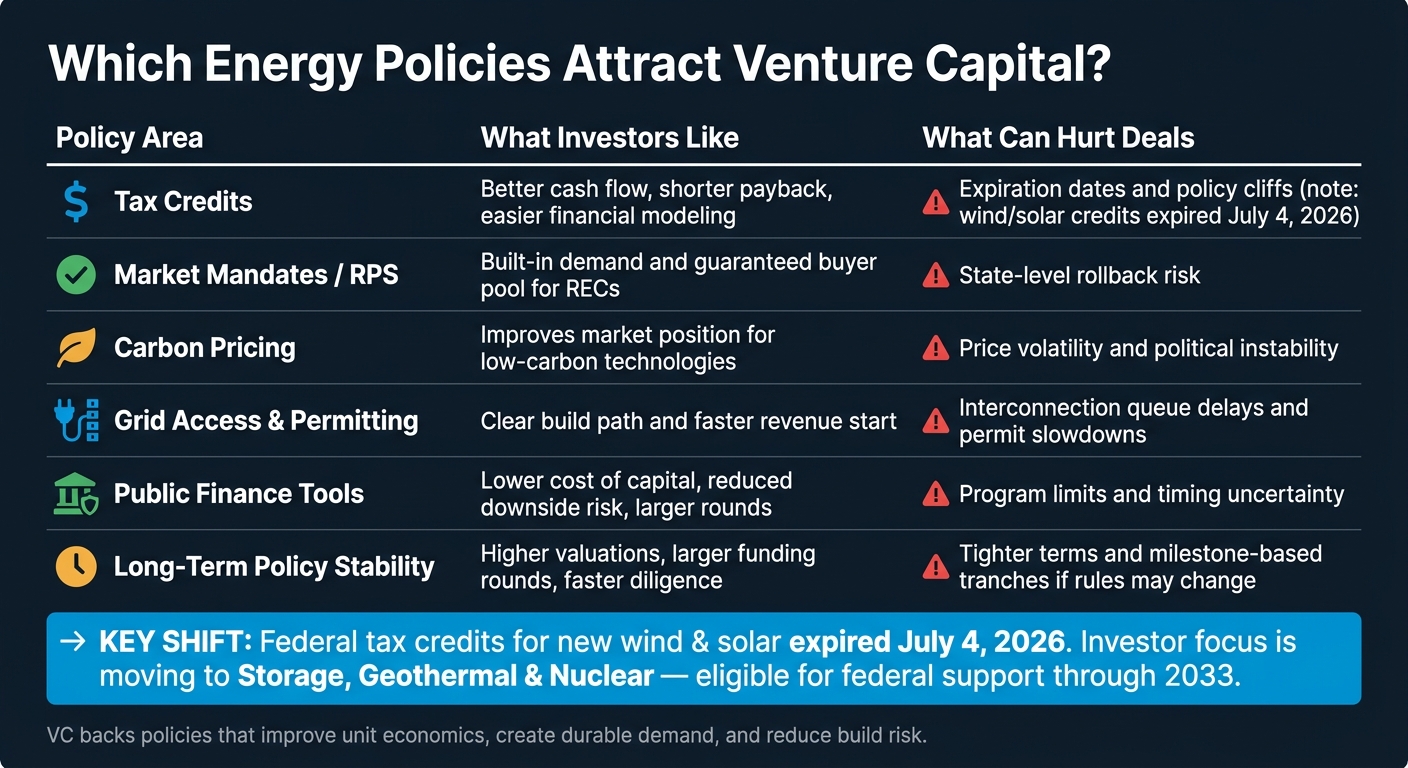
Energy Policy Types That Attract Venture Capital: A Quick Comparison
| Policy area | What investors like | What can hurt deals |
|---|---|---|
| Tax credits | Better cash flow, shorter payback, easier modeling | Expiration dates, policy cliffs |
| Mandates (RPS) | Built-in demand and buyer pool | State-level rollback risk |
| Carbon pricing | Better market position for low-carbon tech | Price swings and political risk |
| Grid and permitting rules | Clear build path and faster revenue start | Queue delays and permit slowdowns |
| Public finance | Lower cost of capital and less downside | Program limits and timing risk |
| Long-term policy | Higher valuations and larger rounds | Tighter terms if rules may change |
So when I look at what draws energy VC, I don’t just look at the subsidy itself. I look at whether the policy can hold up long enough to support deployment, financing, and exit.
VC tends to back policies that do one of three things: improve unit economics, create demand, or cut deployment risk. In practice, investors react most strongly to tax credits, mandates, and carbon prices that are likely to stick around. Why? Because those are the policy tools they can actually plug into revenue forecasts, payback periods, and scale assumptions.
The Investment Tax Credit (ITC) cuts upfront capital costs by covering a share of project installation costs. Lower upfront capital usually means a better project IRR and a shorter payback period. The Production Tax Credit (PTC) works differently. It pays per kilowatt-hour generated, which gives projects a more predictable 10-year revenue stream tied to output. Manufacturing credits matter too, since they lower domestic production costs for solar and storage components and help U.S. startups compete on price.
On July 4, 2026, federal tax credits for new wind and solar projects expired under the One Big Beautiful Bill Act of 2025, shifting investor attention toward nuclear, geothermal, and energy storage, which remain eligible for federal support through 2033. [1]
| Credit Type | Cash-Flow Impact | Investor Attention Point |
|---|---|---|
| ITC | Reduces upfront CapEx by a percentage of project cost | Shortens payback period; improves project IRR |
| PTC | Provides ongoing revenue per kWh generated | Predictable revenue stream tied to output |
| Manufacturing Credits | Lowers domestic production costs for components | Helps domestic startups compete on cost |
Tax credits help the math work. Mandates help make sure there's a market in the first place. Renewable Portfolio Standards (RPS) create a buyer pool for renewable attributes and RECs, which gives startups a clearer route to revenue. The catch is stability. Because RPS rules sit at the state level, state legislatures can weaken them or roll them back.
Carbon pricing changes the picture in another way. It makes carbon-heavy energy more expensive and improves the position of low-carbon options. But there's a hitch: it can be less stable politically. VC tends to like carbon pricing only when it lasts long enough to support long-term pricing models. If credit prices swing around, revenue gets harder to predict, and that shows up fast in deal terms.
| Policy Tool | Revenue Visibility | Policy Durability | Technology Fit |
|---|---|---|---|
| Market Mandates (RPS) | High; creates a guaranteed buyer pool for renewable attributes | Moderate; subject to state-level legislative changes | Mature renewables (wind, solar) |
| Carbon Pricing | Variable; depends on market fluctuations in credit prices | Low to moderate; often less politically stable | Carbon removal, low-carbon fuels |
| Tax Credits | High; direct reduction in tax liability or cash payments | High if long-term; vulnerable to policy cliffs | Broad (storage, nuclear, renewables) |
When power prices go up, projects can pencil out even without subsidies. When prices stay flat, policy support carries more weight. Even then, strong demand signals don't automatically turn into built projects. Grid access and financing still decide whether a policy tailwind becomes something a startup can actually deploy.
Better policy can make a project look good on paper. But investors move to the next issue fast: can this company build and connect on schedule?
Tax credits help the economics. That part matters. Still, term sheets often come down to a simpler test: can the project get built, plugged into the grid, and producing revenue on time? Grid access and financing structure often decide that.
Long interconnection queues and slow permitting do more than push back launch dates. They delay milestones, slow revenue, and change how investors price the deal. A project can have strong subsidy support and still get stuck. That's why many investors now treat permitting and transmission limits as straight-up execution risk.
You can see that in a couple of common patterns:
| Regulatory Feature | Founder-Friendly | Triggers Valuation Discount |
|---|---|---|
| Long interconnection queues | Short queue times; clear path to the grid | Extended milestone timelines; higher execution risk |
| Uncertain permitting | Streamlined approvals | Delayed revenue generation; tighter capital tranches |
There’s also a hard deadline in play. Projects starting construction after July 4, 2026, face a narrow build window: they need to be operational by the end of 2027 to qualify for remaining federal credits [1]. For investors, that kind of clock changes the tone of the conversation. Execution risk stops being a side issue and lands near the top of the term sheet.
Even after a project clears permitting and secures grid access, many capital-heavy energy companies need more than equity to get moving. That's where public finance tools matter.
DOE loan guarantees, state green banks, grants, and tax-credit transferability can take some early risk off the table when private investors won't carry it by themselves. They don't replace venture capital. They make it easier to bring venture capital in.
Here's the basic idea: if a green bank takes a first-loss position, or a federal loan guarantee backs project debt, private investors face less downside. That can lead to lower cost of capital, larger rounds, and better valuations.
| Public Finance Tool | Role in Capital Stack | Risk Reduced |
|---|---|---|
| DOE loan guarantees | Backstop project debt; lower borrowing costs | Financing and credit risk |
| State green banks | First-loss capital; attract co-investors | Early deployment and adoption risk |
| Grants | Non-dilutive project support | Early-stage capital access risk |
| Tax-credit transferability | Lets credits be sold to third-party buyers | Liquidity risk; broader investor base |
In plain English, these tools can shrink early capital needs and make policy-backed projects easier to finance. And that flows straight into term sheet mechanics: how investors size rounds, when they release capital, and which milestones they insist on.
Once policy lifts project economics, investors look one step ahead: Will those rules still exist at exit? That’s the key issue. Policy draws VC only when investors think it will still be in place by the time a project reaches scale.
Durable, bipartisan policy cuts repeal risk and can support higher valuations. Rules tied to domestic content and manufacturing jobs also tend to carry more staying power. The same goes for structural changes like permitting reform. Those features are harder to unwind, and investors bake that into pricing.
When the policy setup is clear, lasts for years, and has support from both parties, investors can model cash flows with more confidence. That usually leads to faster diligence, higher valuations, and larger rounds.
Geothermal, small modular reactors (SMRs), and long-duration storage stay eligible for credits through 2033 [1] [2]. That gives investors a longer runway to underwrite returns than many wind and solar projects now have. Clear safe harbor rules help too, because developers can lock in benefits once construction starts [1].
When that outlook gets murky, term sheets get tighter. If credits go away, revenue gets weaker, and investors underwrite the deal more cautiously.
| Policy Feature | Stable/Durable | Unstable/Volatile |
|---|---|---|
| Duration | Multiyear frameworks support larger rounds and higher valuations. | Short windows compress ROI timelines and trigger rush-to-commence behavior. |
| Transparency | Clear deployment maps and first-ready interconnection rules provide deployment certainty. | Unclear permitting and legal challenge risk lead to larger liquidation preferences and protective covenants. |
| Implementation clarity | Clear timelines reduce execution risk and speed up diligence. | Administrative delays trigger valuation haircuts and milestone-based tranches. |
| Incentive structure | Technology-neutral credits support diverse portfolios. | Repealed or narrowed credits force pivots to PPA-based revenue. |
In practice, that means investors often tie funding to construction or permitting milestones, ask for larger liquidation preferences, and use more conservative revenue assumptions in the model.
Put simply, investors back energy policies that improve unit economics, create durable demand, and cut build risk. Domestic manufacturing credits tend to look durable because they support U.S. jobs and supply chains. Technologies like geothermal, new nuclear reactors, and energy storage still stay eligible for federal subsidies through 2033, which can make them easier to underwrite than wind and solar projects facing the July 4, 2026 expiration [1].
Founders also need to show that the project still holds up if support gets weaker. That means laying out both base-case returns and no-subsidy returns. And if the project qualifies for domestic content bonuses, say that plainly. Investors want to see the upside from U.S.-made components and the supply-chain hedge those parts can provide [1].
Once the model is clear, execution risk moves to the front of the line. Permitting status and interconnection queue position matter just as much as credit eligibility. Make those permitting and interconnection milestones easy to spot in the deck.
Policy uncertainty can slow funding and tighten terms. Clear execution plans and clean modeling help protect valuation.
Investors often lean toward U.S. federal tax credits because the financial upside is easier to see. A tax credit cuts a tax bill directly, and in many cases it can also be turned into cash. That gives a project a more immediate economic boost, helps cash flow, and can make the deal feel less risky.
There’s also a messaging angle. Tax credits can show that a project lines up with federal clean energy priorities, which makes it easier for investors to explain and support the deal with internal teams and other stakeholders.
Carbon pricing is a different story. It’s harder to pin down, less concrete in a deal model, and tougher to build into economics that feel steady and predictable.
Permitting and interconnection delays can stall funding fast. Investors usually want clear proof that a project is ready to move, and that includes a secured interconnection agreement.
When environmental review, local zoning, or grid studies drag on, the project starts to look riskier. The timeline can slip. Costs can climb. And once that happens, lenders and investors may tighten deal terms or walk away from the project altogether.
The flip side is pretty simple: regions with faster approval and interconnection processes often attract more investment.
After the 2026 tax credit changes, venture capital is moving toward utility-scale infrastructure, energy-security assets, and grid modernization.
Wind and solar still matter, but they now face tighter timelines and more permitting friction. That shifts attention to areas with a clearer path forward.
Energy storage, advanced nuclear, and geothermal still look attractive through 2033. And when investors place bets, they’re leaning toward hard tech that can stand on its own numbers.
What tends to win?
Put simply, money is flowing to projects that are easier to plug into the grid, easier to justify on paper, and less exposed to policy whiplash.