Published on
August 30, 2026


A final buyer committee review should end with one dated decision: sign, sign with conditions, or stop. If the meeting ends without owners, deadlines, and a path to close, it failed.
From the article, I’d boil the meeting down to this:
A few numbers make the point clear:
What matters most is simple: the last committee meeting is not for updates. It is for a yes, a conditional yes, or a no.
Here’s the short version of what the review must cover:
| Area | What I’d want settled before the meeting ends |
|---|---|
| Decision | Approved, approved with conditions, or no-go |
| People | Each approver present or already cleared in writing |
| Finance | ROI, payback, total cost, cash impact, funds flow |
| Terms | Price, working capital peg, escrow, consents, key clauses |
| Risk | Legal, tax, IT/security, lease or third-party approvals |
| Close plan | Final owner, target signature date, next actions |
If I were running this process, I’d treat the meeting like the last gate to signature: short, direct, and tied to named owners. The article’s core message is clear - verbal support is not enough; the committee has to turn support into a dated close plan.
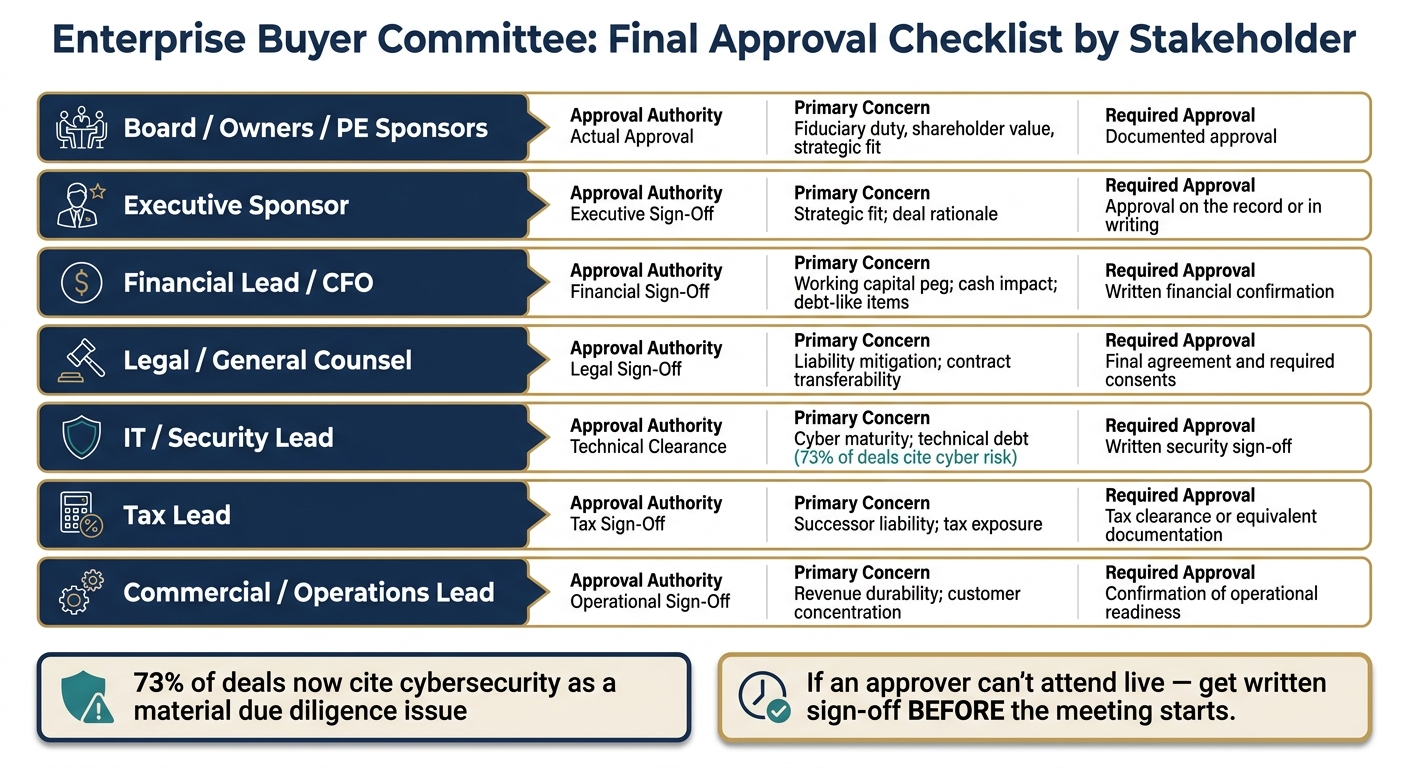
Enterprise Buyer Committee Review: Final Approval Checklist by Stakeholder
A final review can grind to a halt for one simple reason: a required approver isn’t there.
That’s why this needs to be settled before the meeting. Confirm who has approval authority, what each person must approve, and what has to be documented in writing. Once the decision goal is set, lock down who must be in the room and who must already have signed off.
A final review should include the approvers and the leads who can clear open issues. That usually means the board, owners, or PE sponsors, the executive sponsor, the financial lead or CFO, the legal lead or general counsel, the IT/security lead, and the tax lead.
If the deal needs a lease assignment or third-party consent, get that written approval early too.
Some approvers don’t need to join the call live. But if they won’t be there, their written approval should already be in hand before the meeting starts. Because 73% of deals now cite cybersecurity as a material due diligence issue, the IT/security lead is a key advisory role in the final review [3]. If the executive sponsor or financial approver can’t attend live, document their approval ahead of time and spell out any follow-up items that still remain. Don’t treat absent verbal approval as final.
Once the approvers are locked in, the next step is to prep the finance and executive proof they’ll expect.
Before the meeting, create a one-page document that lists each stakeholder’s role, approval authority, main concern, and the exact sign-off required. It’s a simple tool, but it helps you spot missing approvals before they turn into a last-minute problem.
| Stakeholder | Approval Authority | Primary Concern | Required Approval |
|---|---|---|---|
| Board, owners, or PE sponsors | Actual approval | Fiduciary duty, shareholder value, strategic fit | Documented approval |
| Executive Sponsor | Executive sign-off | Strategic fit; deal rationale | Approval on the record or in writing |
| Financial Lead / CFO | Financial sign-off | Working capital peg; cash impact; debt-like items | Written financial confirmation |
| Legal / General Counsel | Legal sign-off | Liability mitigation; contract transferability | Final agreement and required consents |
| IT / Security Lead | Technical clearance | Cyber maturity; technical debt | Written security sign-off |
| Tax Lead | Tax sign-off | Successor liability; tax exposure | Tax clearance or equivalent documentation |
| Commercial / Operations Lead | Operational sign-off | Revenue durability; customer concentration | Confirmation of operational readiness |
Finance sign-off should clearly cover the working capital peg and cash impact. Legal should confirm that any change-of-control or assignment issues are resolved before the meeting. If anything is missing, flag it before the committee meets.
Use the map to pin down the proof points each approver will want to see next.
Use the stakeholder map to build a one-page evidence pack for each approver. Keep it simple: match each proof point to the person most likely to push on it. That means finance proof goes to the CFO and financial approver, while executive proof goes to the sponsor, owner, and board.
Start with the numbers finance will care about most: ROI, payback period, total cost, and cash impact. A buy-side Quality of Earnings (QoE) report helps back up EBITDA, flag one-time add-backs, and test revenue recognition [2][3].
Then add valuation support. That should include enterprise value, equity value, and comparable EBITDA multiples [1][5]. For the working capital peg, use a trailing 12-month average so the purchase price doesn’t get skewed by a short-term swing [2][3].
You’ll also want a funds flow memo ready at least 48 hours before close. It should map buyer equity, debt draws, escrow, and advisor fees [2]. If successor liability could come into play, confirm that the seller has the required tax clearance certificate before closing [4][5].
Once finance can clear the math, move to fit and execution.
Executives usually want clear answers to two things: does this deal fit the plan, and can the company handle the change?
Tie the deal to one or two priorities, such as:
Then show how the business will hold together after close. Document owner dependence with SOPs and employee handbooks, lay out a 100-day integration plan with named owners and weekly milestones, and lock in retention agreements for key employees [2][3][4]. For IT and cyber risk, show security maturity against NIST CSF 2.0 and give a summary of incident history [3].
With the proof lined up, lock down the budget owner, approval limits, and signature path.
Once you have proof points, the next job is to close the gaps that can still stall a signature. This section works best as a live checklist during the review meeting.
Start with a basic question that gets missed all the time: who controls the budget, how much can they approve, and who still needs to sign off?
In enterprise acquisitions, that answer changes by buyer type. Search funds use personal and LP capital. Family offices and PE firms usually need investment committee approval. Strategic buyers often need board approval to meet fiduciary duties.
If debt is part of the deal, confirm final lender approval and escrow funding before close. For SBA 7(a) financing, the loan cap is $5 million, and buyers usually need to put in 10% equity [2]. That lender timeline needs to be built into the close date. If you don't account for it up front, the whole schedule can slip.
Before the meeting ends, make sure the final sources-and-uses table matches the approved budget and the signature path. Also confirm that every budget owner has reviewed it. Once budget authority is clear, turn to the contract terms that can still stop approval.
Unclear terms are one of the fastest ways to create delay after a committee review. So don't leave the meeting with fuzzy language or open questions.
Review the purchase agreement, MSA, order form, and data terms line by line. Each item should have:
On pricing, confirm the base price in U.S. dollars, the working capital peg method, and any debt-free/cash-free rules. Working capital disputes show up in 30% to 40% of M&A transactions [3], so this isn't small print you can gloss over. Nail it down.
Then check the other deal points that often slow approval: escrow size, contract term length, renewal language, non-compete duration, and the implementation or transition timeline [2].
With the budget path set, move to the clauses that still need a final owner and sign-off.
On the legal and compliance side, confirm that bring-down certificates are ready so reps and warranties can be confirmed as true at close. If leased facilities are part of the deal, landlord consent for the lease assignment should be locked down early. Landlords often treat the incoming buyer like a new tenant, which means a full credit check and business plan.
If there are open cybersecurity gaps, flag them now. Loose ends here can lead to escrow holdbacks or remediation covenants.
Use this list to run the meeting and move straight into signed agreement.
At this stage, the attendees, proof, and terms are already in place. So the meeting shouldn't drift into a general discussion. Treat it like a decision meeting with three possible outcomes: approve, approve with conditions, or stop.
Build the agenda around three steps.
This keeps the conversation tight. No vague support. No "we'll circle back." Each approver needs to make their position clear.
Use the table below to settle the last open question for each approver.
| Stakeholder Group | Final Approval Trigger |
|---|---|
| Finance / CFO | Working capital peg confirmed; cash impact accepted |
| Legal Counsel | All reps, IP assignments, and consents signed off |
| Executive / Board | Strategic fit confirmed; fiduciary duty satisfied |
| Operations | Integration plan accepted; transition ownership named |
| Procurement | MSA executed; vendor onboarding cleared |
Once each approver has said yes or named a blocker, turn the meeting output into a dated action list.
Verbal support fades fast. As soon as the meeting ends, send a Mutual Action Plan (MAP). The goal is simple: turn every commitment into a named owner and a hard deadline.
The MAP should include the target signature date, any open legal or procurement items, and the name of the final signatory. Track the purchase agreement, bring-down certificates, and escrow terms. Spell out each owner, action, and deadline.
Also confirm that the funds flow memo is current and shared with all approvers 48 hours before close.
"The cost of a bad first 30 days compounds for years. Build the plan during diligence." - Christoph Totter, Founder, CT Acquisitions [2]
After the MAP goes out, the work shifts to execution. A final buyer committee review works when it's run as a decision meeting with a hard output, not a status update. Get the right people in the room, bring finance-grade proof, confirm budget authority and closing terms before the meeting ends, and leave with named owners tied to a dated signature plan. That sequence moves the deal from verbal support to signature.
Don’t let the review stall. If the main approver is unavailable, use an escalation or backup approval path so the decision still happens on schedule.
Assign a named executive or board/transaction lead to step in and approve on their behalf. Document who has that authority, then have finance and legal confirm they’re signing off on the same budget and terms. Keep the timeline tight:
This keeps the process moving and cuts down on last-minute confusion about who can approve what.
Before signing the purchase agreement, clear every closing condition to help the deal move smoothly and cut post-close risk.
That means making sure the representations and warranties are still accurate, confirming that no material adverse change has occurred, and checking that all required third-party consents and clearances are in place.
You’ll also want to confirm that:
It’s a bit like doing a final walk-through before you get the keys. You want every loose end tied up before the deal closes, not after.
It should be highly specific, actionable, and tied to clear accountability.
Skip broad goals. Instead, use calendar-based milestones like day 30, day 60, and day 90 so everyone knows what needs to happen and when.
Each item should be assigned to a named individual or governing body. Spell out decision rights in an authority matrix, set response deadlines for escalations, and attach the written transition plan to the final deal documents.