Published on
August 12, 2026


A fintech sandbox can help you get regulator feedback sooner and improve funding odds, but it does not remove compliance work or product risk.
If I were a fractional CFO, I’d treat a sandbox as a time-boxed pilot with gates, budget limits, and reserve planning. The article’s main takeaway is simple: model for earlier regulator input, mixed cost timing, better fundraising signal, and risk that is capped during the test but still present.
Here’s the short version:
A sandbox is not a shortcut around rules. It’s a supervised test. So if I were building the plan, I’d budget it like an experiment, track it like a financing event, and move to full launch only if the numbers hold up.
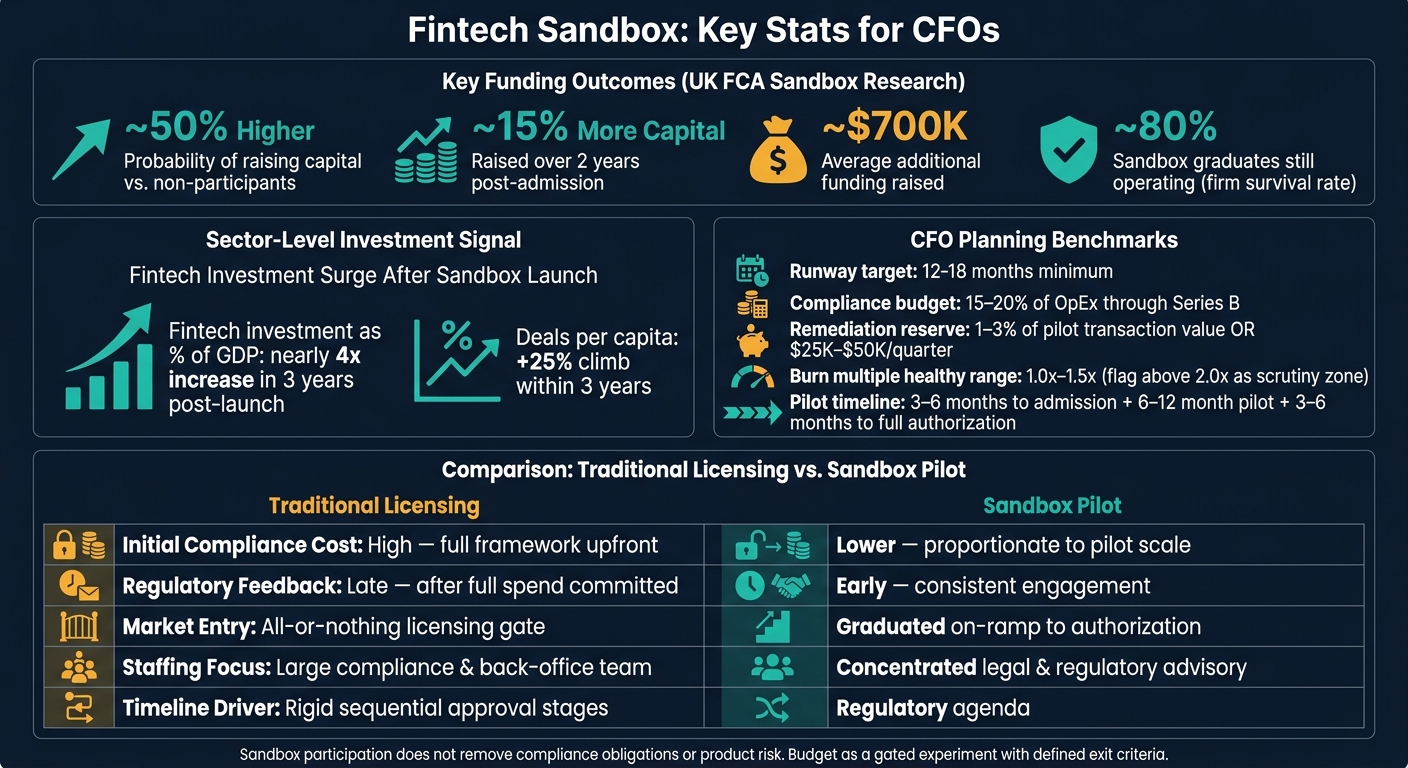
Fintech Sandbox vs. Traditional Licensing: Key Stats for CFOs
Across sandbox research, one pattern shows up again and again: firms tend to get earlier, clearer contact with regulators. That does not mean they reach revenue faster. For a CFO building a financial model, that gap matters.
In a standard licensing process, feedback often comes late - after a company has already put serious money into legal and compliance work. A sandbox changes that sequence. It shortens the feedback loop. In New Zealand, the sandbox gave firms regular access to regulators as they worked through stablecoin and virtual-asset issues [1]. That kind of clarity can cut down on rework.
Under broad licensing rules, firms may have to spend on legal and compliance support before regulators answer the main product questions. Sandboxes shift the timing. So when you model the upside, assume earlier regulatory feedback, not earlier revenue.
Sandboxes can trim long-run compliance burden if they lead to an exemption or a narrower classification, as happened with Easy Crypto's NZDD stablecoin [1]. In practice, that should be treated as a drop in recurring compliance cost - not as proof that the pilot itself will cost less.
The pilot phase can bunch costs together. Firms still need legal and regulatory support for reporting, exemption conditions, and day-to-day rule questions. So CFOs should split costs into two buckets:
That keeps the sandbox phase from looking cheaper than it is on paper.
Speed and cost both matter. But they don't settle the bigger question: whether the pilot helps with funding access or cuts downside risk.
For finance teams, the tradeoff is easiest to see side by side.
| Factor | Traditional Licensing Path | Sandbox Pilot Path |
|---|---|---|
| Initial compliance cost | High; full framework required upfront | Lower; proportionate to pilot scale and risk |
| Regulatory feedback timing | Late; often after full spend is committed | Early; consistent engagement with subject matter experts |
| Market entry structure | All-or-nothing licensing gate | Graduated "on-ramp" steps toward authorization |
| Staffing focus | Large compliance and back-office headcount | Concentrated legal and regulatory advisory hours |
| Typical timeline driver | Rigid sequential approval stages | Regulatory agenda |
For CFOs, it makes sense to budget the sandbox as its own pilot with clear gates, because the next issue is less about speed alone and more about funding and risk.
If a sandbox mainly helps you get faster feedback from regulators, the clearest money upside usually isn't lower operating expense. It's fundraising.
Research links sandbox participation with better funding outcomes. One widely cited BIS study on the UK Financial Conduct Authority (FCA) sandbox found that firms admitted to the sandbox saw about a 15% increase in capital raised over the next two years - about $700,000 in added funding - and a 50% higher chance of raising capital than similar non-participants or later cohorts. [11][12][5]
More recent research suggests these gains may come from both firm-level effects and sector spillovers. [4][5]
The main driver looks like signaling, not savings. Admission sends a message of regulatory viability and cuts investor uncertainty. If a regulator lets your firm into a supervised test, investors often see that as outside validation that the business model can work within the law and that the team can perform under review. So it makes sense to treat sandbox entry as a signaling moment, not as a way to trim costs.
Sandbox rollouts can also increase investor interest across the fintech market. BIS country-level research shows that, in the three years after a sandbox starts, fintech investment as a share of GDP almost quadruples, while deals per capita climb by nearly 25%. [13][14] For CFOs, that can make sandbox milestones useful for fundraising timing and investor messaging.
The upside is better fundraising odds. The tradeoff is that sandbox safeguards don't make product risk disappear. Because the pilot is time-bound and limited in size, risk is contained, not erased.
Sandboxes do include real controls. Common safeguards include:
Those limits are there for a reason: regulators want to reduce the scope of harm if something goes wrong.
But these controls only limit exposure during the test period. They do not show that a product carries lower risk over its full life. That's where the evidence gets thin. Most research looks at innovation and funding outcomes, not long-run product, conduct, or consumer harm. There isn't much systematic, quantitative data comparing sandbox-tested products with standard launches on actual loss events, fraud incidents, complaint volume, or remediation costs. [6][7][8]
For that reason, CFOs should still budget for incident response, customer remediation, and legal reserves as if the product were launching outside a sandbox.
The table below separates the areas where the evidence looks strongest from the areas that still aren't settled.
| Outcome Metric | Direction of Impact | Source Type | Major Limitations |
|---|---|---|---|
| Probability of raising capital | Positive (~50% higher) | Econometric study (UK FCA sandbox data) [11][12][5] | Selection bias; better-prepared firms may be admitted |
| Amount of capital raised | Positive (~15% more over 2 years) | Econometric study (UK FCA sandbox data) [11][2][10] | Effect size varies by methodology; some newer work finds indirect effects only [4][5] |
| Firm survival rate | Positive (~80% of sandbox graduates still operating) | FCA summaries and related analyses [2][3][9] | Causality unclear; survival may reflect admission quality, not sandbox effect |
| Product/consumer loss risk | Inconclusive | Qualitative regulator reports, case studies [6][7][8] | No systematic loss data; small sample sizes, short time horizons; pilots are time-bound with small customer bases |
For fractional CFOs and finance leaders, the practical takeaway is simple: model the sandbox as a gated pilot tied to funding milestones, while still holding reserves for the risk that remains.
Treat the sandbox like a gated pilot, not a shortcut to market. The financial plan should mirror the regulatory path in front of you.
Build three scenarios around gate outcomes:
Each gate should have its own price tag. That way, the model updates cleanly if the company is admitted, extended, graduated, or forced to exit.
After that, break costs into three buckets: compliance, engineering, and remediation. Budget 15%–20% of operating expense for compliance through Series B, plus separate pilot engineering and remediation reserves. [19] The remediation reserve should cover refunds, fee reversals, incident response, and customer support. A solid starting point is 1–3% of pilot transaction value, or a fixed $25,000–$50,000 per quarter, depending on the product’s risk profile. [19]
Keep at least 12–18 months of runway. If runway drops below 12 months, treat that as a clear trigger to either raise capital or reduce scope. [21][22] This setup matters because it stops the sandbox from looking cheaper than it is and helps protect runway at each stage.
Your dashboard should work for both regulators and investors. One reporting spine is better than two disconnected ones.
From day one, track customer count, transaction volume, complaint ratio, loss rate, burn multiple, and time to each authorization milestone. Regulators care about consumer protection outcomes. Investors care about how well capital is being used. Those goals may sound different, but in practice they often point to the same data.
Pay close attention to burn multiple: 1.0x–1.5x is healthy; above 2.0x draws scrutiny. [18][20][21] These are the same outcomes tied to funding and risk performance, so keeping them in one place makes it much easier to connect sandbox results to the financial picture investors care about.
If revenue is held down by pilot caps, don’t stop at raw pilot numbers. Show capacity-based projections backed by conversion and retention data from the pilot. That gives investors a clearer view of market size without asking them to take a leap of faith.

Teams that don’t have much finance bandwidth often need extra help keeping the pilot model, reporting, and data stack in sync. Phoenix Strategy Group provides fractional CFO services and FP&A support to build base, upside, and downside sandbox models, set runway thresholds, create integrated 3-statement models for each gate outcome, and put the analytics stack in place to produce regulator- and investor-grade metrics from one reliable data source.
Taken together, these studies show that sandboxes matter less as shortcuts and more as controlled tests of speed, cost, funding, and risk.
The pattern is pretty clear: sandboxes can speed up regulator feedback, lower uncertainty in compliance planning, improve funding signals, and keep pilot risk contained. But they don't remove the need for disciplined budgeting and governance.
The FMA's treatment of ECDD Holdings shows the main point of a sandbox. It can help a regulator clarify how a product fits within current rules. For finance leaders, that's where the value sits. Regulator alignment matters, but it only pays off when the pilot runs against a clear budget and a defined exit plan.
For CFOs, the right model isn't "sandbox or license." It's a staged pilot with clear milestones, budget gates, and a plan for the next authorization step. Budget the sandbox like a timed experiment, measure it like a capital allocation decision, and move forward only when the numbers support scale.
Startups that want to ease short-term regulatory pressure can apply to join a regulatory sandbox. That gives them room to test new products under lighter rules.
But there’s a catch: sandboxes are temporary. They don’t replace long-term compliance, and they don’t remove the need for full licensing later. If a company plans to keep operating, it will still need to meet the full set of rules.
That makes sandboxes a better fit for early-stage testing than for long-term growth. Once a company starts getting ready to raise funding or scale, the focus should shift. At that point, it makes more sense to build compliance frameworks that can grow with the business and stand up to investor due diligence and future regulatory review.
Budget for both direct vendor costs and the internal resources needed to keep compliance on track. Some sandbox solutions cost $7,500 to $50,000+ per year, but those are only temporary.
You’ll still need to pay for a core compliance program. That usually means $150,000 to $300,000 for the initial technology setup, plus automated monitoring, experienced compliance staff, and regular external audits. Add these costs to FP&A models early so compliance can grow alongside the business.
If a pilot fails, the damage depends on the risk management and governance you put in place before launch. Financial institutions still carry liability for compliance failures during test phases, and regulators do not waive accountability just because a product sits in a sandbox or pilot.
To limit the fallout, set escalation triggers that pause the rollout if metrics cross set thresholds. If something goes wrong, report control breakdowns or data incidents to the board right away, and keep an active issue log with clear ownership and proof of closure.