Published on
August 21, 2026


Yes, I can buy U.S. real estate as a foreign investor. But buying is the easy part. The hard part is choosing the right title setup, handling tax rules, and getting the paperwork right before and after closing.
If I were summarizing this guide in plain English, I’d put it like this: foreign buyers are usually allowed to purchase U.S. property, but one wrong move with title, FIRPTA, tax filings, lender documents, or state land rules can create tax costs, delays, or filing problems. The main decision comes first: should I buy in my own name, through an LLC, through a foreign company with a U.S. LLC, or through a trust?
Here’s the short version of what matters most:
If I wanted one simple takeaway, it would be this: I need to set up the ownership structure before I sign, check the property before I commit, and plan the tax filings before money changes hands. That is what protects the deal.
Foreign buyers can generally own U.S. real estate, though state and local rules may limit certain purchases [4]. The way you hold title matters just as much as your right to buy. Your setup affects liability, privacy, taxes, banking, and yearly filing duties. After you pick the holding structure, the next move is to form the entity and gather the documents banks and lenders will ask for.
Direct ownership is the simplest path. But it also leaves personal assets exposed and can trigger U.S. estate tax on U.S.-located assets [3].
A U.S. LLC is a common pick because it can separate property-related liability from the buyer’s personal assets [3] [1]. That said, if the buyer owns the LLC personally, the membership interest is still treated as a U.S.-located asset for estate tax purposes [3].
A foreign corporation that owns a U.S. LLC can cut U.S. estate-tax exposure, but it also brings more filing work, including IRS Form 5472 [3].
Trusts can serve a similar estate-planning role when set up the right way [1].
| Feature | Direct Ownership | U.S. LLC | Foreign Corp + U.S. LLC | Trust |
|---|---|---|---|---|
| Liability Protection | None | High | High (double layer) | High |
| Privacy | Low | Moderate | High | High |
| U.S. Estate Tax Exposure | High (40% over $60,000) | High (if owned individually) | Low/None | Low (if structured correctly) |
After the structure is set, the buyer can file formation documents and get tax IDs before contract and closing.
Once you’ve chosen a structure, the setup process follows a clear order. For many foreign buyers using an LLC, Delaware and Wyoming are often recommended because of their privacy laws and simple online filing process [4] [6].
LLC formation usually takes one to three weeks. Annual maintenance costs often fall between $500 and $2,000, depending on the state, plus a registered agent fee of $100 to $300 per year [1] [4].
Use this checklist to complete formation before underwriting and closing.
| Document | Purpose |
|---|---|
| Valid Passport | Primary identification for lenders and legal filings [7] [6] |
| Articles of Organization | Proof of U.S. LLC formation [6] |
| Operating Agreement | Defines ownership and management of the LLC [6] |
| EIN (Employer Identification Number) | IRS tax ID required to open a U.S. bank account [4] [6] |
| ITIN (Individual Taxpayer Identification Number) | Required for personal U.S. tax filings (Form 1040-NR) [7] [1] |
An EIN is needed to open a U.S. bank account, while an ITIN is needed for personal U.S. tax filings [4] [1].
After you choose how to hold title, the next step is simple: make sure the property can actually be used, financed, and closed the way you expect. Once your offer is accepted, due diligence starts. That period usually lasts 30 to 60 days. During that window, you’ll want to check title, liens, and zoning limits before you move ahead.
Once the title-holding setup is in place, turn to the property itself.
A title company or real estate attorney will review the property record for liens, unpaid taxes, and ownership defects [3] [1]. That process results in a title commitment or preliminary title report.
Title insurance steps in if the title search misses a defect. You pay a one-time premium at closing, which is usually 0.5% to 1% of the purchase price [3].
A settlement agent, often the title company, handles escrow. That means they hold your funds and documents until every contract condition has been met. At closing, the title company records the deed with the county [1].
In some states, Remote Online Notarization (RON) lets foreign buyers sign and notarize closing documents by video.
Once title is checked, look at use rules. This is where rental plans, occupancy, and financing can run into trouble.
Confirm zoning through municipal records before removing contingencies. Many cities have tightened short-term rental rules on platforms like Airbnb and VRBO, so check local law if you plan to rent the property [3].
For foreign buyers, HOA and condo rules can affect both rental income and financing approval. If the property is in a Homeowners Association (HOA) or condo complex, read the bylaws and CC&Rs with care. HOAs may limit rentals or place other use restrictions on the property [1]. For condos, also check owner-occupancy levels and any litigation history. Some condo projects do not meet standard mortgage guidelines [3].
Use this checklist to connect each review to a closing decision:
| Due Diligence Task | Responsible Party | Timing | Key Documents |
|---|---|---|---|
| Title Search | Title Company / Attorney | After offer acceptance | Title Report, Preliminary Title Commitment |
| Home Inspection | Licensed Inspector | During contingency period | Inspection Report |
| Zoning / HOA Review | Buyer / Attorney | Before contingency expiry | HOA Bylaws, CC&Rs, Municipal Zoning Maps |
| Environmental Review | Environmental Specialist | During due diligence period | Phase I ESA (commercial) / Lead Disclosure |
| Final Walkthrough | Buyer / Agent | 24–48 hours pre-closing | Final Inspection Checklist |
A licensed home inspection usually costs $300 to $600 and covers the main systems and structure [1] [3]. If the home is older, add lead-based paint and other environmental checks. In commercial deals, a Phase I ESA is often part of the file [3]. These reviews can save you from expensive problems showing up right before closing.
After the property clears these items, the next step is FIRPTA, lender, and reporting requirements.
Once title and use issues are sorted out, closing moves into tax, funding, and reporting. At this stage, three trouble spots tend to stand out: FIRPTA, lender funding checks, and federal reporting.
FIRPTA - the Foreign Investment in Real Property Tax Act - comes into play when a foreign person or entity sells a U.S. real property interest [7][4]. In that situation, the buyer must withhold 15% of the gross sale price and send it to the IRS as a credit against the seller's tax bill. If that amount is more than the seller actually owes, the seller can claim the difference back by filing a U.S. tax return [3][5].
There is also a way to reduce the amount held back before closing. If the seller expects a lower tax bill, they can file Form 8288-B to request a withholding certificate [7][4].
Rental income has its own set of rules. By default, foreign owners of U.S. rental property face 30% withholding on gross rental income [5][1]. That can change if the owner files Form W-8ECI and elects to treat the rental income as Effectively Connected Income (ECI). Under ECI, tax applies to net income instead of gross rent, which means deductions can matter a lot. Common deductions include:
Residential rental property is generally depreciated over 27.5 years [5].
On the filing side, individual foreign owners usually need an ITIN, while entities need an EIN [4][6]. Foreign individuals generally file Form 1040-NR each year, and foreign-owned U.S. LLCs may also need to file Form 5472 [4]. Since ITIN processing can take 6–8 weeks, it makes sense to start early [1].
| Requirement | FIRPTA Withholding | Ongoing Annual Tax Compliance |
|---|---|---|
| Trigger | Sale of U.S. real property by a foreign person [7] | Receipt of U.S.-source rental income [4] |
| Standard Rate | 15% of gross sales price [7][5] | 30% of gross rent unless ECI is elected [5] |
| Primary Forms | Form 8288 / 8288-B [7][4] | Form 1040-NR (individuals); Form 5472 (foreign-owned LLCs with reportable transactions) [4] |
| Responsibility | Buyer withholds and remits [7] | Owner files and pays [4] |
| Tax ID Required | ITIN or EIN [4] | ITIN or EIN [4] |
U.S. lenders usually hold foreign-national borrowers to a tighter standard than domestic buyers. In most cases, expect a down payment of 20% to 35% [2][1].
The paperwork stack can feel heavy, but it follows a pattern. Lenders commonly ask for a valid passport, visa or entry records, 6–12 months of bank statements, and proof of foreign income [6]. If any of those records are not in English, they must be professionally certified and translated. Casual or informal translations are usually rejected by underwriters [6].
Buying through a U.S. LLC adds another layer. The lender will usually want:
Lenders also often require 6–12 months of PITIA reserves in a verifiable account. Because of that, many buyers move their down payment and reserve funds into one documented account 60–90 days before applying [6][4]. That step can make the source-of-funds review much smoother.
Separate from mortgage underwriting, some all-cash purchases made through an entity or trust can trigger a FinCEN report filed by the closing professional.
| Feature | Lender AML/KYC Requirements | FinCEN Real Estate Reporting |
|---|---|---|
| Trigger | Any financed purchase | Certain non-financed all-cash entity/trust deals |
| Responsibility | Mortgage lender or bank | Closing professional |
| Focus | Source of funds, identity, and creditworthiness | Beneficial ownership of the purchasing entity |
| Documentation | Passport and 6–12 months of bank statements [6] | Identification of individuals owning 25% or more of the entity [6] |
| Fund Verification | 60–90 days in a verifiable account [6] | Funds traceable to a legitimate origin [6] |
For entity buyers, the closing professional may need to identify any individual who owns 25% or more of the purchasing LLC [6]. That is why it helps to have your Articles of Organization and Operating Agreement ready well before closing. If those papers are missing, last-minute document requests can slow down settlement.
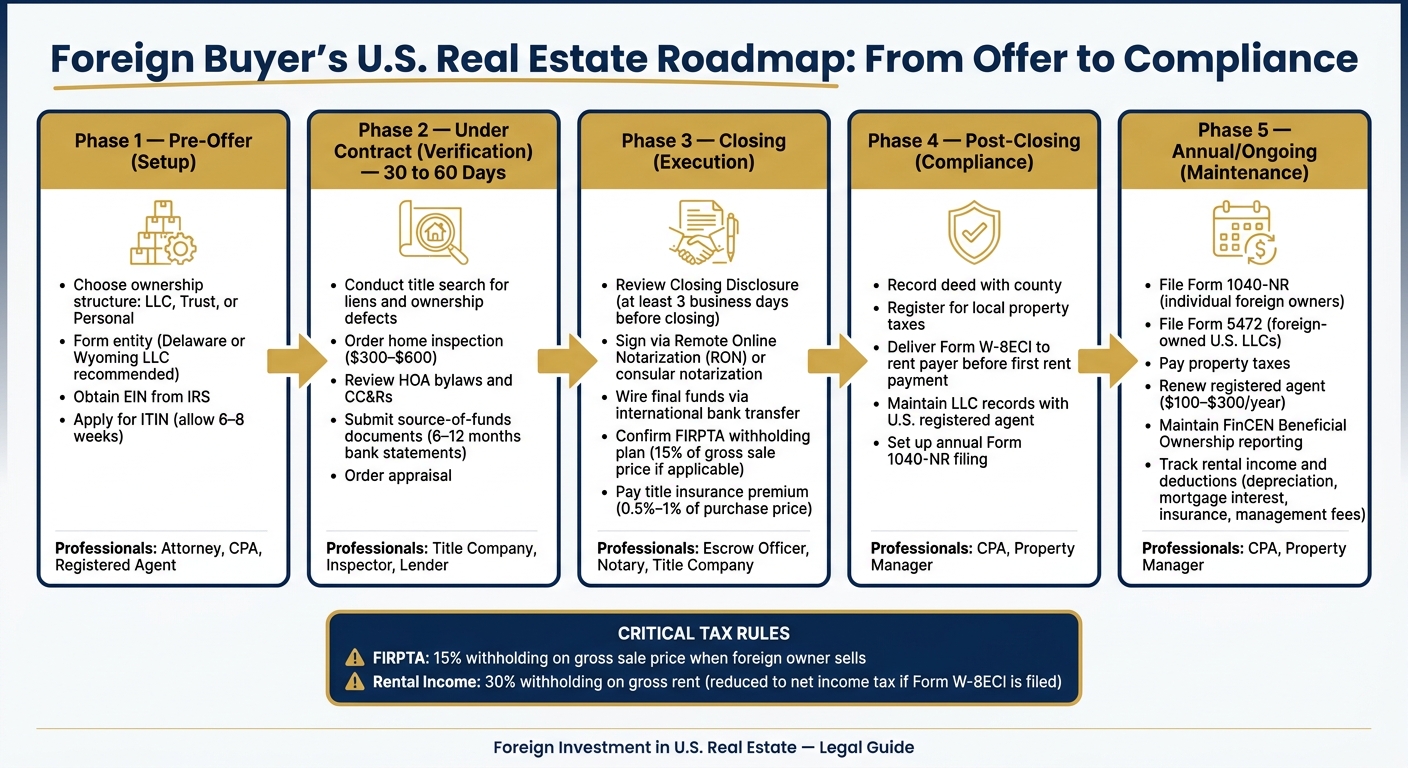
Foreign Buyer's U.S. Real Estate Roadmap: From Offer to Compliance
Once financing, FIRPTA, and reporting are mapped out, closing turns into a set of fixed steps. At that point, the main risk is timing. If one item slips, contract signing or closing can get pushed back. That’s why it helps to form the entity before making an offer, not after.
The table below shows each phase, the main tasks involved, and the people usually handling them:
| Phase | Legal & Administrative Tasks | Tax & Source-of-Funds Tasks | Primary Professionals |
|---|---|---|---|
| Pre-Offer | Choose structure (LLC, trust, or personal ownership); form entity; obtain EIN | Apply for ITIN | Attorney, CPA, Registered Agent |
| Under Contract | Title search; review state disclosures; order inspection | Submit source-of-funds docs; order appraisal | Title Co., Inspector, Lender |
| Closing | Review Closing Disclosure at least 3 business days before closing [6]; sign via RON or consular notarization | Wire final funds by international bank transfer; confirm FIRPTA plan | Escrow Officer, Notary, Title Company |
| Post-Closing | Record deed; register for property taxes; maintain LLC records | Deliver Form W-8ECI to rent payer; set up annual Form 1040-NR filing | CPA, Property Manager |
| Annual/Ongoing | Renew registered agent; track lease records | File Form 1040-NR; pay property taxes; maintain FinCEN BOI reporting | CPA, Property Manager |
A simple way to think about it: pre-offer is setup, under contract is verification, closing is execution, and post-closing is compliance. Each phase has its own paperwork, and missing even one piece can create friction.
After the deed is recorded, the focus shifts from getting the deal done to staying compliant year after year. One of the first tax steps is delivering Form W-8ECI to the rent payer before the first rent payment. Miss that window, and tax handling can get messy fast.
From there, the job is mostly recordkeeping and annual filings. That includes registering for local property taxes, keeping LLC records with a U.S. registered agent, and tracking rental income along with deductible expenses such as depreciation, mortgage interest, property taxes, insurance, and management fees.
The filing rules depend on how title was held. LLC owners need to keep a registered agent in place and file Form 5472 if applicable [4]. Individual owners, by contrast, file Form 1040-NR each year [4].
Good records do more than help at tax time. They also make it much easier to deal with refinancing, audits, ownership changes, or a later sale.
The safest path is straightforward: choose the ownership structure early, clear title and zoning before going under contract, plan for FIRPTA, document funding, and keep post-closing filings up to date.
For most foreign buyers, a U.S. LLC is usually the best way to hold property. It gives you asset protection, and lenders are often more comfortable with an LLC than with a buyer holding title in their own name.
That said, an LLC does not automatically remove U.S. estate tax exposure for non-U.S. owners. So while it’s often the right starting point, the best setup may still call for tailored international tax planning. In some cases, that means using a more advanced blocker structure.
Plan your exit early. Under FIRPTA, the buyer usually has to withhold 15% of the gross sale price.
That doesn’t always mean you’ll owe that full amount in the end. With solid tax planning, the withholding may be reduced through steps like LLC structuring or tax treaty elections. And if your actual U.S. capital gains tax is lower, you may be able to get some of that money back by filing the right U.S. tax return.
This is one area where getting help upfront can save a lot of pain later. Work with a U.S. tax attorney or CPA who has direct experience with FIRPTA.
Before you make an offer, get your U.S. investment setup in place and handle the basic compliance work first.
That usually means:
If you expect U.S. rental income, get an ITIN early. It can save time and make the tax side less of a scramble later.
You should also plan ahead for title review, inspections or appraisals, and FIRPTA exit-withholding. These items can affect timing, paperwork, and how smoothly the deal moves once you're under contract.