Published on
July 22, 2026


If I had to cut this down to one line, it would be this: blockchain works best for fraud when more than one party needs the same record, the same checks, and the same audit trail.
If you’re comparing options, I’d look at where the fraud starts first. In this article, that means five paths: payment monitoring, identity/KYC-AML, invoice validation, claims review, and smart contract rules. Each one targets a different problem, from synthetic identity fraud to duplicate invoice financing to duplicate insurance claims.
A few points stand out fast:
The tradeoff is simple: the more parties involved, the more setup, data rules, and privacy work you need. And blockchain still does not prove off-chain facts by itself. It can show that data matched, changed, or conflicted. It can’t show that a shipment shipped or a loss event happened.
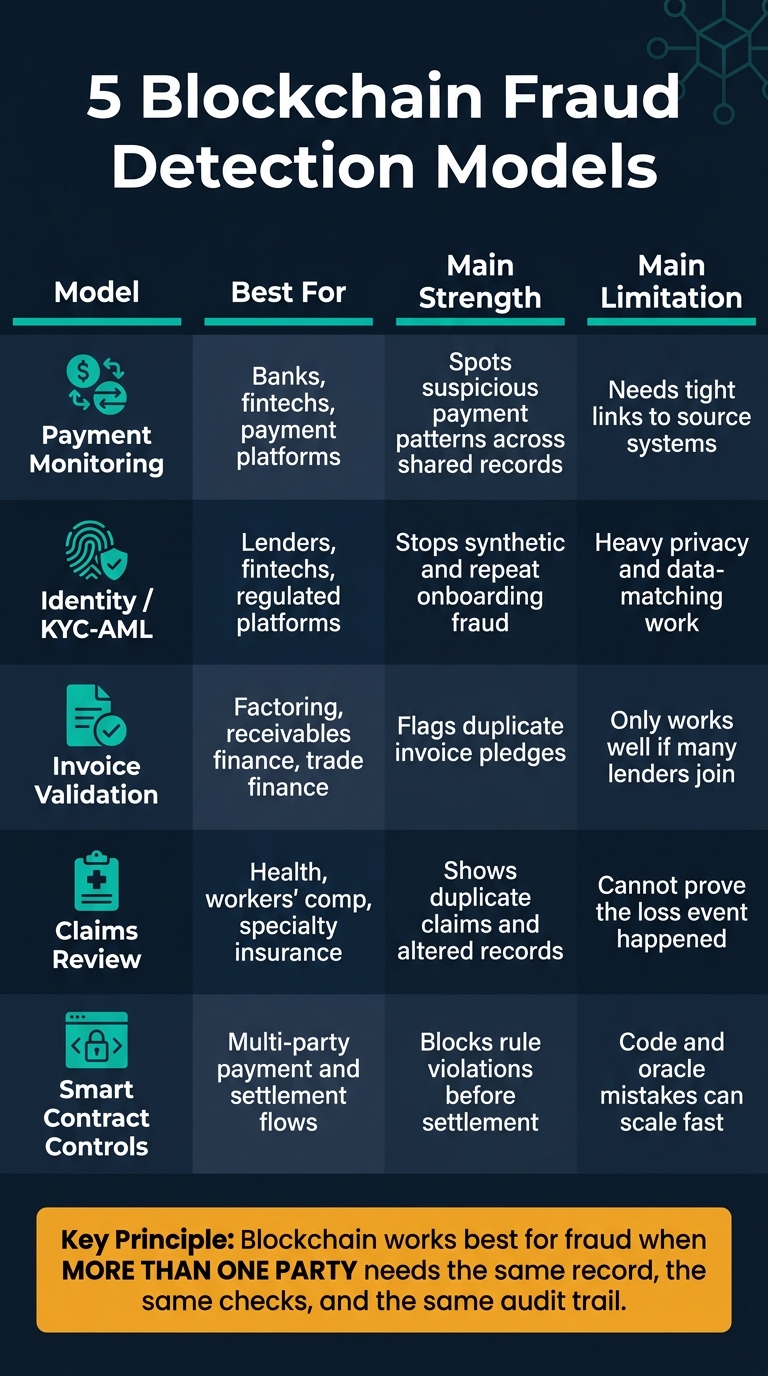
5 Blockchain Fraud Detection Models: Quick Comparison Guide
| Model | Best for | Main strength | Main limit |
|---|---|---|---|
| Payment monitoring | Banks, fintechs, payment platforms | Spots suspicious payment patterns across shared records | Needs tight links to source systems |
| Identity / KYC-AML | Lenders, fintechs, regulated platforms | Helps stop synthetic and repeat onboarding fraud | Heavy privacy and data-matching work |
| Invoice validation | Factoring, receivables finance, trade finance | Flags duplicate invoice pledges | Only works well if many lenders join |
| Claims review | Health, workers’ comp, specialty insurance | Shows duplicate claims and altered records | Can’t prove the loss event happened |
| Smart contract controls | Multi-party payment and settlement flows | Blocks rule breaks before settlement | Code and oracle mistakes can scale fast |
What I like about this framework is that it keeps the decision grounded in plain business questions: Where is the loss happening? What data can you govern now? And do you need a shared network or just tighter internal controls?
That’s the lens I’d use for the rest of the piece.
Use this model when the fraud signal sits inside the payment flow, not in identity checks or document review.
Payment monitoring on a shared blockchain ledger can catch fraud that siloed systems often miss. Because authorized parties look at the same transaction trail, issues like underpayments, misallocated funds, late payments, and phoenixing - when a company shuts down to evade liabilities and relaunches under a new name - can show up much sooner.
That said, this model has limits. It does not verify eligibility, clean up bad source data, or fix cash-flow issues before payment.
Payroll and payment systems need to connect directly to the ledger so obligations and actual transfers can reconcile in near real time. Just as important, governance needs clear rules around:
If those rules are fuzzy, the system can create confusion instead of control.
From an operations standpoint, this model shifts teams away from batch reporting and toward continuous exception alerts, direct system integration, and fast exception handling. In plain terms, you’re moving from “check later” to spot problems as they happen.
This model fits best in mandatory retirement systems such as 401(k) plans, where payment transparency is often low and manual complaints tend to surface problems late. It works best in payment-heavy workflows where the ledger itself acts as the main control point.
Use this model when fraud shows up in the payment rail itself. If the risk starts earlier, during onboarding, identity verification is the better fit.
When fraud begins at onboarding instead of in the payment rail, identity verification becomes the first line of defense. This model makes sense when risk shows up before any payment is sent.
Blockchain-based identity verification can help stop synthetic identities, repeat onboarding, and reused credentials across institutions. But the ledger only does its job when off-chain identity and payment records point back to the same verified source.
The main challenge is linking verified identity records to off-chain payment and onboarding data. In plain English, the ledger has to connect with onboarding, payroll, and payment systems so exceptions show up early, not after money has already moved.
This model calls for system integration, not just policy updates. Identity checks need to run in real time across both onboarding and payment workflows, which means the setup has to work across multiple systems at once.
This approach works best for banks, lenders, fintechs, and payroll-heavy platforms supported by fractional CFO services that deal with repeat onboarding risk. After identity is verified, the next control point shifts to document integrity, which is where invoice validation comes in.
After identity checks, invoice fraud becomes the next place to lock things down. In trade finance and factoring, the same invoice can be pledged to more than one lender. That means a borrower can pull funding from each lender while leaving all of them exposed. This setup works best when the invoice itself is the main point of risk.
Lenders hash core invoice fields - invoice number, issuer ID, debtor ID, amount, and due date - and write that hash to a permissioned ledger [6][8]. When another lender checks the same invoice, they can see whether it has already been financed somewhere else. If someone changes the invoice, the hash changes too, which helps flag tampering [6][8].
Smart contracts can also block a second financing attempt when an invoice is already marked as pledged on-chain [7][9]. That said, hashing has a limit: it can't prove the underlying transaction ever happened. So shell invoices can still get through. And this only works as well as the network behind it. If lenders don't write to the ledger, coverage has gaps.
Consortium-led networks tend to work better here because duplicate detection depends on broad lender participation [2][3]. If only a small group joins, the system misses too much.
Data format matters too. Invoice IDs, amounts, and dates need to be standardized across participants so the hashes match the same way every time [8][10]. If one lender writes $25,000.00 and another stores the same invoice in a different format, the check can fall apart.
The practical work is pretty straightforward: connect ERP, invoicing, and loan-origination systems to the network through APIs, then run hash checks inside the approval flow. That way, teams don't have to jump into a separate tool every time they review a deal.
The World Blockchain Trade Consortium (WBTC) built a tool called Invoice Check to cross-reference invoices before financing is approved [1][4][5]. Phoenix Strategy Group can help map invoice data to shared standards and quantify the case in U.S. dollars.
This model fits best for manufacturers, distributors, logistics firms, and B2B services that finance receivables on a regular basis. In most cases, lenders on the other side get the biggest upside.
For low-volume firms or businesses that work with only one lender, the cost often outweighs the payoff. And if fraud starts shifting away from documents and toward loss events, it makes more sense to move to blockchain-based claims review.
When fraud shifts from paperwork to the loss event itself, the focus changes too. It’s no longer just about whether a file was altered. It’s about whether the claim can be trusted.
Blockchain gives you a tamper-evident trail. Claim date, amount, provider ID, and review events can be hashed and anchored on-chain. That helps flag altered documents, timeline conflicts, and duplicate claims.
But there’s a limit here. Blockchain can show whether claim records were changed. It cannot prove that the loss event happened in the first place. So if someone submits a claim for a procedure that never took place, that claim can still pass through if the first submission looks clean.
HIPAA makes PHI a poor fit for a distributed ledger. That’s why a hash-only setup makes sense: keep patient data off-chain, and store only claim-event fingerprints on-chain.
For this to work, insurers, third-party administrators (TPAs), and regulators need to agree in advance on two things:
The validator layer should also stay permissioned, with nodes run by insurers and regulators.
In February 2026, ADI Foundation and Apeiro completed the first phase of a blockchain audit layer for healthcare claims, with stress tests reaching 15,000 transactions per second [11].
The simplest way to use blockchain here is as a proof layer on top of current e-claims portals. Claims platforms connect by API, hash-triggering events are defined upfront, and the ledger runs quietly in the background.
That setup gives auditors and regulators a live way to check claim integrity instead of waiting months for a manual review.
This approach fits best in areas like health insurance, workers' compensation, and other high-volume specialty lines where document tampering or duplicate claims show up often.
It’s less useful in low-volume lines, where fraud is more likely to involve complicated misrepresentation that a hash record won’t catch.
When fraud needs to be stopped before payment logic runs, the next control point is smart contract automation.
Earlier models detect fraud. Smart contracts aim to stop it before settlement.
They do that by enforcing payment, approval, and compliance rules on-chain. If a required condition isn't met, the transaction simply doesn't go through.
Smart contracts work well for rule-based controls such as payment rules, approval thresholds, settlement conditions, and compliance checks. They can also enforce multi-party approval requirements, certification checks, and token issuance rules automatically on-chain.
For payroll-linked workflows, they can flag missed contributions at the next ledger event.
What can't they do? They can't confirm off-ledger facts like damaged goods or made-up losses. Those cases still need manual review and legal action.
Keep PII, large files, and business logic that changes often off-chain. On-chain, store only hashes, timestamps, approvals, and rule outcomes.
Governance has to be set before any code is written. That means all parties need to agree on:
This is the most technically demanding model. It requires node management, key custody, permissions, and close integration with ERP and identity systems.
Smart contract controls make the most sense in multi-party settings where reconciliation is expensive and no one party is trusted to hold the single source of record. Supply chain, healthcare, and capital markets are the clearest examples.
For internal-only workflows, blockchain is often overkill. Use it only when multiple parties need the same rules and the same record.
That leads into the next section's comparison of speed, cost, privacy, and control strength.
These five models deal with different kinds of fraud. So the best pick comes down to a few plain questions: Where does the risk begin? Do outside parties need to share data? And how much integration work can you handle? The table below trims that down to four decision points: coverage, governance, complexity, and fit.
| Model | Fraud Coverage | Data & Governance Requirements | Implementation Complexity | Best Business Fit |
|---|---|---|---|---|
| Payment Monitoring | Real-time transaction anomalies, velocity patterns | Transaction-level data; best for internal or permissioned networks | Moderate–High (ML + data pipelines) | Banks, fintechs, payment processors, neobanks |
| Identity / KYC/AML | Synthetic identities, account opening fraud, money-mule onboarding | PII-heavy; requires privacy-preserving consortium design | High (cryptographic protocols, regulatory alignment) | Banks, broker-dealers, fintech lenders |
| Invoice Validation | Duplicate financing, invoice manipulation | Standardized invoice data; multi-lender participation | Moderate (hashing + ledger queries; consortium formation is the hard part) | Asset-based lenders, factoring companies, supply chain finance |
| Claims Review | Inflated or duplicate claims, cross-carrier fraud | PHI-heavy; carrier sharing under HIPAA and state rules | Moderate–High (core system integration, state insurance law) | P&C and health insurers |
| Smart Contract Controls | Rule violations, threshold breaches, sanctions hits | Hashes, approvals, and rule outcomes on-chain; PII off-chain | High (node management, key custody, governance rigor) | Supply chain finance, treasury controls, and insurance workflows |
The table gives you the big picture. Here’s what tends to matter most once teams move from theory to rollout.
Real-time prevention vs. event-driven detection. Payment monitoring and smart contract controls are strongest when the goal is near-real-time prevention. They step in while money, approvals, or rule checks are still in motion. Identity verification sits even earlier in the flow, stopping bad actors at onboarding before they can do damage.
Invoice and claims models work more like a checkpoint. They catch fraud when financing is requested or when a claim is submitted. That timing difference matters. If your fraud problem starts inside payment flows, internal payment controls usually make the most sense for banks and fintechs. If the problem shows up across firms, consortium-based models tend to fit lenders and insurers better.
Consortium dependency and privacy burden. Identity, invoice, and claims models lean on shared participation across institutions. If only one party joins, the upside is limited. Decentralized KYC is a good example: it can cut repeat verification in a big way, but only when multiple institutions accept the same proof.
Payment monitoring and smart contract controls have an easier starting point because they can go live before outside partners come in. That can make them a better first move for teams that want a narrower launch.
Privacy is the other big dividing line. Identity workflows carry the heaviest burden because they involve PII, biometrics, and credentials. Claims workflows bring PHI into the mix. In both cases, teams need to keep only hashes and proofs on-chain under U.S. BSA, FinCEN, HIPAA, and state insurance rules. Payment, invoice, and smart contract models can rely on hashed or masked data, which means less regulatory exposure and, in many cases, less friction during setup.
Each model tackles a different fraud issue. And each one brings its own costs, limits, and tradeoffs. That becomes a lot more important once you stop comparing options on paper and start planning an actual rollout.
| Model | Key Pros | Key Cons | Best For | Main Risk or Limitation |
|---|---|---|---|---|
| Payment Monitoring | Stronger transaction visibility; integration with shared ledger surfaces cross-institution patterns | Integration burden with legacy payment systems; throughput limits on public chains | Fintechs, payment processors, and other high-volume payment businesses | Incomplete fraud signal if off-chain activity can't be linked to on-chain records |
| Identity / KYC–AML | Cuts repeated verification across institutions; deployments have reported lower payment fraud | Privacy constraints; rules remain unsettled; high governance complexity | Regulated platforms and consortium networks | Value drops sharply if few institutions accept the same identity standard |
| Invoice Validation | Enables fast duplicate detection without exposing invoice details | Requires broad consortium participation; ERP integration adds operational complexity | Suppliers, lenders, and enterprise procurement teams | Legitimate invoice variations can trigger false flags, so human review is still required |
| Claims Review | Creates a shared audit trail for claims review; one 14-state rollout reported a 34% reduction in fraudulent certificate incidents and an 89% reduction in verification time, from 24–48 hours to under 60 seconds [13] | Sensitive claims data; standardization across carriers is difficult; false positives can delay legitimate payouts | Insurers, reinsurers, and claims administrators | Poor model calibration can create high false positive rates; one legacy system ran at 62% before tuning [12] |
| Smart Contract Controls | Blocks rule violations before funds move | Smart contract bugs can create irreversible losses; high governance rigor required | Tokenized systems, digital asset platforms, and workflows that benefit from real-time rule enforcement | Oracle errors or coding defects can scale bad decisions instantly |
Three variables shape the decision more than anything else:
Identity verification and claims review come with the biggest privacy load. That usually means more compliance work up front before the fraud-detection gains show up.
Invoice validation and identity models both depend on broad adoption across the network. If suppliers, banks, carriers, or counterparties aren't using the same setup, the fraud signal gets thin fast. Put simply, the system is only as useful as the number of participants feeding it.
Smart contract controls can be powerful because they stop bad actions before money moves. But that power cuts both ways. One logic mistake, one bad oracle input, and the system can enforce the wrong rule at scale in seconds.
The false positive issue also deserves its own spotlight. If controls are too sensitive, teams pay for it in other ways. Good payments get blocked. Valid claims sit in limbo. Staff ends up reviewing edge cases by hand. Blockchain can improve data quality and make audits much easier, but it won't fix a badly tuned detection model by itself.
For teams pressure-testing budget and implementation scope, Phoenix Strategy Group can help growth-stage teams weigh fraud-loss reduction against build cost and integration scope.
Pick the model that lines up with your highest-loss fraud pattern, then test that choice against your workflow and data readiness.
After weighing fit and tradeoffs, use a simple rule for your first move: start with the fraud category that costs you the most and the data domain you can already govern. If your data and controls are ready, that’s your first model. If they aren’t, fix those gaps before you commit to a build.
Once one use case shows value, expand into nearby controls. The best model is the one that fits three things at the same time: fraud type, data availability, and governance capacity.
When the first model is live, use those results to make the case for the next control layer. Phoenix Strategy Group can help quantify ROI and choose the first blockchain fraud-control model.
For most businesses, it makes sense to start with core policies based on AML and KYC standards. Since blockchain transactions can't be reversed, begin with a modular, risk-based setup and solid compliance from day one.
Start with the basics, like OFAC sanctions screening and recipient identity checks, before you layer in more advanced blockchain-specific models.
Blockchain makes the most sense when you need immutable, tamper-proof records. Once data is written, changing it or deleting it without approval becomes far harder. That gives you a permanent, transparent audit trail, which can make suspicious activity easier to trace.
It can also help cut chargeback fraud because settlement is final. And with smart contracts, teams can automate compliance checks and payment triggers, which helps reduce human error and manual oversight.
Sensitive information should stay off-chain. That includes personal customer data, invoice details, and any business ID information that could expose private records.
Blockchain can still hold the parts you need for a clear, immutable trail, such as transaction hashes, timestamps, and wallet addresses. Think of it as keeping the proof on-chain, while the private paperwork stays behind locked doors.
PII and detailed supporting documents belong in secure internal systems, like an ERP or Treasury Management System. This setup helps protect privacy, support security, and meet regulatory compliance needs, while still making verification and auditing possible.