Published on
July 21, 2026


Payment reconciliation is no longer just back-office cleanup. It now has a direct link to cash flow, denial follow-up, and revenue loss.
From what I see in this research, the main takeaway is simple: manual payment posting is too slow and too error-prone for the current healthcare payment mix. Errors touch 5% to 10% of claims, missed underpayments can trim 3% to 8% of annual net revenue, and average denial rates hit 11.8% in 2026.
If you want the short version, here it is:
This summary looks at reconciliation across:
It focuses on the parts of payment posting that affect revenue cycle teams most:
Here’s the bigger picture in plain English: healthcare payments now come from more places, with more denials, more patient responsibility, and less room for posting delays. That is why many provider groups are looking for tools that match deposits, remits, and ledger activity with less hand work and better exception tracking.
A few numbers stand out:
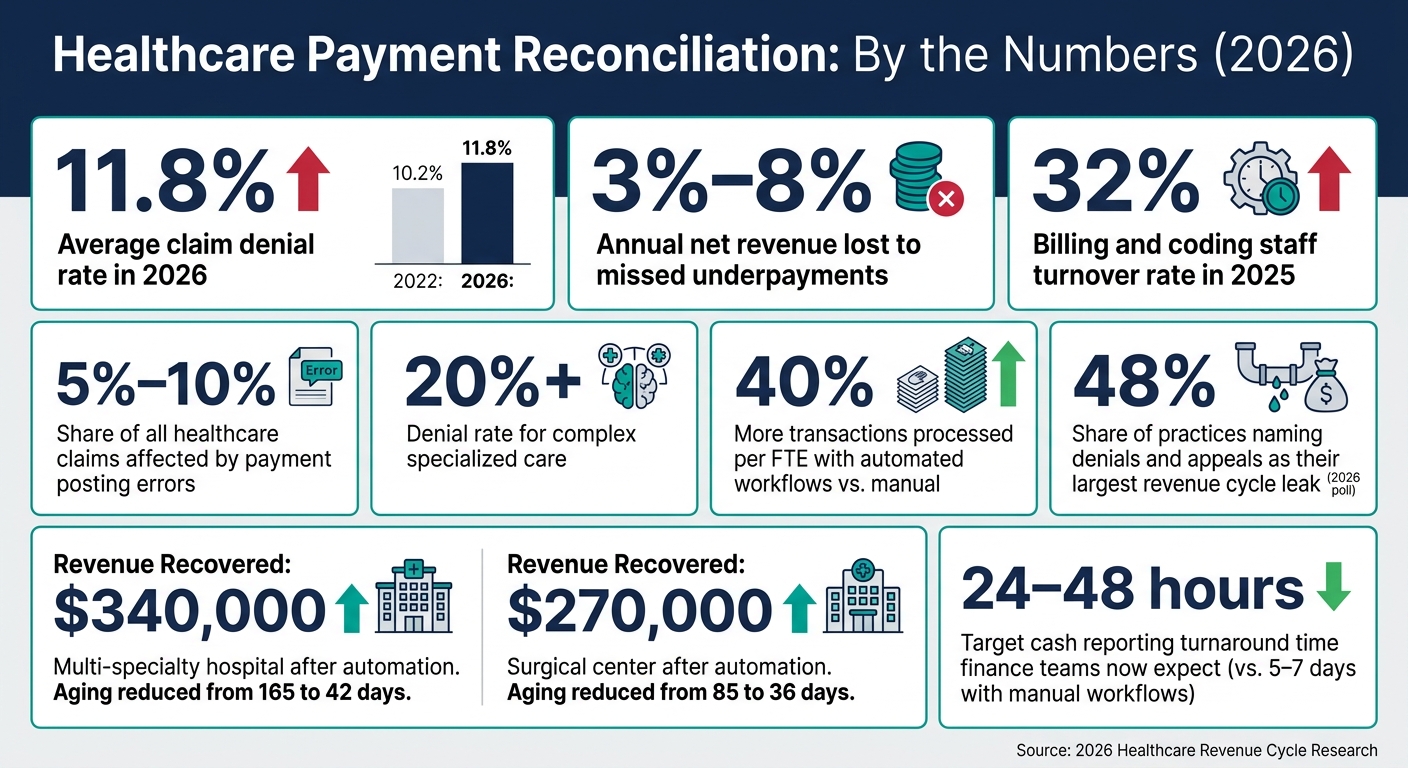
Healthcare Payment Reconciliation: Key Stats & Revenue Risk in 2026
| Area | What the research shows |
|---|---|
| Main problem | Manual posting slows cash reporting and increases errors |
| Revenue risk | Underpayments and write-offs can drain 3% to 8% of net revenue |
| Denial trend | Average denial rate reached 11.8% in 2026 |
| Staffing pressure | Billing/coding turnover hit 32% in 2025 |
| Buyer focus | Auto-posting, exception queues, underpayment checks, and system connections |
| Market direction | Less hand entry, more live visibility, and earlier issue flags |
So if you work in finance or revenue cycle, the message is clear: the value of reconciliation now goes far beyond posting cash. It shapes reporting accuracy, A/R visibility, patient billing, and forecast quality.
Healthcare payments come in from all directions: ERA files, paper EOBs, and patient payments. When there's no automation in place, staff have to post all of that by hand. That means more work, more pressure on billing teams, and more cost. It's one reason many organizations are moving toward automated tools or outside support [1][3]. They want systems that can auto-post payments, flag exceptions, and speed up reconciliation.
The stakes are high. Payment posting errors affect an estimated 5% to 10% of all healthcare claims [1]. On top of that, missed underpayments can eat away 3% to 8% of a practice's annual net revenue [1]. Denials are also moving in the wrong direction: the average claim denial rate reached 11.8% in 2026, up from 10.2% in 2022, and denial rates for complex specialized care went past 20% [6]. When teams track CARC and RARC at the line-item level, they can spot repeat denial patterns early instead of letting them pile up [1].
Matching EFTs adds another layer of work. Payers often send bulk payments that cover multiple patients, which makes it hard to tie those payments back to ledger totals [1]. At the same time, providers want 24- to 48-hour turnaround times so cash reports show what's happening now, not what finished posting 5 to 7 days later [1][2].
"Payment posting is the absolute foundation of truth in your revenue cycle... If someone delays or does this step incorrectly, your entire revenue cycle stalls." - Phoenix Virtual Solutions Editorial Team [1]
From a market view, this work falls under the broader revenue-cycle software space. Healthcare stands apart because payments are split across many sources, which makes reconciliation harder than it looks. As of 2024, the vendor market was still highly fragmented, with no single group of players controlling it [4].
There's also a shift in who pays. As deductibles keep climbing, patients now make up a larger share of payment volume. That leads to more copays, installment plans, and patient portal payments that teams must match against bank deposits [5]. Those signals are shaping the features vendors build and the kinds of products they bring to market.
Manual reconciliation is slow by nature. Staff have to key in paper EOB details line by line - payments, adjustments, and patient responsibility - and one small slip can turn into an error that's tough to track down. When things get busy, payment posting often gets pushed aside, backlogs pile up, and month-end reports are already stale [1]. That delay doesn't just create extra work. It also warps month-end reporting and increases write-off risk.
Labor swings make the problem worse. Rising labor costs and staff turnover are making in-house manual reconciliation more expensive and less predictable [1]. Automated workflows show a clear gap here: they can process 40% more transactions per FTE than manual industry averages [2]. That's a big reason provider expectations around reconciliation software have changed.
The same delays that slow posting also make underpayments easier to miss. Manual posting errors lead straight to revenue leakage. If teams aren't consistently comparing allowed amounts on ERAs against contracted fee schedules, contract variances can get missed, and short-pays can slip into write-offs without review [1]. Missed contractual adjustments can also hold up secondary and tertiary claims [1]. Over a full year, those undetected underpayments can drain 3% to 8% of a practice's annual net revenue [1].
Manual workflows fall behind on speed, accuracy, and review frequency. Automated workflows, on the other hand, help recover revenue faster and cut down on error exposure. The 2026 case studies make that plain:
That's why finance teams now put more weight on faster posting, exception flags, and underpayment detection when choosing vendors. It's also pushing demand toward tools with stronger automation, exception handling, and underpayment review.
As reconciliation pressure climbs, vendors are breaking into clearer product groups. At the same time, they’re moving past basic posting and into broader automation.
The reconciliation software market falls into four categories.
| Category | Primary Scope | Main User | Workflow Stage |
|---|---|---|---|
| RCM Service Providers | Insurance posting, Denials, Underpayments | Billing Managers, AR Teams | Back-end (Post-service) |
| Patient Pay Platforms | Self-pay, Deductibles, Payment Plans | Patients, Front-desk Staff | Pre-service & Post-service |
| Automation Tools | Variance Detection, Exception Handling | Finance Leaders, Billing Teams | Mid-cycle |
| EHR Modules | Basic Posting, Estimates, Portals | All Staff, Patients | Baseline full-cycle support |
These categories divide the market by payment source, workflow stage, and how much automation a tool can handle. EHR modules usually cover basic posting, but advanced exception handling still sits outside their main scope.
Across all four groups, buyers are paying less attention to the label on the product. What matters now is simpler: does it cut manual posting and reduce exception review?
Providers now expect a core feature set out of the box. That includes ANSI 835 ingestion, paper EOB digitization, auto-posting, and matching across deposits, remittances, and the ledger. It also includes exception queues, line-item CARC/RARC capture, and integrations with EHRs, practice management systems, clearinghouses, and general ledgers, plus HIPAA, PCI DSS, and SOC 2 Type II compliance.
Once a platform handles baseline posting, the race shifts. Vendors are now trying to stand out with faster exception handling and earlier leak detection.
The big shift is from reactive posting to proactive exception handling and prevention. In plain English, newer tools aim to catch underpayments and mismatches before they turn into write-offs.
| Feature Dimension | Traditional Tools | Newer AI-Driven Tools |
|---|---|---|
| Payment Support | Manual EOB entry, basic ERA auto-posting | AI document reading for paper EOBs, automated variance detection |
| Exception Handling | Manual review of denied or mismatched claims | Predictive denial analytics, automated appeal generation |
| Analytics | Monthly PDF reports on collection rates | Real-time dashboards for posted vs. unposted cash and denial trends |
| Integration Effort | Standard EHR/PMS API or VPN connections | Autonomous AI agents with real-time documentation prompts that check CPT and ICD-10 codes against clinical notes |
That change matters because the old model waits for a problem to show up in posting. The newer model tries to flag the problem earlier, while there’s still time to act on it.
Taken together, these findings show that payment reconciliation has shifted from a back-office task to a core driver of cash visibility, revenue integrity, and reporting accuracy. When reconciliation data isn’t clean, A/R reports can overstate cash or misclassify patient balances. That creates downstream issues across financial reporting and patient billing [1].
The market data points to a few clear takeaways that finance leaders should act on. Manual workflows are expensive. Posting errors affect 5% to 10% of claims, and missed underpayments can cut annual net revenue by 3% to 8% [1]. In a 2026 poll, denials and appeals were named the largest revenue cycle leak by 48% of practices [3].
That helps explain where the market is headed: earlier detection, less manual review, and tighter system connectivity. The tools that matter most don’t just post payments. They also send clean data into cash forecasting, FP&A, and M&A readiness.
For growth-stage healthcare companies, reconciled payment data leads to cleaner forecasts, better FP&A, and stronger exit readiness.
Manual payment posting is risky because it leans on repetitive data entry. And when people do the same task over and over, mistakes slip in. Staff might apply the wrong contractual adjustment or enter the wrong patient responsibility amount.
Those errors can lead to revenue leakage, ghost revenue, patient frustration, backlogs, inaccurate financial reporting, and missed payer underpayments that automated reconciliation tools might catch.
Poor reconciliation can leak revenue when manual, error-prone work fails to track money the right way. That shows up in a few painful places: contractual adjustments get applied to the wrong accounts, balances get written off instead of billed, and daily deposits don’t line up with posted amounts.
It also lets payer underpayments slip through the cracks. In many cases, those underpayments add up to 3–8% of annual net revenue and end up buried in unreviewed write-offs, which creates losses that are easy to miss until the damage is done.
Prioritize tools with ERA automation so insurance payments are matched to claims and bank deposits automatically.
Also look for integration with your practice management or EHR system for real-time sync. And make sure the tool captures CARC and RARC codes at the line-item level for accurate denial tracking and underpayment detection.