Published on
August 26, 2026


Lenders don’t judge IP the way founders do. I’d sum it up like this: they care about what they could recover after a default, not what the IP helps produce while the company is still running.
Here’s the short version:
In other words: clean title, clean records, transferable rights, and steady cash flow usually matter more than a big headline valuation.
If I were preparing for an IP-backed loan, I’d focus on three things first:
Here’s a quick side-by-side view:
| Area | What lenders want to see | What hurts value |
|---|---|---|
| Ownership | Signed assignments, registry records, PIIAs | Missing founder or contractor assignments |
| Liens and rights | Clear UCC position, assignable rights | Prior liens, exclusive licenses, change-of-control limits |
| Legal status | Active registrations, paid fees, no live challenges | Lapsed rights, IPRs, trademark disputes |
| Revenue | Stable cash flow, low concentration, metrics tied to cash | Weak forecast support, high churn, one big customer |
| Recovery | IP that can be sold or licensed apart from the business | Internal know-how, weak buyer market, hard-to-transfer assets |
That’s the core issue in this article: lenders review IP like recovery property, not like a growth story.
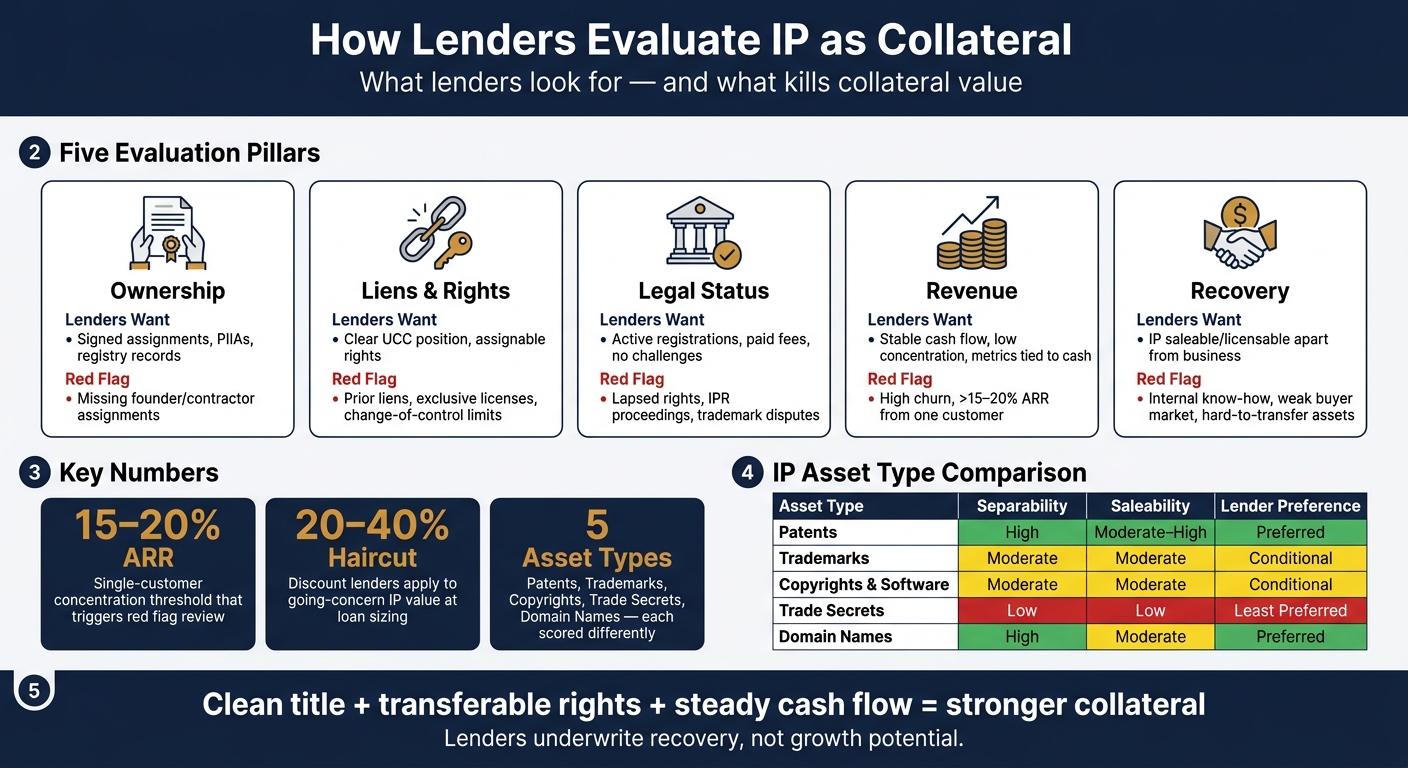
How Lenders Evaluate IP as Collateral: Key Criteria & Red Flags
Before accepting IP as collateral, lenders review title, rights, liens, and dispute risk. In plain English, they want to know one thing first: does the company actually own the asset it wants to pledge?
That process usually starts with proof of ownership. Then it moves to registration, scope, and whether anything could get in the way of enforcement or recovery.
The first question is ownership, not value.
Founder-, employee-, or contractor-created IP does not always belong to the company. That’s why lenders ask for PIIAs, assignment records, and registry filings that show the company owns the rights.
A common snag at early-stage companies is a missing or unsigned assignment agreement. If a founder never signed an invention assignment, title can stay with that person instead of the business. And if title is weak, the collateral is weak too.
Lenders also look for unrecorded transfers between affiliates, especially in cross-border moves. Those gaps can muddy the record and make enforcement harder.
Ownership is only part of the check. Lenders also review pre-existing liens and exclusive licenses. A prior UCC-1 filing can block a clean security interest. An exclusive license can shrink collateral value - or wipe it out entirely - for a given field or territory.
After title is confirmed, lenders check whether the rights are still valid and enforceable.
Once ownership is confirmed, lenders run searches across the USPTO for patents and trademarks, the U.S. Copyright Office, WIPO databases for international filings, and domain registries and WHOIS data. The goal is simple: confirm current status, paid maintenance, and no pending challenges.
Expired or lapsed rights can cut collateral value fast. Lenders also look at territorial coverage. A patent that is valid only in the U.S. may support domestic cash flow, but borrowers with multinational revenue need protection across more than one market.
Unregistered rights, such as trade secrets and proprietary source code, get a harder look. Lenders may still count them, but only if the company has strong internal controls in place, such as:
Without that proof, lenders underwrite trade secrets conservatively.
| IP Type | Primary Registry Check | Key Lender Concern |
|---|---|---|
| Patents | USPTO, WIPO (PCT) | Maintenance fees, validity, pending challenges |
| Trademarks | USPTO, WIPO (Madrid Protocol) | Renewal status, opposition proceedings, territorial coverage |
| Copyrights | U.S. Copyright Office | Registration status, ownership of record |
| Domain Names | WHOIS / domain registrar | Registrant match, transfer restrictions |
| Trade Secrets | No public registry; internal documentation only | Access controls, NDAs, security practices |
Once ownership and rights are clean, lenders move to cash flow and recovery testing.
Once ownership and rights are confirmed, lenders move to the tougher part: can this IP support debt repayment? That’s the lens they use. They’re not underwriting upside or betting on a big future exit. They’re underwriting repayment, collateral, and continuity. So the next step is simple in theory and tough in practice: test whether the cash flow can carry the loan.
For IP-heavy businesses, lenders usually care less about a headline valuation and more about repayment capacity. A big number in a pitch deck may sound good, but it doesn’t make the monthly debt service any easier to cover.
That’s why lenders often normalize EBITDA before they size the loan. They strip out owner compensation adjustments, personal expenses, and other items that may make earnings look better on paper than they are in day-to-day operations. The goal is to get to a cleaner view of what the business actually earns.
Lenders also often require an independent appraisal to establish collateral value. That gives them a third-party check on what the IP may be worth if things go sideways.
After they set a baseline, lenders start pushing on the forecast assumptions. They test renewal rates, churn, and the staying power of IP-driven revenue. Put plainly, they want to know whether revenue will still hold up if a few things go wrong.
Customer concentration is one of the biggest warning signs. Lenders typically treat any single customer representing more than 15% to 20% of ARR as a material concentration risk. If too much revenue depends on one account, the forecast can look fine right up until that customer leaves.
Beyond concentration, lenders also check whether reported revenue leaves a cash trail. They reconcile ARR or MRR against bank statements and cash deposits. In other words, they want the story in the metrics to match the money in the account.
If the numbers hold up on paper, lenders then turn to one more issue: whether legal risk could weaken recovery.
After cash flow testing, lenders move to a more practical question: would the IP still be worth something in a default? They care less about the headline valuation and more about enforceability. In plain English, they want to know if the IP can be defended, transferred, and sold if things go sideways.
Lenders treat enforcement history as proof, not background noise. If an IP asset has survived infringement cases, defended validity challenges, or produced steady royalty income, that tends to support collateral quality. If it has a pattern of losses or weak settlements, that cuts the other way.
The biggest red flags usually include:
When those issues stay unresolved, lenders may leave the asset out of the collateral pool or cut advance rates hard.[1][3]
Even when legal title is clean, that still doesn't settle the issue. Transferability matters too. An asset can look fine on paper and still be a poor fit for debt.
Clean IP can still fail as collateral if it can't be transferred or sold apart from the business. Lenders usually look at two simple tests: separability, meaning whether the IP can be transferred or licensed on its own, and saleability, meaning whether there is an actual buyer or licensing market.
A patent portfolio with clean assignments and documented third-party licenses is often easier to separate from the operating company than a brand tied closely to customer relationships or management know-how. The same goes for a trade secret buried inside an internal process. You can't just pull it out, hand it over, and expect a buyer to use it on day one.
If no buyer exists, the valuation doesn't do much work for lending. That's why lenders may apply a haircut of 20% to 40% of going-concern value when sizing loans against IP collateral.[2]
These differences show up clearly by asset type:
| IP Asset Type | Separability | Saleability | Legal Strength Considerations |
|---|---|---|---|
| Patents | High, with clean assignments | Moderate to high, especially for licensing and enforcement | Validity, claim scope, expiration, prior validity challenges |
| Trademarks | Moderate, because value is tied to goodwill | Moderate, often through brand or going-concern sales | Distinctiveness, registration status, ongoing use |
| Copyrights & Software | Moderate | Moderate, often through licensing and SaaS models | Authorship, assignment records, open-source exposure |
| Trade Secrets | Low, because they depend on internal processes | Low, because they are hard to transfer without context | Secrecy controls and dependence on internal processes |
| Domain Names | High | Moderate | Registration control, transferability, brand linkage |
So two companies can post the same revenue and still end up with very different collateral value. A software company with licensed patents and clean title is much easier to lend against than one whose value sits mostly in internal know-how that can't be transferred.
Once the loan closes, the lender’s focus changes. The deep review is done, but monitoring starts. From that point on, lenders keep an eye on the IP package to protect recovery value by watching for lapses, assignments, and weak reporting.
Borrowers need to stay on top of maintenance fees, renewals, and chain-of-title records so their rights remain current. That means the job doesn’t end with a clean closing package. Lenders look for complete, up-to-date records over time, because stale paperwork can chip away at collateral value.
Borrowers should keep lender-ready IP files current and complete. In practice, that usually includes:
Clean bookkeeping and solid forecasts also make lender reviews faster and less burdensome.
The goal is simple: keep collateral defensible, measurable, and current.
Lenders often put the most weight on trademarks because they tend to work as the main form of collateral.
That said, they don’t look at trademarks alone. They usually review the full IP mix, including patents, trade secrets, proprietary data, and digital assets such as domain names, website content, and social media profiles.
For tech companies, proprietary code and algorithms matter too. In plain terms, lenders care most about IP that helps drive cash flow, gives the business an edge, or makes it harder for competitors to break in.
Yes, trade secrets can qualify as loan collateral, but it depends on the lender.
Many lenders prefer registered rights, such as trademarks or patents. Still, some may accept trade secrets as part of a broader collateral package.
The catch is simple: a trade secret only has value if it stays secret. Because of that, lenders look closely at how well the information is protected. They’ll often review access controls, non-disclosure agreements, and records that show clear ownership.
Treat your IP with the same rigor you’d apply to physical collateral. Put together a master IP register that covers patents, trademarks, copyrights, trade secrets, software, and domain names. For each asset, spell out whether it’s owned, licensed, or jointly held, and flag any third-party dependencies.
Then verify the legal chain of title. Tie key assets to revenue and margins, track related costs, and keep the records organized in a secure virtual data room so lenders can review them during due diligence.