Published on
September 4, 2026


If you run more than one legal entity, you need separate local books, matched intercompany entries, and one clean USD consolidation process. Without that, local filings can drift from group reporting, audits take longer, and board numbers become less reliable.
I’d sum it up like this: keep each entity’s ledger clean in its own currency, map every local account to one group chart of accounts, track country deadlines, and reconcile intercompany activity before consolidation. That’s how you cut filing risk and shorten the close.
A 2025 benchmark cited in 2026 coverage found that 50% of finance teams take more than five business days to close, and 50% say Excel is a main reason. I see the lesson pretty clearly: when the process lives in spreadsheets, errors and delays pile up fast.
Here’s the article in plain English:
A simple way to think about it: local books support statutory filing, while group consolidation supports board and investor reporting. You need both, and they need to tie out.
| Area | What needs to happen | What goes wrong if it doesn’t |
|---|---|---|
| Entity books | Separate ledgers, bank recs, AR/AP, accruals, local close | Filing errors, messy rollups |
| Account mapping | Each local account maps to one group account | Gaps in consolidated reporting |
| Country rules | Track tax years, filing dates, payroll, VAT/GST | Late filings, tax mistakes |
| Intercompany | Match both sides of every related-party entry | Out-of-balance eliminations |
| Consolidation | Translate FX, eliminate balances, review variances | Slow close, weak board reporting |
| Audit trail | Keep support, approvals, and dated recs | More audit testing, more questions |
If I were setting this up from scratch, I’d start with the entity list, reporting hierarchy, account mapping, intercompany policy, and clear owners for each close step.
Each legal entity needs its own general ledger, bank accounts, and monthly close process. In plain terms, every subsidiary should keep its own books and close them on its own schedule before anything rolls up to the group level.
That means each subsidiary produces its own income statement, balance sheet, and cash flow statement in local currency, with USD used for group reporting. Before group consolidation starts, each entity closes its own books by reconciling bank accounts, accounts receivable, accounts payable, accruals, and intercompany balances.[1][2]
Once each entity has a clean close, you can roll those books into one group view without turning the process into a mess.
Use a group chart of accounts to map each local account to one consolidated reporting line. The local accounts stay in place for statutory filings, while the mapping table translates them into group-level lines for consolidated reporting.[3]
For example, a French entity can keep its local taxe sur la valeur ajoutée récupérable account for VAT filings, while the group reports one VAT receivable line across all entities.
To make that mapping work, you need to:
The mapping also needs a clear owner. If a new local account gets opened and no one maps it before the next close, reporting gaps show up fast.
That mapping is the link between local filing and consolidated reporting.
Each entity works under its own rules. That includes a local tax year, filing deadlines, payroll obligations, and indirect tax exposure.
Track each entity’s tax year, filing deadlines, payroll obligations, VAT/GST status, and where revenue is earned and where employees and assets are located. For U.S.-based founders, that also includes state sales tax and corporate income tax obligations.
A global close calendar should reflect the slowest jurisdictions so the group close stays on track. If one country has monthly VAT filings, that entity has to close indirect tax accounts on a tight schedule, and that can delay the broader group close.[4]
Those deadlines shape the timing for intercompany postings and the group close.
With entity books and country calendars in place, intercompany transactions can be recorded in a consistent way.
Once your entity ledgers are set up and country deadlines are mapped out, intercompany activity becomes the next place where things can go off track. And this is where many teams run into trouble.
Intercompany transactions are a common source of filing and consolidation mistakes. Every related-party charge needs a matching entry in both ledgers. If that doesn't happen, consolidation gets messy fast.
Each intercompany transaction should be booked as a mirror image in both entities.
Say Entity A charges Entity B a management fee. Entity A should record an intercompany receivable and fee revenue. Entity B should record an intercompany payable and management fee expense. That same mirror-entry rule should apply across all related-party activity.
The process usually breaks down when the entries don't line up. Maybe the posting dates are different. Maybe the account codes don't match. Maybe one entity books the transaction and the other never does. That's when reconciliation drags and elimination entries turn into a headache.
A cleaner approach is pretty simple:
That kind of consistency makes elimination entries faster and much cleaner during consolidation.
A tax memo by itself won't clean up the books. The policy has to show up in what gets booked: invoices, journal entries, allocation schedules, and period-end true-ups.
If actual activity comes in differently from the forecast, a true-up entry should fix the balance before close. That's the part that turns policy into booked numbers.
The charge also needs support for the pricing method and allocation basis. Tax authorities don't just look at what was charged. They look at how the charge was calculated. If the backup isn't there, the entry is hard to defend.
That ledger support also flows straight into local-file documentation and tax review.
The gap becomes pretty clear when you compare ad hoc booking with a more standardized process.
| Dimension | Ad hoc booking | Standardized booking |
|---|---|---|
| Audit risk | Higher - entries may not tie to agreements or support schedules | Lower - entries follow a repeatable process with documentation |
| Tax support | Weaker - pricing and allocation logic may be inconsistent | Stronger - transfer pricing logic is documented and traceable |
| Reconciliation time | Longer - manual matching and exception handling | Shorter - consistent account structures reduce exceptions |
| Close speed | Slower - unresolved differences delay elimination | Faster - balances are matched before close |
| Board-reporting reliability | Lower - consolidated results may include unresolved noise | Higher - eliminations and balances are controlled |
Use transaction-specific support for each type of intercompany entry:
Manual vs. Systematized Multi-Entity Consolidation: Key Differences
Once intercompany balances are matched, the close moves into translation, eliminations, and reporting. This is where a steady consolidation process matters. It turns separate entity books into board-ready financials without the usual scramble.
Start by collecting each entity’s trial balance, income statement, and balance sheet using the same cutoff date. Then line up all reporting periods so you’re working from one clean timeline.
Next comes foreign-currency translation. Convert results into U.S. dollars before you run eliminations. Under ASC 830, balance sheet items should use month-end spot rates, while income statement items should use average monthly rates.[6][7]
After translation, eliminate intercompany balances and transactions with a standard template that maps every debit and credit by counterparty. From there, check group totals against prior periods and budget, then prepare the consolidated income statement, balance sheet, and cash flow statement.
It helps to keep the process tight and visible:
Those workpapers aren’t just admin. They’re the backup behind the consolidated numbers.
Auditors, lenders, and board members need a clean line from the final numbers back to the source transactions. In practice, that means keeping three kinds of support in place:
Just as important, record who posted each entry, when it was posted, and why. That extra context can make the difference between a journal entry that looks thin and one that holds up in an audit or due diligence review.
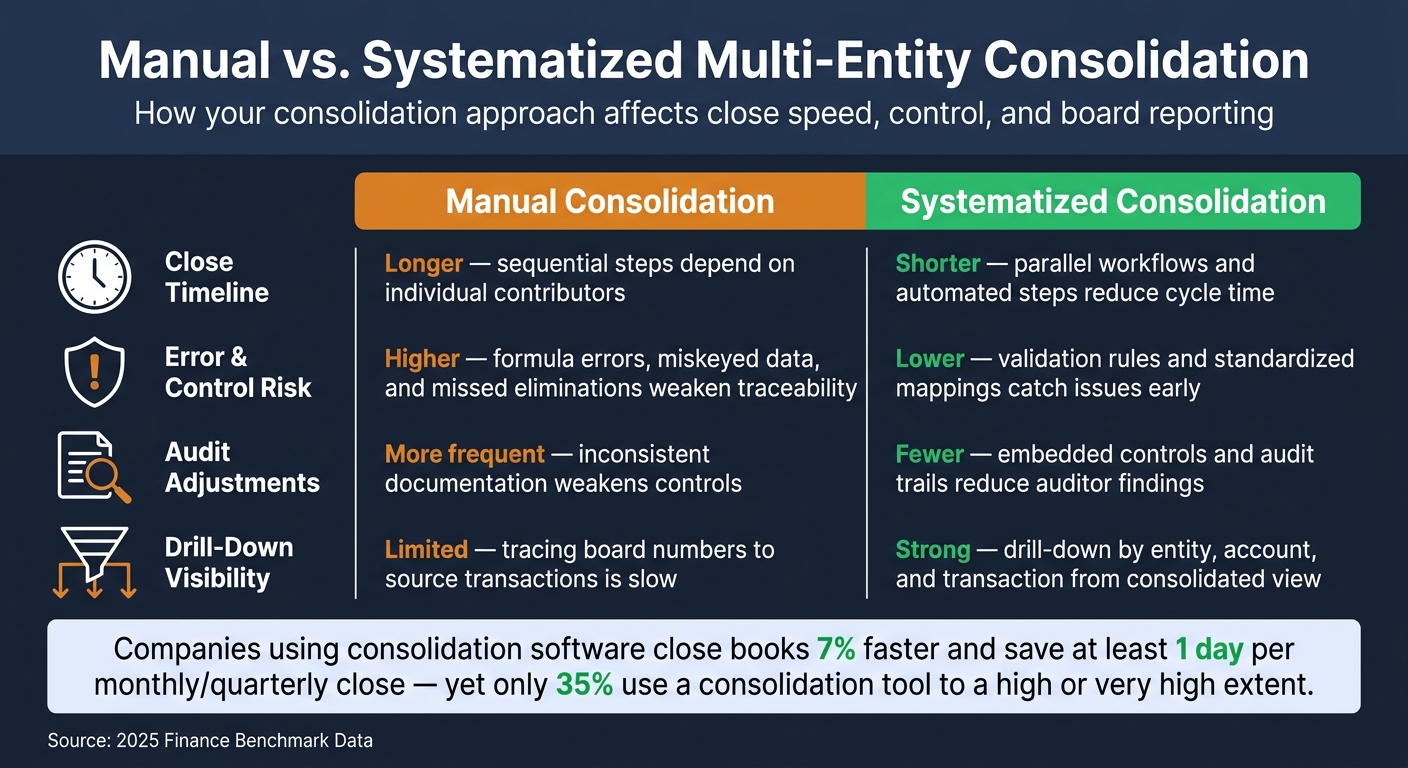
The gap between manual and systematized consolidation shows up fast in close speed, control, and drill-down visibility. Companies that use consolidation software instead of spreadsheets save at least one day in their monthly and quarterly close. They also close their books 7% faster than companies that rely on ERP alone.[8] Even so, only 35% of companies use a consolidation tool to a high or very high extent.[5]
| Dimension | Manual consolidation | Systematized consolidation |
|---|---|---|
| Close timeline | Longer - sequential steps depend on individual contributors | Shorter - parallel workflows and automated steps reduce cycle time |
| Error and control risk | Higher - formula errors, miskeyed data, and missed eliminations weaken traceability | Lower - validation rules and standardized mappings catch issues early |
| Audit adjustments | More frequent - inconsistent documentation weakens controls | Fewer - embedded controls and audit trails reduce auditor findings |
| Drill-down visibility | Limited - tracing board numbers to source transactions is slow | Strong - drill-down by entity, account, and transaction from consolidated view |
As the number of entities increases, a centralized model makes the close process and audit support easier to keep in sync.
Global compliance is much easier to handle when each entity keeps its books locally, intercompany activity follows the same rules, and consolidation runs through one repeatable process.
That setup makes local filings easier to defend, gives you a more predictable consolidation cycle, and helps you trace board numbers back to the source. As the number of entities grows, this structure matters even more.
Once you start adding entities, the choices you make early around entity roles, reporting hierarchy, and intercompany rules shape whether the close stays under control or turns into a monthly mess.
If your team is stretched thin, outside help can make the setup much smoother. Phoenix Strategy Group helps growth-stage companies build bookkeeping, FP&A, and CFO support for multi-entity reporting.
Once the operating model is set, move in this order.
Start by confirming your legal entity structure. List every entity, its jurisdiction, ownership, and role. Then define the reporting hierarchy so the board sees the business the way it actually operates, whether that view is by region, product, or function.
Next, standardize accounts across all entities with a group chart of accounts and clear mapping rules. After that, put a short intercompany policy in writing. It should cover what gets charged between entities, how pricing is set, how often entries are booked, and who approves them.
Last, assign a named owner for each entity’s monthly close, plus a named owner for group-level consolidation and reconciliation review. Clear ownership and firm deadlines help stop intercompany differences from holding up the close.
You need multi-entity books when your company grows beyond a single legal structure and starts running across subsidiaries, sister companies, or international units that each need their own financial records, plus combined reporting at the top.
It’s time to make the switch if you’re dealing with manual consolidation, messy intercompany reconciliations, more than one currency or fiscal calendar, local tax or reporting rules, M&A prep, or weak real-time visibility across the business.
Local books connect to USD consolidation through a unified chart of accounts that standardizes categories across entities. That gives companies room to meet local rules while still mapping regional data into one consistent reporting structure.
During consolidation, systems convert local currencies into USD, reconcile intercompany transactions, and remove duplicate entries so consolidated statements reflect performance in U.S. format, such as $1,234.56 and MM/DD/YYYY.
Start with a unified chart of accounts across all entities. That gives you the base for consistent reporting and compliance.
From there, standardize reconciliation schedules, naming rules, approval workflows, and the way teams handle common transactions. Before any system migration or integration, audit and clean your data so records use the same formats and can grow with fewer errors.