Published on
July 28, 2026


A tax treaty can cut withholding from the default 30% U.S. rate to 0%, 5%, 10%, or 15% - but only if the payment is put in the right tax bucket and the forms are ready before closing.
If I had to boil the article down, I’d say this: the tax result depends less on the headline sale price and more on what each payment is called under source-country tax law. A share sale, redemption, earn-out, seller note, or IP payment can each trigger a different rule. If the seller misses the treaty test or the paperwork deadline, the payer will often withhold at the full domestic rate first and leave the seller to seek a refund later.
Here’s the short version:
A simple way to think about it:
| What I check first | Why it matters | What can happen |
|---|---|---|
| Payment classification | It sets the treaty article | Rate may drop, change, or stay at full domestic withholding |
| Seller eligibility | Treaty claims can be denied | LOB, PPT, conduit risk, or hybrid mismatch may block relief |
| Pre-closing documents | Payers need proof before funding | Late or weak forms often lead to withholding first, refund later |
So the core point is simple: treaty relief protects net exit proceeds only when classification, eligibility, and documentation all line up before money moves.
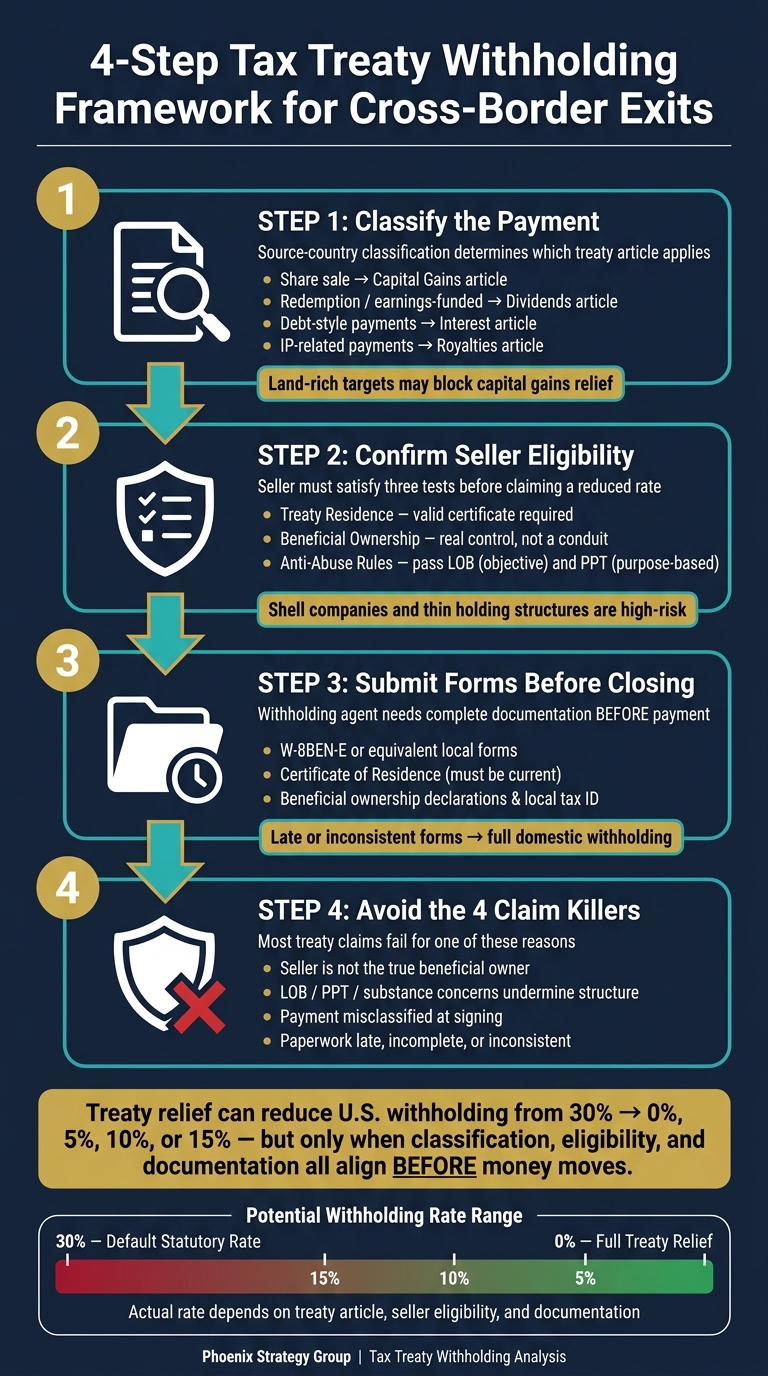
4-Step Tax Treaty Withholding Framework for Cross-Border Exits
Before you claim a lower withholding rate, you need to know which treaty article applies.
That sounds simple. In practice, it usually isn't. Exit deals often include several payment types at the same time, and each one can fall under a different treaty article with its own rules. The best place to start is the source-country classification, then map that treatment to the treaty article. That first classification drives everything that comes after it.
Redemptions funded by earnings are often treated as dividends under local law. That means dividend withholding may apply unless a treaty or participation exemption changes the result.
Other payments can land in different buckets. Debt-style payments may fall under the interest article. IP-related payments may fall under the royalties article if the recipient is not performing the core IP functions.
Here's where things get messy: tax authorities can recharacterize payments on audit. Intercompany debt that lacks real economic substance may be reclassified as equity. When that happens, the treaty analysis shifts from the interest article to the dividends article, and the withholding result can change completely.
That is why deal teams should test each payment type before signing, not after.
For share sales, treaties often limit or remove source-country tax on capital gains. But there is a major carveout: land-rich entities.
If the target's value mainly comes from local real estate or natural resources, the source country may keep the right to tax the gain. The local land-rich threshold matters here, and it varies by country. Indirect transfer rules can lead to the same outcome even when the asset sold is a share instead of the property itself.
If the target is land-rich, the treaty may not remove source-country tax.
Partnership interests add another layer. When a seller holds its interest through a pass-through vehicle, the source country may look through the entity to the underlying assets. If those assets include local real estate, the gain may be sourced to the country where the property is located, not where the seller is resident.
Transparent structures can also create PE risk. Share-sale treaty relief usually does not cover that exposure. In some cases, blocker structures are used to turn flow-through income into corporate income and cut direct PE exposure. But that move can create corporate-level tax leakage and dividend withholding that would not apply in a direct sale.
So the structure choice is rarely automatic. It turns on the treaty, the entity type, and the resident-status rules.
After the article is identified, the next step is proving residence and treaty entitlement. Once the treaty article is identified, test whether the seller qualifies for relief.
Once you've classified the payment, the next step is simple in theory and messy in practice: check whether the seller can claim treaty relief at all.
That check comes before any request for a lower withholding rate. The seller must show three things:
If any one of those falls apart, the reduced rate can disappear.
Every treaty claim starts with two baseline tests: treaty residence and beneficial ownership.
Residence usually means the seller needs a certificate of residence from its tax authority. No certificate, no clean treaty claim.
Beneficial ownership is a different issue. Here, the question is whether the seller has actual control over the income or is just sitting in the middle as a conduit. A pass-through setup is a weak position.
Tax authorities usually look at the facts on the ground. They want to see things like decision-making control, economic risk, and control over distributions. If a holding company just receives cash and sends it upstream, that can be a problem. The same goes for thin capitalization or back-to-back cash movements.
Put plainly, a shell with a bank account isn't much help. You usually need real people, governance, and operating costs in the holding jurisdiction.
Even if the seller is a valid treaty resident and has substance, anti-abuse rules can still block the claim.
In modern cross-border exits, two tests matter most: the Limitation on Benefits (LOB) clause and the Principal Purpose Test (PPT).
LOB rules, which are common in U.S. tax treaties, use objective legal tests to decide whether an entity gets treaty benefits. These rules often focus on ownership thresholds, base erosion, and other specific conditions. A private equity fund held through a foreign holding company can run into trouble here because it may not fall into the right qualification bucket.
The PPT works differently. It's more subjective. If one of the principal purposes of the arrangement was to get treaty benefits, relief can be denied even when the structure meets the technical rules. The OECD Multilateral Instrument has pushed the PPT into many current treaties, so this is no longer a side issue in cross-border exits.
LOB is an objective gatekeeper; PPT denies relief when treaty benefits were a principal purpose of the structure.
Because the PPT turns on purpose, financial models shouldn't assume treaty relief is automatic. If the structure could look tax-driven, it's safer to apply a probability-weighted haircut than to assume full relief at source.
Partnerships, LLCs, and investment funds add another layer of friction.
Treaty entitlement for these vehicles often depends on how each country classifies the entity. And that's where things can go sideways. If the source country and the residence country do not agree on whether the vehicle is transparent or taxed at the entity level, the fund or hybrid structure can lose treaty relief.
Hybrid mismatch rules can make that problem worse. If a payment is deducted in one country but not taxed in the other, treaty relief may be blocked even if the underlying structure seems fine on paper.
For transparent vehicles and funds, the review usually has to happen at the investor level, not just the entity level. That means mapping each jurisdiction's classification before closing, line by line.
Once eligibility is clear, get the claim package to the withholding agent before closing. Even when the seller qualifies, the claim can still fail if the withholding agent doesn't have the right forms in hand.
A treaty claim can be valid on paper and still fail at closing.
Why? Because the withholding agent needs the right documents before payment goes out. That paperwork decides whether more cash stays in the deal now or gets stuck in a refund process later. After eligibility has been tested, the issue is pretty simple: can the withholding agent apply the reduced rate at closing? Once the treaty article and eligibility tests are set, the claim lives or dies on closing-day documentation. [1]
What the withholding agent needs at closing goes past the baseline treaty tests covered in Step 2. Depending on the jurisdiction, reduced withholding at closing may also depend on local tax identification numbers, pre-approval filings, annual renewals, and beneficial ownership declarations. For IP-related proceeds, use board minutes, governance records, and records showing who developed and managed the IP. [1]
The key point is simple: the documents have to line up with the treaty position already tested in Step 2. If the forms say one thing and the deal facts say another, the claim can fall apart fast.
Most problems come down to timing and paperwork. Missing forms, late submissions, or weak support often push the withholding agent to apply the full domestic rate.
| Failure | Likely Outcome |
|---|---|
| Incomplete treaty package | The withholding agent applies the statutory rate |
| Entity not entitled to the income | The claim is rejected; a refund process may be needed |
| Stale or missing Certificate of Residence | Reduced withholding at closing is denied or delayed |
| Missing local tax ID or pre-approval | Reduced withholding at closing is not available |
| No beneficial ownership support | The treaty claim is likely to be challenged |
| Forms not delivered before payment date | Refund delay reduces IRR |
When any of these items is missing or late, the agent will usually default to domestic withholding. If reduced withholding at closing is uncertain, model statutory withholding first and refunds separately. [1]
Treaty relief depends on tight coordination among the seller, buyer, escrow agent, and paying agent. The SPA should spell out tax risk in plain terms, including tax warranties, gross-up clauses, and who controls the audit process. Getting those points aligned before signing can help avoid last-minute friction at closing. [1]
Start early. Review entity residence, substance, forms, approvals, and renewal deadlines before the sale process begins. [1]
If the package is incomplete or inconsistent, the claim will usually fail for one of the reasons covered next.
Even after Steps 1–3, treaty claims still break down in four common ways. You can classify the payment the right way. You can gather the right forms. And the claim can still fall apart at closing because of these issues.
Treaty residence is only the starting point. The tougher test is beneficial ownership. Tax authorities look at who can control the proceeds and keep them, not just whose name appears on the wire transfer.
Common trouble spots include nominee setups, back-to-back payment duties, and holding companies that can’t retain or control the proceeds. If the recipient has to pass the money along based on someone else’s instructions, that party will likely be treated as a conduit. And conduits usually do not qualify as beneficial owners.[5][6][7]
A thin holding company with no business role is exposed under both LOB and PPT. If that company was dropped into the ownership chain shortly before a sale, has no business history, and plays no operating role, the PPT risk gets hard to ignore. Put bluntly: it can look like the structure was built just to get a treaty rate.
Internal emails or board materials can make things worse. If they say the main goal was treaty rate optimization, the position becomes much harder to defend.[9][10]
Even when the entity chart looks fine, the claim can still fail if the deal price itself was allocated the wrong way.
Local law can reclassify part of the deal as dividends, interest, royalties, or real property income. When that happens, the treaty article changes, and so does the withholding rate.[4][3]
That’s why a payment mapping exercise at signing matters. Break each part of the payment into its likely domestic tax classification, then confirm which treaty article applies to each one. This helps keep the SPA language and tax forms lined up with the withholding result that will actually apply at closing.
Late, missing, or inconsistent forms usually force the withholding agent to apply domestic rates first and leave the seller to chase a refund later. That’s a bad surprise to discover when money is about to move.
For example, if a W-8BEN-E claims treaty residence in one country, but the mailing address or payment instructions point somewhere else, the withholding agent has to question the mismatch.[8][2] Small inconsistencies can turn into big delays.
Documentation is usually due before closing, not at funding time.
Once these failure points are cleared, the claim is ready for closing-day execution.
Withholding on cross-border exit proceeds isn't always a fixed cost. Treaty analysis works best when it starts early enough to shape the deal itself, not just the paperwork at closing.
What decides the outcome? Getting the classification, treaty test, and documentation right before any money moves. That means:
Timing matters more than many teams expect. It's not just a closing task. It's a deal term. If treaty analysis starts at the term sheet stage, it can affect structure, holding arrangements, and SPA language in ways that cut withholding at closing. If it starts late, the room to improve the result often shrinks fast.
Even a strong treaty position comes with some leftover risk. Tax authorities may challenge beneficial ownership, question substance, or dispute how a payment was classified. That's why it helps to model both paths: the treaty case and a fallback case based on statutory withholding and a refund process that may take months or longer. Phoenix Strategy Group can help teams build both treaty and fallback withholding into exit modeling early.
The takeaway is simple: treaty relief may be on the table, but exits need to be planned around it if the goal is to protect net proceeds.
Start by finding the tax treaty between the United States and the other country involved. Then check the treaty’s effective dates, residency rules, and the parts that apply to the income being paid, such as capital gains or dividends.
You should also confirm that you meet the treaty’s residency and eligibility rules, including any limitation on benefits tests, before you rely on those protections.
Even if you qualify on paper, treaty relief can still be denied if you fail the PPT or LOB rules.
Other common reasons include:
Before closing, get your paperwork in order if you plan to claim treaty relief or a lower withholding rate. That usually includes:
For U.S. transactions, file Form 8833 with your income tax return to explain your treaty position.