Published on
August 7, 2026


If you sell stock, federal tax usually takes the bigger bite, but Illinois still adds a flat 4.95% on top. That means your after-tax cash depends mostly on holding period, income level, basis, NIIT, residency, and QSBS.
Here’s the short version:
What matters most:
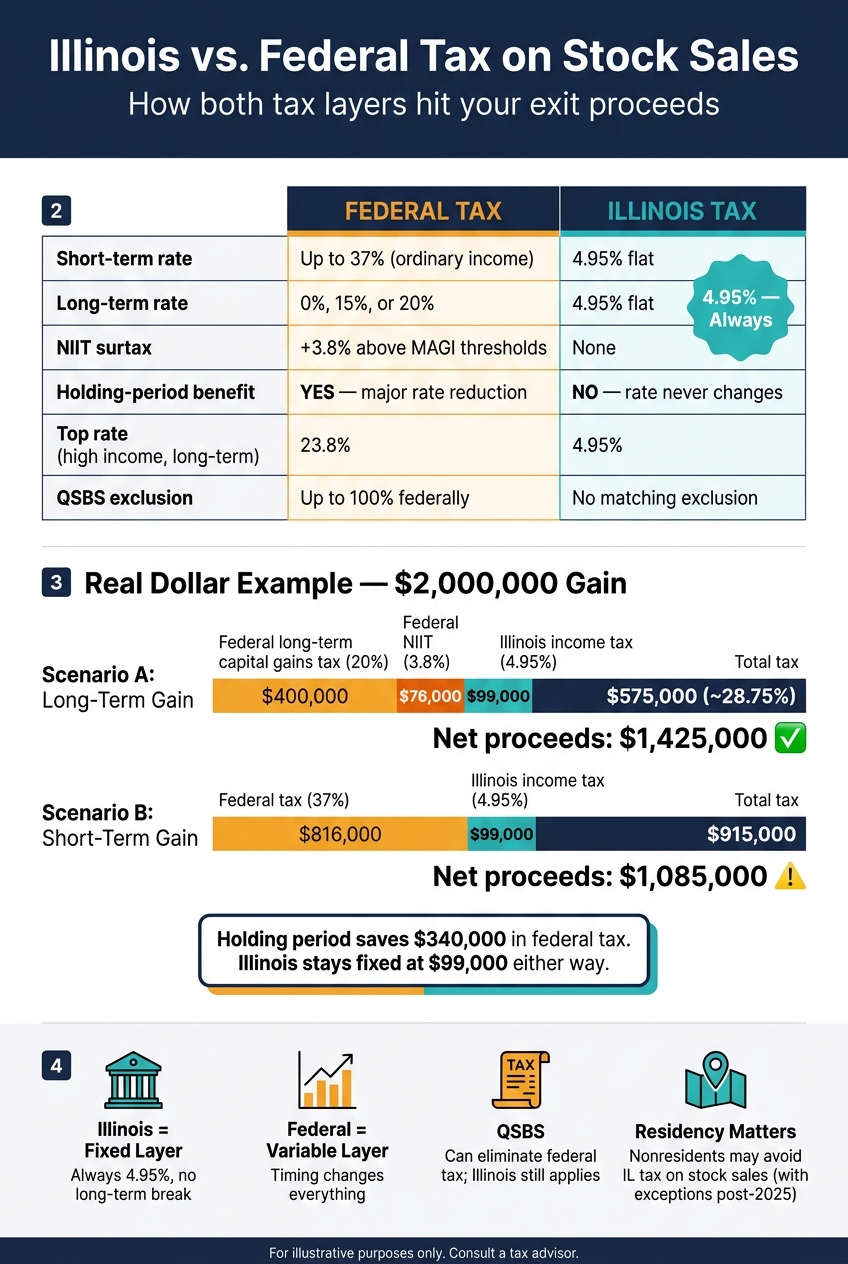
Illinois vs Federal Tax on Stock Sales: Rate Comparison & Real Dollar Impact
| Topic | Federal | Illinois |
|---|---|---|
| Tax rate | 0%, 15%, 20%, or up to 37% for short-term | 4.95% flat |
| Long-term tax break | Yes | No |
| NIIT | 3.8% may apply | No |
| Residency effect | Federal applies either way | Resident vs. nonresident matters |
| QSBS | May exclude up to 100% federally if rules are met | No matching exclusion |
If I were estimating sale proceeds, I’d treat Illinois as the fixed layer and federal as the moving part. That’s the main point of this article.
Illinois doesn't have a separate capital gains tax. Instead, the state taxes stock sale gains under its flat 4.95% individual income tax rate for taxable income.[13][14][16] That means there are no brackets and no special lower rate for long-term gains.
Federal tax rules change based on how long you held the stock. Illinois takes a much simpler approach. If a founder sells shares after 8 months, the state rate is the same as it would be after 8 years: 4.95%.[14][16]
On a $1,000,000 gain, that comes out to about $49,500 in Illinois tax either way.[13]
That makes the state-side math pretty simple. But there's a tradeoff: Illinois gives you no tax break for waiting to hit a long-term holding period milestone. That timing game matters federally, not here.
Residency is where this starts to get less simple.
Illinois residents owe Illinois tax on worldwide income. So if you're an Illinois resident, the full stock sale gain can be taxed by Illinois no matter where the company is based or where the buyer sits.[7][9][13]
Nonresidents often have a better result. In general, nonbusiness capital gains from the sale of intangible property, such as corporate stock, are usually not taxed by Illinois when the seller is not an Illinois resident.[4][10]
But there's a major exception, and it matters more starting in 2025.
For tax years ending on or after June 16, 2025, Illinois uses a new apportionment rule for sales of S corporation stock and partnership interests, not including investment partnerships.[6][11][12][15] If the entity is taxable in Illinois, the gain gets allocated to Illinois based on the average Illinois apportionment factor for:
That average drives how much of the gain counts as Illinois-source income.[4][5][6] So if a nonresident sells a partnership interest and that partnership has 40% of its revenue in Illinois, then about 40% of the gain could be taxable by Illinois.[4][5]
Illinois doesn't compute the gain from zero. It starts with your federal adjusted gross income (AGI), which already includes the capital gain worked out on federal Form 8949 and Schedule D. That amount then flows to Line 1 of Illinois Form IL-1040.[7][9][13]
From there, Illinois applies its own additions, subtractions, exemptions, and credits before applying the 4.95% tax rate to the amount owed.[7][9][13]
Two mistakes come up a lot in exit-year returns.
First, some founders think moving out of Illinois right before a sale erases Illinois tax exposure. It may not. If Illinois still sees them as a resident, or if the new pass-through sourcing rules apply, the state may still claim part or all of the gain.[3][4][5][6]
Second, some tax software setups mistakenly use the federal long-term capital gains rate in the Illinois calculation. That can understate the state tax bill. Illinois doesn't use federal capital gains brackets. It uses 4.95%, period.[14][16]
Illinois uses a flat rate. Federal tax is a different story. It changes based on how long you held the stock, your income, and the kind of shares you sold.
If you held stock for 1 year or less, the sale creates a short-term gain. That gain is taxed at ordinary income tax rates, up to 37%.[2][31][35] If you held the stock for more than one year, it may get long-term capital gains treatment at 0%, 15%, or 20%, based on your taxable income and filing status.[2][34]
For 2026, the 0% long-term capital gains rate applies up to:
The 15% rate applies above those amounts and up to $545,500 for single filers, $613,700 for married filing jointly, and $579,600 for head of household. Above those levels, the rate is 20%.[2][34]
High-income founders may also owe the 3.8% Net Investment Income Tax (NIIT). It applies to the lesser of your net investment income or the amount your MAGI exceeds $200,000 for single filers or $250,000 for married filing jointly.[32][33] So if a founder has a large gain, that extra 3.8% can sit on top of the 20% long-term rate, pushing the top federal rate to 23.8%.[32][33]
But the rate is only half the story. Your basis and holding period decide how much gain you report in the first place.
For federal tax, gain usually equals your sale price minus your tax basis. In plain English, basis is often what you paid for the shares, plus any amount that was already taxed to you. That sounds simple. In practice, it's where many founders trip up.
The reason is straightforward: basis and holding period change based on how you got the shares.
For founder shares issued at formation, basis is usually the purchase price, and the holding period starts on the issue date. If those shares were subject to vesting and you filed an 83(b) election, the holding period usually starts on the grant or transfer date even if the shares are still vesting, and any income recognized at grant increases your basis.[18][21] Miss the 83(b) deadline, and later vesting can be taxed as ordinary income while also pushing back the start of the holding period.[18][21]
NSOs work differently. When you exercise a nonqualified stock option, the spread between the fair market value and the exercise price is taxed as ordinary income, and that amount is added to your basis. The holding period for capital gains starts on the exercise date, not the grant date.[18][21]
ISOs can lead to long-term capital gains treatment, but only if you hold the shares for at least two years from grant and one year from exercise.[19][21] Sell earlier than that, and part of the gain becomes ordinary income.
RSUs are taxed as ordinary income when they vest, based on fair market value. That taxed amount becomes your basis, and the holding period for any later gain starts at vesting.[20][22]
In a secondary sale, each tax lot has its own basis and holding period tied to how those shares were acquired. Use the wrong lot, and the tax result can shift in a big way, including whether the gain is long-term or short-term.
QSBS is the main federal rule that can sharply cut, or even wipe out, tax on a sale.
Qualified Small Business Stock (QSBS) under IRC Section 1202 can exclude up to 100% of the gain from federal tax on stock that meets the rules, subject to a per-taxpayer cap.[25][26][27]
The main rules are fairly strict:
You also must hold the stock for more than five years to claim the full exclusion. For stock issued on or after July 4, 2025, the per-taxpayer exclusion cap increased to $15 million, with annual inflation adjustments starting in 2027.[29][30]
QSBS only works if the stock qualified when issued. If you did not get the shares at original issuance, or if the business is in an excluded field such as finance, professional services, or hospitality, QSBS does not apply.[26][27][28] There is no fix later if the stock failed the rules from the start. That's why founders should check QSBS status well before signing a sale agreement - ideally 12 to 24 months in advance, while there is still time to deal with any problems you find.
Now that both systems are on the table, the day-to-day difference for a founder's exit gets pretty simple: federal tax changes based on timing, while Illinois does not.
At the federal level, the gap between short-term and long-term treatment is huge. Short-term federal tax can reach 40.8%, while long-term federal tax tops out at 23.8%. Illinois, by contrast, stays at 4.95% no matter how long you held the stock.[17][36][37][38][41]
| Factor | Federal | Illinois |
|---|---|---|
| Short-term rate | Up to 37% (ordinary income) | 4.95% flat |
| Long-term rate | 0%, 15%, or 20% (income-based) | 4.95% flat |
| NIIT surtax | 3.8% above MAGI thresholds | None |
| Holding-period benefit | Yes - material rate reduction | No - rate never changes |
| Top federal rate on long-term gain at high income | 23.8% | 4.95% |
So if you're thinking about when to sell, that decision can change your federal bill in a big way. It does not change your Illinois rate.
Here's how the tax flow works. The gain gets figured under federal rules first, then moves into federal AGI. Illinois starts with that federal AGI and still taxes the gain at 4.95%, even if the gain got long-term treatment at the federal level.[37][38][39]
| Item | Federal | Illinois |
|---|---|---|
| Capital loss offsets | Capital losses offset capital gains first; excess up to $3,000 offsets ordinary income | Uses federal AGI, so federal losses lower Illinois tax indirectly |
| Excess loss vs. ordinary income | Up to $3,000/year deductible | No separate state rule; flows through AGI |
| Loss carryforward | Indefinite | Indirectly benefits Illinois via lower AGI |
| Preferential rate for long-term gains | Yes | No |
That means loss harvesting before an exit helps federal tax first. Illinois may still go down, but only because the lower federal AGI flows through to the state return. The state benefit is more of a side effect than its own rule.
To put real dollar figures on it, take a $2,000,000 long-term gain.
Assumptions: Married filing jointly. Full $2,000,000 recognized as long-term capital gain in a single tax year. No QSBS exclusion. Other income already places the founder in the 20% federal long-term capital gains bracket and above the NIIT threshold. Basis is minimal.
| Tax Layer | Rate | Amount |
|---|---|---|
| Federal long-term capital gains tax | 20% | $400,000 |
| Federal NIIT | 3.8% | $76,000 |
| Total federal tax | 23.8% | $476,000 |
| Illinois income tax | 4.95% | $99,000 |
| Combined tax | ~28.75% | $575,000 |
| Net proceeds after tax | $1,425,000 |
Now look at that same $2,000,000 gain if it were held short-term, using the same founder and the same income level, with the 37% ordinary federal bracket:
| Scenario | Federal Tax | Illinois Tax | Combined | Net Proceeds |
|---|---|---|---|---|
| Long-term gain | $476,000 | $99,000 | $575,000 | $1,425,000 |
| Short-term gain | $816,000 | $99,000 | $915,000 | $1,085,000 |
The holding-period shift saves $340,000 at the federal level. Illinois tax stays fixed at $99,000 in both cases.[37][40]
Looking at tax rates is just the starting point. The bigger hits usually come from bad modeling, poor timing, and messy records.
The costliest mistake is modeling only federal tax. You need both layers. If you leave out Illinois, that can add another $99,000 on a $2,000,000 gain.[17][43][44]
Another big one is getting the holding period wrong. Shares from recently exercised options or conversion shares may still count as short-term. When that happens, federal tax can jump to 40.8% for top-bracket taxpayers, while Illinois remains 4.95%.[1]
Two more problems often show up during an exit. If your lot-level basis records are weak, you may end up with a lower basis than you should have, which makes the taxable gain look bigger. And if the sale involves an S corporation or partnership, nonresidents may still owe Illinois tax on part of the gain.[11][8][47][48]
The last major mistake is missing QSBS status. This is where a small miss can turn into a very large tax bill.
That can wipe out a possible 100% federal exclusion on up to the greater of $15 million or 10× basis per taxpayer for stock issued on or after July 4, 2025.[45][46] Illinois still taxes that gain at 4.95% either way, so losing the federal exclusion makes the damage much worse.[17]
Here’s the core idea: Illinois taxes stock-sale gain at 4.95% no matter how long you held the shares. Federal tax depends on timing, deal structure, and whether QSBS applies.[17][15][42]
So the two systems run side by side. Your final tax bill is always the mix of both.
Run after-tax scenarios before signing an LOI.
It can lower your Illinois tax bill, but the key issue is when the income is treated as earned.
With a standard stock sale, tax usually follows the state where you lived when you sold the stock. Equity compensation works differently. If you’re dealing with stock options or similar awards, Illinois may still tax part of the gain if it’s tied to work you did in Illinois or to equity that vested while you lived or worked in Illinois.
Cost basis is the amount you paid for a stock, plus any fees tied to the purchase. When you sell, you subtract that basis from the sale price to figure out your capital gain.
Tax lots are groups of shares you bought at different times or at different prices. Each lot has its own holding period. That matters because it helps determine whether your gains are taxed at lower long-term capital gains rates or at ordinary income rates.
It depends. Illinois usually starts with the federal income tax rules, but you should check current Illinois guidance on Section 1202.
So even if your QSBS gain is fully excluded on your federal return, you may still owe Illinois tax. States do not all treat QSBS the same.