Published on
July 27, 2026


Clean energy scales when large investors do seven things well: pick where money goes, set return targets, limit what funds can buy, choose projects, watch them after closing, track results, and plan the sale from day one.
If I had to boil the article down, it’s this: U.S. clean energy needs big, patient pools of money because many projects cost $10 million to $100 million+, and about 2,500 GW of renewable and storage projects were sitting in U.S. interconnection queues in 2025. At the same time, many power contracts are now under 7 to 10 years, which means more exposure to market prices. That changes how large investors judge risk, returns, and timing.
If you want the full picture fast, here are the 7 roles:
Here’s the short takeaway for you: institutional investors do more than fund projects. They shape which assets get built, how risk is priced, what data sponsors must show, and how money gets recycled into the next round of clean energy deals.
| Role | What it changes |
|---|---|
| Capital allocation | Which sectors and projects get money |
| Risk pricing | Discount rates, deal terms, and go/no-go decisions |
| Fund mandates | What a fund manager is allowed to own |
| Project selection | Which assets pass diligence |
| Governance and stewardship | How deals are watched after closing |
| Impact and climate reporting | What LPs, buyers, and regulators can measure |
| Exit planning | When capital returns and where it goes next |
For me, the main point is simple: if a clean energy company wants institutional money, it needs clear cash-flow logic, clean data, and a plan that works from first screening to final exit.
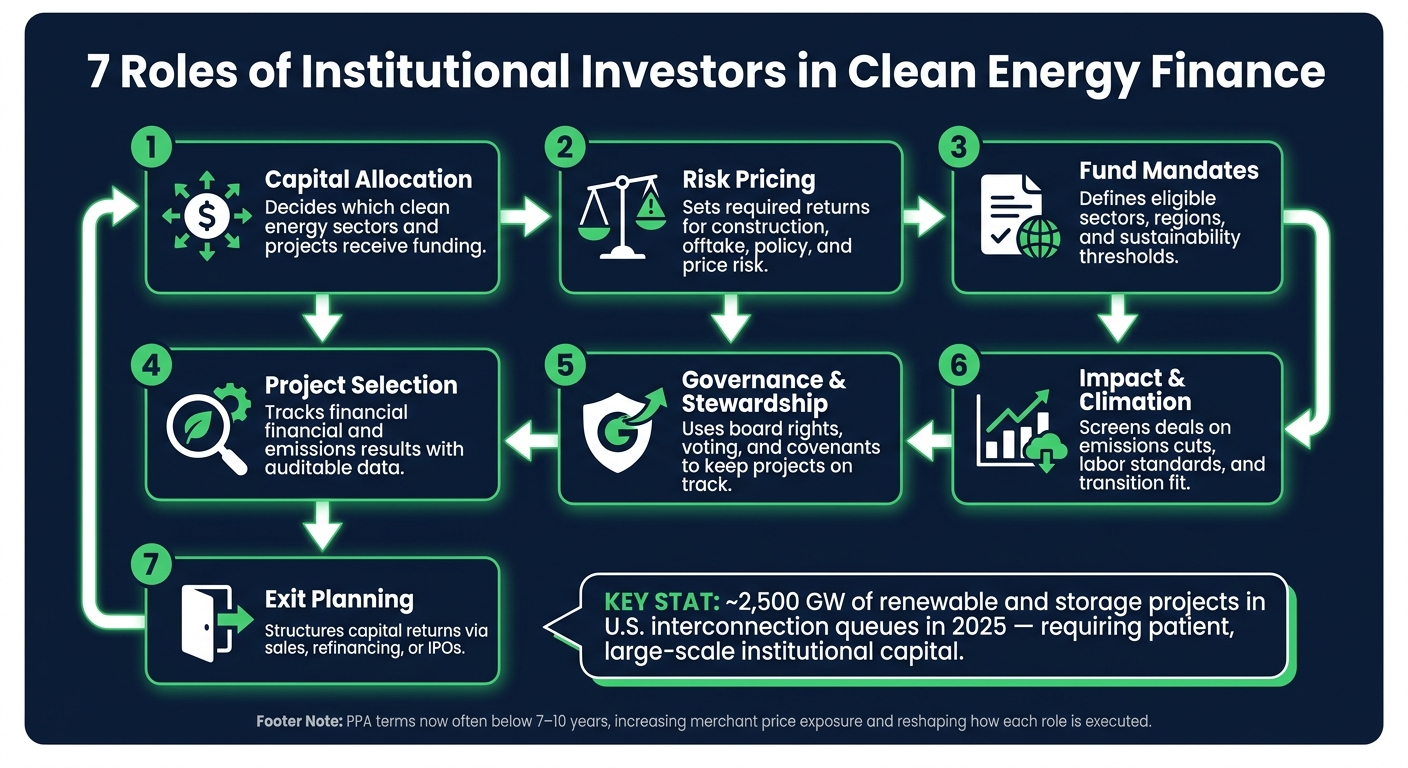
7 Roles of Institutional Investors in Clean Energy Finance
Utility-scale solar, onshore wind, battery storage, and grid modernization projects need a lot of money up front. In many cases, that means $10 million to $100 million+ per project[1]. That kind of funding need is exactly why institutional capital sits at the center of clean energy finance.
The scale is hard to ignore. In 2025 reports, about 2,500 GW of renewable and storage projects were stuck in U.S. grid queues[1]. Moving even part of that pipeline takes patient capital at large scale, plus investors that can handle the messier side of grid integration.
There’s another layer here: contract risk is changing. PPA terms are getting shorter, often falling below 7 to 10 years[1]. That means more projects are exposed to market pricing sooner. And when that happens, institutional investors have to deal with more merchant exposure and more price risk. That pressure shows up first in how capital gets allocated.
Capital allocation decides where money goes and how much gets deployed. For institutional investors like pension funds, insurance companies, and endowments, that choice is tied to fiduciary duty: the duty to act in the best interests of beneficiaries. That first filter matters a lot because it helps decide which clean energy projects get funded at all.
Fiduciary duty also means investors need to treat material climate risk as part of financial performance. In clean energy, that usually means checking policy risk, counterparty risk, and price risk before any money is committed. Transition risks, like stranded fossil assets and tighter carbon rules, can hit returns in a direct way, so they belong in any serious allocation process.
Once investors gauge revenue stability, capital tends to move toward assets with less price exposure. In plain English, money often flows to contracted assets with lower merchant exposure, such as rooftop solar, heat pumps, and efficiency upgrades. These demand-side assets can produce cash flows that are more protected from wholesale power price swings. [1]
Allocation also goes past picking single projects. It shapes a portfolio’s carbon exposure over time. Investors use carbon-intensity and temperature-alignment metrics to measure progress toward a 1.5°C-aligned portfolio. [2]
Once capital is allocated, the next step is simple to state but hard to get right: what return does an investor need for a given deal? That’s what risk pricing is about.
Institutional investors price each project against portfolio return targets. If that pricing is wrong, two bad things can happen. A project may never get funded, or an investor may end up taking on more exposure than planned. Either way, the underwriting matters because it shapes how much risk a manager can take on after that.
In practice, that underwriting usually falls into four main risk buckets. Investors don’t price a project as one big blur of risk. They break it apart by category. Construction risk is priced with contingency reserves and fixed-price EPC contracts. Technology risk is priced based on operating history and Independent Engineer reviews. Offtake risk is priced through counterparty credit and contract term.
Buyer credit quality directly affects the discount rate. An investment-grade offtaker can support a lower discount rate than a weaker counterparty.
Merchant power price risk is becoming a bigger issue as contract terms get shorter. Shorter PPAs leave more projects exposed to wholesale prices, which means investors have to look harder at both merchant exposure and volume risk. That’s why many now lean on conservative P90 production estimates and long-term forward price curves to stress-test that exposure. If a project fails that stress test, it usually doesn’t get financed.
| Risk Type | How It's Priced | Common Mitigation Tool |
|---|---|---|
| Construction | Contingency reserves | Fixed-price EPC contracts with liquidated damages |
| Technology | Higher discount rate for unproven tech | Independent Engineer report |
| Offtake | Adjusted discount rate based on counterparty credit | Investment-grade PPA |
| Merchant price | P90 estimates and forward price curve stress tests | Long-term PPAs, pay-as-nominated structures |
| Policy | Tax credit and policy stability | Change-in-law protections |
This also shows a bigger change in the market. Infrastructure investing is moving away from a purely defensive model and toward a more active, private-equity-like style of risk management. When risk is underpriced, capital can be misallocated. When it is overpriced, solid projects can get stranded. Those pricing signals then flow straight into fund mandates, which set the risk limits for managers.
Once risk pricing sets the economics, fund mandates decide which clean energy deals a manager can even look at.
A fund mandate lays out the sectors, technologies, and geographies a manager is allowed to invest in. In clean energy, that can mean specific renewable or efficiency assets, certain regions, and carbon-intensity thresholds. For institutional investors, the mandate turns fiduciary duty into a practical investment rule. It sets a clear boundary for allocation and decides whether a deal is eligible before anyone digs into the project itself.
Many mandates now treat measurable sustainability outcomes as part of financial value. For clean energy sponsors, that changes the pitch. Emissions cuts, climate alignment, and other impact metrics can make a fund fit stronger when they line up with the fund’s stated goals. In that sense, mandates don’t just filter risk. They also steer capital toward measurable climate outcomes.
For sponsors, the play is pretty simple: shape each pitch to the mandate in front of you. Match the fund’s sector screen, sustainability benchmark, and impact goals, then make the financial case in those same terms.
Those mandate filters then shape which projects move on to selection, governance, and reporting.
Once fund mandates draw the lines, project selection is where investors make the deal-by-deal call. This is the point where standards get more specific and the bar gets much higher. Investors then test each project against impact, labor, and transition criteria.
Institutional investors tend to back projects that can show measurable emissions cuts in the economy, not just nicer-looking portfolio carbon scores. Selection also screens for just-transition factors like union labor standards, job creation, and Indigenous rights.
Allocation and pricing shape the economics. Mandates determine eligibility. Selection decides which assets actually make it through the screen. It also helps investors steer clear of stranded assets by favoring projects that fit long-term transition pathways and net-zero targets. Gas infrastructure, grey hydrogen, and unproven technologies, including some CCS projects, are more often left out. Those exclusions help prevent capital from getting tied up in assets that can weaken the transition.
These screens also influence how investors govern projects after closing.
Once a project is picked, governance is what keeps the deal from drifting off course.
In private deals, investors often lock in board seats or observer rights. That gives them a direct view into management decisions, build milestones, and emissions commitments. They’re not just writing a check and hoping for the best - they have a seat close enough to see what’s happening.
Public markets work a bit differently. Investors usually don’t get that same direct access, so they lean on proxy voting and shareholder engagement. That can mean pushing for changes to board composition, tying executive pay to climate KPIs, and voting on climate transition plans.
In project finance, lenders have another tool: covenants. These can require environmental reporting, put limits on asset sales, and enforce safety standards. If a borrower breaks those covenants, investors can step in and escalate, including through default remedies.
PRI defines stewardship as using investor influence to protect long-term value for beneficiaries and the broader economy. [2] That kind of oversight also feeds the reporting investors use to monitor impact and climate performance.
After stewardship comes measurement. Reporting is what turns stewardship into auditable proof for LPs and regulators.
Institutional investors usually track two sets of results at the same time: financial performance and climate performance. On the financial side, that often means IRR and cash yield. On the climate side, it means metrics like metric tons of CO2e avoided, megawatt-hours generated, and emissions intensity.
For climate reporting, the IIGCC recommends a dashboard approach that pairs at least one absolute metric with one intensity-based metric.[3] In plain English, that means investors shouldn't rely on just one number. They need one metric that shows total emissions and another that shows emissions in relation to investment or revenue.
| Metric Type | Metric | What It Measures |
|---|---|---|
| Absolute | Financed emissions (tCO2e) | Total greenhouse gas emissions associated with a portfolio |
| Intensity | Economic emissions intensity | Emissions relative to capital invested |
| Intensity | WACI | Emissions relative to portfolio company revenue |
Common portfolio metrics include:
That said, the numbers only help if investors can explain why they changed. They need to separate real emissions cuts from portfolio turnover and market effects. Allianz has used attribution analysis to pinpoint what is actually driving emissions changes, including operational improvements, shifts in portfolio composition, and changes in revenue or enterprise value.[3] That's the difference between real decarbonization and simple portfolio churn.
Consistency over time matters just as much as the metrics themselves. The National Grid UK Pension Scheme developed a rebaselining approach so its reported greenhouse gas data stayed comparable year over year, even as data quality and portfolio composition changed.[3] Without that kind of discipline, it's much harder to trust the trend line.
Climate disclosure is also becoming more standardized. Frameworks like TCFD and ISSB IFRS S1 and S2 are becoming the baseline for climate disclosure.
Clean, auditable data helps on the back end too. It can improve exit readiness by supporting valuation work and buyer diligence.
That same data matters just as much when buyers put a price on the exit. Strong reporting can make due diligence move faster and give buyers more comfort around valuation.
Exit planning isn't something investors tack on at the end. Institutional investors set exit terms early, right in fund documents and financing agreements. Closed-end infrastructure funds usually run for 10–12 years, and they often build in an exit target for years 5–10. Closed-end structures also tend to exit more reliably than direct deals.[4] In plain English: the rules set at the start can shape which exit paths are even possible later.
In U.S. clean energy, the main exit routes are:
Each route comes with its own tradeoffs. Trade sales can win control premiums, but they often take longer to negotiate. Secondary sales usually close faster and come with more predictable valuations. Refinancing at commercial operation gives investors a way to de-risk part of the deal while still keeping some upside. And tax equity structures add one more timing layer that investors have to plan around.
Tax equity exits usually open after the 5-year ITC recapture period and can be tightly timed.[5]
Those exits then recycle capital into new clean energy projects.
Clean energy projects don't all look the same on paper. Each one comes with its own mix of upfront cost, timing, operating risk, and policy exposure. And those differences matter because they're the things institutional investors tend to underwrite first.
| Project Type | Capital Intensity | Development Timeline | Operational Risk | Policy Sensitivity | Cash Flow Profile | Impact Potential |
|---|---|---|---|---|---|---|
| Utility-Scale Solar | High | Long (grid dependent) | Moderate - curtailment and merchant exposure | High - tax credits & grid access | Shorter PPAs; more merchant exposure | High - carbon displacement at scale |
| Onshore Wind | High | Long (permitting and grid dependent) | Moderate - volume risk and merchant price | High - federal/state policy | Shorter PPAs; more merchant exposure | High - carbon displacement at scale |
| Battery Storage (BESS) | Moderate to High | Moderate (grid dependent) | High - cycling and trading volatility | Moderate - market structure rules | Tolling agreements or merchant trading | High - grid stability & storage capacity |
| Energy Efficiency | Low to Moderate | Short | Low - performance-based contracts | High - building codes & mandates | Fixed, fully amortizing, behind-the-meter | High - direct waste reduction |
This spread helps explain why some assets pull in core capital, while others land in higher-risk, higher-transition buckets. Utility-scale solar and wind, for example, now come with more merchant exposure as PPA terms shrink below 7–10 years.[1]
Energy efficiency sits in a different lane. It has a short development timeline and low operating risk, which leaves it more protected from wholesale power price swings. The reason is simple: returns come from building performance, not grid pricing. That makes it a strong match for liability-driven capital.[1]
For sponsors, the job isn't just to present a clean energy story. It's to package each asset class around these risk and cash flow traits so institutional capital can actually get comfortable with it.
Asset class fit is just the entry point. Institutional capital still depends on diligence-ready financial infrastructure.
For growth-stage clean energy companies, that usually means accurate bookkeeping, institutional-grade forecasting, and data systems that bring financial and impact metrics together in one place. If those pieces don't hold up under close review, the fundraising process can stall fast.
Climate and operating risks can materially affect financial performance and value creation. [2] Investors want to see the financial link clearly: how climate and operating factors shape cash flow, margins, and valuation. That calls for diligence-ready models, auditable data rooms, and fundraising materials prepared before companies start conversations with large-scale investors.
Once the model and data are credible, sponsors can turn impact into terms institutional investors use every day. Phoenix Strategy Group works with growth-stage companies on bookkeeping, fractional CFO services, FP&A, data engineering, and M&A support to build investor-ready financial systems. That same discipline also helps sponsors get through investor diligence across allocation, pricing, reporting, and exit.
These seven roles work like links in one chain: allocation, pricing, mandates, selection, governance, reporting, and exit planning. Put them together, and you can see how clean energy moves from an early idea to a bankable asset. Each role supports the one after it.
Institutional investors don't just decide how much money flows into clean energy. They also influence which projects get built, how those projects are run, and whether the returns are strong enough to keep capital coming back. That shapes the entire investment cycle.
For clean energy companies, the takeaway is pretty simple: meet investor expectations at every step. The companies that line up their financial systems, impact data, and governance with institutional requirements are the ones that pass diligence and secure large-scale capital.
Shorter Power Purchase Agreements (PPAs) matter because they bring merchant price exposure and volume risk into portfolios that used to lean on steady, long-term cash flows.
The result is less predictable revenue, more demanding price-risk modeling, and, in most cases, a higher discount rate applied to the merchant tail once the contract ends.
A clean energy project becomes institutional-grade when it checks three big boxes: technical reliability, operational maturity, and financial stability.
That’s what serious investors want to see.
They tend to look for:
It also helps when a project shows strong risk management and open reporting on finances and ESG performance. Standardized impact metrics matter too, because they make results easier to compare across projects.
And if the project qualifies for government-backed incentives like tax credits, that can make the deal even more attractive.
Exit planning should start early - about 12 to 24 months before you bring in an advisor or kick off a formal sell-side process.
That lead time gives you room to tighten the value drivers buyers care about most: audited financials, steady revenue and EBITDA growth, and legal readiness. It also helps you plan around market timing, your development stage, interconnection status, and tax credit eligibility.
Phoenix Strategy Group can help with that prep work while keeping your impact goals in place.