Published on
August 15, 2026


Fintech fundraising in 2026 rewards a smaller set of companies. If I had to sum up the shift in one line, it’s this: investors now pay for retention, margins, and control - not just growth.
Here’s the short version you can use right away:
If you’re a founder, the message is simple: you need tighter metrics, a cleaner model, and fewer weak spots before you go out for a round. Story still matters. But in 2026, numbers carry the pitch.
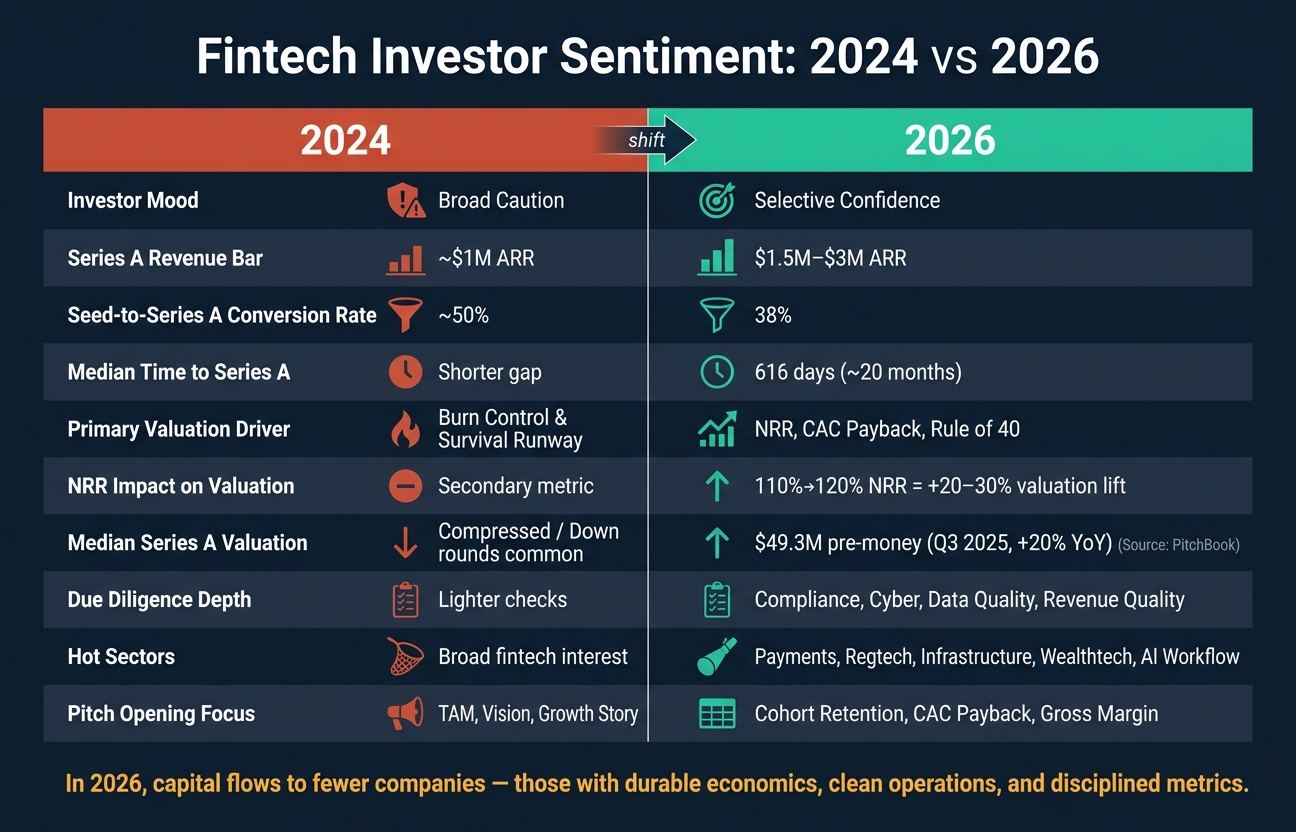
Fintech Investor Sentiment 2024 vs 2026: Key Metrics & Shifts
| Area | 2024 | 2026 |
|---|---|---|
| Investor mood | Broad caution | Selective confidence |
| What got attention | Survival, runway, proof | Retention, margins, efficient growth |
| Series A bar | Around $1 million ARR | $1.5 million to $3 million ARR |
| Main valuation focus | Burn control | NRR, CAC payback, Rule of 40 |
| Sector interest | Broad fintech interest | More focus on payments, infrastructure, regtech, wealthtech, and AI workflow tools |
| Diligence | Lighter | More checks on compliance, cyber, and data quality |
So when I look at this market, I don’t see a broad comeback. I see a market that is more selective, more numbers-driven, and less forgiving.
From 2024 to 2026, the mood didn't swing from panic to cheer. It shifted from broad caution to selective confidence. Investors didn't suddenly start writing checks left and right. They just got much sharper about what they would fund and what they would pass on.
In 2024, fintech was still working through a market reset. Deal volume stayed near multi-year lows, and investors took their time. Getting a meeting wasn't easy, and the main question wasn't how fast a company could grow. It was whether that company could make it through the cycle.
The companies that stood out had clean traction. That meant solid revenue quality, strong retention, and a believable path to profitability. Big growth stories without the numbers to back them up didn't go far. For companies that couldn't meet that standard, down rounds and flat bridge rounds were common [2].
By 2026, exit visibility had improved and more capital came back into the market. But it didn't flow evenly. It went to the strongest businesses.
The numbers tell the story. The median pre-money Series A valuation hit $49.3 million in Q3 2025, up about 20% year over year for primary rounds [2]. At the same time, fewer companies made it that far. The Seed-to-Series A conversion rate fell from about 50% to 38% by 2025 [2].
What separated the winners? In 2026, fintech companies had to grow efficiently, not just fast. Investors now look at the Rule of 40 - growth rate plus EBITDA margin - as a baseline check [1]. Fintechs with gross margins above 70% and durable recurring revenue are getting the most attention. Companies that can't show capital efficiency are having a harder time getting a deal done [2].
For founders, the message is pretty plain: capital is there in 2026, but it's going to a smaller group of companies with disciplined metrics. That's the shift. And it's why investors started pricing economics first.
The contrast is easiest to see side by side:
| Feature | 2024 Investor Mood | 2026 Investor Mood |
|---|---|---|
| Deal Pace | Multi-year lows; slower decision-making | Stable; faster for high-quality targets |
| Risk | Broad caution; focus on survival and path to profitability | Selective conviction; focus on durable scale and economics |
| Primary Metric | Proof of traction and revenue quality | Durable recurring revenue and Rule of 40 |
| Valuation Conditions | Down rounds and flat bridges common | Rising medians for primary rounds ($49.3M) |
| Capital | Restrained and highly selective | Concentrated in fewer, stronger businesses |
That shift shows up most clearly in valuation discipline.
That caution shows up most clearly in how investors price fintech deals.
In 2024, the first pricing question was survival: how long can this company keep going? Investors pressed hard on burn control, margin improvement, and a believable path to profitability. A good story alone didn't carry much weight. If the numbers weren't there, the story usually fell flat.
By 2026, investors were willing to pay more only for companies with durable unit economics. Multiple recovery showed up, but only for companies with recurring revenue, software-like margins, and Rule of 40 performance that cleared the new bar [1]. For marketplaces, the anchor changed too. Investors moved away from GMV and simple revenue multiples. Public marketplace companies in 2025/2026 traded at a median of 2.3x EV/Revenue, far below the long-term average of 5.6x [1]. So buyers and investors started leaning on EV/Gross Profit instead, often in the 10x–20x range [1].
In 2026, investors start with NRR, then look at CAC payback and the Rule of 40. And if GRR drops below 80%, that's a red flag right away [1].
| Metric | 2024 Market | 2026 Market |
|---|---|---|
| Primary valuation driver | Burn control and survival runway | Durable economics and Rule of 40 |
| Marketplace anchor | GMV, often discounted | Gross profit, with 10x–20x EV/Gross Profit multiples [1] |
| SaaS multiples | Compressed; heavy bottom-line scrutiny | Selective recovery for high NRR and software-like margins [1] |
| CAC Payback tolerance | Strict; often under 12 months | 12–15 months; up to 24 months for enterprise [1] |
| Narrative-driven growth | High skepticism | Still skeptical unless metrics support it |
The recovery in pricing didn't lift all of fintech. It showed up in the parts of the market investors think can produce strong margins over time.
By 2026, capital was clustering around payments, financial infrastructure, wealthtech, regtech, and AI-enabled workflow automation with clear operating leverage [1]. These groups had something investors could hang onto: revenue visibility, infrastructure value, or regulatory defensibility. AI-native platforms, in particular, drew premium pricing that looked a lot like 2021. Marketplace models, on the other hand, faced a much tighter setup, with investors zeroed in on unit economics they could actually verify [1].
| Sector | 2024 Investor View | 2026 Investor View |
|---|---|---|
| Payments | Broad interest | Favored |
| Regtech | Broad interest | High conviction |
| Financial infrastructure | Mixed | High conviction |
| Wealthtech | Mixed | Renewed interest |
| AI-enabled workflow automation | Early curiosity | High conviction [1] |
| Consumer fintech (broad) | Selective | Lower priority unless daily users are at least 20% of monthly users [1] |
Once investors narrow in on a few sectors, the growth bar changes too.
In 2024, the ask was simple: limit burn. Investors rewarded companies that cut costs, stretched runway, and proved they could run lean. Growth still mattered, but not if it came with heavy cash use.
By 2026, that standard had shifted. Efficiency still matters, but by itself, it isn't enough. Investors want to see revenue keep compounding while margins stay intact. That's efficient scale: growth without margin slippage. Median SaaS growth rates have settled at 26%, while top performers are hitting 50% [1]. The SaaS Magic Number now needs to be above 0.75 to look healthy, and above 1.0 to stand out [1]. If it drops below 0.5, investors tend to read that as a go-to-market problem that should be fixed before fundraising [1].
Back in 2024, a path to breakeven was often enough to earn trust. In 2026, investors want more than that. They want proof that getting to breakeven won't choke off growth. And the Magic Number is one of the clearest ways they test that balance.
You can see the shift right in the pitch deck.
In 2024, a lot of fintech decks started with TAM, product vision, and future upside. By 2026, the decks that land better usually open with cohort retention, CAC payback, gross margin trend, net revenue retention where relevant, and cash flow conversion. Investors want proof that the business repeats well and runs with discipline before they spend much time on valuation.
Market size still matters. But it doesn’t carry the same weight on its own. Now it needs to connect to conversion, retention, margin expansion, and sales capacity. A big market is nice. A big market you can actually convert into durable revenue is what gets attention.
Investors often look for LTV:CAC ratios of 3:1 or higher. Ratios under 2:1 point to cash burn that won’t hold up and weak unit economics [7][8].
| Pitch Element | 2024 Expectation | 2026 Expectation |
|---|---|---|
| Opening focus | TAM, vision, and growth potential | Cohort retention, CAC payback, gross margin trend |
| Market size framing | Broad TAM as standalone argument | Tied to defensible niche, conversion, retention, and margin |
| Unit economics | Secondary; shown later in deck | Primary; surfaced early and clearly |
| Recurring revenue metrics | Optional for early-stage | NRR where relevant; cohort retention expected |
| Sales efficiency | Mentioned but rarely scrutinized | Quantified; payback period required |
By 2026, the model has a tougher job. It has to defend the valuation in base, upside, and downside cases. That changes the point of the exercise. It’s not just about showing a nice top-line curve anymore. It’s about pressure-testing the round.
That pushes founders to use tighter assumptions on revenue growth, hiring pace, margin movement, and capital needs. It also puts more weight on downside cases and sensitivity analysis that show what happens if sales slow down, churn goes up, or funding takes longer than planned [3].
A strong model links operating drivers straight to financial results. That way, an investor can follow the chain from customer acquisition, pricing, take rates, and collection timing all the way to cash burn and runway. If that link is fuzzy, trust drops fast.
The practical starting point is pretty plain:
| Model Feature | 2024 Standard | 2026 Standard |
|---|---|---|
| Primary focus | Top-line growth trajectory | Valuation defense across scenarios |
| Scenario planning | Base case; upside optional | Base, upside, and downside required [3] |
| Sensitivity analysis | Rarely included | Expected; churn, CAC, and pricing tested |
| Operating drivers | Loosely connected to financials | Directly tied to cash burn and runway |
| Margin assumptions | Often optimistic; lightly scrutinized | Must show durability as headcount and costs scale |
| Reporting cadence | Monthly or quarterly, often delayed | Real-time visibility into operational drivers preferred |
Once the numbers look solid, investors move to the next layer: operating controls and data quality.
In 2026, regulatory posture, cybersecurity controls, data integrity, and audit readiness all carry real weight in fintech diligence. Weak controls can cut valuation, add closing conditions, or stop a deal cold, even if top-line growth looks strong.
The average cost of a data breach now exceeds $4.45 million [5]. That helps explain why investors are looking more closely at SOC 2 compliance, access controls, encryption practices, and breach history [5][6]. Cyber diligence frameworks also dig into backup immutability, third-party risk tiers, and regulatory exposure checks, then connect those findings to valuation and deal terms [4][9].
Some deal frameworks now include cyber-related price adjustments tied to disclosed cybersecurity incidents. In some cases, cyber-specific holdbacks and escrows are written right into the deal terms [4][9].
Common red flags include:
| Diligence Area | 2024 Focus | 2026 Focus |
|---|---|---|
| Compliance | High-level regulatory awareness | KYC/AML processes, licensing, and regulatory posture scrutinized |
| Cybersecurity | Mentioned; rarely tested in depth | SOC 2, access controls, breach history, third-party risk tiers |
| Data integrity | Assumed if metrics looked consistent | Reconciliation of usage, billing, and booked revenue required |
| Audit readiness | Optional for early-stage | Expected; clean audit trail and documented controls |
| Revenue recognition | Accepted if growth was strong | Inconsistency is a red flag regardless of growth rate |
| Business continuity | Rarely evaluated | Vendor concentration and single-bank or payment-partner dependency flagged |
In 2026, the bar is higher. Before you start outreach, use that new diligence standard to review your deck, model, and data room. The shift from 2024 to 2026 is pretty clear: proof beats story, durable economics matter more than growth talk, and clean operations need to be in place before the first meeting.
Start with your financials. If your books and core metrics aren't ready for investor review—perhaps by leveraging fractional CFO services—, the process can stall fast. Once the books are clean, put the round under pressure with scenarios investors can actually underwrite.
Tighten your model too. Build base, upside, and downside cases with assumptions you can explain without hand-waving. Keep Burn Multiple at 1.5x or lower [2]. If NRR is below 120%, fix retention before fundraising [2]. Also check customer concentration. If one customer makes up more than 15% of total ARR, that alone can kill a deal in diligence, even if the rest of the business looks solid [2].
Get your diligence materials ready early. Compliance docs, audit trails, cybersecurity controls, and KPI reporting should be organized before outreach begins. That kind of prep saves time later, and it also signals that the company is being run with care.
You can see the shift most clearly in the operating bar investors now use. The biggest change isn't mood. It's the standard itself. In 2024, investors were cautious across the market. In 2026, confidence came back, but only in a much narrower way. Better sentiment didn't make fundraising easier. It meant investors were more willing to move only when they saw durable economics and clean operations.
| What Shifted | 2024 | 2026 |
|---|---|---|
| Investor mood | Broad caution across the market | Selective confidence for companies with durable economics |
| Valuation discipline | Broad multiple compression | Premiums only for durable economics |
| Sector focus | Broader attention across the sector | Narrower focus on companies with cleaner operations |
| Growth expectations | Efficiency first | Efficient scale: growth and efficiency both matter |
| Pitch standard | More narrative-led | Cohort retention, CAC payback, and gross margin-led |
| Financial modeling | Top-line growth story | Valuation defense with base, upside, and downside cases |
| Due diligence depth | Light on controls | Compliance, cybersecurity, and data quality scrutinized |
The gap between seed and Series A widened to 616 days on average [2]. That's close to 20 months when your metrics, controls, and financial discipline are either strengthening the case or quietly weakening it. Founders who spend that window chasing growth alone often show up to Series A less ready than they think.
In 2026, fundraising rewards companies that prove durable economics early.
Series A rounds now take longer because investors have changed what they want. A few years ago, fast growth could carry a fundraise. Now, the bar is different: investors want sustainable, capital-efficient performance.
That shift has stretched the median time from seed to Series A to 616 days. In plain terms, founders now need to show more than momentum. They need clearer proof of product-market fit and stronger signs that the business can operate well as it grows.
Due diligence has changed too. It’s deeper and more exacting. Investors are spending more time digging into the numbers and the way the company runs, including:
The result is a tougher Series A process. It’s not just about telling a good growth story anymore. It’s about showing that the company works, the economics make sense, and the team can handle the next stage.
Investor interest is focused on fintech segments with clear revenue models, room to grow, and practical use of advanced tech.
A few areas stand out.
Why these areas? The business case is easier to see. B2B payments, in particular, tend to have more predictable unit economics and better resilience than consumer-facing models. That makes them easier for investors to get behind, especially in a market that cares more about steady execution than hype.
Before fundraising in 2026, founders should shift away from pure growth metrics and put more weight on sustainable unit economics and day-to-day operating discipline.
That change matters because investors are looking harder at profitability, efficient customer acquisition, and bottom-up financial models tied to core KPIs like NRR, CAC payback, and churn. Growth still matters, of course. But growth on its own doesn't carry the same weight if the business burns cash without a clear path to making money.
Founders should also have clean, GAAP-compliant financials in place. It helps to reconcile them early, not at the last minute, so due diligence doesn't turn into a fire drill.
On top of that, teams should build regulatory compliance into product development from the start. When a company can show that compliance is part of how the product is built - not a patch added later - it comes across as a lower-risk business.