Published on
July 25, 2026


If I want investors to take my IP story seriously, I need more than filings. I need clean ownership, clear revenue links, cost records, and a data room that is easy to review.
This checklist boils IP prep down to four jobs: list every IP asset, confirm who owns it, check filing and license status, and tie each asset to sales, margin, and costs. It also covers market comps, open-source risk, and the final one-page summary I can hand to investors.
A few numbers stand out: patent-backed startups were reported at nearly 2× higher valuations, were 47% more likely to get venture funding, and first patent approval was linked to a 59% jump in the chance of getting VC funding. That is why I would do this work 2 to 4 weeks before meetings, and start ownership cleanup 60 to 90 days before opening the data room.
Here’s the short version:
The core message is simple: IP value is not just about what is filed. It is about whether I can show, in plain English and with numbers, how that IP supports the business and what risks still need work.
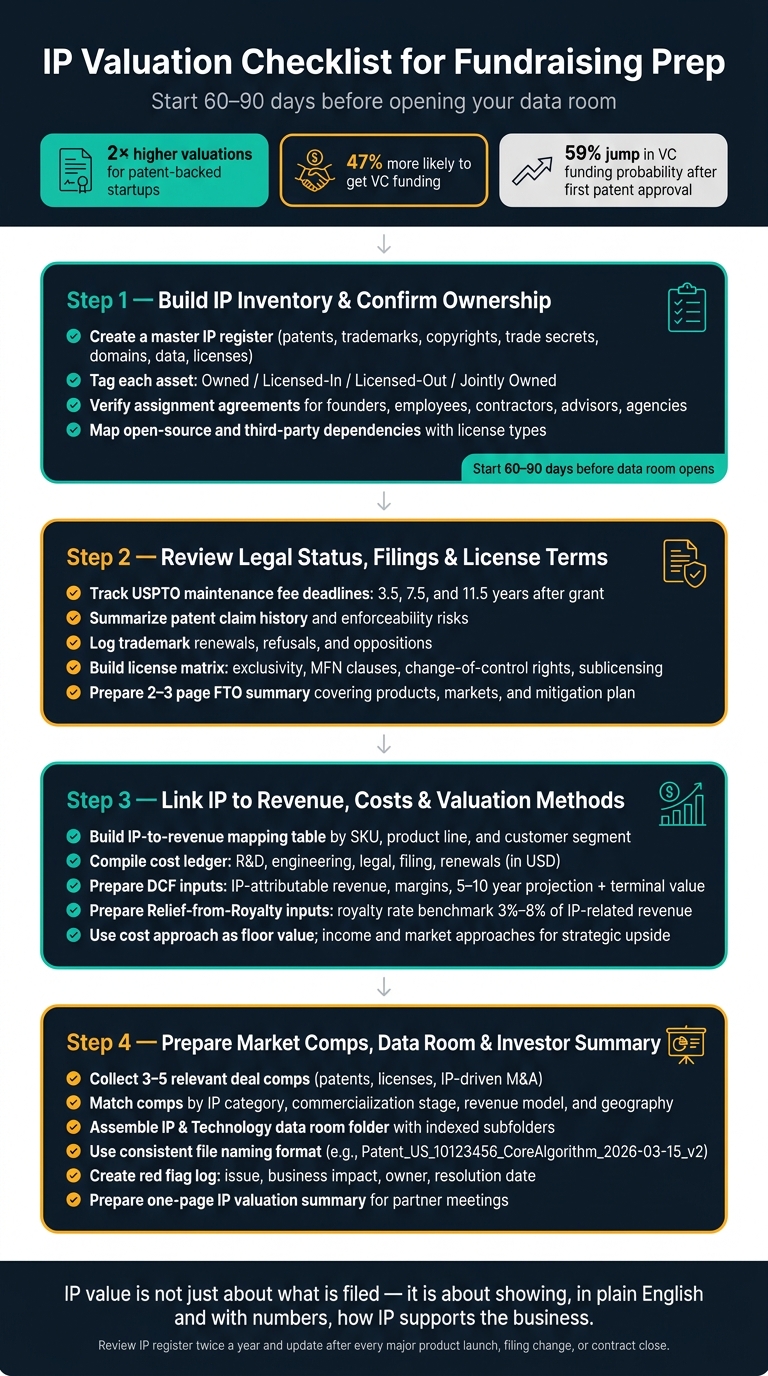
IP Valuation Checklist: 4-Step Framework for Fundraising Prep
Ownership gaps can slow diligence and chip away at valuation. Before investors start review, get clear on what the company owns, what it uses under license, and who owns each asset.
A master IP register is your working record of every IP asset the company owns or relies on. That includes patents and patent applications, trademarks, copyrights, trade secrets, proprietary software, domain names, and major inbound and outbound licenses.
For each asset, record:
Also tag each item as owned, licensed-in, licensed-out, or jointly owned. If there are liens, security interests, or disputes, flag them right in the register.
For proprietary software and trade secrets, add a short description, where the asset is stored, who has access to it, and what business function it supports. Think of this register as the master source for your data room.
Make a list of every founder, employee, contractor, advisor, and agency that touched core IP. Then match each person to a signed invention assignment agreement dated on or before the contribution.
This is where deals often get sticky. Contractor work with no assignment language, prior-employer claims, and university IP with no company assignment or license can all hold up a closing for weeks or lead to escrow demands [3][1].
Collect recorded assignments where they apply. If you have jointly owned assets or active disputes, note them plainly in the register.
Your product may depend on open-source libraries, third-party APIs, SDKs, or licensed datasets. Scan the codebase for open-source and third-party dependencies, then record the license type and any restrictions for each one.
Some licenses come with strings attached. Copyleft licenses can trigger source disclosure duties if they’re mixed with proprietary code. Vendor API terms may also give the vendor broad rights over derived models or data.
Add each dependency to a dedicated part of the IP register. Note the key limits and which product features depend on it. If a critical dependency can be terminated at will or comes with tight data terms, have a backup plan ready to explain.
Start this process 60–90 days before the data room opens. Once ownership is in order, move to filing status and license terms.
Once ownership is settled, the next job is to check protection status and contract limits. Then you can connect each asset to revenue and margin in Step 3.
Set up a patent and trademark status tracker before the data room opens. For each U.S. patent and application, record the application number, filing date, priority date, current status, and remaining term. Patents that are close to expiry can drag down value. [6][7]
Also track USPTO maintenance fee deadlines at 3.5, 7.5, and 11.5 years after grant, and add each date to counsel's calendar. [6][7]
For each core patent family, pull the file history and write a short summary of any claim narrowing, prior-art issues, or enforceability risks. That gives investors a plain-English view of what could weaken the asset. [4][6]
Trademarks matter too. They can support long-term brand value. For each registered mark, log the goods/services class, registration number, jurisdiction, and renewal date. If there are refusals or oppositions, flag them with counsel's view so no one gets blindsided later. [6][7]
If you have FTO work, boil it down into a 2–3 page summary covering the products, markets, blocking patents, and mitigation plan. Put the full opinion in the data room. Keep the summary tight. Investors want the risk and the fix, not a giant legal memo. [4][5][2][8]
Build a license matrix for all material inbound and outbound agreements. Include the counterparty, IP type, territory, exclusivity, economics, sublicensing rights, termination triggers, and change-of-control rights. [5][2][8]
Change-of-control clauses need a close look. If a licensor can terminate or reprice a deal when the company is sold, that can hit exit value fast. The same goes for inbound licenses with high royalty minimums or steep per-unit fees. Those terms squeeze margins and push up breakeven points, and investors will bake that into valuation models. [5][2]
On the outbound side, pay close attention to most-favored-nation (MFN) clauses. They can limit your room to price future deals the way you want. Broad sublicensing rights given to early distribution partners can create another problem: they may cut into your upside in markets you later want to enter on your own.
The table below shows how each structure affects pricing power, future deal room, and risk:
| License Structure | Pricing Power | Flexibility for Future Deals | Investor Risk View | Valuation Impact |
|---|---|---|---|---|
| Exclusive, perpetual | Constrained long term in the covered scope | Very low | High dependency on one counterparty | Upside in that market may be heavily discounted |
| Exclusive, term-limited | Moderate | Medium | Medium | Near-term value from the exclusive period, with some optionality at renewal |
| Non-exclusive, perpetual | Higher | Medium | Diversified risk | Stable cash flows, with value tied to scale achieved |
| Non-exclusive, term-limited | Highest | High | Distributed risk | Often supports the strongest growth assumptions and multiples |
Use this summary to show how licensing shapes revenue, margin, and exit flexibility. Then carry that into Step 3, where you map revenue and cost to each asset.
Turn each material IP asset into clear revenue, margin, and valuation inputs.
Build an IP-to-revenue mapping table that links each asset to specific product lines, customer segments, and contract revenue in USD. Then quantify how much revenue and margin that asset supports.
The main figure here is the share of revenue tied to the IP. Don’t just guess. Back it up with win/loss data, customer feedback, or cohort analysis.
A simple way to do this is to tag each SKU or product feature in your catalog with the IP that makes it possible, pull SKU-level revenue from your finance system, and write down your attribution assumptions in plain English. Investors will pressure-test these links during diligence.
Use the same asset names from your IP register throughout the process. That keeps your attribution clean across all diligence materials.
Track R&D, engineering labor, testing, legal, filing, renewal, and trade-secret protection costs by year in USD.
Build an IP cost ledger, then reconcile it against the general ledger, payroll records, and vendor invoices. If you’ve split shared costs across projects - for example, engineering hours shared across multiple workstreams - spell out the method you used. Jira issue tags or project codes work well because they leave an audit trail investors can check.[13][14]
That ledger becomes the cost baseline for your valuation methods.
For DCF, gather forecasted IP-attributable revenue by year, IP-driven operating margins, a projection period - usually 5 to 10 years plus terminal value - and a risk-adjusted discount rate.[9][10][13][14]
For relief-from-royalty (RfR), you’ll need the IP-specific revenue base, a market-supported royalty rate - often 3% to 8% of IP-related revenue based on observed licensing benchmarks - a tax adjustment that converts pre-tax savings into after-tax cash flow, and a discount rate.[9][11][12][13][14][15]
Use this table to show what each method needs, where it helps, and where it falls short:
| Approach | Required Data | Strengths | Limitations |
|---|---|---|---|
| Income-based (DCF, relief-from-royalty) | IP-attributable revenue forecasts; margins; economic life; royalty benchmarks; discount rate | Directly ties IP to future cash flows; aligns with how investors think about returns | Sensitive to growth and discount-rate assumptions; harder to support for very early-stage IP with limited traction |
| Market-based (comps, transaction benchmarks) | Comparable deal data (license fees, M&A multiples, royalty rates); own revenue and usage metrics | Anchors valuation in real-world transactions; easy for investors to understand | Quality of comps varies; few truly comparable IP transactions; past deals may reflect different market conditions |
| Cost-based (replacement-cost) | Historical R&D, engineering labor, legal, testing, and infrastructure costs; current market rates; time-to-build assumptions | Defensible floor value rooted in actual spend; useful when cash-flow or market data is thin | Does not capture strategic value or pricing power; can understate value in high-growth markets |
Treat the cost approach as the floor. If your IP drives incremental margin far above replacement cost, that spread helps show its strategic value. Put all three input sets in the data room so investors can review the numbers and trace the logic.
These inputs carry into the market comps and data room in Step 4.
Use the revenue, margin, and cost inputs from Step 3 to turn your valuation into a package that can stand up to due diligence.
Build a set of 3-5 relevant deal comps for patents, licenses, or IP-driven M&A. For each one, record:
Benchmark rates can help set the frame. But they shouldn't do all the work. Your chosen rate needs to connect to actual comparable contracts, with a clear explanation for where your IP fits in that range.
Also, don't stop at royalty rates. Investors want to see business impact. Keep the focus on the three examples that matter most: higher gross margins on protected product lines, lower churn tied to proprietary features, or enterprise wins driven by defensible technology.
There's a trap here: bad comps can make the whole story fall apart. A splashy pharmaceutical royalty deal or a bundled M&A transaction doesn't say much about a software patent license. Match comps based on IP category, commercialization stage, revenue model, geography, and the legal rights being transferred or licensed.
Once your comps support the value range, put the backing material in a folder investors can scan fast.
Set up a dedicated IP & Technology folder with a simple index. The goal is plain and practical: investors should be able to find what they need without digging around.
| Subfolder | What to Include |
|---|---|
| IP Inventory & Summary | Master list of patents (filed and granted, with numbers, jurisdictions, and dates), trademarks, copyrights, trade secrets, domains, and key datasets or models |
| Ownership & Assignments | Founder, employee, and contractor IP assignment agreements; work-for-hire clauses; chain-of-title documents |
| Registrations & Filings | Patent and trademark applications, registration certificates, prosecution histories, office actions and responses, maintenance fee records |
| Licenses (Inbound & Outbound) | All material license agreements for software, data, SDKs, and APIs; outbound licenses to customers or partners; any most-favored-nation (MFN) clauses, exclusivity terms, or change-of-control triggers |
| Open-Source & Third-Party Compliance | Software bill of materials (SBOM), open-source usage policy, license classification per dependency, copyleft compliance evidence |
| Valuation Support & Financial Linkages | IP valuation reports, revenue attribution analyses, royalty tables, and income/market/cost model inputs |
| Technical Context | Product roadmap, architecture diagrams, and short descriptions of what each core IP asset protects in business terms |
Use the same file naming format across every document. Something like Patent_US_10123456_CoreAlgorithm_2026-03-15_v2 tells an investor what the file is before they even open it.
Keep one current master copy of each document. Mark old drafts clearly. Use role-based permissions, audit logs, and watermarks so you know who has viewed sensitive files.
Before sharing the room, do one last review for ownership gaps, license conflicts, and claims that don't have support behind them. Check for missing assignment records, expired or pending filings, unresolved license obligations, unsupported revenue claims, and weak market evidence.
Create a red flag log that lists each issue, its business impact, the person responsible for fixing it, and the target resolution date. Fix what you can before the meeting. For anything still open, disclose it plainly and include a remediation plan.
A startup that approved its first patent saw a 59% increase in the probability of raising VC funding,[16] which underscores why clean, documented IP ownership matters well before the first investor conversation.
Before you close the data room, prepare a one-page IP valuation summary or a short slide. In plain English, explain what the IP is, who owns it, why it matters commercially, what evidence backs the value, and what risks still remain.
That summary should include the most important assets, the strongest market comps, the main revenue or margin links, and any legal or diligence items that are still open. The sweet spot is simple: short enough for a partner meeting, but detailed enough that an investor can follow the logic without opening every file in the data room.
Bring in outside help when ownership, licensing, or revenue attribution gets too messy to explain cleanly to investors.
After the data room is built, do one last pass before investors get access. Before fundraising, make sure you have a complete IP register, clean ownership, current filings, mapped licenses, revenue and cost links, supporting comps, and a clean data room.
Before opening the room, verify that every item on this checklist is complete and documented.
Once the checklist is done, keep it up to date. This isn’t a one-time task. Update the IP register when products ship, filings change, or major contracts close. Then review it twice a year.
If the structure is complex, bring in outside help early. When ownership, licensing, or revenue attribution gets messy, it’s better to sort it out before opening the data room. Phoenix Strategy Group can help link IP to revenue, margin, and valuation work.
Start 3 to 6 months before investor outreach. That window gives you time to fix missing IP assignment agreements and clean up incomplete records before active diligence starts.
At the early stage, investors may live with small gaps if you have a clear plan to fix them. At the growth stage, the bar is much higher. Investors usually expect tight documentation, and starting early can help you avoid weak spots that put the deal at risk.
Investors care most about clear legal ownership and any liabilities that could cut into company value.
Big red flags often come down to missing or flawed paperwork. That includes unsigned PIIA agreements or missing work-for-hire clauses for founders, employees, and contractors. If the chain of ownership is messy on paper, it can slow a deal down fast.
They also look hard at patent rights that were never assigned, especially if the work was done before the company was incorporated. On top of that, they review inbound license terms for third-party tech and any past or current IP disputes that might limit freedom to operate or affect the deal.
Show a clear, documented link between your IP and financial results. Keep an IP inventory that connects specific patents, trademarks, or trade secrets to the core products or services that bring in revenue.
For investor due diligence, organize contracts and invoices by fiscal year and by client. Then tie major revenue sources back to the IP behind them. Use an income-based valuation and a financial model that maps ARR and MRR to those IP-backed offerings, with clear assumptions and historical data.