Published on
August 30, 2026


If I exercise ISOs and hold the shares, I can owe AMT before I sell anything. The main way to cut that risk is to control the spread, the timing, or both.
Here’s the short version:
For 2026, the AMT exemption is $90,100 for single filers and $140,200 for married couples filing jointly. And if I do pay AMT, part of it may turn into an AMT credit I can use in a later year.
| Path | Main tax effect | Cash need | Main tradeoff |
|---|---|---|---|
| Staged exercises | Spreads AMT across years | Medium | More waiting, more stock risk |
| Same-year sale | Removes AMT adjustment on sold shares | Lower | Ordinary income treatment |
| Early-year exercise | Gives me more time to decide by year-end | Higher | I need cash sooner |
| Grant-by-grant review | Helps me pick lower-spread grants first | Varies | More tracking |
| Income timing and offsets | Can lower AMT exposure | Varies | Needs tax modeling |
My takeaway: the best ISO move is usually the one that fits my cash, my income, and how long I can afford to hold the stock. Model first, exercise second.
One common way to handle ISOs is to spread exercises across tax years.
The basic idea is simple: if you exercise a smaller number of shares each year, the AMT adjustment for that year may stay lower. That can help reduce the chance of getting hit with a large AMT bill all at once.
Staging can also ease the cash burden. Instead of coming up with all the money in one shot, you spread out the strike cost over time. That said, each year still comes with its own cash needs, including the exercise cost and possible AMT.
There’s a tradeoff here. Every new exercise starts a fresh one-year holding period for long-term capital gains treatment. So if you want that tax treatment, you may need to wait longer before selling. And the longer you wait, the more market risk you take on. If the stock price drops, that delay can sting.
This is why it’s smart to track your annual exercise volume closely. A plan that looks fine on paper can still lead to an unexpected tax bill if you exercise too many shares in a single year.
That works well when a sale is also part of the plan, which leads to the next approach: disqualifying dispositions.
A disqualifying disposition happens when you sell ISO shares before you clear both holding periods: two years from the grant date and one year from the exercise date.
Here’s the tradeoff in plain English: if you sell too soon, the spread is taxed as ordinary income instead of getting long-term capital gains treatment. On paper, that can look worse, since ordinary income rates are usually higher.
But there’s a big wrinkle. If the sale happens in the same calendar year as the exercise, the AMT adjustment for those shares goes away. That can change the math fast, especially if you need cash now and can’t afford to sit on the shares.
For 2026, the AMT exemption is $90,100 for single filers and $140,200 for married couples filing jointly [1].
If you exercise and hold the shares, the spread can trigger AMT before you’ve sold anything. In other words, you might owe tax on gains you haven’t put in your bank account yet. If your income pushes past those exemption amounts, that risk gets more serious.
A same-year disqualifying sale removes that AMT adjustment for the shares you sold. That’s why the timing of the sale matters so much.
Waiting may let you keep long-term capital gains treatment. The catch? You also take on market risk while you wait.
If you don’t have enough cash to cover a possible AMT bill, a disqualifying disposition may be the more practical move. You sell, lock in the gain, use the proceeds to cover the tax bill, and avoid the stress of holding shares that could drop in value.
Sometimes this is less about getting the “best” tax outcome and more about not getting stuck with a tax bill and no cash to pay it.
This choice is still grant-specific. Each grant has its own holding-period clock, so you need clean, grant-by-grant records to know which shares qualify for which tax treatment.
Before you exercise, run a tax projection. That gives you a clearer view of your AMT exposure and helps you decide whether holding or selling makes more sense for each grant.
If staged exercises spread AMT across years, early-year timing gives you more room to manage this year's tax result.
With ISOs, when you exercise can matter almost as much as whether you exercise. An early calendar-year exercise - best case, in January - gives you something a late-year exercise just doesn't: time. And with taxes, time gives you options.
A January exercise opens your decision window right away. You then have close to 12 months to watch the fair market value before December 31 locks in your tax picture. If the stock goes up, that can work in your favor. If it drops, you may still have time to sell before year-end and avoid carrying that spread into AMT.
A November exercise is a different story. At that point, the clock is almost out, so there's far less room to react.
Exercising early also starts the one-year holding period sooner. That can help preserve long-term capital gains treatment if you keep the shares long enough.
The catch is pretty simple: you need cash sooner. You pay the strike price now, and if you hold the shares through year-end, you may still owe AMT.
You'll want to track fair market value throughout the year and review each grant before December 31 to decide if holding still makes sense. That review should happen grant by grant because each ISO lot can lead to a different tax result.
Review each grant based on three things: spread, expiration date, and cash need. Those are the main drivers of AMT risk.
Start with the spread. A higher spread means more AMT per share, so this is the first thing to rank before you exercise. That simple sort helps you see which grants fit a staged exercise plan and which ones need a faster call.
Low-spread grants are usually easier to fit into your AMT room. High-spread grants are a different story. They need tighter timing and more careful cash planning.
Once you've ranked grants by spread, look at the calendar. At that point, expiration dates help you decide what matters more: tax efficiency or keeping the option from expiring.
Expiration dates can push you to exercise before the holding periods line up the way you'd want. If a grant is getting close to its 10-year limit, you may need to exercise it no matter what the spread looks like. Losing the option altogether is usually worse than paying some AMT.
High-spread grants also need more cash up front. You have to cover the strike price and, in many cases, a larger AMT bill.
There’s one more check here: the $100,000 rule. Review it before ranking grants, because it can change the tax treatment for any excess value. Go grant by grant before you exercise so you can rank AMT exposure and avoid tax treatment you didn’t plan for.
Use that ranking to sort grants into three buckets:
After that, line up the ranked grants with your income timing and deductions.
Once you've ranked your grants, line up exercises with years when your outside income is lower. The goal is simple: exercise ISOs when less of your income is coming from salary, bonuses, or other sources, so more of the spread can stay below the AMT line.
Tax-loss harvesting can help here. If you sell losing positions in the same tax year, those losses can offset ISO gains and cut your net AMT exposure.
That said, lower AMT only helps if you can still afford the exercise in the first place.
A lower-income year doesn't magically fix the cash issue. You still need money for the strike price and for any AMT bill that comes with the exercise.
And here's where people get tripped up: if the stock isn't easy to sell fast, you could owe AMT before you have a way to sell shares and cover it. That's a rough spot to be in. Plan for that cash gap before you exercise, not after.
Holding shares for 12 months keeps long-term capital gains treatment in play, but it also leaves you exposed to market risk for longer.
This approach takes forward-looking tax modeling, not just a glance at last year's return. You need to know the income range where AMT starts to hit. That means modeling income, deductions, and exercise size together so you don't get blindsided by an AMT bill.
Work through the year in advance with a tax advisor before you exercise.
Next, compare the five strategies side by side.
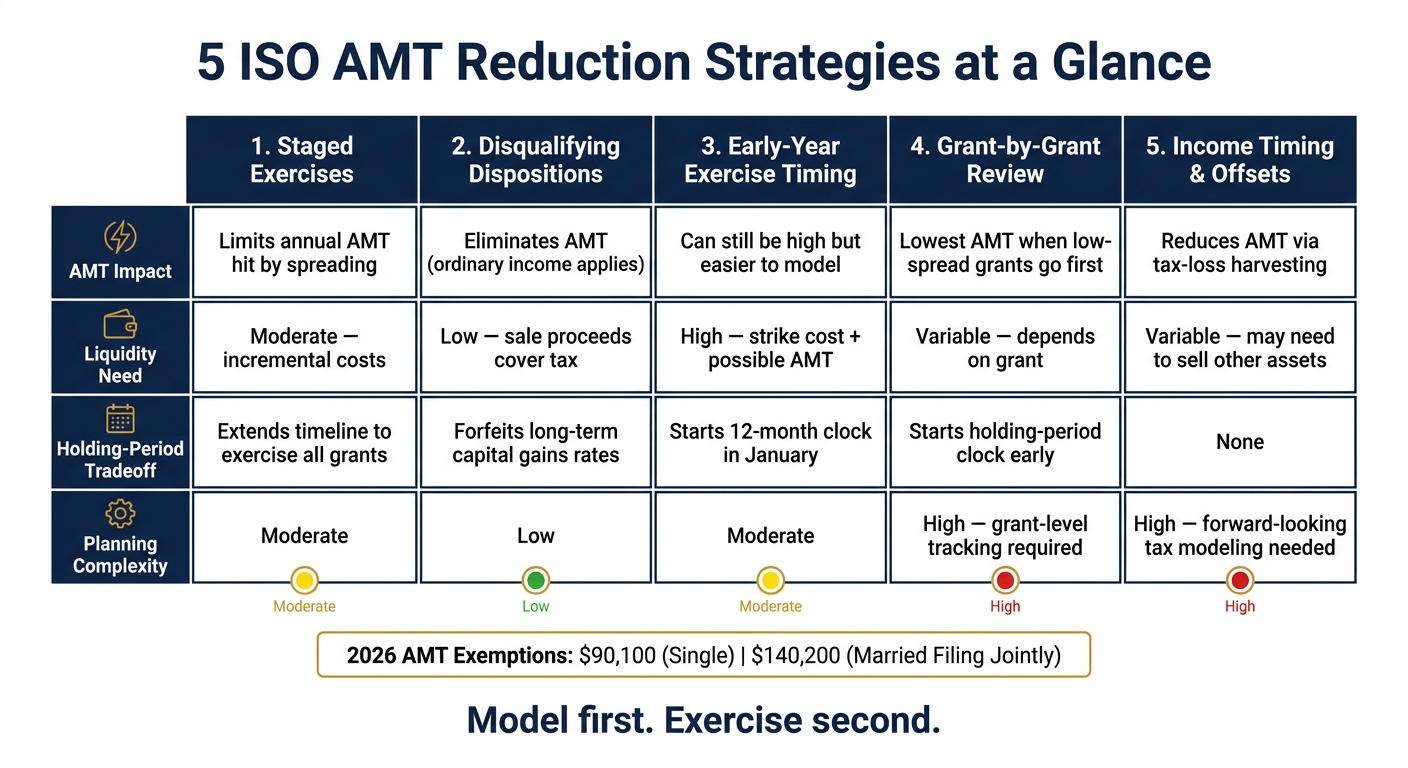
5 ISO AMT Reduction Strategies: Side-by-Side Comparison
No single strategy fits everyone. The best move depends on three big things: how much cash you can set aside for taxes, how jumpy the stock price looks, and how soon you want out. After you rank your grants and model your income, use this table to pick the leanest AMT route.
| Strategy | AMT Impact | Liquidity Need | Holding-Period Tradeoff | Planning Complexity |
|---|---|---|---|---|
| Staged Exercises | Limits annual AMT hit by spreading exercises across years | Moderate - incremental costs over time | Extends the timeline to exercise all grants | Moderate |
| Disqualifying Dispositions | Eliminates AMT entirely - but ordinary income rates apply instead | Low - sale proceeds cover the tax bill | Forfeits long-term capital gains rates | Low |
| Early-Year Exercise Timing | Can still be high, but easier to model before year-end | High - strike cost plus possible AMT | Starts the 12-month clock in January, helping with exit timing | Moderate |
| Grant-by-Grant Review | Lowest AMT when low-spread grants are exercised first | Variable - depends on the grant | Starts the holding-period clock early | High - requires grant-level tracking and filing decisions |
| Income Timing & Offsets | Reduces AMT via tax-loss harvesting | Variable - may require selling other assets | None | High - needs forward-looking tax modeling |
Here’s the basic tradeoff: some moves cut AMT head-on, while others mostly control when it lands.
Disqualifying dispositions are the easiest path, but the swap is pretty clear. You avoid AMT, yet you give up the chance for long-term capital gains treatment and take ordinary income instead.
Early exercise can keep AMT low when the spread is close to zero. That can matter a lot if you want to start the 12-month holding clock as soon as possible.
Staged exercises and income timing don’t usually erase the tax issue. They help smooth it out over time, which can be a lot easier on cash flow.
One more thing: AMT paid in one year can create a credit against future regular tax [1]. So even if a plan shifts AMT instead of wiping it out, it may still help later on.
Each of the five paths cuts AMT in a different way. Some reduce the spread. Some change the timing. Others change the income mix.
That’s why ISO AMT planning needs to start before you exercise. Once you do, most of that year’s tax result is already locked in. If you wait until tax season, you usually won’t have much room left to adjust.
It also helps to know how close you are to the AMT exemption. That one detail can change which path makes the most sense. The best move depends on your share count, stock price movement, cash on hand, and other income during the year.
In plain English: the best ISO plan is usually the one that lines up with your cash, your income, and your exit timeline.
A staged exercise plan can work well one year and fall apart the next. That’s why it makes sense to model current-year income, deductions, and exercise size before taking action.
For growth-stage companies, fractional CFO services can help connect ISO decisions with the bigger picture around liquidity and exit planning.
Model first, exercise second.
Estimate the bargain element like this: (FMV - exercise price) × number of shares. Then add that amount to your regular taxable income to estimate your AMTI. After that, subtract the AMT exemption that applies to you and use the 26% and 28% AMT rates to figure out your tentative minimum tax.
Next, compare that number with your estimated regular tax. In most cases, you pay whichever amount is higher.
This is where things can get a little tricky. Your income, tax brackets, and state tax rules can all change the math, sometimes by a lot. So before you lock in your exercise plan, it’s smart to work with a tax advisor.
A same-year sale, sometimes called an intentional disqualifying disposition, can be the smarter move if your goal is to avoid or cut down AMT. Why? Because it keeps the bargain element from turning into an AMT preference item.
It can also make more sense if you don't have cash set aside for a surprise AMT bill. The same goes if you're trying to lower single-stock concentration risk, or if you need liquidity and more certainty around timing because an M&A deal forces a sale before the holding periods are met.
Start with grants where the gap between fair market value and strike price is smallest. That keeps the immediate AMT hit, or bargain element, lower.
It also helps to look at grants that allow early exercise when fair market value is close to the strike price. From there, pick the grants that line up with your yearly AMT budget and your long-term holding-period goals.