Published on
July 31, 2026


If I had to boil this down to one line, it’s this: K-1 deals may cut current taxes, while 1099 deals are usually easier to file.
When I compare these investments, I don’t just look at yield. I look at:
Here’s the short version:
A big point from the article is that the same cash payout can lead to very different after-tax results. For example, a K-1 investment might send cash but still show a tax loss because depreciation lowers taxable income. A 1099 debt deal is often easier to report, but that income is usually taxed right away at your marginal rate, which can go as high as 37% at the federal level.
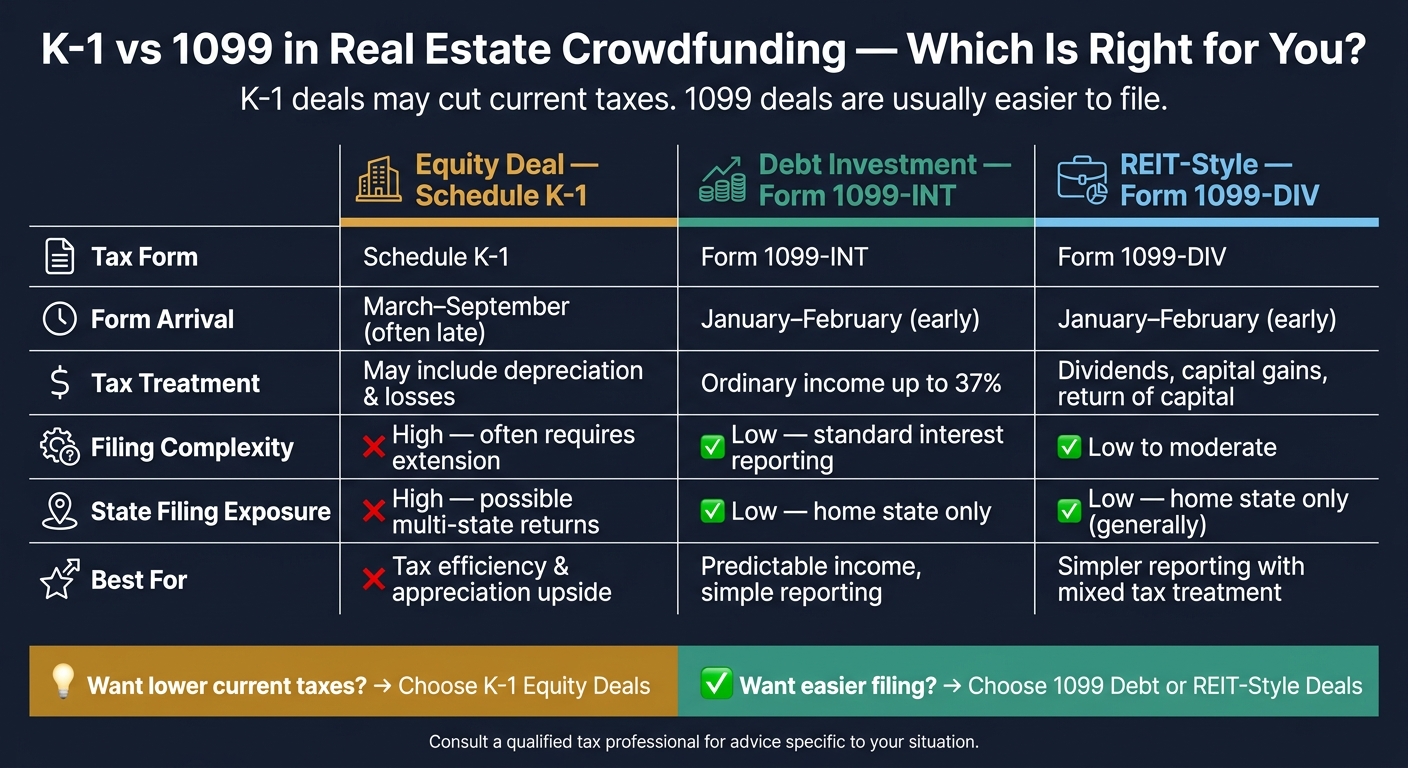
K-1 vs 1099 in Real Estate Crowdfunding: Tax Form Comparison

| Deal Type | Tax Form | Form Timing | Tax Treatment | State Return Risk | Filing Work |
|---|---|---|---|---|---|
| Equity | Schedule K-1 | March-September | May include depreciation, losses, gains | Higher | More |
| Debt | 1099-INT | January-February | Interest taxed as ordinary income | Lower | Less |
| REIT-style | 1099-DIV | January-February | Dividends, capital gains, return of capital | Lower, in general | Less |
My takeaway: if I want tax-efficient cash flow, I’d lean toward K-1 equity deals. If I want cleaner filing, earlier forms, and fewer tax surprises, I’d lean toward 1099 debt or REIT-style deals.
That’s the whole decision in plain English: lower current taxes vs. easier tax season.
Equity crowdfunding usually means you own a piece of an LLC or limited partnership. So the deal’s tax items pass through to you on a Schedule K-1. That pass-through setup is why K-1 reporting gets more involved than a simple 1099.
A K-1 is more than an income statement. It reports your share of income, losses, gains, interest, and depreciation [1][2].
That matters for two reasons. It can change how much work goes into your tax return, and it can change what you owe right now. A K-1 may include depreciation, which can lower current taxable income even when the investment is sending you cash.
For example, sponsors who commission a cost segregation study can reclassify items like appliances or parking lots into shorter depreciation schedules. That pulls more depreciation deductions into the early years of the deal [1].
Here’s the part that throws people off: your K-1 can show a tax loss even while you’re getting actual cash distributions. That tax loss may offset other passive income on your return [2].
Before investors get K-1s, the partnership has to file Form 1065. That takes time.
So while 1099s often land in January or February, K-1s usually show up in March or April - and sometimes as late as September [1][5].
"K-1 forms show up late. Sometimes really late - we're talking September of the following year. And that delays your entire tax filing and creates headaches if you're unprepared." - Kevin, KDS Development [5]
Because K-1s tend to arrive late, investors with several equity deals often plan to file a federal tax extension. And the form itself has more moving parts than a 1099, which is why many investors use a CPA who knows real estate and can enter everything the right way.
The late timing is only one part of the hassle. The filing footprint can grow by state too.
Owning an equity stake in a partnership can trigger state filing duties in the state where the property sits [3][5]. If your holdings include properties in Phoenix, Dallas, and Atlanta, you may need to file state returns in more than one state, on top of your home-state return [3][5].
That’s the trade-off with K-1 tax treatment. The same pass-through setup that can lower current taxes can also mean more paperwork.
Depreciation can help current cash flow, but part of that tax break may be recaptured when the property is sold [1].
Debt deals and REIT-style investments usually come with Form 1099 instead of a K-1. That means less tax prep work, earlier tax documents, and, in most cases, a simpler filing process.
Debt deals are the most straightforward 1099 setup. When you invest in a real estate debt deal, you're lending money, and the interest is reported on Form 1099-INT. There’s no partnership return and no K-1 allocation to sort through.
The trade-off is pretty clear: 1099-INT income is taxed as ordinary income at your federal marginal rate, which can go as high as 37% [3]. You also don’t get the paper losses that equity investors may use to offset cash distributions. What you do get is a clean tax form that usually shows up in January or February and can be added to your return with very little hassle [1].
REIT-style deals also stay in the 1099 world, but the tax treatment can vary more. These investments issue Form 1099-DIV instead of a K-1 [4]. That single form may include ordinary dividends, capital gains, and return of capital.
Return of capital lowers your basis instead of adding to your current taxable income. For many investors, 1099-DIV income is taxed in your home state, not in the states where the properties are located [2][4]. That strips out one of the bigger headaches that often comes with K-1 investing.
Getting these forms in January or February gives you more time to estimate what you owe and plan tax payments. That timing can make the filing process feel a lot less rushed.
| Feature | 1099-INT (Debt Deals) | 1099-DIV (REIT-Style) |
|---|---|---|
| Income Type | Interest income | Dividends, capital gains, return of capital |
| Tax Rate | Ordinary income | Varies by distribution type |
| Depreciation Benefit | None | Limited (private REITs only) |
| State Filing Exposure | Home state only | Home state only (generally) |
| Document Arrival | January-February | January-February |
| Filing Complexity | Low | Low to moderate |
K-1 and 1099 reporting differ in filing work, delivery timing, state tax exposure, and what you may keep after taxes. The table below shows where those gaps tend to matter most when it's time to file.
The basic pattern is pretty simple: K-1s lean toward tax savings. 1099s lean toward easier filing.
| Feature | Equity Deal (K-1) | Debt Investment (1099-INT) | REIT-Style (1099-DIV) |
|---|---|---|---|
| Typical Tax Form | Schedule K-1 | Form 1099-INT | Form 1099-DIV |
| Filing Burden | High - more complex filing, often extension-driven | Low - standard interest reporting | Low - standard dividend reporting |
| Form Arrival | Late: March through September [1][5] | Early: January–February [4] | Early: January–February [4] |
| State Filing Exposure | High - possible multi-state returns [5] | Low - federal and home-state reporting [3][4] | Low - federal and home-state reporting [3][4] |
| Cash-Flow Impact | High - sheltered by pass-through depreciation [2] | Lower - ordinary income tax treatment [3] | Moderate - may include return of capital |
| Best For | Tax efficiency and appreciation upside | Predictable income, simpler reporting | Simpler reporting with mixed tax treatment |
In plain English, this comes down to a trade-off.
If you invest through a K-1 structure, you may get better tax treatment and more upside from appreciation. The catch? Filing can be a hassle. Forms often show up later, and multi-state reporting can enter the picture [5]. That’s the part many investors don’t love.
If you invest in a 1099 deal, the tax paperwork is usually much easier. Forms tend to arrive earlier, often in January or February [4], and reporting is more in line with what most people already know. Debt deals reported on 1099-INT usually produce ordinary income [3], while 1099-DIV deals can come with mixed treatment, including return of capital.
So the choice often comes down to this: Do you want simpler filing, or do you want more tax-efficient cash flow? The table makes that trade-off easier to see side by side.
| Reporting Type | Main Pros | Main Cons | Best For |
|---|---|---|---|
| K-1 Reporting | Pass-through deductions can cut current taxable income [1][2] | Late forms and more complex filing, sometimes across multiple states [1][5] | Investors focused on tax efficiency and long-term wealth building |
| 1099 Reporting | Simple annual filing; forms usually show up well before the April deadline; income is easy to report [4] | Income is usually taxed at ordinary marginal rates, and there are no pass-through depreciation deductions to offset it [3] | Investors who want simplicity, steady income, and a clean filing process |
This decision is pretty simple at its core: do you want easier filing, or do you want more tax-efficient cash flow?
K-1 investments can send you cash while showing little or even no taxable income, because depreciation can offset that income [2][5]. That can be a big win on the tax side. The catch? Paperwork can get messy. If you own several K-1 investments, it helps to track expected delivery dates so you don't get stuck waiting and pushing back your tax filing [5].
1099 reporting is the opposite. Forms tend to arrive early, and the income is straightforward to report. No maze, no extra layers. But that simplicity often comes with a higher current tax bill, since interest and dividend income is usually taxed at ordinary rates [3].
This choice boils down to one trade-off: K-1s can help lower taxes, while 1099s make filing easier.
Based on the factors above, the better fit depends on which burden you want to cut: current taxes or filing complexity.
If your top goal is tax efficiency, equity deals with K-1 reporting usually come out ahead. K-1 equity deals can produce current tax losses through depreciation while still sending cash distributions. But there's a catch. K-1s often show up in March or April, and sometimes not until September. You may also need to file in more than one state, depending on where the syndication owns property [1][5].
If you'd rather have simpler compliance and steady cash flow, 1099-reporting debt and REIT-style investments are the easier route at tax time. The downside is plain enough: that income is taxed as ordinary income, and you don't get a depreciation offset [3].
| Investor Priority | Better Fit |
|---|---|
| Maximize after-tax cash flow | K-1 equity deals |
| Avoid late forms and extensions | 1099 debt or REIT-style |
| Minimize multi-state filing exposure | 1099 debt or REIT-style |
The clearest dividing line is simple: Do you care more about lowering taxes or making filing easier? If tax efficiency matters most, K-1 is often the better pick. If you care more about simplicity, speed, and fewer state filings, 1099 is usually the cleaner path.
Yes. With K-1 deals, you should plan to file a tax extension because K-1 forms often show up late - sometimes as late as September.
These forms report your share of partnership income, losses, and depreciation. If they arrive after the usual filing deadline, it can be tough to finish your personal tax return on time.
Yes - K-1 losses, especially those tied to depreciation passed through from an investment, can offset other passive income on your tax return.
In real estate syndications and LLC deals, that often shows up as a paper loss. And that paper loss may help shelter distributions or other passive gains.
That said, IRS passive activity loss rules still apply. So it’s smart to talk with a tax professional to see how these offsets work in your specific situation.
It mostly comes down to simplicity vs. tax treatment.
REIT-style investments usually send a 1099-DIV, which is a lot easier to deal with when tax season rolls around.
Syndications and LLC-based deals usually send a Schedule K-1 instead. Those forms often show up later, sometimes as late as September. That delay can be a headache if you like to file early.
That said, K-1 deals can offer a tax upside. They may pass through depreciation, which can create paper losses and lower your current taxable income. When the property is sold, though, you may face depreciation recapture.