Published on
August 6, 2026


Most deal friction after closing comes down to five points: control, timing, incentives, retention, and post-close authority. If I were preparing for a sale, I’d want those terms locked down before signing because weak transition terms can drag down earn-outs, slow integration, and hurt deal results.
Here’s the short version:
What I’d lock in before close:
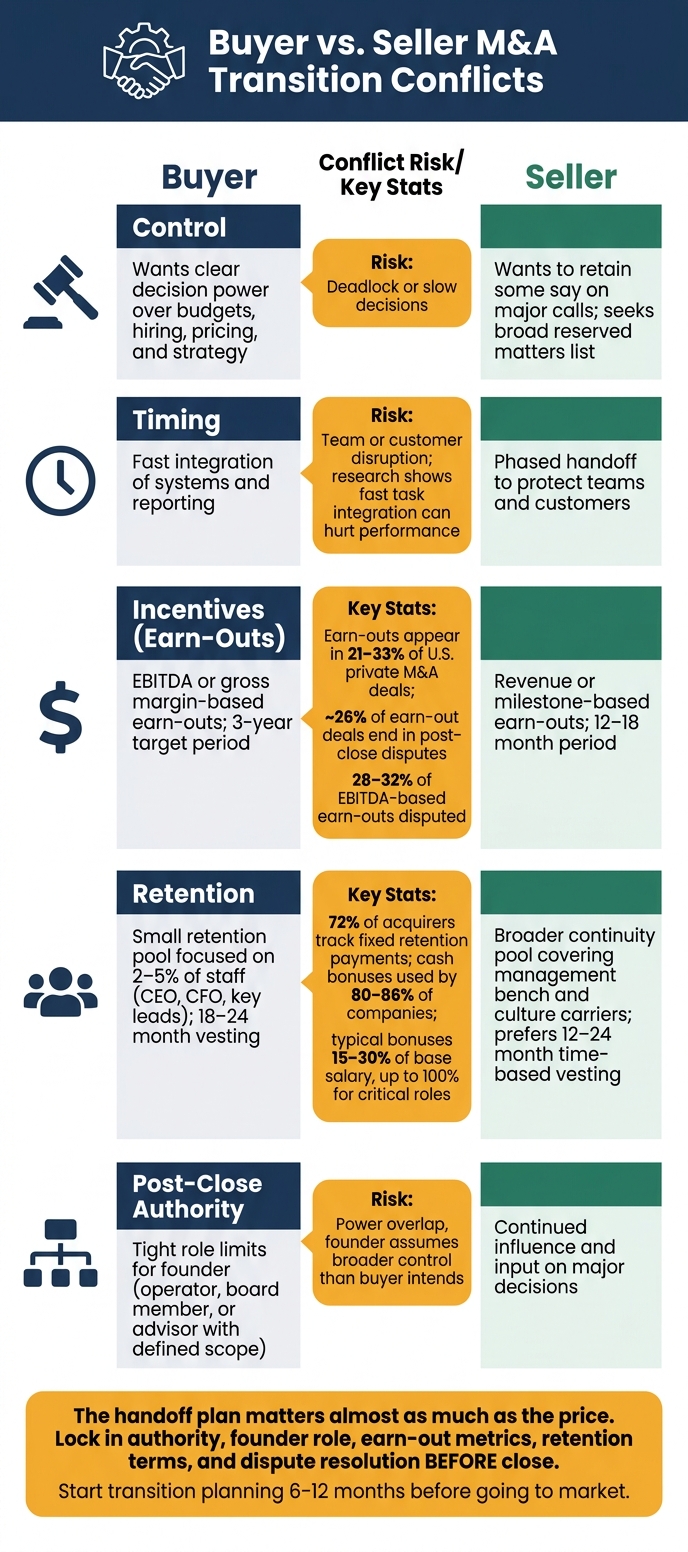
Buyer vs. Seller M&A Transition Conflicts: Key Flashpoints & Stats
| Issue | Buyer View | Seller View | Main Risk |
|---|---|---|---|
| Control | Clear buyer decision power | Founder keeps some say | Deadlock or slow decisions |
| Timing | Faster integration | Phased handoff | Team or customer disruption |
| Incentives | Profit-based earn-out | Revenue or milestone earn-out | Payout disputes |
| Retention | Small pool for key leaders | Broader continuity focus | Key departures |
| Post-close role | Tight role limits | Continued influence | Power overlap |
If I had to boil the article down to one point, it would be this: the handoff plan matters almost as much as the price. In many mid-market and growth-stage deals, the hard part is not getting to closing day. It’s deciding who runs what on Day 1, Day 90, and Year 1.
After closing, buyers want clear decision-making power over strategy, budgets, hiring, and reporting. They usually don't want informal input or shared control. Sellers, especially founders who stay on for a period or roll equity into the new setup, often expect to keep a say on major calls. That's where governance friction starts.
Reserved matters set the line on which decisions need seller approval. Buyers push for a short list. Sellers usually want more protection. The tension isn't just about who decides. It's about which decisions sit inside that authority.[3][8][9]
| Governance Area | Buyer's Position | Seller's Position | Misalignment Risk |
|---|---|---|---|
| Board seats | Buyer-controlled majority | Seller retains one or more seats | Deadlock on key votes |
| Veto rights | Narrow or none | Broad consent rights on major moves | Slower execution |
| Reserved matters | Short list, management decides most things | Long list covering strategy, capex, and hiring | Slower execution in first 90 days |
| Executive appointments | Buyer controls all C-suite changes | Seller wants approval rights on key roles | Leadership instability during handoff |
A practical middle ground often looks like this: the buyer keeps approval rights over strategy, budgets, capital allocation, and major contracts, while the founder keeps running day-to-day operations within agreed limits, often supported by fractional CFO services. That setup tends to work best during earn-out periods, when the seller still has money tied to post-close results.
Control is only half the fight. Timing decides how that control plays out.
Buyers usually want to move fast. Sellers usually want a phased handoff. Research backs the seller's caution on one point in particular: fast task integration - systems, processes, and reporting - can hurt performance if pushed too hard, while fast human integration - clear leadership roles and reporting lines - often helps.[4][5][6] Put simply, it's risky to move systems faster than people.
| Transition Phase | Buyer's Priority | Seller's Priority | Typical Conflict |
|---|---|---|---|
| Pre-close | Finalize org chart, set Day 1 reporting structure | Protect employee and customer communications | Who announces what, and when |
| First 100 days | Align systems, replace duplicative roles, establish reporting cadence | Stabilize client relationships, avoid abrupt changes | Pace of headcount and systems changes |
| First year | Full integration into buyer's systems and reporting cadence | Seller remains active as CEO or key relationship holder | Whether seller's continued role helps or slows execution |
| Beyond year one | Complete ownership transfer, wind down seller's day-to-day role | Ensure earn-out targets aren't undermined by integration disruption | Lingering founder influence vs. clean handoff |
Ambiguity after close usually costs more than compromise before it. When buyers and sellers leave the transition timeline vague, they often end up with slower integration, weaker earn-outs, and less deal value on both sides.[7][1][10][11] The fix is simple in theory, even if it takes work in practice: define the transition calendar in the deal documents before closing.
Once control and timing are set, incentives become the next source of conflict.
Once control and timing are settled, the next clash is about money: how the seller gets paid and who sticks around after close.
Earn-outs appear in about 21–33% of U.S. private M&A deals.[12][13][14][15] On paper, both sides say they want alignment. In practice, they mean different things by it. Buyers treat earn-outs as a way to share risk. If future growth is still uncertain, they don't want to pay top dollar for results that may never show up. Sellers see the same setup very differently. From their side, the earn-out is often tied to value they believe they already built, except now the payout depends on choices they may no longer control.
That’s why metric design becomes such a battleground.
Sellers usually prefer revenue-based earn-outs because they’re simpler and less exposed to buyer-controlled costs. Buyers don’t love that approach, since revenue alone says little about whether the business is making money. They often push for EBITDA- or gross margin-based earn-outs because those fit the way they run the business. The catch is obvious: those metrics give buyers a lot of room to shape the outcome through cost allocations, overhead charges, and staffing moves.
Seller caution isn’t paranoia. The numbers back it up. About 26% of deals with earn-outs led to post-closing disputes, and around 28–32% of EBITDA- or gross-profit-based earn-outs ended up disputed.[2]
| Earn-Out Element | Buyer's Position | Seller's Position | Conflict Risk |
|---|---|---|---|
| Metric design | EBITDA or gross margin (reflects profitability) | Revenue or milestone-based (harder to manipulate) | Disputes over cost allocations and adjustments |
| Target period | 3 years (smooths volatility) | 12–18 months (limits exposure to buyer decisions) | Misaligned integration incentives |
| Calculation disputes | Buyer applies standard accounting policies | Seller wants locked policies and no new overhead charges | Accounting manipulation risk |
| Control over levers | Buyer controls pricing, hiring, and capital spend | Seller wants operating covenants and information rights | Buyer actions depress earn-out metrics |
The best earn-out structures deal with the control issue head-on. That often means:
That same push and pull shows up in retention. Buyers want to keep a small group that matters most. Sellers usually want much more continuity than that.
Retention takes the incentive debate and turns it into a people problem.
The sharpest disagreement is usually over which roles are actually critical to the deal. Buyers tend to focus retention dollars on a very small slice of the company, often less than 2–5% of staff,[19][21] centered on the CEO, CFO, head of sales, key technical leads, and people who own major customer ties. The logic is simple: protect the value drivers, not every box on the org chart.
Sellers often push back hard. Founders rarely see the company as a handful of star roles. They see an interdependent team, where long-tenured managers and internal culture carriers hold more of the place together than any spreadsheet can show. If those people walk, sellers argue, the buyer may lose part of what it just paid for.
That tension shapes both the size of the retention pool and who makes it into it.
A 2024 Willis Towers Watson survey found that 72% of acquirers track or set aside fixed retention payments during M&A, and cash bonuses are used by about 80–86% of companies for senior leaders and salaried employees.[16][20] In the market, retention bonuses for key roles usually fall in the 15–30% of base salary range in middle-market deals, with especially critical roles moving up to 25–100%, typically paid in tranches over 12–24 months after closing.[17][18][21]
| Retention Element | Buyer's Position | Seller's Position | Conflict Risk |
|---|---|---|---|
| Critical-role selection | Deal-critical leaders only | Broader management bench included | Key departures erode deal value |
| Retention pool size | Small, tightly scoped pool | Broader pool tied to continuity needs | Budget disputes during negotiation |
| Vesting period | 18–24 months, sometimes with performance gates | Time-based vesting over 12–24 months preferred | Leaders exit before vesting completes |
| Title or role protection | Flexibility to reorganize reporting lines | Defined role scope and title guarantees | Leaders mentally check out despite staying |
| Continuity risk | Integrate into buyer's management system | Preserve key team practices | Silent attrition among retained leaders |
One workable middle ground is a two-tier pool. The first tier is a core pool for the most deal-critical people, with larger grants and tighter conditions, which tends to reflect the buyer’s view. The second tier is a broader recognition pool with smaller, time-based bonuses meant to support continuity across the rest of the team, which lines up more closely with the seller’s view.
Role protection needs the same kind of middle ground. The cleanest agreements usually avoid locking in exact titles. Instead, they define minimum role parameters such as budget authority, team size, and reporting level. They also spell out what happens if the employee is terminated without cause before vesting ends, with accelerated vesting in full or in part being the usual answer.
Even when control and timing seem settled, fights often pop up after close. The issue changes shape. Instead of arguing over whether the deal should happen or when, both sides start bumping into each other over who gets to make decisions once the buyer owns the business.
That’s where a lot of trouble starts. Signing the deal doesn’t end tension. It just moves it into post-close decision rights. And if those rights aren’t spelled out in the purchase agreement, employment agreement, and governance documents, each side may walk in thinking it has more say than it does.
Buyers usually want decision control. Sellers usually want to keep some influence, but without confusion. That split is just the earlier control fight in a new form, and it shows up fast in the founder’s post-close role.
In most deals, that role lands in one of three buckets: operator, board member, or advisor. Each comes with a different level of authority, time commitment, and pay structure. And each can create friction when the lines are blurry.
| Role | Authority | Time Commitment | Compensation Approach | Common Conflict Risk |
|---|---|---|---|---|
| Operator (e.g., division CEO) | Day-to-day execution within a delegated budget or hiring band | Full-time | Salary or consulting fee; sometimes a performance bonus or earn-out | Founder assumes broader control than the buyer intends |
| Board Member | Governance and oversight, not management | Limited | Board compensation | Founder expects to manage instead of govern |
| Advisor / Consultant | Periodic guidance only; no formal operating authority | Limited, fixed hours per month | Retainer-based advisory pay | Founder continues acting like the decision-maker |
Once the role is set, the deal documents need to lock it down. The best way to head off conflict is to deal with it before close. Attach a written transition plan to the deal documents. It should spell out role definitions, decision authority, communication rules, and a dispute-resolution process. It also needs to say who leads customer communication, employee announcements, vendor transitions, and system changes during the first 30, 60, and 90 days after close.[22][23]
Be specific. Use calendar-based milestones and name the person responsible for each item. For example, financial reporting moves to the buyer's format by day 45, HR policies line up by day 60, and the founder's direct approval authority ends after day 90. A written authority matrix should assign budget approval, senior hiring, pricing changes, capital spending, and vendor selection to one named person or governing body.[22][23]
That matters because this is still the same core fight: the buyer wants authority, and the seller wants to keep some influence.
Governance terms need the same level of detail. State which decisions need founder input and which need buyer approval. Then build a clear escalation path, such as:
Set response deadlines too. A 48-hour window for escalation and one week for a final decision can stop a small issue from turning into a messy post-close dispute.[23]
Clear role boundaries help protect deal value by cutting down post-close power struggles.
Phoenix Strategy Group helps growth-stage companies model leadership transition scenarios, test operating and cash-flow impacts, and document role boundaries before close.
Most transition disputes come back to the same basic tension: buyers want control and speed, while sellers want continuity and protection. When leadership changes hands, the conflicts usually show up in the same places - control, timing, incentives, retention, and post-close authority. Clear terms head off most of these problems.
Start transition planning 6–12 months before going to market. Waiting too long adds friction, slows diligence, and cuts into negotiating leverage.
Before close, lock in:
Earn-outs need precise drafting. Disputes still show up often when payouts depend on decisions controlled by the buyer.[24]
Phoenix Strategy Group helps founders model earn-outs, define leadership roles, and document governance before close.
Founders can keep influence without dragging down decision-making if decision rights and governance are set before the deal closes. A formal Delegation of Authority matrix should spell out who has final approval for things like hiring, capital spending, and contracts.
It also helps to choose an operating model that matches the deal thesis before Day 1. Clear reporting lines and escalation paths let founders stay involved without turning into a bottleneck.
Earn-outs are much easier to fight over when the milestone depends on numbers the seller can’t control. Net profit is a classic example. The buyer can change the result just by adding expenses, which can shrink profit even if the business itself is doing fine.
Trouble also starts when the deal doesn’t spell out exactly how a metric will be calculated or tracked. If the math is fuzzy, friction usually follows.
To cut down on disputes, tie the earn-out to measurable outcomes the seller can still influence, such as revenue retention. It also helps to use virtual data rooms so both sides can report and verify financial performance from the same source of truth.
Retention plans should focus first on high-performing employees and the people most tied to the company’s success. That usually means flight-risk leaders and anyone flagged in a retention risk map.
Many companies also include high-potential talent, often the top 2% of the workforce. Why? They’re often among the first to leave during periods of change.
The aim is simple: use data to focus on the roles that matter most for day-to-day stability and synergy realization.