Published on
September 3, 2026


If I want funding for a Pacific Islands fintech, I need to prove three things fast: revenue is clean, customers stay, and cash lasts. For a company doing $500,000 to $10,000,000 a year, investors will check bank reconciliations, churn, burn, licenses, fraud logs, and cap table records before they move forward.
Here’s the short version:
I’d treat this checklist as a simple test: Can I show how money comes in, where it goes, what risks exist, and what fixes are in place? If the answer is yes, diligence tends to move with less friction.
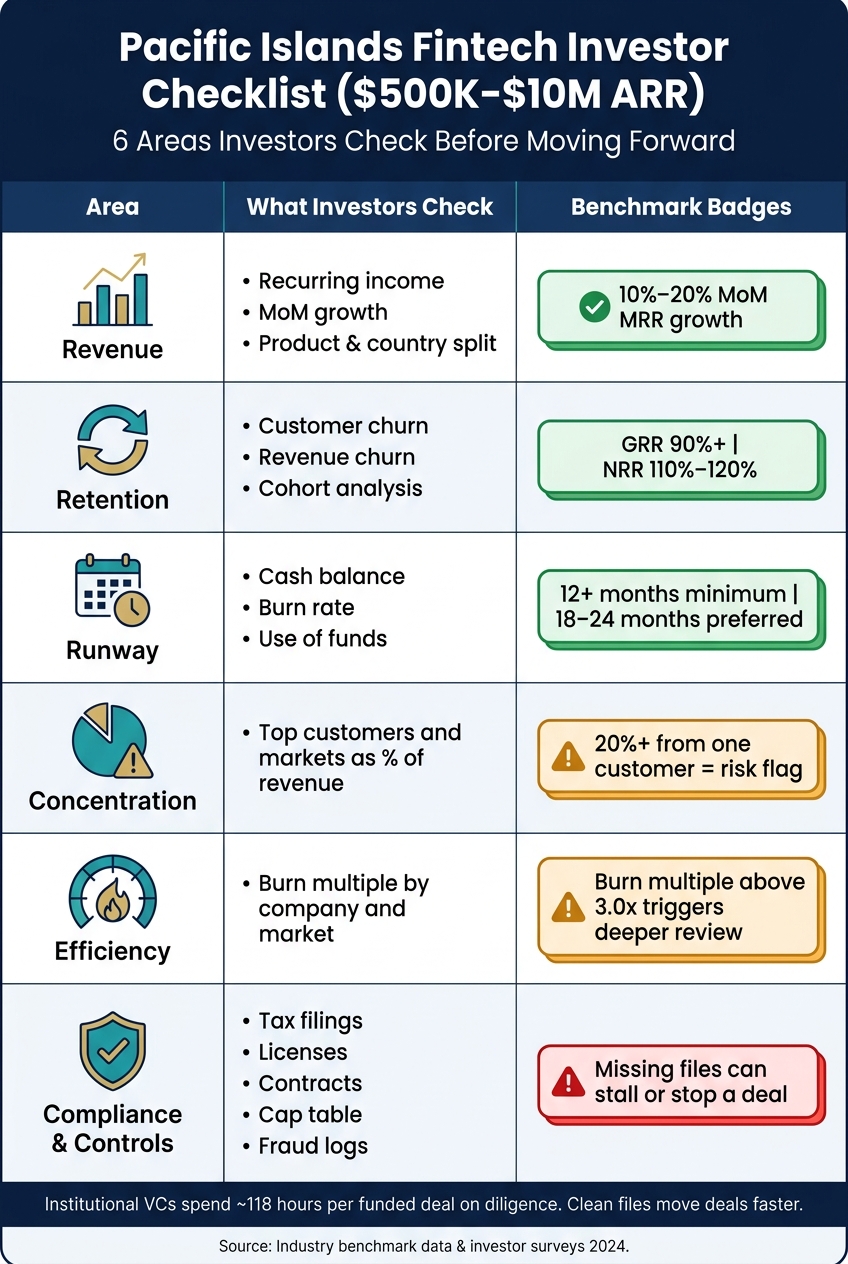
Pacific Islands Fintech Funding: Key Investor Benchmarks at a Glance
| Area | What investors check first | Common benchmark or trigger |
|---|---|---|
| Revenue | Recurring income, MoM growth, product and country split | 10%–20% MoM MRR growth for early traction |
| Retention | Customer churn, revenue churn, cohorts | GRR 90%+, NRR 110%–120% |
| Runway | Cash balance, burn, use of funds | 12+ months expected; 18–24 months preferred |
| Concentration | Top customers and markets | 20%+ from one customer can be a risk |
| Efficiency | Burn multiple by company and market | Above 3.0x often gets deeper review |
| Compliance | Tax, licenses, contracts, cap table | Missing files can stall or stop a deal |
| Controls | Reconciliations, fraud logs, access records | Investors often review 6–12 months of statements |
In short, this article is about getting your numbers, files, and market plans in order before investors start asking hard questions.
In Pacific Islands markets, investors want proof that revenue is recurring, not just going up. Show your trailing twelve-month revenue in USD, split by product line, like payments processing vs. lending fees, and by geography, such as Fiji, Samoa, and Tonga. That breakdown helps separate recurring revenue from one-off income. It also matters because a single country can distort the full picture.
You should also back this up with 12–18 months of month-over-month (MoM) revenue growth in a table or chart. If your business has seasonality, say so plainly. Holiday remittance spikes are a good example. For early-stage fintechs with strong traction, a common benchmark is 10–20% MoM monthly recurring revenue (MRR) growth [2].
Include a few operating metrics that make the revenue picture easier to trust:
If one customer or one market drives too much of the business, investors will spot it fast. Better to show it directly and explain it.
Report both customer churn and revenue churn, but put more weight on revenue churn. A healthy Gross Revenue Retention (GRR) is 90%+, while strong Net Revenue Retention (NRR) lands around 110–120% [3][5][7]. If your NRR is above 100%, that tells investors something simple but powerful: customers are not just staying, they're spending more over time.
Cohort retention is where this starts to feel real. Build cohorts based on first transaction month and show the share that remains active and revenue-generating at 3, 6, 12, and 24 months. In Pacific Island markets, customer acquisition can get expensive because users are spread across islands and regions. That makes strong cohort retention one of the clearest signals you can show. Add repeat transaction frequency by segment to prove the product is becoming part of a customer's routine.
Keep a documented log of churn reasons, then group and summarize them. If high fees or KYC friction come up again and again, show what changed. Investors don't want churn numbers in isolation. They want to see that the team understands the pattern and is doing something about it.
State your current cash balance in USD as of a specific date. For example: Cash balance as of 08/31/2026: $725,000. If part of that cash is held in NZD or AUD, note that too.
Then show your average monthly net burn over the last three to six months, broken out by category:
The basic formula is simple:
Show at least three cases: base case, conservative case such as a 10% FX cost increase, and a growth case with planned hires included. Investors usually expect at least 12 months of runway. 18–24 months is preferred, and 24–36 months is common when funding markets are tighter [4].
Be direct about the raise amount, target runway, and use of funds. Once those numbers are clean, move to compliance and fraud files.
After runway, investors look at something less flashy but just as telling: whether your licenses, controls, and records line up cleanly in every market where you operate. Once runway is sorted out, the review shifts to legal, tax, fraud, and security files.
Start with local corporate, payroll, and indirect tax filings, along with any cross-border tax exposure. If there are gaps, surface them early. Trying to hide a small issue usually turns it into a trust problem later.
Gather these files:
Organize everything by operating country. Keep each license, tax return, and contract separated by country so an investor can move through the file set without guessing where anything belongs.
Institutional venture capital firms spend approximately 118 hours of diligence per funded deal [1], so missing records usually show up fast. As David Rakusan, Founder & CEO of SeedForge, puts it:
"The dollar amounts [of financial discrepancies] are usually small. The trust damage is usually large." - David Rakusan, Founder & CEO, SeedForge [1]
Next comes the part investors care about just as much: how those records are protected and how they tie back to the numbers you report.
Once the documents are in place, investors test whether the controls work in practice. They’ll often reconcile 6-12 months of bank statements against reported financials. They’ll also check for related-party transactions.
Prepare:
What are they looking for, in plain English? They want to see that your bank, payment, and accounting records match up, and that your headline metrics can be traced back to source data. If revenue says one thing, cash says another, and the ledger says something else, that disconnect gets attention fast.
After compliance and fraud controls, investors want to see whether growth can carry from one market to the next. If fundraising depends on multi-country growth, you need to show that each target market can launch, stay compliant, and bring in revenue. In Pacific Islands markets, that bar can be hard to clear because every country may come with its own licensing rules, tax setup, and payment-rail requirements.
For each market, document clear proof that the launch is ready to happen. Investors will usually look for signed customer contracts. If a market is still pre-revenue, signed LOIs help show there is actual demand, not just interest on paper.
A simple checklist for each market should include:
Once the launch path is clear, the next step is to show that each market can grow without dragging down the company’s overall economics.
Expansion only helps if capital efficiency stays in line as you scale. Show burn multiple by market and call out any outlier against company-wide economics. If one market posts a burn multiple above 3.0x, investors will dig deeper. At that point, the question becomes simple: is expansion adding growth, or is it eating into runway?
After country-level expansion readiness, pull together the files investors will use to check traction, controls, and ownership.
The table below covers the core files to have ready before contacting investors.
| Category | Files to Include |
|---|---|
| Core Financials | Accrual P&L, Balance Sheet, Cash Flow Statement, 6–12 months of bank statements |
| Revenue & Growth | ARR/MRR build-up, cohort reports, churn analysis, top 5–10 customer contracts |
| Capitalization | Reconciled cap table, all signed SAFEs, notes, and option grants, current 409A valuation report |
| Compliance & Tax | Last 2 years of tax returns, payroll tax records, sales tax nexus evaluation |
| Operations | Headcount tracker, KPI dashboard, vendor contracts over $25,000 |
Use accrual books. Cash-basis books can slow diligence while the books are rebuilt [1]. If you haven’t switched yet, make the move at least six months before you plan to raise. Many startups utilize fractional CFO services to manage this transition and ensure data room readiness.
Before outreach, do one last consistency check across revenue, runway, compliance, and market files.
The goal isn’t perfection. It’s making sure nothing blindsides anyone. Put every SAFE, every note, and every compliance gap on the table before an investor’s lawyer finds it. Undisclosed instruments can change the effective pre-money valuation and hurt trust, even when the dollar amount looks small [1].
Show that revenue is durable, predictable, and backed by disciplined operations. Use GAAP-compliant financials with consistent revenue recognition, and keep a clear audit trail that ties revenue to contracts, invoices, and payment confirmations.
Just as important, keep your key metrics aligned across your deck, model, and reports. That includes MRR, CAC, churn, cohort retention, NRR, and Burn Multiple. If one number says one thing in the board deck and another in the model, people notice fast.
Phoenix Strategy Group can help build board-ready models backed by verifiable data.
If your cash runway is under 12 months, tighten financial management. If it drops below 6 months, put it on your watchlist. If it falls under 3 months, treat it as an urgent crisis.
To preserve capital, cut nonessential spending, review costs line by line, and delay new hires where you can. At the same time, get ready to raise funds or look for bridge financing, because that process often takes 3 to 6 months. It also helps to run downside scenarios so you can see how changes in revenue or expenses might shorten your runway.
Organize folders by jurisdiction so investors can review each market without digging around. Set up a subfolder for each country, then group local licenses, permits, registrations, and foreign qualification documents in one place. Mirror that structure for legal compliance, tax filings, and local IP so each market follows the same layout.
Use one file-naming format across all regions, with MM/DD/YYYY dates and USD amounts. Keep documents up to date, and use version control plus role-based access so review stays secure and easy to manage.