Published on
September 5, 2026


If you want lower PCI work, keep card data out of your systems from day one. In most cases, that means using a hosted checkout page or hosted fields so your team handles tokens, not full card numbers.
Here’s the short version:
A few points matter most:
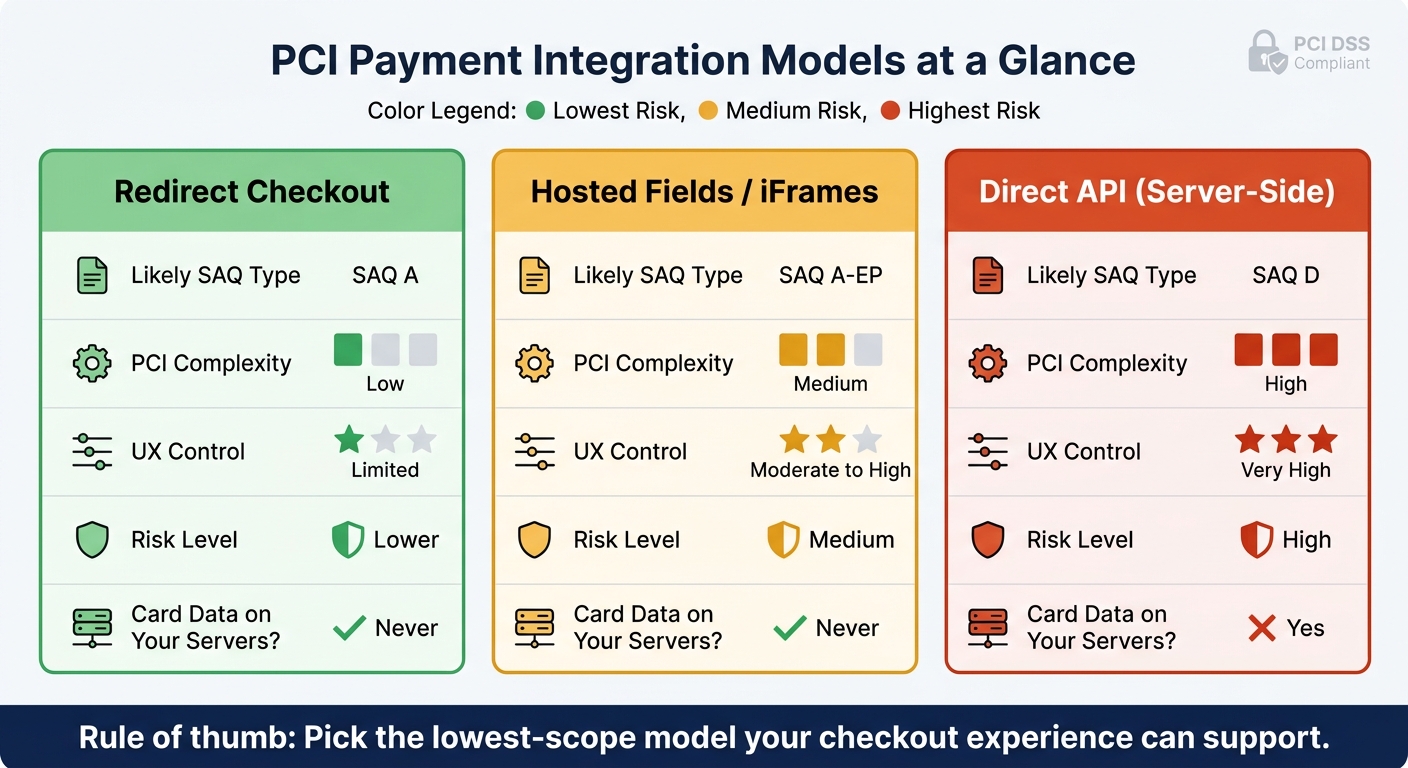
PCI Payment Integration Models: SAQ, Scope & Complexity Compared
| Model | Likely SAQ | UX control | PCI work |
|---|---|---|---|
| Redirect checkout | SAQ A | Lower | Lower |
| Hosted fields / iFrames | SAQ A-EP | Medium to high | Medium |
| Direct API | SAQ D | Highest | Highest |
I’d read this article as a playbook for one simple goal: ship payments without letting PCI spread across your stack, your team, and your finance process.
Start with scope. Before you pick a payment setup, decide exactly where card data can exist. That one step shapes almost everything that follows.
PCI DSS applies any time card data is stored, processed, or transmitted. So in this section, define the cardholder data environment first, then choose the checkout model that keeps that environment as small as you can.
Your cardholder data environment, or CDE, includes every system that stores, processes, transmits, or can affect the security of card data. The PAN is the card number itself, usually 16 digits in the U.S. If any part of your stack touches a PAN, that system is in scope. PCI DSS 4.0 also expects companies to check on a regular basis that no cardholder data exists outside the defined CDE.
Your SAQ type flows straight from how checkout is built. SAQ A applies when a PCI-compliant third party handles all card data through a full redirect or hosted payment page, so your systems never see a PAN. SAQ A-EP applies when you host your own checkout pages but use hosted fields, iFrames, or JavaScript SDKs on that page; card data still goes straight to the provider, but your web environment stays in scope. SAQ D applies when your servers directly receive, process, or store card data, and it brings a much larger control set.
| Integration Model | SAQ Type | Complexity | UX Control | Risk |
|---|---|---|---|---|
| Redirect checkout | SAQ A | Low | Limited | Lower |
| Hosted fields / iFrames | SAQ A-EP | Medium | Moderate to high | Medium |
| Direct API (server-side) | SAQ D | High | Very high | High |
Before any code gets written, map every place card data could enter the business. Think of this as drawing the full path of payment data before it has a chance to spread into finance, support, analytics, or admin tools and turn into a compliance mess, which is where fractional CFO services can help align financial controls with technical requirements.
Cover these entry points:
For each part, capture who owns it, what data it sees, and how it's secured. For scripts and SDKs, document the vendor name, version, which pages they load on, and whether they can access DOM elements inside payment forms. For APIs and endpoints, note whether PAN, CVV, or expiration dates appear in request or response payloads, and whether logs store those payloads in full. For third-party services, confirm their PCI DSS compliance status, including SAQ or Report on Compliance status. This map becomes your CDE blueprint.
Once every entry point is mapped, you can choose the integration model that limits exposure without getting in the way of checkout.
Redirect and hosted-field setups keep raw card data off your servers. That means engineering can avoid most of the encryption, key management, and logging burden and spend more time on the product itself.
The tradeoff is control over the user experience. Redirect flows can feel disconnected when users leave your domain to finish payment. Hosted fields give you more room to shape the page, but styling is still limited by what the provider's iFrame allows. Direct API integrations give you full control over checkout and back-end orchestration - custom routing, advanced fraud rules, and shared subscription logic - but they also pull your servers, databases, and networks into scope. That drives up testing, change management, and long-term maintenance costs.
The right model has to fit both your checkout needs and your team’s ability to handle compliance over time. That choice sets up the next step: how you design tokenization and payment data flow.
Once scope is clear, the next step is to set up a payment flow where raw card data stops with the provider and only tokens move through your systems. That keeps checkout smooth and helps stop compliance work from creeping into the rest of your stack. It also makes it much easier to pin down security ownership with each vendor in Section 3.
The cleanest setup is simple: the customer types card details into a provider-hosted field or iframe served from the payment provider's domain. Your frontend never reads those values. The provider sends back a token, and that's the only thing you store - not PAN, CVV, or expiry data.[1][2]
After that, charges, refunds, and recurring billing all run off the token. Your database should hold customer IDs, transaction IDs, and token references only.
Logging, observability, and downstream tools need one hard rule: only non-sensitive metadata can cross the payment boundary. Strip card-number patterns before logs hit storage. Do the same for APM traces and error reports.[10] Support tools and your CRM should only show customer IDs, tokens, transaction IDs, payment status, and last four digits. For analytics, keep event tracking limited to payment status, amount in USD, currency, customer segment, and product IDs. If you need card-related details like brand or issuing country, get them from the provider and store only the label - "Visa" or "US-issued" - not the source number.
A data flow map shows the full path payment data takes and marks what each system handles. In a clean setup, the flow looks like this:
amount: 12900, currency: "usd" for $129.00. Your backend stays out of cardholder-data scope, but PCI still applies to authentication, access control, and secure communications.[4][5]Each node in the map should show three things:
That map becomes the main working doc for PCI reviews and engineering discussions.
Use it as the baseline for vendor checks, webhook controls, and finance handoffs. This ensures your fractional CFO has the clean data needed for strategic growth without the overhead of a full-time hire.
The token-control model you pick has a direct effect on PCI scope and day-to-day complexity:
| Model | Detokenization control | PCI scope impact | Flexibility | Complexity |
|---|---|---|---|---|
| Processor vault only | Provider controls all tokenization and detokenization; you store tokens only | Smallest scope because PAN stays inside the provider environment | Lower; constrained to provider capabilities | Lower operational complexity |
| Internal token vault | You control the vault and any detokenization path | Higher scope because the vault and any system that can reverse tokens are in scope | Highest flexibility for routing and custom workflows | Highest security, audit, and compliance complexity |
| Hybrid model | Provider tokenizes first; a tightly controlled internal service handles detokenization for specific use cases | Intermediate scope; token-only systems are lighter, but the detokenization service stays in scope | Good balance of customization and safety | Moderate complexity due to controlled detokenization boundaries |
If you decide to build an internal detokenization service, treat it like in-scope PCI infrastructure. Put explicit authorization controls around it and keep full audit logs.[4][6][7] Tokens only shrink scope when detokenization stays tightly locked down.
With the token boundary in place, Section 3 moves into vendor selection and security ownership.
Once you have your token boundary and data flow map, vendor selection gets a lot less fuzzy. At that point, this isn't about picking the flashiest feature set. It's about answering one plain question: does this vendor shrink your PCI scope, or does it just move the work somewhere else? Your data flow map should show, in black and white, which systems stay out of scope with each option.
Use that map to compare vendors based on how much scope they remove. Ask for the vendor's current AOC, responsibility matrix, and a written mapping that shows how each integration mode lines up with the right SAQ path. And don't assume the SAQ path applies just because the vendor says so. Confirm it with your acquirer or a QSA. Hosted fields, for example, can still pull more into scope if page scripts or iframes are exposed.
Before you sign, compare vendors across these areas:
| Dimension | What to look for |
|---|---|
| PCI DSS level | Level 1 service provider with a current AOC and clear scope description |
| Supported SAQ paths | Explicit mapping of integration mode (redirect, hosted fields, direct API) to SAQ A, A-EP, or D |
| Hosted UI options | Drop-in checkout, hosted iframes, mobile SDKs, custom styling support |
| Tokenization | Single-use tokens for authorization, multi-use vault tokens for recurring billing, network tokenization support |
| Authentication methods | API keys at minimum; OAuth 2.0 and mTLS for webhooks and settlement APIs |
| Webhook protections | HMAC-signed payloads, IP allowlisting, mTLS option, retry policies, event replay tooling |
| Compliance artifacts | AOC, responsibility matrix, penetration test summaries, implementation guides |
Use the sandbox before the contract is signed. This is where you find out whether the vendor works well in practice or just looks good in a sales deck.
Test card behavior that looks like production: approvals, declines, fraud flags, and edge cases like network timeouts, duplicate charges, and 3D Secure flows. Pay close attention to idempotency keys for charges and refunds. They need to work as expected. Also check that partial refunds are supported and tied back to the original transaction. On top of that, make sure dispute and chargeback events show up with reason codes and dispute-response endpoints.
For API hardening, check for scoped API keys. A webhook consumer should not also be able to issue refunds or change settlement accounts. Key rotation should be clear and documented, not buried in a support article. Production credentials should also follow a defined provisioning and approval process that is separate from sandbox credentials.
Uptime matters too. Look for a published SLA, a public status page, and a defined incident communication process. If something breaks on a Friday afternoon, you don't want to guess how updates will reach your team.
Finance needs to be part of vendor selection from day one, not looped in after the contract is done. Settlement timing has a direct effect on cash. Whether payouts land on T+1, T+2, or a weekly cycle can change how much cash is available and make forecasting messy when timing shifts.
Fee reporting matters just as much. Finance should be able to break fees down by interchange, scheme fees, and processor margins, then split that by transaction type and card brand. That's how the team gets to true contribution margins by product and channel. Headline pricing rarely tells the full story.
Reserve terms and rolling holdbacks can also hit working capital in ways that are easy to miss at first glance. Model worst-case cases using the vendor's past dispute rates and reserve formulas before you commit.
Finance also needs settlement, fee, refund, dispute, and reserve data that maps cleanly to the general ledger. That should feed directly into how you set up endpoints, webhooks, refund controls, and approval controls in the next section.
Once scope and vendor boundaries are set, turn those choices into day-to-day controls. PCI compliance lives in daily work. Engineering protects payment systems. Finance protects transaction accuracy. And both teams own the evidence trail. Engineering handles technical safeguards, finance handles transaction integrity, and both need a clean audit trail. When ownership gets fuzzy, controls start to crack.
| PCI Control Family | Engineering Control | Finance Workflow |
|---|---|---|
| Access control | RBAC for all payment APIs and admin tools; MFA required for production access; no shared accounts | Separate roles for refund approvers and reconcilers; approval required for larger refunds |
| Encryption | TLS 1.2+ on all payment traffic; keys stored separately from code and data | Settlement and fee reports feed reconciliation |
| Logging & monitoring | Tamper-evident logs for API calls, webhooks, admin actions, and failed logins; 12-month retention [11][12] | Audit trail for every refund, void, and dispute action tied to user ID and timestamp |
| Vulnerability management | Scheduled scans, patch SLAs, and periodic penetration testing, including segmentation validation | Periodic review of access grants for finance tools that touch payment data |
| Incident response | Documented runbook for suspected token leakage, unauthorized refunds, and webhook compromise | Escalation path for reconciliation breaks, duplicate refunds, and unmatched settlements |
Next, lock down the paths that can move money or trigger admin actions. Treat every webhook as untrusted until the signature, timestamp, and event ID check out. Verify the HMAC signature on every request using the raw body - never a parsed version - before any business logic runs. Reject any event older than 5–10 minutes to block replay attacks. [13][14] Store processed event IDs in a database with a unique index so duplicate deliveries don't trigger duplicate charges or refunds.
Privileged actions like refunds, voids, and detokenization need a separate layer of protection. A webhook consumer role should never also have refund permissions. Signing secrets should live in a secrets manager, rotate on a set schedule, and never show up in client-side code or shared support tools. Put MFA and audit logging on admin dashboards and support tools too. If a customer service agent can issue a refund through an internal tool, that tool is in scope. That's the kind of detail teams miss when things get busy.
After the technical side is locked in, finance needs matching reconciliation rules to catch breaks before the close. Daily reconciliation is finance's control check. Each day, match authorized, captured, refunded, disputed, and failed payments from the processor report against actual bank deposits and general ledger entries - all in U.S. dollar amounts. Use a documented cutoff rule for capture-to-deposit timing.
Exception reports should flag unmatched transactions, duplicate refunds, failed settlements, and any refund above the approval threshold before it posts. Refund approval thresholds should be set by dollar amount or customer risk, with larger or riskier refunds sent to higher-level approval. Chargeback responses need a named owner, a documented deadline, and a record of the dispute reason code tied back to the original transaction. At scale, reconciliation gaps can pile up fast, so define who approves, who reconciles, who monitors, and who responds before volume turns small misses into expensive ones.
PCI compliance gets a lot simpler when you reduce scope first and let that drive the architecture. Start with the lowest-scope model your team can support. Then, as you grow, keep your token setup, data flows, vendors, and finance controls in sync.
This isn’t a one-time launch item. Compliance is ongoing. Once the product is live, the job changes. Early on, you’re mostly making design choices. After launch, you’re reviewing, checking, and tightening things on a set cadence.
| Cadence | Key Activities | Primary Owners | Expected Outputs |
|---|---|---|---|
| Monthly | Review API logs for failed auth spikes and unusual refund patterns; reconcile processor settlement reports to bank statements ($); validate webhook health; audit user access to payment dashboards and finance tools | Engineering, Finance/Accounting, Security/DevOps | Exception reports, reconciliation summaries, updated access-control records |
| Quarterly | PCI scope review for new features and integrations; incident response tabletop exercises; vendor SLA review; chargeback trend analysis and fraud rule adjustments | Security/Compliance lead, Engineering leads, Finance/FP&A, Product | Updated data flow diagrams, incident drill reports, vendor scorecards, chargeback dashboards |
| Annual | Full PCI assessment (SAQ or QSA-led based on merchant level); security training for engineering and finance teams; payment architecture review; audit of settlement, refund, and chargeback processes for accuracy and segregation of duties | Compliance/Legal, Security, Engineering management, Finance leadership, external advisors | PCI attestation or SAQ documentation, training records, architecture recommendations, remediation plans |
For growth-stage teams, finance review and architecture review often land on the same person. That’s common. When that happens, some teams bring in Phoenix Strategy Group for finance and strategic advisory work, including FP&A, bookkeeping, and M&A support.
Your launch architecture shapes your long-term PCI workload. If you choose direct API control, you take on more scope, more review work, and tighter segmentation demands. If you fall out of compliance, your breach and fine exposure goes up too. That’s why the smart move is usually simple: pick the lowest-scope checkout model that still gives you the reporting, reconciliation, and room for growth you need.
To keep PCI scope as small as possible, use hosted payment pages or iFrames first. They send cardholder data straight to the payment processor, which keeps that sensitive info out of your app environment.
If people type card details directly into your application, your PCI scope gets much larger. For growth-stage teams, tokenization can help. It swaps sensitive data for non-sensitive tokens, so raw card data stays out of downstream systems.
Tokenization cuts PCI exposure by replacing sensitive card numbers with non-sensitive, randomly generated tokens. When it's set up the right way, sensitive card data never enters or remains in your internal systems. That can take those systems out of PCI DSS scope.
Here’s the big difference from encryption: encryption protects the data, but the original PAN may still pass through systems that remain in scope. Tokenization works differently. It keeps the original PAN out of downstream environments.
A secure token vault then controls access to the original data. That lowers the impact of a breach and makes compliance easier to manage.
Before launch, finance should check that the payment API and all connected systems have current PCI evidence on file. That includes scope and data-flow diagrams, a shared-responsibility matrix, a vendor inventory with AOCs, and immutable, audit-ready logs for card events and access-control changes.
They should also confirm that scan results, pen-test results, and segmentation test results are documented and up to date. And one more thing matters here: logs must never contain raw PAN, CVV, or secrets.