Published on
August 3, 2026


If you handle card data, PCI DSS 4.0.1 comes down to 12 rules: set scope, lock down access, protect data, test controls, and keep proof ready. In my view, the biggest mistake is simple: teams think a cloud provider’s PCI status covers their app, IAM, logs, and vendors. It does not.
Here’s the short version:
A few facts stand out:

| Area | What matters most | What teams often miss | What auditors ask for |
|---|---|---|---|
| Scope | Map every system that stores, processes, transmits, or can affect CHD security | CI/CD, logs, support tools, serverless, cloud storage | Data-flow maps, scope diagrams |
| Data protection | Store less PAN, never store SAD after auth, use strong crypto | PAN in logs, weak key ownership, full PAN in support tools | Retention records, KMS logs, masking proof |
| Access | Least privilege and MFA for all CDE access | Shared accounts, stale roles, weak vendor access | IAM exports, access reviews, MFA reports |
| Monitoring | Keep audit trails and alert on odd activity | Missing immutable logs, short retention | SIEM settings, 12-month log archive |
| Testing | Scan and retest after major changes | No segmentation retest after cloud changes | ASV reports, pen tests, segmentation results |
| Vendors | Track each provider’s PCI status and control ownership | “Inherited compliance” thinking | AOCs, TPSP list, responsibility matrix |
The bottom line: PCI DSS 4.0.1 is not just a security checklist. It is a day-to-day process for scope, access, logging, testing, and vendor control across your payments stack.
Use these rules to keep track of how new payment tools, vendors, and cloud services change your PCI duties as you grow. Each rule centers on four simple questions: what it means, why it matters for fintech payment operations, where teams usually miss controls, and what proof auditors will want to see.
Start with scope. The CDE includes every system that stores, processes, or transmits cardholder data, plus anything that can affect its security. In fintech, that often reaches further than teams expect. It can include cloud platforms, payment processors, support tools, analytics, CI/CD, IaC, and serverless functions. Any cloud VM, bucket, container, or serverless function that can reach the CDE stays in scope unless segmentation proves isolation. [1]
Tokenization can take systems out of scope, but only if those systems never see PAN. Encryption doesn’t do that. Encrypted data and the decryption keys still stay in scope. [1]
Once scope is set, begin with the controls that define and protect the CDE.
Rule 1 requires fintech teams to install and maintain Network Security Controls (NSCs) across every environment that stores, processes, or transmits cardholder data. PCI DSS 4.0.1 uses "NSCs" as an umbrella term for firewalls, security groups, and network ACLs. In plain English, this is the rule that takes PCI scope and turns it into network policy your team actually has to enforce. [1]
For fintech teams, the big issue isn't just where card data lives. It's how traffic can get to it. Rule 1 puts firm network boundaries around APIs, queues, storage, and logging paths. As payment stacks grow to include more vendors, more environments, and more APIs, Rule 1 helps stop network sprawl from dragging more systems into PCI scope. [1]
Cloud ownership is split, and that's where teams often get tripped up. Your team is still on the hook for virtual network controls, rule changes, and proof that segmentation works. You also need to review each CSP's Attestation of Compliance so you can show which Rule 1 items the provider covers and which ones stay with your team. [1]
The issue that shows up most often is a flat network that's far too open and missing microsegmentation. Broad VPC peering or loose security group rules can quietly pull more systems into PCI scope. Manual updates make things worse because they lead to configuration drift. [1]
Once you've set the boundary and locked it down, auditors want proof that the controls line up with the diagrams. They usually ask for current network and data flow diagrams, NSC configuration files, segmentation test results, change review records, and a documented shared responsibility matrix. [1]
| Evidence Type | Expected Content |
|---|---|
| Network & data flow diagrams | Current diagrams of CHD flows, boundaries, APIs, queues, and segmentation points |
| NSC configuration files | Security group exports, VPC rules, and ACLs with documented justification |
| Segmentation test results | Test results proving out-of-scope systems cannot reach the CDE, plus retesting after significant changes - run at least annually, not only at audit time |
| Change review records | IaC logs or change tickets approving NSC changes |
| Shared responsibility matrix | A RACI showing CSP versus your team responsibilities |
If Rule 1 defines the boundary, Rule 2 locks down everything inside it.
This rule requires fintech teams to apply secure configurations to all in-scope system components and remove vendor-supplied defaults. That includes default passwords, unneeded services, and insecure settings. As fintech stacks grow across cloud services, Rule 2 helps stop defaults and config drift from quietly expanding PCI scope. In cloud setups, that includes virtual machines, object storage, containers, and serverless functions that can reach a CDE component. [1]
Responsibility shifts based on the cloud model. Every new service, environment, or function creates one more place where insecure defaults can slip into the CDE. And the control split changes depending on the service model.
| Cloud Service Model | Fintech Responsibility (Rule 2) | CSP Responsibility (Rule 2) |
|---|---|---|
| IaaS | Operating system, middleware, runtime, and application hardening | Physical infrastructure and hypervisor integrity |
| PaaS | Application-layer settings; the CSP manages infrastructure, OS, and runtime | Infrastructure-layer network controls, OS, and runtime |
| SaaS | Access control and data retention policies | Full stack configuration and maintenance |
This matters for a simple reason: one drifted setting can expose payment-data paths, logs, or secrets. A system may launch in a locked-down state and then slowly drift as teams patch, test, and ship changes. That’s how insecure defaults creep back in. Policy as code helps here because it can enforce secure settings at provisioning time, instead of leaving each team to configure things by hand. [1]
A CSP’s AOC covers the provider’s layer. It does not cover your hardening work, your default settings, or your application config. That’s a common miss.
Teams also tend to overlook serverless functions. If a serverless function processes or transmits cardholder data, the fintech is still responsible for securing the function’s code and its environment variables. [1]
Assessors will usually want proof that secure configuration is planned, assigned, and enforced in practice. That often includes:
| Evidence Category | Typical Audit Artifacts |
|---|---|
| Hardening Standards | Documented hardening standards, IaC templates, and records of secure default configurations |
| Hardening Records | Logs showing removal of unnecessary services and replacement of vendor-supplied default passwords |
| System Inventories | CDE boundary maps, cloud resource inventories, and third-party service provider (TPSP) lists |
| Ownership Map | A responsibility map for hardening and configuration ownership |
Once the environment is secured, Rule 3 puts tight limits on what that environment can keep.
At the center of this rule is a simple idea: store as little card data as possible. PANs can be stored only if they are made unreadable. That usually means AES-256 encryption, truncation, tokenization, or one-way hashing. Sensitive Authentication Data (SAD) - including CVV, PIN, and full magnetic-stripe data - must never be stored after authorization, whether it is encrypted or not. [1]
Requirement 3.5.1 covers key protection. Requirement 3.7 covers key-management controls. [1]
For growing fintechs, the big issue is not only where card data goes. It’s also how little of that data the business keeps in the first place.
In many cases, the biggest architecture call comes down to tokenization vs. encryption.
Tokenization swaps a PAN for a non-sensitive token. When it is set up the right way, it can take systems out of PCI DSS scope. Encryption works differently. It keeps the data format intact, but the encrypted data and the decryption key keep those systems in scope. [1]
That difference matters a lot during audits. One path can shrink your card-data footprint. The other can leave more of your stack under review.
Cloud key management also shapes audit evidence. A CSP’s default encryption does not prove key ownership. CMKs in a dedicated key-management service do. [1]
| Cloud Component | Protection Requirement | Common Fintech Implementation |
|---|---|---|
| Databases | Encryption at rest | AES-256 or tokenization |
| Cloud storage | Access control + encryption | Private buckets with CMKs |
| Logs | No SAD storage; masked PANs | Truncation or hashing in application logs |
Serverless functions often become a blind spot.
If a function processes or transmits cardholder data, its environment variables and invocation logs are in scope. That’s where teams often get tripped up. PAN or SAD can slip into logs without anyone noticing until review time. [1]
Assessors will usually ask for a data-flow map that shows the path from ingress to storage. They will also want proof that retention rules are enforced through automated deletion or archival. [1]
| Control Area | Common Fintech Miss | Expected Audit Evidence |
|---|---|---|
| Data Retention | No automated deletion for cloud storage/logs | Formal retention policy and logs showing periodic data purging |
| Key Management | Relying on CSP-default encryption keys | KMS configuration reports and key access logs |
| PAN Masking | Full PAN visible in support tools or logs | Screenshots of masked PANs and truncation logic in code |
| Scope Management | Misconfigured VPC peering or security groups pulling storage into scope | Network diagrams and segmentation testing results |
Locking down stored data isn't enough. Cardholder data also needs protection while it's moving.
Rule 4 says cardholder data sent across public networks must use strong cryptography, which usually means TLS 1.2 or higher. TLS 1.0 and 1.1 do not meet the rule. Once storage limits cut down exposure, Rule 4 covers the data that still needs to travel.
For fintech teams, this goes far beyond checkout traffic. Every in-scope handoff matters.
That includes internal service-to-service traffic tied to cardholder data, such as traffic between containers, VMs, serverless functions, queues, event streams, and logging pipelines. If cardholder data passes through it, Rule 4 applies.
In an IaaS setup, the cloud provider may secure the base infrastructure. But TLS and application-layer encryption are still on the customer.
A common failure point is unencrypted east-west traffic between microservices. This shows up all the time in fast-moving cloud setups, where teams secure internet-facing traffic but miss what happens inside the stack. Segmentation also can't just be assumed; it has to be proven.
Third-party integrations can also cause trouble. Review each TPSP's AOC every year, and spell out which controls the vendor handles and which ones still belong to you. If that line is fuzzy, audits tend to get messy fast.
Auditors usually trace each transmission path back to the data-flow map and then check the encryption settings behind it.
| Evidence Type | Audit Evidence |
|---|---|
| TLS configuration evidence | TLS 1.2+ enforced; deprecated protocols blocked |
| Data-flow diagrams | All CHD transmission paths mapped, including internal queues and logs |
| TPSP documentation | Annual AOC reviews and responsibility matrix for each vendor |
| Segmentation test results | Proof that out-of-scope systems cannot reach CDE components |
After network and transmission controls are in place, malware becomes the next big path to card data exposure. Rule 5 requires active, current anti-malware controls on every in-scope system and on any system that can affect CDE security.
Those controls can't just exist on paper. They need to stay turned on, stay up to date, and log detections so teams can review what happened.
Responsibility follows the cloud service model. In IaaS, the fintech owns workload-level anti-malware. In PaaS, that responsibility is shared. In SaaS, the fintech needs to confirm coverage through the TPSP agreement and the provider's annual AOC.
As a fintech stack grows, Rule 5 follows every system that can touch cardholder data. That includes newer deployment models too. With containers and serverless, the fintech still owns the code, environment variables, and logs tied to cardholder data.
A common mistake is assuming the CSP handles workload-level anti-malware in IaaS and PaaS. In many cases, the fintech still owns that piece.
Scope can also spread fast. Overly permissive VPC peering or loose security groups may pull more workloads under Rule 5 than teams expect. Then there's configuration drift, which tends to sneak in over time. Using infrastructure as code helps enforce anti-malware settings during provisioning and cuts down drift. [1]
| Evidence Type | What Auditors Look For |
|---|---|
| Anti-malware logs | Active scanning and threat detection across all in-scope systems |
| Alert and scan logs | Evidence of active scanning, detections, and response across in-scope systems |
| Configuration standards | Anti-malware set to active and cannot be disabled by end users |
| Responsibility matrix | Clear documentation of which controls the fintech owns vs. the CSP |
| TPSP documentation | Current AOCs showing which Rule 5 controls each provider owns |
Anti-malware logs should be kept for 12 months, with the most recent 3 months available right away for review. [1]
Once malware defenses are in place, the next weak point is vulnerable code and delayed patching. Rule 6 requires secure development, patching, change control, and vulnerability tracking for every in-scope system component. Teams also need written procedures for code review, testing, and deployment.
Across cloud models, the fintech owns application code, secrets, and release controls for any in-scope service. When teams ship faster, CI/CD, secrets, and third-party dependencies often become the biggest sources of PCI risk.
Serverless functions are a common blind spot. If a function uses credentials or handles cardholder data, its code, environment variables, and logs are in scope. APIs, queues, and logging pipelines are also in scope when they can affect CDE security. [1]
A common mistake is assuming a CSP's AOC covers application-level security. It doesn't. The AOC covers the provider's layer, not the fintech's code.
Scoping gaps also show up again and again. Teams focus on the CDE itself but miss adjacent systems that can reach the CDE, even if they don't process card data directly. Serverless is a classic example. Functions get treated as out of scope because the underlying infrastructure is managed by the CSP, while function code and environment variables go unchecked. [1]
The practical fix is simple: make software security part of the release process instead of treating it like a separate checkpoint at the end.
Auditors want proof that secure development is built into the pipeline, not bolted on after release.
| Evidence Type | What Auditors Look For |
|---|---|
| Shared responsibility matrix | Clear split of Rule 6 controls between the fintech and each CSP |
| Application security results | SAST/DAST results, dependency scan reports, and remediation tickets |
| Penetration test results | Annual penetration test documentation and evidence of remediation |
| Change management logs | Code reviews, testing records, and approval trails before deployment |
| TPSP records | Current AOCs for all third-party providers, confirmed annually |
For each release, retain proof of code review, testing, approval, and remediation.
Once the stack is secured, the next step is simple: limit who can get to it.
Rule 7 comes down to one idea: give people access only to what their job needs. Apply least privilege across every in-scope system and any CHD. Access should be defined by role, approved, and documented.
In day-to-day terms, that usually means Role-Based Access Control (RBAC). Permissions should map to actual job functions, not broad team labels. A support rep and a DevOps engineer should not have the same access profile, even if both work near the CDE.
In fintech, access control needs to match how payments move through the business.
For cloud-native stacks, split human access, service accounts, and break-glass access by function. Keep a clear responsibility matrix so there’s no confusion about which controls belong to the fintech and which belong to the Cloud Service Provider.
Tokenization can reduce the number of systems that fall under Rule 7. But the token vault and its mapping tables still need tight access limits. Those systems should be reviewed on a regular basis and kept locked down to a small set of approved roles.
The usual problems aren’t in the policy text. They show up in day-to-day access management.
The biggest gap is IAM that’s too broad: shared admin roles, stale service accounts, and too many privileges on token vaults and support tools. Role creep is common too. Someone changes jobs, keeps old access, and suddenly has far more reach than they should.
Vendor access needs the same role-based limits and clear boundaries as employee access. Do not treat TPSP AOCs as proof of least privilege.
Auditors want proof that access is defined, approved, reviewed, and revoked on time. A policy by itself won’t cut it.
| Evidence Type | What Auditors Look For |
|---|---|
| RBAC documentation | Role definitions tied to specific job functions with approved access levels |
| Access request records | Tickets or forms showing management approval before access was granted |
| Periodic access reviews | Logs showing regular reviews confirming permissions still match current roles |
| Offboarding records | Termination logs compared against IAM timestamps to confirm timely revocation |
| IAM configurations | IAM policy files and service account configs proving least privilege |
It also helps to pair written policy with IAM configs and IaC checks that block over-privileged access and catch drift before it turns into a bigger problem.
Once you've limited access, the next step is simple: verify every identity that reaches the CDE.
Each user who can access the CDE needs a unique ID. That way, any action can be tied back to one specific person. PCI DSS 4.0.1 also requires MFA for all access to the CDE, including internal admin access.
This doesn't stop with human users. Service accounts and systems that connect to the CDE also need strong authentication. In practice, that means handling credentials with care and avoiding hardcoded keys or exposed environment variables.
A cloud provider's PCI AOC does not cover your IAM setup, MFA enrollment, or service identities. That work stays with your team across IaaS, PaaS, and SaaS.
As fintechs add more IAM roles, service accounts, and automation, it's easy for access control to sprawl. And when that happens, Rule 8 doesn't get lighter. It stays on the fintech to set up and maintain those controls.
Scope can spread in quiet ways too. If adjacent systems come into scope, Rule 8 applies to those access paths as well. A misconfigured VPC peering setup or an overly permissive security group can drag admin dashboards and nearby systems into scope fast.
Some issues show up again and again:
Third-party vendor access is another common weak point. Under Requirement 12.8, you need to document which Rule 8 controls the vendor owns and which ones still sit with the fintech.
Auditors looking at Rule 8 want proof that every access point is authenticated, documented, and monitored. The table below covers the main evidence they'll ask for:
| Evidence Type | What Auditors Look For |
|---|---|
| Unique ID documentation | Proof that users with CDE access have unique IDs and that shared or generic accounts are not in use |
| MFA enrollment reports | Records confirming MFA is active for all access paths, including console, CLI, and API access |
| IAM configuration exports | Role definitions and access policies showing least privilege |
| Secret management logs | Audit trails from secret management tools showing access to stored credentials |
| TPSP shared responsibility matrix | Documented split showing which Rule 8 controls each vendor owns versus your team |
Access logs tied to Rule 8 must be kept for 12 months, with the most recent 3 months immediately available. Those same access records also support Rule 10 monitoring.
Rule 9 says fintechs must limit physical access to any systems, media, and devices that store, process, or transmit cardholder data (CHD). Put simply, only people with a valid business reason should be able to get near the cardholder data environment (CDE).
This rule also applies to media handling. If paper records or electronic media contain CHD, they need to be protected and then destroyed in a secure way when you no longer need them. And if you use devices that capture payment data, you need a current inventory of those devices plus routine checks for tampering.
As fintech teams grow across offices and remote setups, physical scope gets bigger fast. It’s no longer just about a data center.
For cloud-native fintechs, the cloud service provider (CSP) handles security in its own data centers, while the fintech is still responsible for its offices, workspaces, devices, and physical records. You should use the CSP’s AOC to confirm exactly which Rule 9 physical controls the provider covers.
Your offices, remote workspaces, and any other locations where staff handle CHD are still on you. Those places need to show up in your physical access policies.
A common mistake is thinking a PCI-compliant CSP handles all physical security duties. It doesn’t. Fintechs also often miss a clear split-responsibility matrix that shows which physical controls sit with the CSP and which sit with the fintech.
Remote work is another weak spot. Teams may miss the risk of someone physically seeing a screen without permission or of physical media with CHD being stored the wrong way. A third gap involves hardware and terminal vendors. Their PCI status should be reviewed every year under Requirement 12.8 [1].
Auditors usually ask for:
| Evidence Type | What Auditors Look For |
|---|---|
| CSP Attestation of Compliance (AOC) | Current AOC showing the CSP covers Rule 9 physical infrastructure controls |
| Split-responsibility matrix | Documentation showing which Rule 9 controls are handled by the CSP and which are handled by the fintech |
| TPSP compliance records | Annual confirmation that third-party vendors handling hardware or media maintain PCI DSS compliance |
| Device inventory | Up-to-date list of payment-capture devices, with inspection records for tampering or substitution |
| Media destruction records | Documented evidence that physical media containing CHD is rendered unrecoverable before disposal |
Tokenization can help here too. By keeping CHD off physical media in your office setup, it can shrink the physical scope of Rule 9 for your team [1].
After physical access is locked down, Rule 10 moves to logging and monitoring access to those systems.
Rule 10 requires fintechs to create audit trails that tie each event to a single user ID. That includes all access to cardholder data (CHD), every action taken by users with root or admin privileges, and changes to system-level objects. In a fintech setting, logging is the proof trail for each payment path, admin action, and incident.
Organizations must keep audit logs for at least 12 months, with the most recent 3 months ready for immediate analysis [1]. Teams should also set up automated alerts for unusual access events and review security logs on a regular basis.
For cloud-native fintechs, the logging scope can get big fast. Rule 10 applies not just to databases that store CHD, but also to virtual machines, storage buckets, APIs, message queues, and serverless functions next to the CDE [1].
If a serverless function handles CHD, treat it like any other in-scope system. Log its invocations, variables, and outputs the same way you log databases and APIs.
That much data adds up. SIEM ingestion and storage can become a major cost line item.
One common gap is assuming the cloud service provider (CSP) gives you immutable logs out of the box. That’s not always the case. If the CSP does not provide them, the fintech has to add its own controls, such as exporting logs to a secured, read-only environment.
Cost pressure causes another gap. Some teams cut logging scope to lower storage spend, and that can create compliance risk. A better approach is to use lifecycle policies to move logs to cold storage after 3 months while still keeping them retrievable for the full 12-month period. Microsegmentation also helps by shrinking the set of systems that need nonstop monitoring.
| Evidence Type | What Auditors Look For |
|---|---|
| Audit log archive | 12 months of logs retained, with 3 months immediately accessible [1] |
| SIEM or logging platform config | Settings showing all in-scope resources are covered |
| Alerting and review records | Documentation of anomalous access alerts, regular log reviews, and follow-up actions taken |
| Log integrity controls | Evidence that logs are immutable or exported to a write-protected archive |
| CSP AOC review | Confirmation of which specific Rule 10 sub-controls the CSP manages versus the fintech |
Rule 11 then checks whether those logs, alerts, and controls work in practice.
Rule 10 shows you what happened. Rule 11 checks that your controls still work.
You need to run quarterly ASV scans on all external-facing CDE components. You also need annual penetration tests, plus retesting after changes, including segmentation tests. If your team makes a significant change - like adding a new API integration or redesigning part of your cloud setup - you need an out-of-cycle penetration test too.
If you use network segmentation to shrink PCI scope, those controls need testing at least once a year and again after significant changes under Requirement 11.4.5.
In cloud-native fintech setups, small mistakes can widen scope fast. One open VPC peering link or a loose security group can pull systems that were supposed to stay out of scope into the CDE. That makes the test plan bigger, and the audit harder.
The same logic applies to serverless. If a function handles CHD, treat it as in scope.
A common miss here is the shared-responsibility issue. A CSP AOC does not take the place of your own penetration testing, segmentation testing, or remediation checks.
Another weak spot is the lack of a clear significant change policy. When that policy isn't spelled out, teams tend to focus on the calendar and forget to retest after infra updates. That's where IaC and CSPM help. They can flag changes that should trigger retesting.
| Test Type | Required Frequency | What Auditors Want to See |
|---|---|---|
| ASV Scan | Quarterly | Reports from an Approved Scanning Vendor |
| Penetration Testing | Annually & after significant changes | Formal penetration test reports and remediation evidence |
| Segmentation Testing | Annually & after significant changes | Testing methodology docs and successful isolation results |
| Post-Change Retest | After significant changes | Documentation showing the post-change test was completed |
Auditors will also want current AOCs for third-party service providers, along with clear records showing which Rule 11 tasks the provider covers and which ones your team owns directly.
Rule 12 takes those test results and ties them to policy, training, and ownership.
Rule 11 tests security. Rule 12 makes sure someone owns it and keeps it running. This is the governance layer that connects the controls across Rules 1–11.
At its core, Rule 12 requires your organization to keep a documented information security policy in place. That policy needs to cover incident response, access control, change management, and third-party oversight. It also has to be reviewed at least annually so it stays up to date.
Requirement 12.8 puts special focus on third-party service provider (TPSP) management. You need to maintain a current TPSP list, confirm each provider's PCI DSS status every year, and document which requirements each provider owns. That record can't sit still. As vendors, tools, and payment flows change, the ownership map needs to change with them.
Fintech payment flows often involve more than one layer. A merchant might use a SaaS gateway that runs on an IaaS provider. Rule 12 says you still have to track compliance across that full chain.
A CSP's AOC covers only the CSP's own layer. Your application, your configurations, and the way you handle data are still on you.
As the payments stack gets more crowded, Rule 12 helps stop ownership gaps from spreading. This is where the shared responsibility matrix becomes the working control map for Rule 12. If that map doesn't exist, it's easy for a control to end up with no clear owner.
The issue auditors flag most often is the PCI "inheritance" myth. Teams assume that because AWS or Azure has a PCI DSS AOC, the fintech using it is covered too. That's not how it works.
Other gaps show up all the time:
Auditors want proof that policy, ownership, and vendor review are all current.
| Evidence Category | What Auditors Want to See |
|---|---|
| Policy Documentation | Approved Information Security Policy; Incident Response Plan; Access Control and Change Management policies |
| Third-Party Records | Current TPSP list; signed contracts with data protection language; annual AOCs for every provider |
| Responsibility Mapping | Shared Responsibility Matrix for each cloud service model (IaaS, PaaS, SaaS) |
| Review Logs | Evidence of annual policy reviews; records of annual TPSP compliance status checks |
| Completion Proof | SAQ or ROC package with supporting evidence |
Embed compliance as code in IaC pipelines to enforce Rule 12 before resources are provisioned.
Use the quick-reference table below to map Rule 12 to the evidence your team should keep.
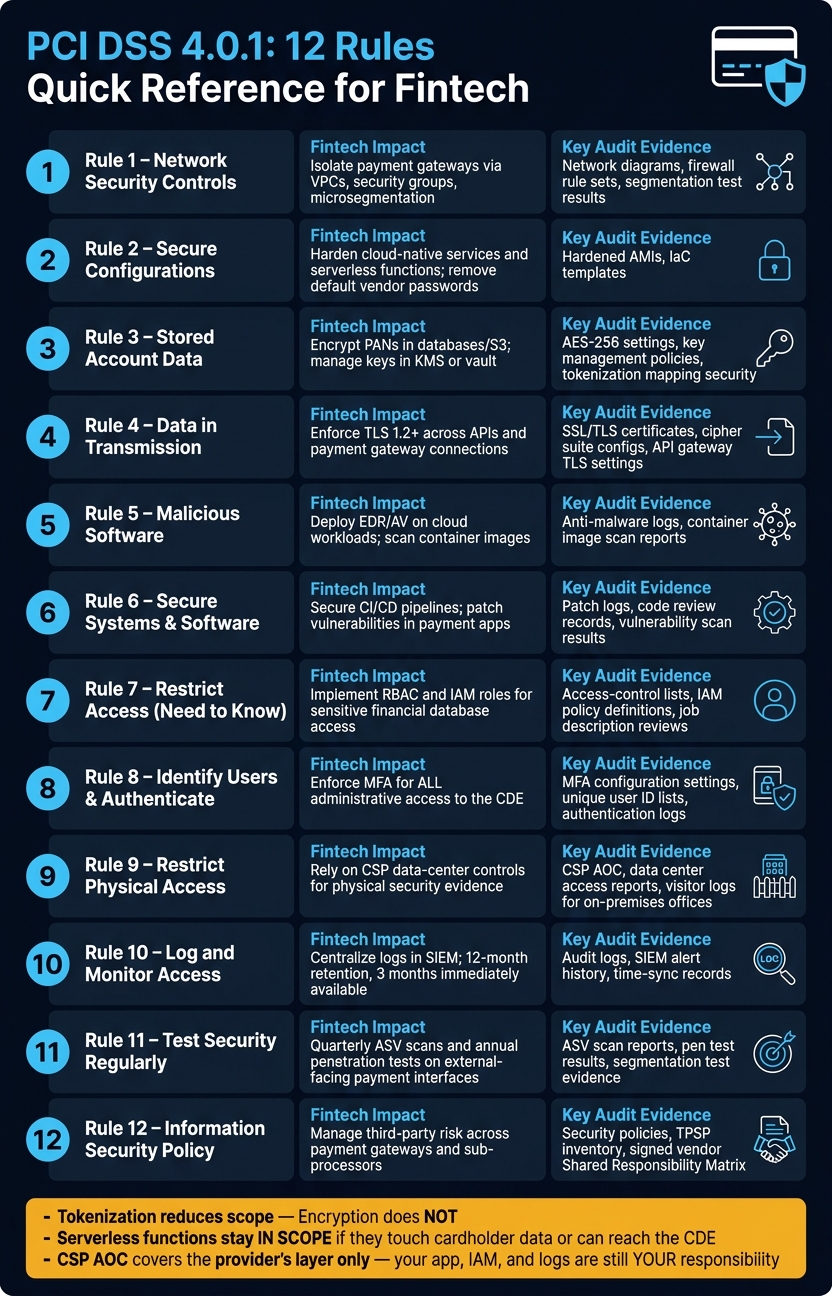
PCI DSS 4.0.1: 12 Rules Quick Reference for Fintech
As your fintech stack grows, this table helps you keep track of which PCI controls shift with new tools, vendors, and payment flows. Think of it as the fast-check version of the rule-by-rule guidance above.
| Rule # | Primary Control Area | Fintech Impact | Common Audit Evidence |
|---|---|---|---|
| 1 | Network Security Controls | Isolating payment gateways via VPCs, security groups, and microsegmentation | Network diagrams; firewall/security group rule sets; segmentation test results |
| 2 | Secure Configurations | Hardening cloud-native services and serverless functions; removing default vendor passwords | Hardened machine images (AMIs); Infrastructure-as-Code (IaC) templates |
| 3 | Stored Account Data | Encrypting PANs in databases/S3; managing keys in a KMS or vault | AES-256 encryption settings; key management policies; tokenization mapping table security |
| 4 | Data in Transmission | Enforcing TLS 1.2+ across APIs and payment gateway connections | SSL/TLS certificates; cipher suite configurations; API gateway TLS settings |
| 5 | Malicious Software | Deploying EDR/AV on cloud workloads; scanning container images | Anti-malware logs; container image scan reports; malware-detection dashboards |
| 6 | Secure Systems & Software | Securing CI/CD pipelines; patching vulnerabilities in payment apps | Patch management logs; code review records; vulnerability scan results |
| 7 | Restrict Access (Need to Know) | Implementing RBAC and IAM roles for sensitive financial database access | access-control lists; IAM policy definitions; job description reviews |
| 8 | Identify Users & Authenticate | Enforcing MFA for all administrative access to the CDE | MFA configuration settings; unique user ID lists; authentication logs |
| 9 | Restrict Physical Access | Relying on CSP data-center controls for physical security evidence | CSP Attestation of Compliance (AOC); data center access reports from the provider; visitor logs for on-premises offices |
| 10 | Log and Monitor Access | Centralizing logs in a SIEM; 12-month retention with the most recent 3 months immediately available | Audit logs; SIEM alert history; time-sync records |
| 11 | Test Security Regularly | Quarterly ASV scans and annual penetration tests on external-facing payment interfaces | ASV scan reports; internal/external pen test results; segmentation test evidence |
| 12 | Information Security Policy | Managing third-party risk across payment gateways and sub-processors | Security policies; TPSP inventory; signed vendor contracts; current provider AOCs for each vendor; Shared Responsibility Matrix |
A few points matter more than they may seem at first glance.
Use this table during sprint planning and pre-audit reviews to spot missing controls, owners, or evidence. After that, move to the next section to confirm scope, vendors, and audit readiness.
Use this section to lock down scope, vendors, and evidence before each release or major infrastructure change. This is where the 12 rules stop being theory and start working like an operating process. Once scope is clear, the next audit question is simple: which vendors touch that data?
Map every CHD/SAD path and keep that map up to date as systems, logs, and APIs change. That map is your proof. It ties Rules 3, 4, and 10 together, and it should match every vendor and internal owner.
Keep a current TPSP inventory, collect each provider's AOC, and document which PCI duties each provider covers. That's where scope gaps usually hide.
For each vendor, use a shared responsibility matrix so ownership is clear across IaaS, PaaS, and SaaS. Those three artifacts - the scope map, vendor list, and responsibility matrix - are the fastest way to spot gaps before review.
Build scope reviews, vendor checks, and evidence collection into your normal operating cadence.
Once scope, vendors, and evidence are mapped, PCI DSS 4.0.1 shifts from a project into a daily operating habit. It runs on cadence, clear ownership, and steady evidence collection across new vendors, cloud services, and payment flows.
These 12 rules connect to each other. A gap in one area can expand CDE scope and add audit work across the full stack.
Review the 12 rules on a fixed schedule and collect evidence on an ongoing basis so audit logs are always ready. CSP compliance does not make the customer compliant. That means ownership and evidence matter just as much as the controls themselves. Unresolved gaps in segmentation testing, log retention, or TPSP oversight can delay assessments. [1]
Start by mapping every system that stores, processes, or transmits cardholder data. That means your application, databases, logs, backups, CI/CD pipelines, analytics tools, and any third-party APIs in the flow.
Your payment setup has a big effect on scope. Hosted payment pages or iFrames usually keep scope tighter. If users enter card details directly into your app, scope gets much larger.
You should also include any systems connected to the CDE that could affect its security. Even if a system doesn’t handle card data itself, it still matters if it can influence the cardholder data environment.
A fintech usually moves from a Self-Assessment Questionnaire (SAQ) to a Report on Compliance (ROC) for one main reason: transaction volume.
If a merchant processes more than 6 million Visa or Mastercard transactions per year, it must complete a full ROC through an annual on-site audit carried out by a Qualified Security Assessor.
That move can also happen when risk goes up. For example, a ROC may be required if operations expand into:
In plain terms, once a fintech handles more card data, more sensitive payment functions, or both, the bar gets higher.
Collect evidence that shows your PCI DSS 4.0.1 controls are active and line up with day-to-day work. Group everything by control area, then map each item to the matching requirement.
This usually includes policies and diagrams, system and security logs, scan and penetration test records, MFA and firewall settings, vendor records, staff training records, access reviews, remediation records, and finished validation items such as your AOC.
A simple way to keep this organized is to build an evidence set for each area, such as:
For each item, tie the evidence back to the exact PCI DSS 4.0.1 requirement. That way, you’re not just showing that a control exists on paper. You’re showing that it is in place, used, reviewed, and supported by records that match how your cardholder data setup works in practice.