Published on
August 13, 2026

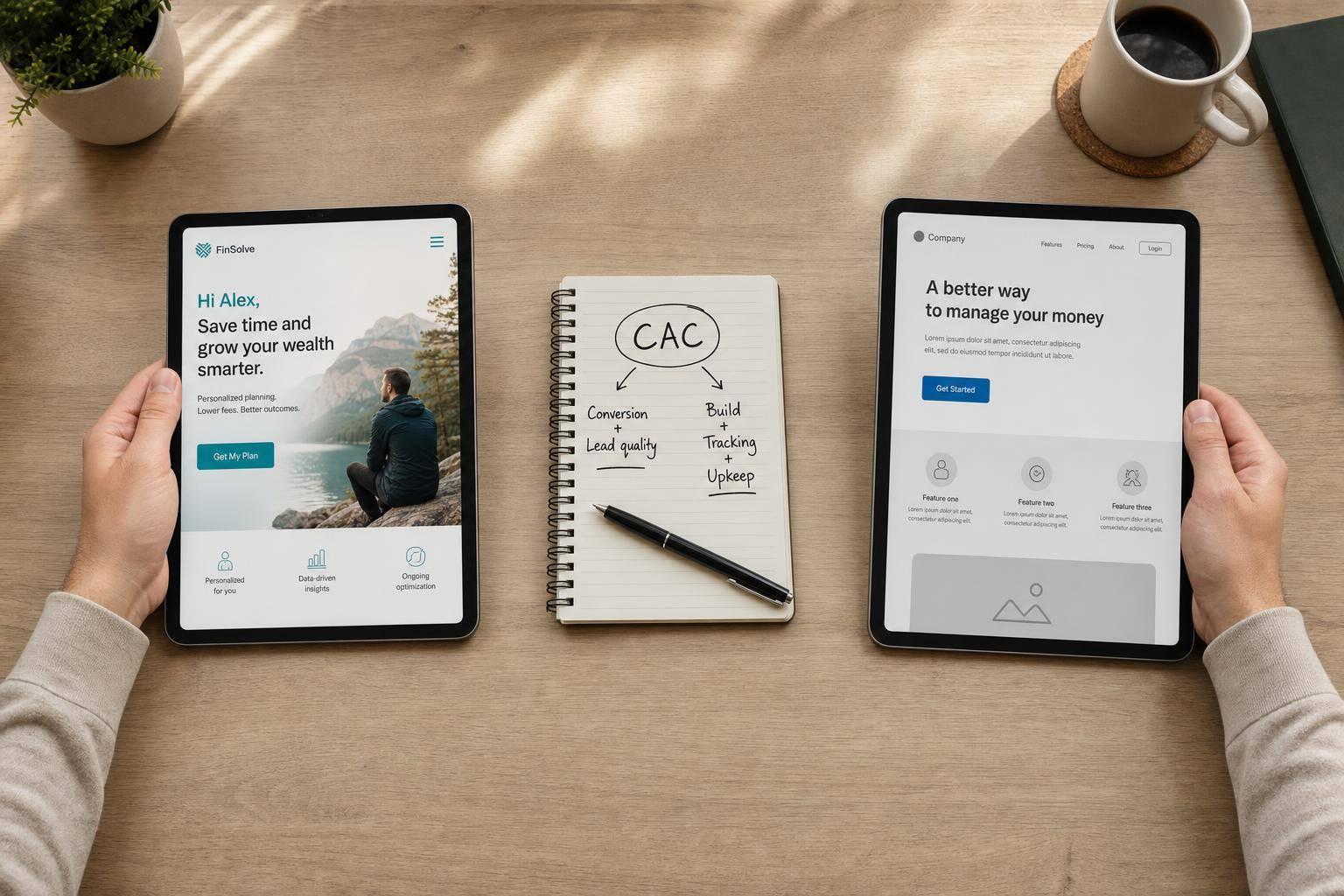
Your landing page can cut CAC - or quietly make every customer cost more.
If I had to sum up the article in one line, it’s this: personalized landing pages win when the conversion lift and lead quality gains are large enough to pay for extra build, tracking, and upkeep. If not, a strong generic page is the better choice.
Here’s the short version:
In plain English: more leads do not always mean lower CAC. If those leads are weak, or if the page system becomes expensive to run, the gain disappears.
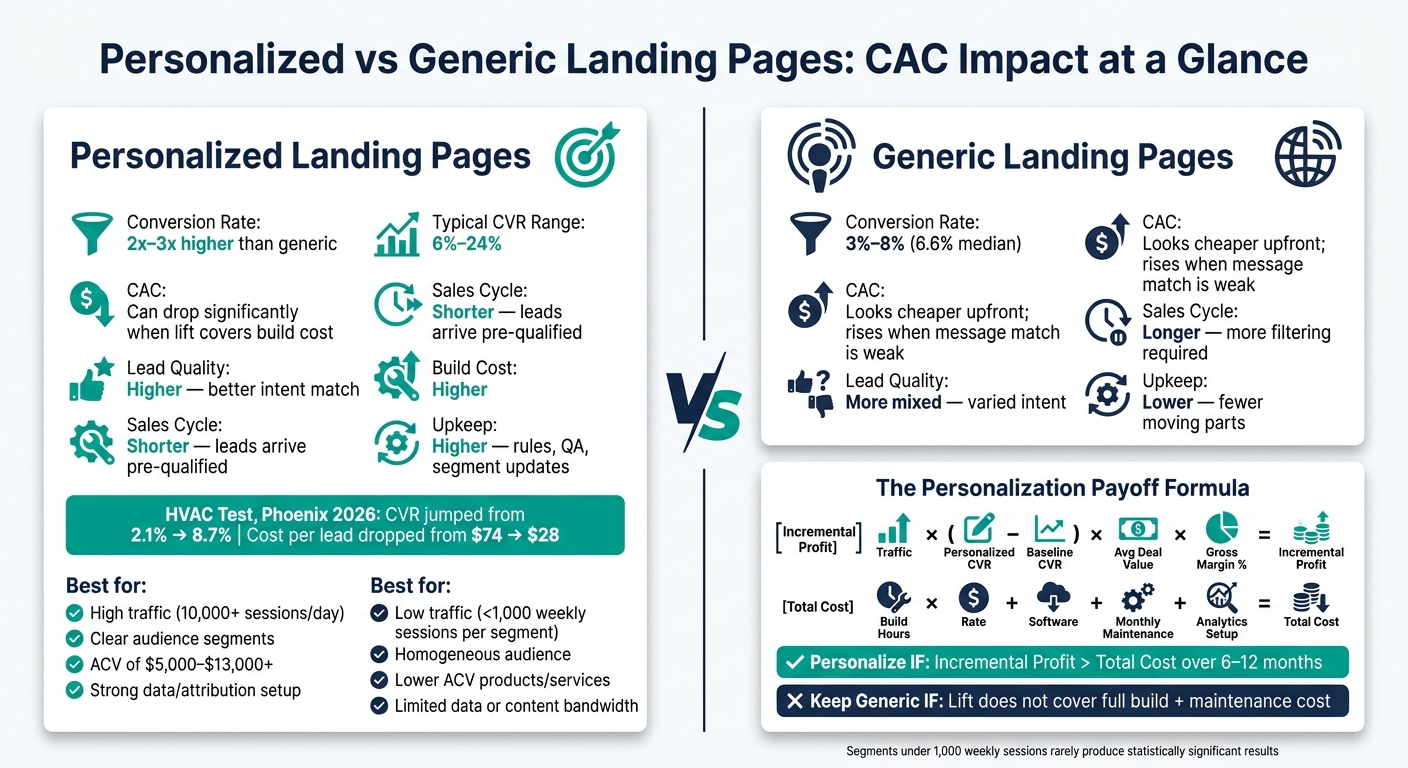
Personalized vs Generic Landing Pages: CAC Impact at a Glance
| Criteria | Personalized Pages | Generic Pages |
|---|---|---|
| Conversion rate | Often higher | Often lower |
| CAC | Can drop if lift covers added cost | Can stay high if message match is weak |
| Lead quality | Often better when intent match is tight | More mixed |
| Sales efficiency | Often better with better-fit leads | More filtering for sales |
| Build cost | Higher | Lower |
| Upkeep | Higher | Lower |
| Best fit | High traffic, clear segments, higher ACV | Low traffic, similar audience, lower ACV |
My takeaway: I’d choose personalization only when I can prove that the extra profit over 6 to 12 months beats the full cost to build and run it. Otherwise, I’d keep the generic page, track results, and wait until the numbers support a change.
With the same ad budget, the landing page you pick has a direct effect on CAC. A generic landing page gives every visitor the same experience. A personalized page changes the headline, offer, or content block based on the ad, keyword, or audience segment that brought the person in.
That difference shows up in the numbers. It affects conversion rate, CPC, and lead quality.
When the message on the ad and the page don't line up, more people bounce. Those missed clicks still cost money, which pushes CAC up. That's why conversion rate is the first lever to look at when you compare these page types.
When the ad and landing page line up better, Quality Score can improve and CPC can drop. That means you can turn more clicks into leads without spending more per click [1][4].
Personalized pages can also bring in better leads because the page matches purchase intent more closely. In plain English, you have a better shot at getting customers instead of just form fills [4].
The main math is pretty simple: does the gain from personalization cover the fixed cost to build and maintain it?
One 2026 HVAC test in Phoenix gives a clear example. It increased conversion from 2.1% to 8.7% and lowered cost per lead from $74 to $28 [4].
Personalization isn't always the smart move. At low traffic levels, the fixed cost can eat up the return.
Below 10,000 sessions per day, advanced personalization often doesn't have enough volume to pay for its build and maintenance cost [2]. In that situation, a simpler page with a clear match between the ad and the landing page is usually the better financial call until traffic grows.
Here’s the side-by-side view of how each page type affects the metrics behind CAC when ad spend stays fixed:
| Metric | Personalized Landing Pages | Generic Landing Pages |
|---|---|---|
| Conversion rate | Higher when message match is strong | Lower when message match is weak |
| CAC (USD) | Often lower if the conversion lift outweighs build and maintenance costs | Looks cheaper upfront, but CAC rises when relevance is weak |
| Cost per qualified lead (USD) | Usually lower when the page filters for better-fit traffic | Can look efficient on raw lead volume but weaker on qualified-lead cost |
| Qualification rate | Usually higher when the page helps the wrong visitors self-disqualify | Usually lower across mixed-intent traffic |
| Sales cycle length (days) | Can be shorter with clearer fit and expectations | Can be longer if more leads need filtering |
| Implementation cost | Higher due to added build effort | Lower due to a simpler build |
| Ongoing maintenance | Higher because of testing and segment updates | Lower because there are fewer moving parts |
The core trade-off is pretty simple: lower build cost now vs. better efficiency later.
A generic page can look cheaper on day one. But that’s not the whole story. If your sales team has to spend extra hours sorting through weak-fit leads, the cost didn’t disappear. It just moved downstream.
That’s why the right test isn’t “Did conversion go up?” It’s: Did the higher conversion rate bring CAC down after build and management costs were included?
At 100 visits, a 3% generic page generates 3 leads, while an 8% personalized page generates 8 leads [1][4]. With the same ad spend, CAC drops before you even factor in any lift in lead quality - if lead quality stays steady [5].
That “if” matters a lot.
If the extra leads are just more noise, the math starts to fall apart. But if quality holds, the gain is hard to ignore. More leads from the same spend usually means better sales efficiency.
The catch is that the lift has to last long enough to pay back the fixed costs.
Higher conversion alone doesn’t save the day. If the data is thin or the setup gets messy, the upside can shrink fast.
Rule sprawl is a hidden cost. Rule-based personalization often piles up hundreds of active rules, and without regular pruning, the cost of human management and QA can exceed the incremental revenue lift [2].
That’s where things can go sideways. What starts as a smart targeting setup can turn into a maintenance headache.
Weak attribution is the final trap. The better approach is to connect landing page performance to qualified-lead rate, appointment rate, and closed revenue, not just raw lead volume [5]. Measure revenue, not just leads.
Once you know your conversion rate and lead quality, the next step is simple: does the page make money?
A personalized page is only worth it when the extra gross profit is higher than the cost to build it, maintain it, and measure it. That’s why raw lead volume can be misleading. Qualified-lead rate and gross profit are the metrics that matter.
Here’s the formula:
Decision rule: If Incremental Profit is higher than Total Personalization Cost over a 6–12 month window, the investment pencils out.
Higher ACV makes payback easier. So does fast implementation. On the flip side, when deal values are low, the fixed cost of building and maintaining the page doesn’t change much, but the margin you get back gets smaller.
This formula only holds up when traffic, ACV, and segment fit are strong enough to produce a lift that matters.
Personalization tends to work when a few things line up.
High average contract values are the clearest green light. Services in the $5,000 to $13,000 range usually leave enough extra margin to cover build and maintenance costs sooner [1]. Distinct audience segments matter too. If your traffic comes from groups with different needs, one generic page will usually miss the mark for part of that audience.
A higher CVR sounds good, but it only counts if qualified-lead rate and close rate stay steady. Otherwise, you may get more conversions on paper without more revenue in practice. And if your sales cycle is long, better-fit leads that show up pre-qualified can help your team move deals through the pipeline with less friction and less wasted time.
When those conditions aren’t there, a simple page is often the smarter financial move.
Low traffic is the most common reason personalization falls short. Segments with fewer than 1,000 weekly sessions usually can’t produce statistically significant test results, which makes it hard to show that any lift is real [6].
A homogeneous audience is another strong reason to wait. If most visitors share the same intent, job title, and pain point, a well-written generic page can do almost as well as a personalized one, without the extra work. Low ACV creates the same problem. The added page cost is still there, but the return is smaller.
There’s also the day-to-day side of this. If your team lacks the data setup or content bandwidth to keep segmented pages current, the extra complexity tends to add drag instead of gains. In that situation, a focused generic page is often the better financial choice.
The math only helps if you can tie revenue back to each page type. To run the ROI test, connect ad spend, analytics, CRM data, and revenue records by page type [3][7]. If those systems don’t connect, CAC by page type is just an estimate.
Page-level tracking matters. Capture UTM parameters and landing page URLs at the session level so you can separate generic page traffic from personalized page traffic [1][2]. If you blend the conversion data together, the comparison falls apart.
Tracking quality also matters because long sales cycles can wreck cookie-based attribution. Safari ITP weakens cookie-based attribution on longer sales cycles, which is why server-side attribution is a better option [3].
Track RPV alongside CAC so you measure revenue efficiency, not just lead volume. A page or channel can have a higher CAC and still come out ahead if its RPV is stronger [3]. Once attribution is clean, the choice turns into a straightforward cost-versus-lift test. And that moves the work out of monthly spreadsheets and into weekly automated tracking [3].
The choice comes down to one question: if the incremental lift is greater than the full cost to build, maintain, and measure the page, personalize. If not, keep the generic page and check again when CAC, conversion rate, lead quality, or sales efficiency change enough to shift the math.
Run a controlled holdout test and measure incremental CAC, not just traffic or conversion-rate shifts. Benchmark each segment, include a control group, and check for statistical significance at the 95% threshold.
Use consistent attribution so your CAC math stays accurate. If personalization lifts conversion and improves CAC payback or LTV:CAC, it’s working. If not, it may be personalization theater.
Look past conversion rate alone. Pay close attention to metrics that connect more directly to revenue and sales performance: lead quality, cost per qualified lead, and CAC compared with CLV.
It also helps to watch engagement signals like bounce rate, time on page, and scroll depth. These can point to friction that hurts results before a lead ever books a call.
When you track these numbers alongside booked calls and closed deals, you get a much clearer picture of what’s driving actual business results.
Stick with a generic landing page until you’ve shown that personalization leads to a measurable lift in conversions for a specific segment.
Here’s why: personalization takes time, money, and a lot of setup. Add it too soon, and you can make your strategy harder than it needs to be before you even know your baseline.
For ad campaigns, start with dedicated pages for the ad groups that get the most spend. That’s usually where the upside is.
If spend is low or intent is fuzzy, a well-optimized generic page is often the smarter move.