Published on
August 13, 2026

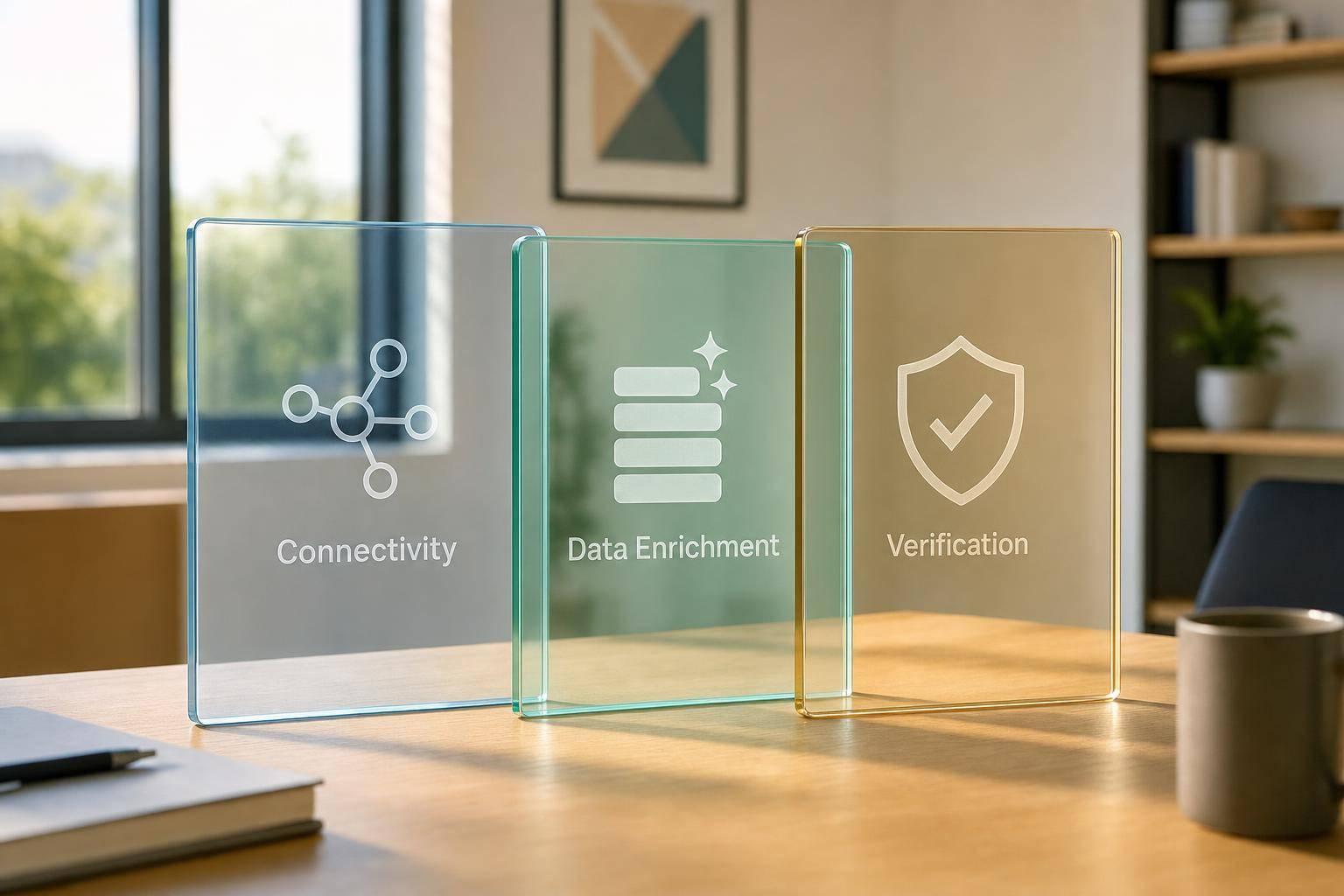
If I had to boil this down to one line: Plaid is the best fit for fast launch and broad bank connectivity, MX is strongest for cleaner transaction data, and Finicity is the better pick for income and asset verification.
If you’re choosing between these three, I’d focus on six things first:
Here’s the short answer:
A few numbers help frame the choice:
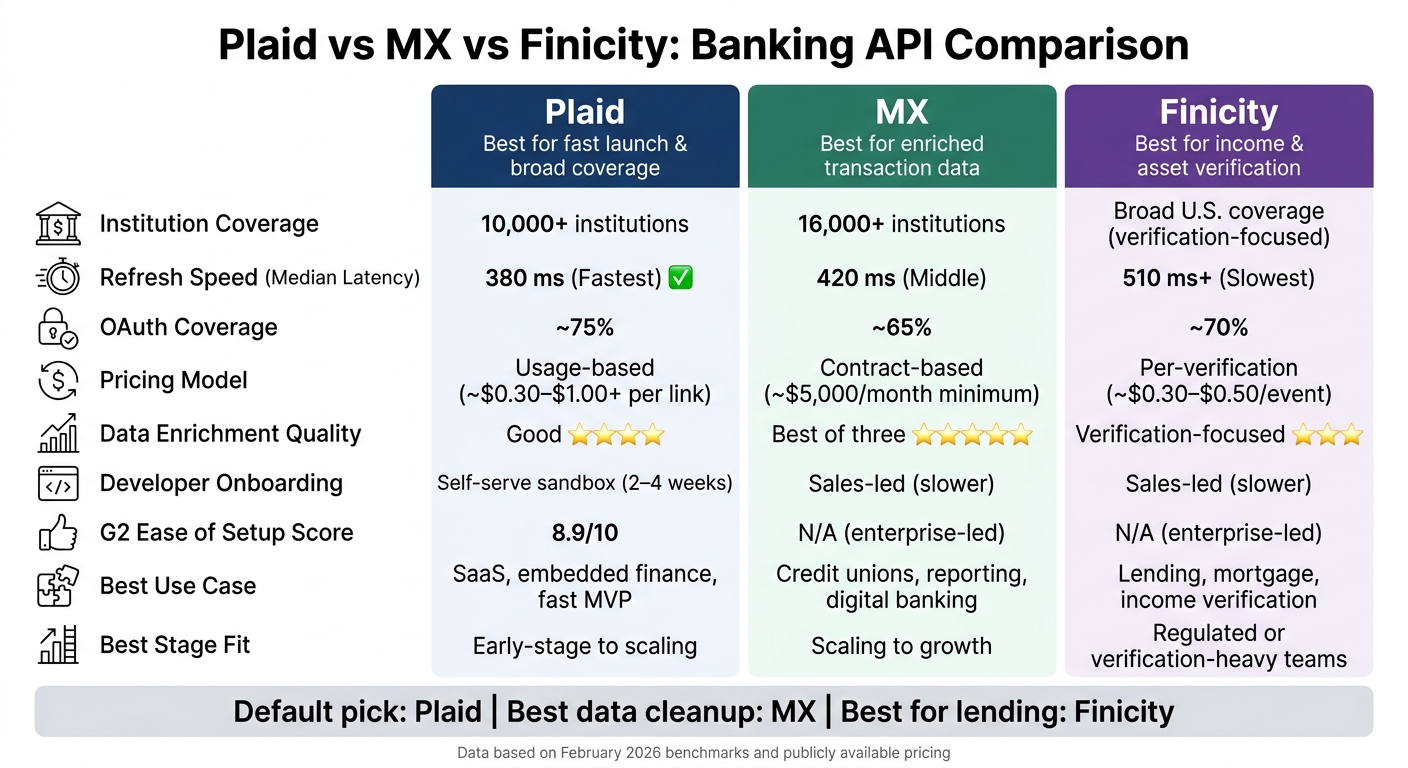
Plaid vs MX vs Finicity: Banking API Comparison Chart
| Criteria | Plaid | MX | Finicity |
|---|---|---|---|
| Best for | SaaS, embedded finance, fast launch | Enriched transaction data, credit unions, reporting cleanup | Lending, mortgage, income and asset checks |
| Coverage | 10,000+ institutions | 16,000+ institutions | Broad U.S. coverage with strength in verification flows |
| Speed | Fastest | Middle | Slowest of the three in common U.S. bank flows |
| Data cleanup | Good | Best of the three | More verification-focused |
| Connection stability | Strong OAuth experience | Mixed by institution | Mixed, with focus on verification use cases |
| Pricing style | Usage-based | Contract-based | Per-verification plus contract terms |
| Best stage fit | Early-stage to scaling | Scaling to growth | More regulated or verification-heavy teams |
My read: if you want the safest default, start with Plaid. If reporting cleanup and transaction labeling matter more, look at MX. If your product lives or dies by borrower verification, choose Finicity.
That’s the core decision this article walks through in more detail.
Here’s the short version of the tradeoffs that matter most.
The table below shows where the differences tend to shape finance, product, and reporting decisions.
| Dimension | Plaid | MX | Finicity (Mastercard) |
|---|---|---|---|
| U.S. institution coverage | 10,000+ institutions in North America[3][7][2] | 16,000+ institutions; strong among community banks and credit unions[3][7][4][1] | Extensive coverage with strength in lending and verification workflows[3][7][1][2] |
| Refresh speed | Fastest | Slower than Plaid | Slowest in typical U.S. bank flows |
| OAuth / connection reliability | Strong OAuth experience; refreshes smoothly for most consumer accounts | Mix of OAuth and fallback methods; reliability varies by institution | Mix of direct connections and fallbacks; best for verification workflows |
| Enrichment & categorization | Solid for most consumer fintech use cases | Strongest transaction enrichment and merchant naming | Verification-oriented rather than consumer finance-oriented |
| Verification capabilities | Account ownership and balance verification | Account ownership and balance verification | Income, asset, and account verification for lending workflows |
| Developer onboarding | Self-serve; fastest path to launch | Enterprise-led and sales-driven; slower launch | Sales-led, verification-focused; slower launch |
| Pricing model | Usage-based; roughly $0.30–$1+ per successful link[7][1][8] | Contract-based; enterprise subscriptions often start around $5,000/month or more[4][1] | Per-verification pricing, often around $0.30–$0.50, plus contract terms[3][7][1][8] |
| Typical fit | SaaS platforms and embedded finance | Digital banking and embedded finance for credit unions | Income and asset verification for lending and mortgage |
Next, let’s look at the tradeoffs that tend to show up during setup and day-to-day work.
All three providers support up to about 24 months of transaction history for standard U.S. retail accounts. That’s enough for most budgeting, analytics, and baseline credit assessment use cases. If you’re working with multi-entity businesses and need longer trend lines, you’ll still want your own data warehouse to close the gap.[7][4]
The bigger split shows up in enrichment quality. MX stands out most for transaction categorization and merchant naming, which makes a difference for personal finance, wealth, and digital banking products. Plaid handles most consumer fintech needs well. Finicity leans toward lending and verification workflows, so if your product isn’t built around verification, that extra depth may not show up as much in daily use.[3][7][4][1][5][6]
Refresh speed is another clear separator. Plaid is the fastest, with median round-trip latency of about 380 ms in a typical U.S. bank flow. Finicity usually comes in above 500 ms, and MX sits in the middle. Across all three, OAuth-linked accounts tend to refresh more smoothly, and Plaid has the edge on reliability in those flows.[7][6]
The biggest day-one differences come down to launch speed and budget planning.
Plaid is usually the fastest to get live. MX and Finicity give up some speed in exchange for a more structured sales and support process. With Plaid’s self-serve sandbox, engineers can link test accounts and check product assumptions before talking to sales. On G2, reviewers score Plaid 8.9/10 for ease of setup and 8.8/10 for ease of use, and its docs come up again and again as a strong point. Support is rated 7.9/10 on G2, which trails MX’s 9.4.[9]
Pricing also pushes teams in different directions. Plaid’s usage-based model is usually simpler to estimate early. MX asks teams to plan around a fixed monthly contract floor. Finicity’s per-verification setup fits lending businesses well, since verification events are discrete and easy to track.[7][4][1][8]
| Provider | Pros | Cons |
|---|---|---|
| Plaid | Broad U.S. coverage; fast self-serve setup; strong Link UI for user onboarding; usage-based pricing scales with early growth | Costs rise at high volume; enrichment is less specialized than MX for complex analytics; non-OAuth fallbacks can affect reliability |
| MX | Strong transaction enrichment and categorization; great fit for credit unions and community banks; strong support | Sales-led onboarding adds lead time; contract minimums require upfront budget commitment; less suited to rapid MVP iteration |
| Finicity | Deep income and asset verification; strong fit for mortgage and lending workflows; backed by Mastercard | Less optimized for consumer finance; slower in non-OAuth scenarios; per-verification pricing is less convenient for non-lending products |
This section ties those tradeoffs to day-to-day operating needs. Once one API has to support product, finance, and reporting at the same time, use-case fit matters more than a long feature list.
For most U.S. SaaS teams, Plaid is the default choice. It’s usually the fastest path to launch, and it tends to scale in a predictable way.[7][5][8]
MX makes more sense when transaction enrichment is part of the product itself. Say a SaaS platform white-labels financial insights for credit unions or community banks. In that case, cleaner merchant and transaction data can matter more than MX’s slower, enterprise-heavy sales process.[3][7][4][5][10]
Finicity fits a narrower slice of SaaS: embedded lending flows that need income and asset verification. A mortgage-tech SaaS company serving U.S. lenders can use Finicity for verification of income and assets that line up with Fannie Mae and Freddie Mac requirements, while using Plaid for account connectivity and ongoing monitoring.[3][6][8]
Healthcare adds another layer. The payment flow has to work for patients, but verification still has to hold up behind the scenes.
These workflows rely on the same core rails: account ownership verification, ACH payments, recurring billing, and fraud checks. Plaid fits patient portals and payment-plan enrollment well because broad coverage and fast refresh help cut drop-off.[1][6][11]
When healthcare overlaps with patient financing or medical credit products, Finicity is a better fit for underwriting those financing flows.[3][6][8] MX is less tuned for healthcare-specific verification, but it can still help when a clinic serves many patients who bank with regional institutions, credit unions, or community banks.[3][7][4]
For high-volume recurring billing, reliability is the main issue. If connections fail, payments fail. Plaid has an edge here because its refresh speed and OAuth reliability help keep recurring payment rails steady and lower failed-payment rates.[7][1][6][11]
The picture changes again when one company runs across multiple entities.
Multi-entity businesses need transaction data from many institutions in a normalized format so both entity-level and consolidated reporting can close on time.[8]
MX cuts reconciliation work by standardizing descriptions and merchant names across entities, which makes chart-of-accounts mapping faster and less prone to errors.[3][7][4][5][10] Plaid brings broad coverage and fast refresh, which helps reduce manual-export exceptions in automated reporting pipelines.[7][1][6][8]
Finicity can still play a role for subsidiaries tied to lending or mortgage operations, but it works better as a supporting feed than as the main reporting source.[3][10][6]
A common setup is to send API feeds from one or more aggregators into a data warehouse, then apply normalization and GL-mapping layers on top. That’s where the aggregator choice starts to hit close timelines and board reporting quality in a very direct way.
Once your use case narrows the options, compare rollout speed, compliance work, and long-term cost. The right banking API is not the one with the biggest feature set. It’s the one that fits your stage, your team’s bandwidth, and the reporting you’ll need 18 months from now.
Before you sign, check the decision against five factors: product goals, implementation speed, compliance requirements, reporting complexity, and total cost of ownership.
Start with your product goals. Figure out what you actually need: basic account linking and ACH, deeper transaction enrichment for analytics, identity and KYC checks, or more specialized lending and income verification. Use-case fit should shrink the list before you look at launch speed and price.[12][8]
Next, test implementation speed against your real engineering capacity. Basic Link setups often take 2–4 weeks and cost $3,000–$8,000. More complex workflows can stretch to 8–16 weeks and $20,000–$50,000+.[14] If you're pushing toward a launch date, that timing matters. MX and Finicity usually involve sales-led onboarding, which can add extra lead time.
That’s why cost modeling should come early, not at the end.
Compliance and support also need their own line item. Ask about uptime SLAs, outage handling, consent flows, audit controls, and what kind of support you get at your expected spend level. A low sticker price can look a lot different when support is thin and your team is stuck chasing issues.
Once you’ve tested launch speed and support, model how usage changes both monthly spend and your close process. Do a simple usage model before you negotiate. Estimate:
As a rough baseline, Auth and Balance calls often cost about $0.10–$0.25 each, Transactions calls around $0.30–$0.60, and identity verification endpoints can reach $0.65–$3.30 depending on the method.[13][15][16] For MX and Finicity, ask for detailed rate cards and convert them into effective per-link and per-call rates. That gives you an apples-to-apples comparison.
Then add the reporting impact. This is where teams often get burned. A cheaper API that gives you messy transaction categories or misses key institutions can end up costing more in analyst hours and reconciliation mistakes than a slightly higher-priced option with cleaner data.
So model both sides: the API bill, and the time your team saves - or loses - during the monthly close.
After weighing cost, reporting, and implementation, the choice comes down to three tradeoffs: connectivity, enrichment, or verification.
No provider is the right fit for every use case.
Plaid works well for fast launches. MX makes sense for teams with heavier reporting needs. Finicity is a strong match for verification-led workflows.
The table below boils that down by stage and core strength.
| Provider | Best Stage Fit | Core Strength |
|---|---|---|
| Plaid | Early-stage to scaling | Developer speed, broad coverage |
| MX | Scaling to growth | Enriched, normalized transaction data |
| Finicity | Exit-ready or regulated | Income and asset verification |
If the choice feels close, reporting complexity should break the tie.
Multi-entity reporting often pushes teams toward cleaner normalization. In that case, MX's standardized transaction data can cut manual cleanup in a way Plaid's broader coverage alone may not.
Phoenix Strategy Group can help model API cost, reporting impact, and downstream finance workflows before you commit.
For a startup MVP, the best banking API strikes a balance between easy setup now and enough depth to support you as transaction volume climbs and your finances get more complex.
Focus on a few things from the start: secure OAuth 2.0 authentication, solid data normalization, and a smooth connection to your current accounting and CRM tools. That setup helps you automate cash flow tracking and transaction categorization early on, cut down on manual entry mistakes, and build a strong base for growth.
Cleaner transaction data matters most when you need intraday accuracy and a clear view of operations. That way, cash movement, balances, and dashboards show what’s happening now, not hours later after data lags catch up.
This becomes even more important during growth, fundraising, or exit prep. It also matters when you’re building auditable, backfillable reporting. On top of that, clean data cuts down on manual categorization and reconciliation, so insights stay current instead of turning into a look back at what already happened.
Yes, often.
If you’re pulling financial data from multiple entities or separate systems, one banking API usually isn’t enough. In many cases, you need more than one API or data source to build a single, governed view of your financials.
When data comes in from several providers, orchestration and deduplication matter a lot. Without them, it’s easy to introduce errors or count the same transaction twice.
A simple way to cut that risk is to match records using unique transaction IDs and other checks so your combined data stays clean and accurate.