Published on
September 4, 2026


Leadership change after a deal can go wrong fast if people do not hear the right message in the right order. I’d build the plan around three checkpoints: Day 1, Day 30, and Day 100, then tie each update to clear owners, reporting lines, approval rules, and a fixed update schedule.
Here’s the short version:
What I like here is the focus on plain language: who do I report to, who approves spend, what happens next, and when do I hear more? That is what people want after an M&A event.
A few points stand out:
If I had to sum up the article in one line, it would be this: say less, say it clearly, say it early, and keep saying the same facts on a set schedule.
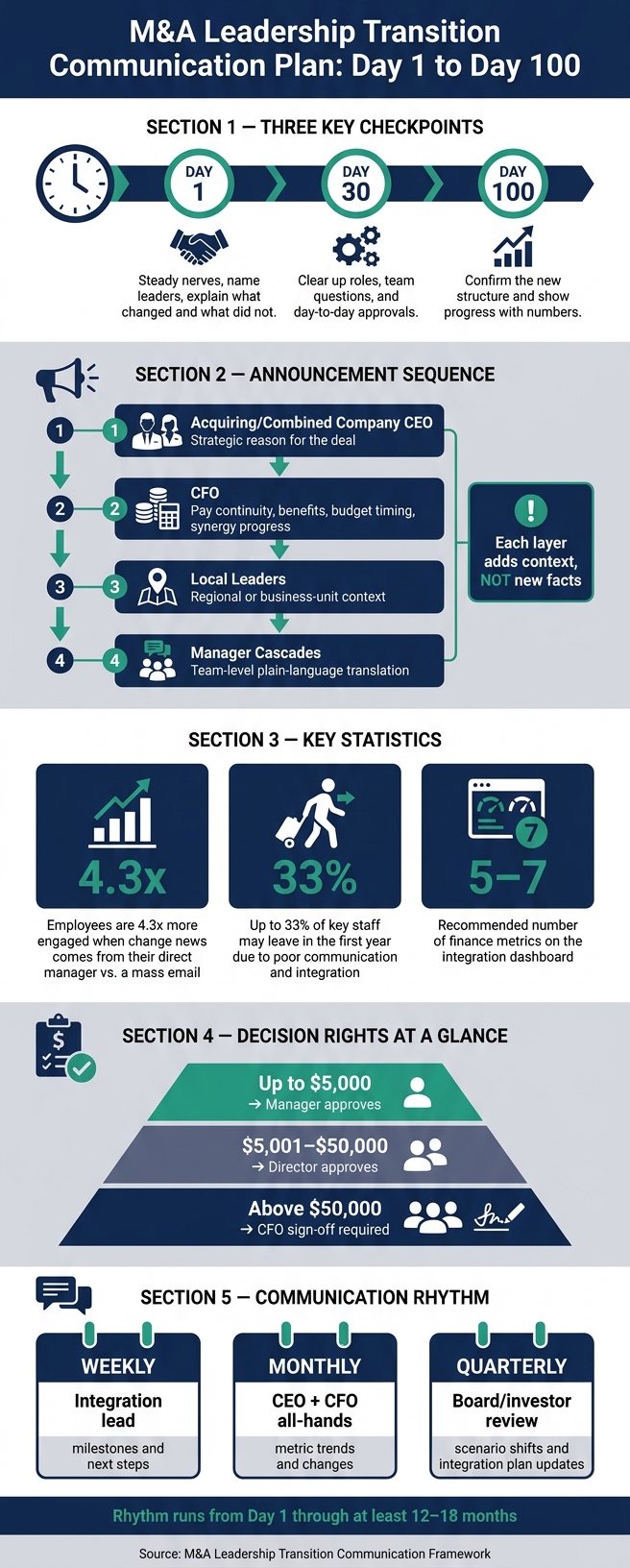
M&A Leadership Transition Communication Plan: Day 1 to Day 100
Once you've mapped decision rights, the next move is simple: assign each audience a message, a messenger, and a timeline. Different groups need different facts. They also need to hear them at different moments, and sometimes from different people.
Rank stakeholders by two things: how much disruption they'll feel and how much influence they have over decisions. A senior manager or key account owner may rank high on both. A frontline employee in a mission-critical operations role may rank high on disruption but lower on influence. Both groups need tailored communication, but the message, level of detail, and timing shouldn't be the same.
Employees need to hear early about job status, reporting lines, and any immediate shifts in priorities. Managers need that same base information, plus talking points, escalation paths, and clear decision rights. They should be briefed before the company-wide announcement so teams hear one consistent message.[1][2] Customers need clear confirmation that contracts, service levels, pricing, account ownership, and day-to-day contacts remain in place. Investors and lenders need details on leverage, covenant status, and the timeline for synergies. General reassurance won't cut it.
For each audience, spell out three things: what changes, what stays the same, and what they need to do next. Then attach dates to each commitment. That's what makes the message feel concrete instead of sounding like boilerplate.
An employee message might cover reporting line changes, benefit continuity, and the deadline to review the updated org chart. An investor message might cover leverage position, guidance timing, and when synergy progress will be visible. Same structure, very different substance.
A priority table helps you avoid two common problems: missed audiences and mixed messages. It pushes you to name an actual messenger, an actual channel, and an actual deadline for every group. It also makes gaps easy to spot. If a key audience is missing - or set to hear the news in the wrong order - you'll see it right away.
| Audience | Top Concern | Messenger | Channel | Timing |
|---|---|---|---|---|
| Frontline employees | Job security and reporting lines | Operations Director + HR Business Partner | Email + site meeting + intranet FAQ | Initial message by Oct. 5, 2026; Q&A by Oct. 12, 2026 |
| Middle managers | Consistent talking points and decision rights | CEO + HR Director | Manager-only briefing deck + small-group call | 24–48 hours before company-wide announcement |
| Top-revenue accounts | Contract and service continuity | Account Executive + VP of Sales | Personal email + scheduled video call | Within 48 hours of public announcement |
| Investors and lenders | Execution risk, covenant compliance, synergy timeline | CEO + CFO | Investor letter + conference call | Investor call on Oct. 20, 2026; updated guidance by Dec. 15, 2026 |
After audience mapping, the next step is sequencing who speaks first and through which channel.
Once your stakeholder priority table is set, the next step is straightforward: who speaks first, and when? Order matters. It cuts uncertainty before rumors take over. And it helps carry the same facts through every channel without mixed signals.
Day 1 should follow this order: acquiring company CEO or combined-company CEO town hall, CFO follow-up, local leader sessions, then manager cascades.
The acquiring company CEO or combined-company CEO should open with the strategic reason for the deal and explain what will change and what will stay the same. Then the acquired company CEO, founder, or another trusted business leader should reinforce continuity and show that familiar voices still have a seat at the table.
After that, the CFO should cover the topics people care about right away: pay continuity, benefits, budget timing, and when synergy progress will start to show up. Then managers should hold team huddles to turn the company message into plain terms: what this means for each role and day-to-day work.
Each layer should add context, not new facts.
Pick the channel based on speed, sensitivity, and how much detail people need.
| Channel | Speed | Emotional Impact | Best For |
|---|---|---|---|
| Live town hall | Fast once scheduled | High | Announcing the deal, introducing new leadership, live Q&A |
| All-hands email | Very fast | Low–Medium | Documenting key facts, timelines, and commitments |
| Manager cascade | Medium | Medium–High | Translating the corporate message into team-level implications |
| One-on-one conversation | Slow | Very high | Role changes, compensation impacts, sensitive restructuring |
| Written org update | Medium | Low | Clarifying reporting lines, titles, and decision rights |
If a change affects someone’s job, pay, or reporting line, that person should hear it straight from their manager before any company-wide announcement, ideally within 24 hours.[3] In those cases, one-on-ones and small manager sessions should happen first. Broader communication comes after.[4][5]
That approach isn’t just common sense. Research shows employees are 4.3 times more engaged when their direct manager shares change news instead of a generic company-wide email.[3]
Every messenger should repeat the same four facts:
The emphasis can shift by audience, but the facts should stay the same.
A one-page core script shared across all messengers helps prevent drift. The CEO should stress long-term strategy. The CFO should add detail on financial health, capital allocation, and synergy tracking. Managers should stick to confirmed facts, open decisions, and what happens next for their team over the next 90 days.
What no one should do is guess. If a decision hasn’t been made, say that plainly. Clear uncertainty lands better than vague reassurance.
Once the message sequence is set, translate it into plain reporting lines and decision rights.
Once your message sequence is set, put the new org setup into plain English people can use right away. Employees should not have to guess. They need three answers fast: who they report to, what changed, and who approves what from this point on.
Every org chart needs a short written explanation next to it. A chart by itself leaves too much room for hallway guesses and Slack speculation. A short note helps people understand the change without reading between the lines.
That note should name the new manager, list the effective date, explain what is staying the same, and tell employees where to send questions.
At a minimum, the org chart should show the top two layers of leadership - CEO, CFO, COO, and key business-unit directors - with teams grouped by function and geography using plain labels only. Add a short narrative that says which reporting relationships are effective now and which ones will phase in over 60 to 90 days. If lower-level structure is still being worked out, say that plainly. Use a temporary reporting setup and give a specific date for the next update. Keep one current version of the org chart on the intranet, marked with a version number and date, so employees can see which file is current.
A job title does not tell people who can make a call. You need plain rules. Spell them out in practical terms and in U.S. dollars.
For example:
Headcount rules should be just as clear. Replacing an open role is not automatic. Requests can go to the monthly integration committee, and the VP for that function can decide within 10 business days whether to backfill the role, change the scope, or spread the work across the team.
This matters because it stops each manager from making up their own rules. It also keeps teams from committing to spending, hiring, or work plans that the combined budget can't support.
Cross-functional disputes need a named path for escalation too. If Sales and Product are stuck, the issue can move to the CRO and CPO. If Operations and Finance are stuck, it can move to the COO and CFO. In each case, set a clear target for how fast the issue will be acknowledged and resolved.
Use the table below as a release checklist.
| Factor | Vague Reporting Update | Clear Reporting Update |
|---|---|---|
| Timing | Sent weeks after rumors start | Sent on Day 1 with follow-up dates |
| Level of detail | Uses generic language about structure | Lists specific teams and new managers by name |
| Manager timing | Managers hear at the same time as staff | Managers briefed with FAQs 3–5 days in advance |
| Compensation clarity | Gives only general reassurance | States what is unchanged, when reviews occur, and the bonus approach |
| Review cycle | Leaves goals undefined | Explains the goal framework and upcoming review cycle with dates |
| Decision rights | Leaves budgets and hiring unclear | Names approvers and USD thresholds for expenses and headcount |
If your message can't answer the questions covered in the clear-update column, it's not ready to send.
When leadership messages drift away from the numbers, people pick up on it fast. During integration, the CFO helps translate the deal thesis into figures managers can repeat with confidence.
Once reporting lines are set, finance needs to show if the integration is actually working.
Use a short, repeatable dashboard that managers can explain in two to three minutes. Keep it to five to seven metrics tied directly to the questions employees, customers, and investors are already asking.
| Metric | What It Tells People |
|---|---|
| Revenue retention | Whether customers are staying through the transition |
| Cash runway | How long the business can operate at current spending levels |
| Gross margin | Whether cost savings are showing up |
| Integration costs | Which costs are one-time and which will remain |
| On-time milestone completion | Percent of integration milestones completed on schedule |
Each metric needs a plain-English definition. For example, cash runway can be explained like this: At $12,000,000 in cash and $1,200,000 in monthly spend, runway is about 10 months. A VP can repeat that sentence without tripping over it.
Once leaders have the dashboard, run scenarios against it before anything goes public. That step helps pressure-test the story and spot weak points early.
Don't promise more than the numbers can support. Research keeps showing the same pattern: most deals fall short of projected synergies, and revenue synergies tend to arrive much later than planned.[6][7][8]
Scenario planning helps leadership avoid statements they'll regret later. Build at least three cases:
Model staffing, integration costs, and cash runway for each one. Then use conditional language in outside communications. Tie staffing or investment decisions to whether integration timelines stay on track, so leadership doesn't get boxed in by a promise that a slower system migration could derail.
This hits mid-market companies even harder because cash flow is often tight. If integration spending cuts runway from 14 months to 9 months, leaders need a clear reason for delaying hires. That reason should come from a model, not a guess.
Use the same metrics in every update so leaders keep answering the same questions the same way. Finance-backed updates only work when they show up on a set schedule and follow the same messenger, channel, and timing discipline already in place for the broader communication plan.
A weekly update from the integration lead should cover milestones and next steps. A monthly all-hands gives the CEO and CFO a shared setting to walk through metric trends and explain what changed. Quarterly reviews should cover scenario shifts for the board and investors, along with any changes to the integration plan.
That rhythm should start on Day 1 and continue for at least 12 to 18 months. Each update should follow the same structure: key metrics, milestones achieved, upcoming changes, and risks with mitigation steps.
Before Day 1, focus on clear structure and smooth handoffs.
Write down who is leaving, who is staying, and what the new reporting lines will look like. Then attach a written transition plan to the deal documents. That plan should spell out roles, decision-making authority, communication rules, and how disputes will be handled.
You’ll also want a centralized communication plan so messages don’t drift or clash. Prepare announcement materials at least one week in advance so legal has time to review them. And make sure key knowledge and operational handoffs have clear owners. If no one owns the handoff, it usually doesn’t happen cleanly.
Don’t leave a void. If you don’t have all the answers yet, say so. Explain how decisions are being made, and commit to a clear timeline for the next update.
Use one central communication plan and approved talking points so managers give the same answer, not five different versions of it. Keep feedback channels open, track open issues with a named owner and due date, and escalate anything unresolved within 48 hours.
Focus on three areas: employee sentiment, customer stability, and synergy realization.
For employees, track retention, pulse survey engagement, and how well teams are blending together. On the customer side, watch indicators like Net Promoter Score (NPS), churn, and lifetime value. For synergies, measure progress against milestones, cost savings, and revenue growth.
Set baselines before closing so you can compare results during the first 180 days and in the months that follow.