Published on
August 7, 2026

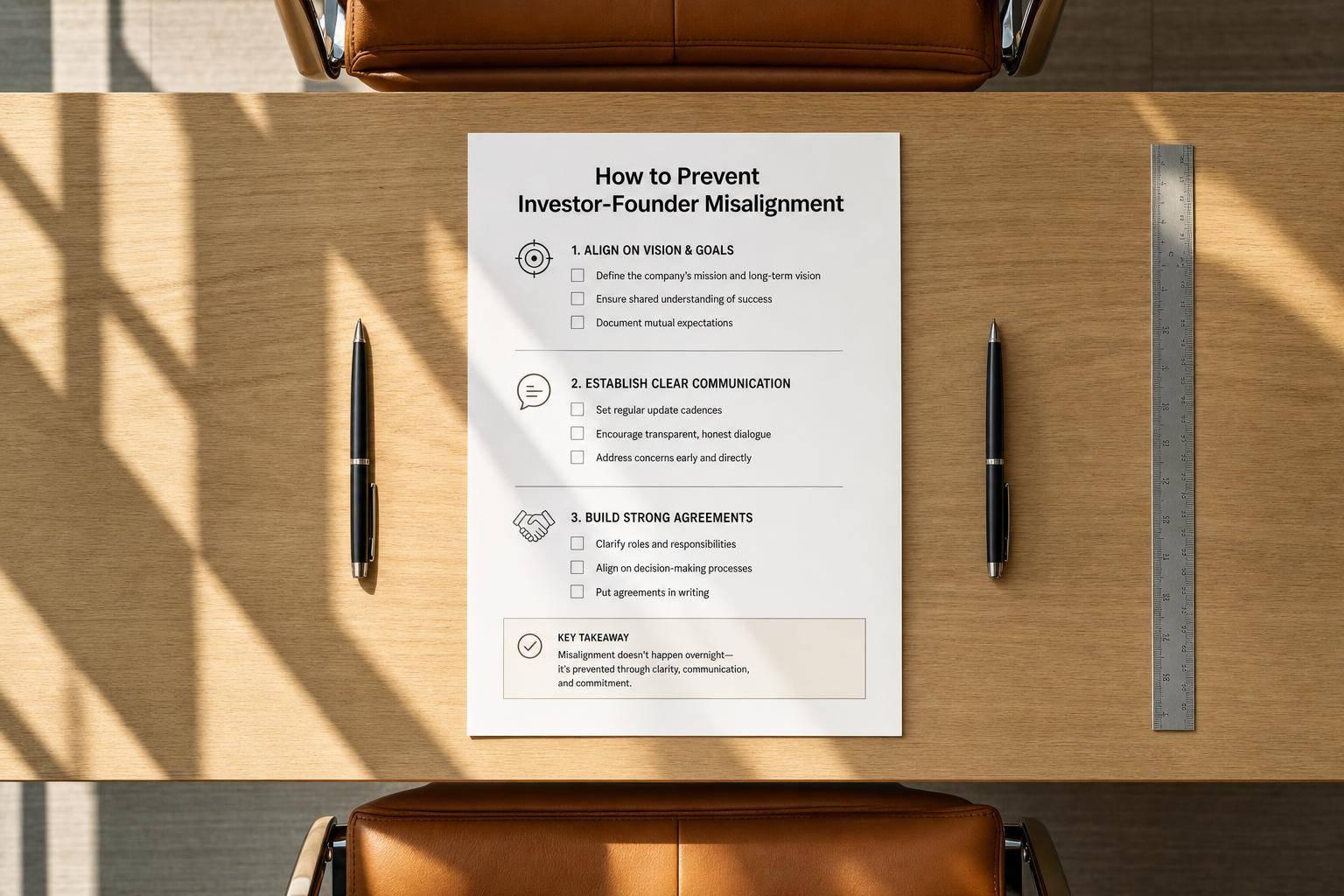
Misalignment after a funding round can damage growth, burn cash, and even cost founders the CEO seat. I’d boil the fix down to four moves: set clear targets before signing, lock reporting rules right after closing, define who decides what, and match your cash plan to your investor’s fund timeline.
Here’s the short version:
A few numbers show why this matters. Research in the article notes that 20% to 40% of startup founders are later replaced as CEO by investors. It also cites a Sifted survey where 71% of founders and senior leaders said investor relationships had worsened, and nearly 44% said that happened in the last 12 months.
If I had to sum up the whole article in one line, it would be this: put the hard rules on paper before stress hits.
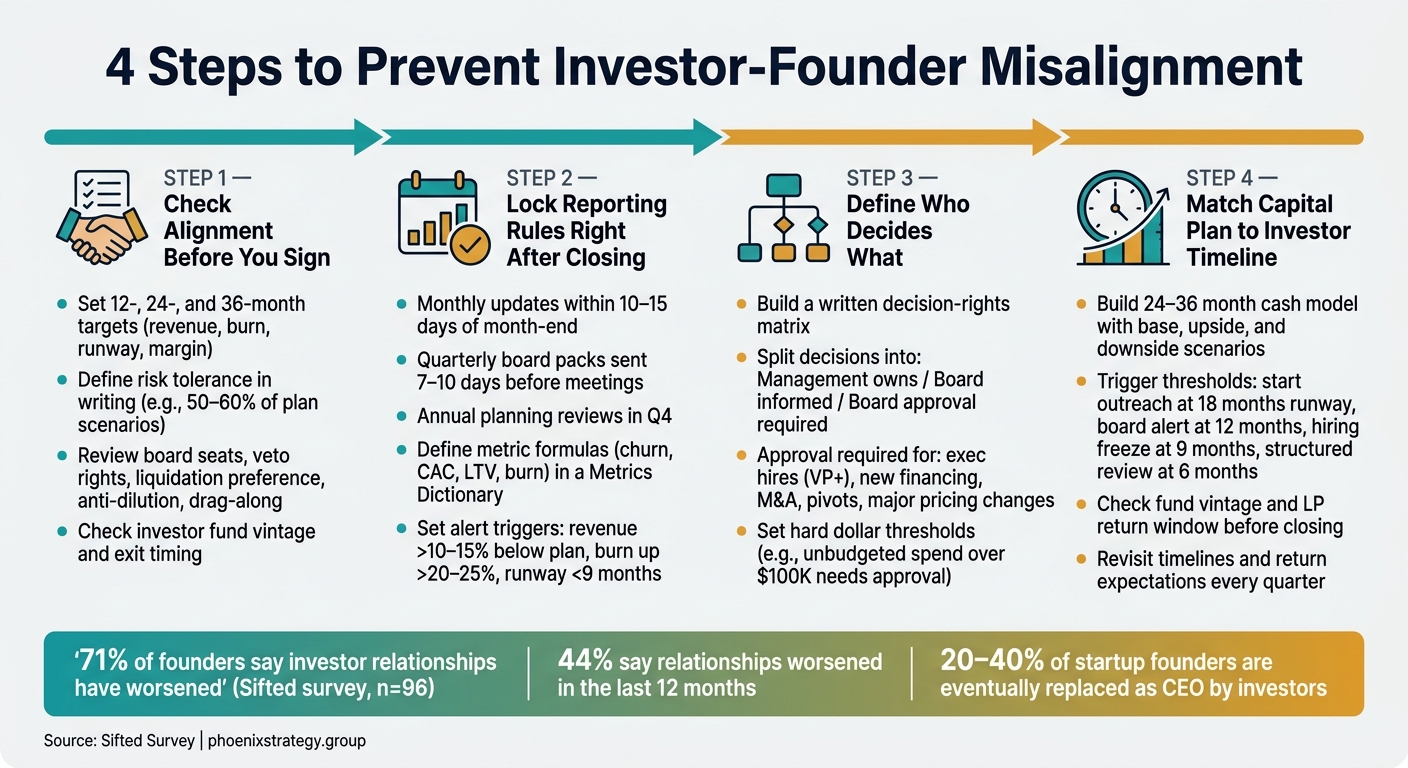
4 Steps to Prevent Investor-Founder Misalignment
A lot of founder-investor misalignment starts before the deal closes. This is usually when time pressure kicks in, everyone wants to get to the wire, and the hard questions get brushed aside.
Use this step to turn the four risk areas from the introduction into clear written targets and deal terms.
Before you sign anything, turn broad goals into a short list of numbers with set time frames. A simple one-page scorecard for 12, 24, and 36 months works well. Include revenue, margin, burn, runway, and key milestones. A fractional CFO can help build this scorecard to ensure financial accuracy. Then review that scorecard line by line with your lead investor before signing so you can confirm you're both looking at the same business picture.[6][4][10]
Risk tolerance is often where the hidden tension sits. That's why a direct 60- to 90-minute conversation about growth, burn, concentration, and control matters so much. Ask a plain question: if growth comes in at 50% to 60% of plan, do they want lower burn or shorter runway? Write the answer down in a short Risk & Operating Principles memo. That memo should spell out agreed rules, like choosing runway of at least 12 months over chasing maximum growth. Keep it as the reference point for later board decisions.[1][9][10][5]
Exit timing also needs to line up with the capital plan and the investor's fund timeline. Ask about the investor's fund vintage and when it needs to return capital to LPs. A fund in year 7 of a 10-year life is in a very different spot than one in year 2. Ask what return and timing they would view as a good, great, and weak outcome. Put those answers into a short written Exit & Capital Alignment Summary so both sides have the same record.[1][6][4][2][5]
And yes, do diligence on the investor too, not just the firm name. Ask for references that include a founder who had a rough stretch, not only one with a win. Ask what happened when targets were missed, whether the investor pushed for an early sale, and whether that founder would pick the same investor again.[3][7][10]
Some term sheet clauses quietly change who has control, who gets paid first, and where pressure shows up later.[8][11][12] The table below covers the clauses that most often create problems, what each one affects, how misalignment can happen, and what to clear up before closing.
| Clause | What It Affects | How It Can Create Misalignment | What to Clarify Before Closing |
|---|---|---|---|
| Board composition | Who controls strategy and CEO removal | Investor board majority early on can push hard growth demands or force leadership changes | Aim for a balanced board; negotiate shared appointment of independent directors |
| Protective provisions / veto rights | Investor approval over financings, sales, budgets, or major hires | Veto rights that are too broad can slow decisions or block needed financings | Limit vetoes to clearly defined, material events |
| Liquidation preference | How exit proceeds are distributed before common shareholders are paid | A 2–3× or participating preference can make mid-range exits unattractive for founders even when investors still do well | Push for 1× non-participating; model how different preference structures affect your proceeds at different exit values |
| Anti-dilution protection | Protects investors if future rounds price lower | Full-ratchet anti-dilution can heavily dilute founders and employees in a down round | Negotiate broad-based weighted-average anti-dilution; avoid full-ratchet provisions |
| Budget and hiring approval rights | Investor approval for budgets or major hires | These rights can slow execution and create friction when founder and investor disagree on spend or team shape | Define the dollar thresholds or role levels that actually need approval |
| Drag-along rights | Ability to compel other shareholders to approve a sale | Investors may use drag-along to force a sale at a price or timing the founder opposes | Clarify minimum price thresholds and required consent percentages before drag-along can be triggered |
Model every control or payout clause before you sign.
Once you agree on targets and terms, the next move is to make them measurable through reporting. After the terms are fixed, lock them into reporting and board rules in Step 2.
Take the targets from Step 1 and turn them into a reporting rhythm before the first month closes. In plain English: set the rules right after closing, not later. If you wait, small misses can start to look like bigger problems than they are. When information is missing, investors often assume the worst.[14][18]
Right after closing, lock in three reporting cadences:
Spell out who gets what. Monthly updates can go to the full investor base. Detailed board packages should stay with board members and observers.[14][15][19][22]
Use one U.S. reporting format across everything: USD with $, MM/DD/YYYY dates, and the same labels each time for counts and percentages.[14][17][19]
It also helps to build a one-page Metrics Dictionary. Define every KPI the same way, every time. For example, gross revenue churn is MRR lost from existing customers in the month, excluding expansions, divided by MRR at the start of the month. CAC is total sales and marketing expense in the month divided by new paying customers added in the same period. Put those definitions in writing, and you avoid the same argument every quarter over what a number means.[16][18][20]
Once the metrics are locked, compare them to plan every month. Each update should include a simple Actual vs. Plan vs. Variance table for revenue, cash balance, burn, runway, hiring, churn, CAC, and LTV. Add a short note beside each line so investors can see what changed and why.
You should also agree ahead of time on triggers for updates outside the normal schedule. Common examples include:
Write these triggers into the reporting policy. Name the channel too, such as an email summary followed by an optional call, and list who gets notified.[18][19][21][22]
Good reporting depends on basic discipline. That means using accrual-basis accounting, finishing monthly bank and credit card reconciliations by the 5th to 7th business day after month-end, keeping the CRM lined up with revenue recognition, and maintaining an FP&A model that connects actuals to plan each month.[13][16][22]
Setting up this reporting infrastructure within 30 days of closing can save a lot of time fast. By the fourth board meeting, prep work can shrink from days to hours.[22]
Those reports should then flow straight into board decisions and approval thresholds in Step 3.
Once reporting is in place, the next friction point is authority: who decides what. If that isn't clear, founders and investors start from different assumptions, and tension shows up fast. Reporting shows what happened. Decision rights decide who acts on it. These rules work best when they connect directly to the metrics from Step 2.
The fix is a written decision rights matrix. It assigns each major decision type to an owner, shows how much board involvement is needed, and sets any dollar or plan-based threshold that triggers formal approval. The point is simple: agree in advance on which decisions need visibility, discussion, or approval.
The matrix should split decisions into three buckets: what management owns outright, what the board should be told about, and what needs formal board approval. Budgets, fundraising, executive hires above VP level, material compensation changes, major pricing shifts, and product or market pivots almost always sit in the approval column.[25][28]
Here’s a practical starting point. Adjust the thresholds to fit your company’s size, burn rate, and governing documents. Don’t just lift numbers from another startup’s template.
| Decision Type | Owner | Board Involvement | Approval Threshold |
|---|---|---|---|
| Routine operating spend | Management | None | Within approved budget and delegation limits |
| Unbudgeted spend | CEO or management | Inform or approve depending on size | Any unbudgeted commitment over a preset limit, such as $100,000[25] |
| Annual operating budget | Management (prepares) | Board approval | Before fiscal year starts |
| Executive hire (VP and above) | CEO | Board approval | Any hire at this level |
| New financing round | CEO + CFO | Board approval; shareholder consent if required | Any new equity or debt round |
| Acquisition or M&A | CEO | Board approval; shareholder approval if required | Any transaction |
| Material compensation change | CEO | Board approval | Any broad compensation change |
| Major pricing or margin change | CEO | Board discussion | Any change affecting margin structure |
| Product or market pivot | CEO | Board approval | Any material change to the operating plan |
Once approval rights are clear, meetings can stay focused on the small set of decisions that actually need the board.
One part people often skip: define major in dollars. Vague phrases like significant spend cause fights all the time. Write the threshold as a hard number - for example, any unbudgeted commitment over $100,000 - and place it in the governance memo next to the matrix.[25]
You’ll also want to map reserved matters, protective provisions, and shareholder consent rules into the matrix. Some fundamental actions may need shareholder approval too, so the matrix should match your charter, bylaws, investor rights agreement, and any side letters.[23][26][28]
Decision rights tell you who approves what. Board meeting norms tell you how that approval process works in practice. Set those norms before the first meeting, not in the middle of a dispute.
For most growth-stage companies, quarterly formal board meetings lasting 90 to 120 minutes work well, with monthly written updates that cover the metrics from Step 2.[24] Materials should go out 5 to 7 days before the meeting so directors can prepare real questions instead of reading the deck for the first time in the room.[27]
Pre-reads should stay short and cover:
A good rule of thumb is roughly 15% recap, 60% decisions, and 25% risks and capital planning.[24] That split helps keep the meeting from drifting into a status update.
Label each agenda item as inform, discuss, or approve. That way, directors know whether they’re there to absorb information, debate tradeoffs, or make a call. If a disagreement comes up, the escalation path should already be on paper: management discussion first, then lead investor review if needed, then the full board only for issues that actually belong there.
When conflict does show up, frame it around business tradeoffs - runway versus growth speed, margin versus market share - instead of personal control. That usually makes resolution much easier.
With authority and board rules set, the next step is to align the capital plan with the investor's timeline.
Some misalignment isn't about bad communication. It's built into the system.
Many venture funds run on a 10-year structure. In most cases, years 1 to 5 are used to invest capital, and years 5 to 10 are focused on returning that capital to limited partners.[29][30][31] So even if your company is doing fine, pressure can build fast when the fund's clock and the company's clock don't line up.
That's why your runway plan has to match the investor's fund cycle.
After you set targets, reporting rules, and board expectations, take one more step: check whether your capital needs fit the investor's timeline. Before you close a round, ask each investor direct questions:
Then put that information next to your cash model: fund vintage, exit window, and exit expectations. That one step can save a lot of pain later.
Founders should plan for 24 to 36 months of runway after each raise, using a conservative model.[32][38] You also need downside planning for slower growth and a delayed next round.
A simple way to do this is to build three scenarios: base, upside, and downside.
The base case should reflect the path you think is most likely. That means your current pipeline, approved headcount, expected gross margin, and normal operating expense. The upside case should assume growth comes in stronger than expected or conversion happens faster. The downside case should test slower sales, weaker hiring payback, or a tougher fundraising market.
Each version of the model should show monthly burn, ending cash, runway, and the point when the next raise needs to begin.
Use that model to spot key decisions early: when you need to raise again, when spending has to come down, and when hiring may need to wait.
| Scenario | Core Assumptions | Cash Runway | Next Fundraising Trigger |
|---|---|---|---|
| Base case | Current pipeline, approved hires, standard burn | ~18–24 months | Start outreach around 18 months of runway |
| Upside case | Accelerated sales or new markets; 20%–30% above plan | ~12–15 months due to higher spend | Bring forward the next round to capture momentum |
| Downside case | Slower adoption or market shift; 20%–30% below plan | 24+ months with cost control | Delay the raise; consider a bridge if the milestone slips |
A useful set of thresholds looks like this: start investor outreach when runway hits 18 months, notify the board at 12 months, freeze non-critical hiring at 9 months, and begin a structured review at 6 months. That review should cover cost cuts, bridge financing, or other paths if needed.[34][35][36][38]
Set these triggers in advance and keep them beside the decision-rights matrix. When cash gets tight, you do not want to invent the rules on the fly.
Quarterly reviews keep the capital plan current and test whether your runway still fits the next raise or exit path.[33][35][36][37][38] They give you a regular moment to reset runway, fundraising timing, and exit assumptions based on actual performance and market conditions.
If growth slows or the funding market gets tighter, reset expectations early. Show what changed. Then share an updated plan with revised milestones and capital needs.
That conversation is much easier 6 months before a problem than 6 weeks before you run out of runway. Tie the forecast closely to board reporting so timing disputes show up early, not when options are already narrowing.
Investor-founder misalignment usually starts with different incentives. One side is focused on return targets, fund timelines, and exit needs. The other is trying to run the company day to day. That gap can stay quiet for a while, then show up fast in the boardroom.
The four controls in this guide are meant to deal with that early, before it turns into a larger issue.
Taken together, these four steps work as a simple system: align before signing, document reporting after closing, define decision rights, and connect the capital plan to investor timelines.
In practice, that usually means putting a few basic tools in place:
That’s enough to cover most of the basics. The upfront cost is just a few hours of planning and documentation. The cost of skipping it can be much higher: lost operating time, damaged trust, restructuring costs, and reputational harm[40][41].
The strain is not theoretical. A Sifted survey of 96 founders and senior leaders found that 71% felt their investor relationships had worsened, and nearly 44% said those relationships had worsened in the past 12 months[39]. In many cases, that friction comes from vague targets and weak operating rules.
When founders and investors work from the same targets, the same rules, and the same capital plan, disagreements are more likely to stay where they should be: focused on data and strategy, not fights over control.
If your team doesn’t have the finance capacity to run this discipline in-house, Phoenix Strategy Group can help. The goal is simple: make alignment part of every round, not an afterthought.
Before signing a term sheet, founders should get aligned on governance and control. The big issues are usually board composition and who can outvote whom. If you sort that out early, you’re less likely to run into ugly surprises later.
One point matters a lot: agree in advance on how independent directors will be chosen. If that process is vague, investors may end up with a path to a one-sided board majority.
It also helps to keep protective provisions tight and limited to major structural moves. Think things like a sale of the company, changes to the charter, or issuing new senior securities, not day-to-day decisions.
You’ll also want to spell out how the employee stock pool is treated. That detail can shift dilution in a big way, and founders often feel the hit if it isn’t clear from the start.
Finally, set a high bar for drag-along rights. A higher approval threshold can give the company more room to stick to its long-term vision instead of getting pushed into a sale by a smaller group of stakeholders.
Conflicts usually show up around who gets to make decisions, how dilution is handled, and what happens at exit. In plain terms, founders and investors often clash over control.
The most common sticking points are investor board seats, veto rights, and how much say investors should have in day-to-day matters like hiring and budgets.
Tension also builds around anti-dilution provisions, liquidation preferences, and board composition. The choice of independent directors can turn into a fight too. So can clauses that let investors add more board seats or take control later on.
Startups should update investors on a regular basis to keep trust strong and avoid surprises. The right rhythm usually comes down to three things: growth stage, capital needs, and burn rate.
For many companies, monthly financial reporting becomes standard after Series A. By Series B, teams often add weekly cash flow updates, along with quarterly board packages. Quarterly strategic reviews also matter at any stage.
This setup makes sense. Monthly reporting gives investors a clear view of how the business is performing without turning every week into a fire drill. Weekly cash flow updates, on the other hand, help later-stage companies keep a close eye on runway and spending. And quarterly strategic reviews create space to step back, look at the bigger picture, and talk through what’s changing.