Published on
August 27, 2026


If I sell ISO shares too early, part of my profit can be taxed like wages instead of long-term capital gain. That one timing mistake can change my tax bill, my Form W-2, and the company’s reporting.
Here’s the short version:
That means my ISO decision is often a tradeoff between:
| Item | Qualifying ISO Sale | Disqualifying ISO Sale |
|---|---|---|
| Timing rule | > 1 year after exercise and > 2 years after grant | Miss either rule |
| Tax on spread | None as ordinary income | Usually taxed as ordinary income |
| Capital gain treatment | Full gain usually taxed as long-term capital gain | Only post-exercise gain gets capital gain treatment |
| W-2 impact | Usually no wage reporting | Ordinary income usually reported on Form W-2 |
| Main tradeoff | Lower tax, but I wait longer | Cash sooner, but higher tax on part of the gain |
A simple example helps: if I got the ISO on 03/01/2023 and exercised on 09/01/2024, my first qualifying sale date would usually be 09/02/2025. Sell on 09/01/2025 instead, and the tax result can change.
So when I look at ISO sales, I’m not just asking, “Should I sell?” I’m asking, “What happens if I sell on this exact date?”
Timing is what separates a tax-favored ISO sale from one that turns part of the profit into ordinary income. A qualifying ISO sale lets the gain stay taxed at long-term capital gains rates. A disqualifying ISO sale happens when you sell too early and miss one or both holding periods, which means ordinary income applies to the spread.
For the sale to qualify, you need to hold the shares for more than one year after exercise and more than two years after grant.
If you meet both rules, you generally avoid ordinary income on the spread. Instead, the full profit is taxed as a long-term capital gain.
If you miss either holding period by even one day, the sale becomes disqualifying. When that happens, the spread - FMV at exercise minus the exercise price - is taxed as ordinary income in the year of sale. Any gain after the exercise date is taxed as capital gain, either short-term or long-term, based on how long you held the shares after exercise.
That tax difference often shapes the decision. Some employees or founders sell for liquidity now. Others wait to get better tax treatment.
The table below shows how the two paths change tax treatment, reporting, and liquidity.
| Feature | Qualifying ISO Sale | Disqualifying ISO Sale |
|---|---|---|
| Timing Test | >1 year from exercise AND >2 years from grant | ≤1 year from exercise OR ≤2 years from grant |
| Ordinary Income on Spread | None | Spread taxed as ordinary income |
| Capital Gains Treatment | Entire gain (sale price minus exercise price) as long-term capital gains | Only post-exercise appreciation |
| Payroll/Reporting | No ordinary income reporting | Spread reported as ordinary income on W-2 |
| Planning Tradeoff | Maximum tax efficiency; requires patience | Immediate liquidity; higher tax cost on the spread |
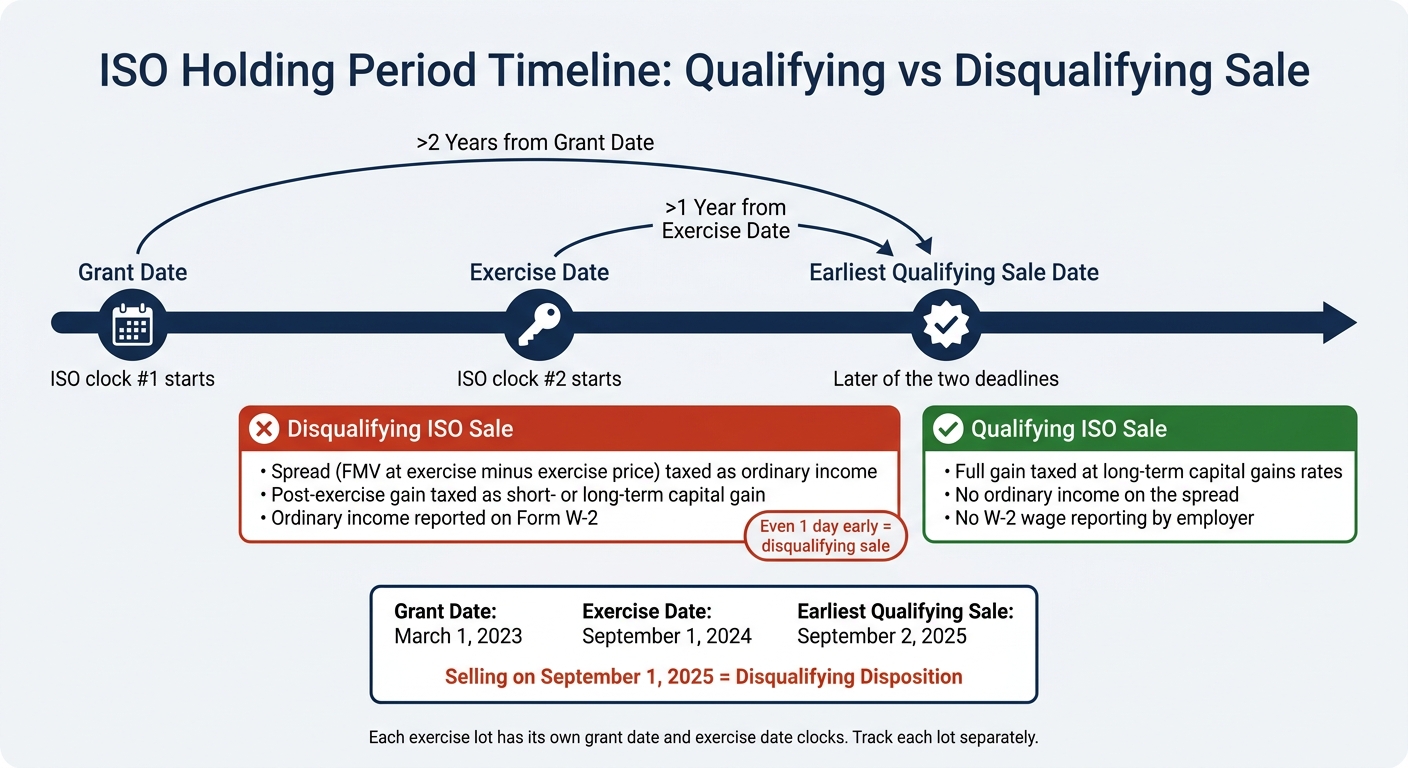
ISO Holding Period Timeline: Qualifying vs Disqualifying Sale
Two separate clocks decide whether an ISO sale gets qualifying treatment: one starts on the grant date, and the other starts on the exercise date.[1]
The tax result turns on two holding periods. The grant-date clock must run for more than two years. The exercise-date clock must run for more than one year. Both rules have to be met.[1]
Here’s how that looks in practice. Say you receive an ISO grant on March 1, 2023, and you exercise on September 1, 2024. The earliest qualifying sale date would be September 2, 2025 because that’s the later of the two deadlines.[1]
There’s one more detail that trips people up: each exercise creates a separate lot, and each lot has its own holding periods. So one lot might qualify for the better tax result while another lot does not. If you exercised in stages, the same exit can lead to different tax treatment across those shares. That’s why cap table and equity management systems matter so much here. They’re the practical place to track grant dates, exercise dates, and the fair market value at exercise for each lot.[1]
If a liquidity event or secondary sale closes before your qualifying date, the sale becomes a disqualifying disposition.[1]
That means the closing date of an exit can lock in the tax outcome before you get any room to adjust. Miss the date by even one day, and the tax and payroll result changes. Once the sale date is locked, the result follows.[1]
Next, let’s look at how the gain gets taxed and reported.
A qualifying sale lets the full gain stay under long-term capital gains rates. A disqualifying sale works differently: part of the gain is taxed as ordinary income, and the rest may get capital-gains treatment.
The bargain element - the spread between the fair market value (FMV) at exercise and your exercise price - is taxed as ordinary income [1]. Any increase in value after the exercise date is treated as a capital gain, either short-term or long-term based on how long you held the shares after exercise [2].
Here’s the simple way to think about it: the gain up to the exercise-date spread is treated like pay, while any growth after that is treated like an investment gain. If the stock price drops after exercise, ordinary income is generally capped at the actual gain on sale [2].
That tax split also affects how the company handles reporting.
The reporting rules change based on the type of disposition.
A qualifying disposition generally does not create wage-reporting or payroll withholding duties for the employer [3]. The gain is taxed at capital gains rates on the employee’s return.
A disqualifying disposition is different. The ordinary income portion must be reported as wages, so it appears on the employee’s Form W-2 [1]. The company may claim a matching deduction for the W-2 amount [3]. The employee reports that ordinary-income amount on the return, and any remaining tax is paid through the normal filing process [3].
Because of that, exercise and sale dates matter a lot. If those dates are off, year-end W-2 reporting may not match the right disposition type.
Exit decisions usually come down to three things: taxes, cash, and risk. Once you know the tax result, the next step is simpler but not always easy: is waiting still worth it? That decision ties straight to liquidity events, deal timing, and stock-price swings, not just the tax bill.
Holding shares long enough to qualify can make sense if you don't need cash right away and you're okay taking on more stock-price risk. The bigger the spread, the more you may save on taxes. But there’s a catch. Every extra day you hold adds concentration risk, which means more of your net worth stays tied up in one company.
You also need to look at AMT exposure from the exercise itself. Exercising ISOs can trigger an AMT liability even if you don’t sell the shares right away [1].
If waiting no longer lines up with the deal timeline, the math changes fast.
If a deal closes before you qualify, timing certainty may matter more than tax savings [1]. In that case, a disqualifying sale can be the better move.
The main reasons are pretty simple:
Yes, the spread may be taxed as ordinary income. Still, selling earlier can make sense when cash needs are pressing or when too much of your financial life is riding on one stock. In practice, most ISO exit decisions come back to the same tradeoff: wait for a better tax result, or sell sooner for cash and less risk.
A qualifying ISO sale takes more than one year after exercise and more than two years after grant. Miss either rule, and the sale becomes disqualifying, with the bargain element taxed as ordinary income.
That tax gap can be a big deal. And timing, cash needs, and liquidity matter just as much. The way the sale is taxed also changes employer reporting.
Once the tax result is clear, the choice turns into a simple tradeoff: cash now or lower taxes later. The right move depends on exit timing, risk tolerance, and after-tax planning. Qualifying treatment can cut taxes, but it also means waiting longer for liquidity and taking on more stock-price risk. Disqualifying treatment gives up some tax savings in exchange for more certainty and faster access to cash. The better option is the one that lines up with your cash needs, risk tolerance, and tax position.
When the stakes are high, model both outcomes with a tax advisor or financial advisory team - like Phoenix Strategy Group - before you exercise or sell.
Your earliest qualifying sale date is the first date when you’ve met both holding periods:
Put simply, the earliest qualifying sale date is whichever of those two dates comes later.
If you sell before both holding periods are met, the sale is a disqualifying disposition.
Each ISO lot is its own tax event, and each one has its own holding period.
That means you need to track the grant date and exercise date for every lot. Those dates tell you whether a sale meets the qualifying disposition rules.
There’s another reason this matters: each lot can come with a different bargain element. So if you exercise in batches, you may be able to spread AMT adjustments across more than one tax year.
Yes. If a company sale forces you to sell or cash out ISO shares before you meet the holding periods - at least two years from the grant date and one year from the exercise date - the sale is a disqualifying disposition.
In plain English, that means you lose the better long-term capital gains treatment. Instead, the bargain element gets taxed as ordinary income, and it may also be subject to payroll taxes.