Published on
July 31, 2026


If I had to sum this up in one line: Fundrise and Arrived fit smaller budgets, while CrowdStreet, Yieldstreet, and EquityMultiple are mostly for accredited investors with more cash and a longer time horizon.
If you're comparing these six platforms, I’d focus on just four things first:
Here’s the short version:
The main tradeoff is simple: lower minimums usually mean more pooled exposure and less control, while higher minimums often mean more deal choice, more sponsor risk, and less liquidity.
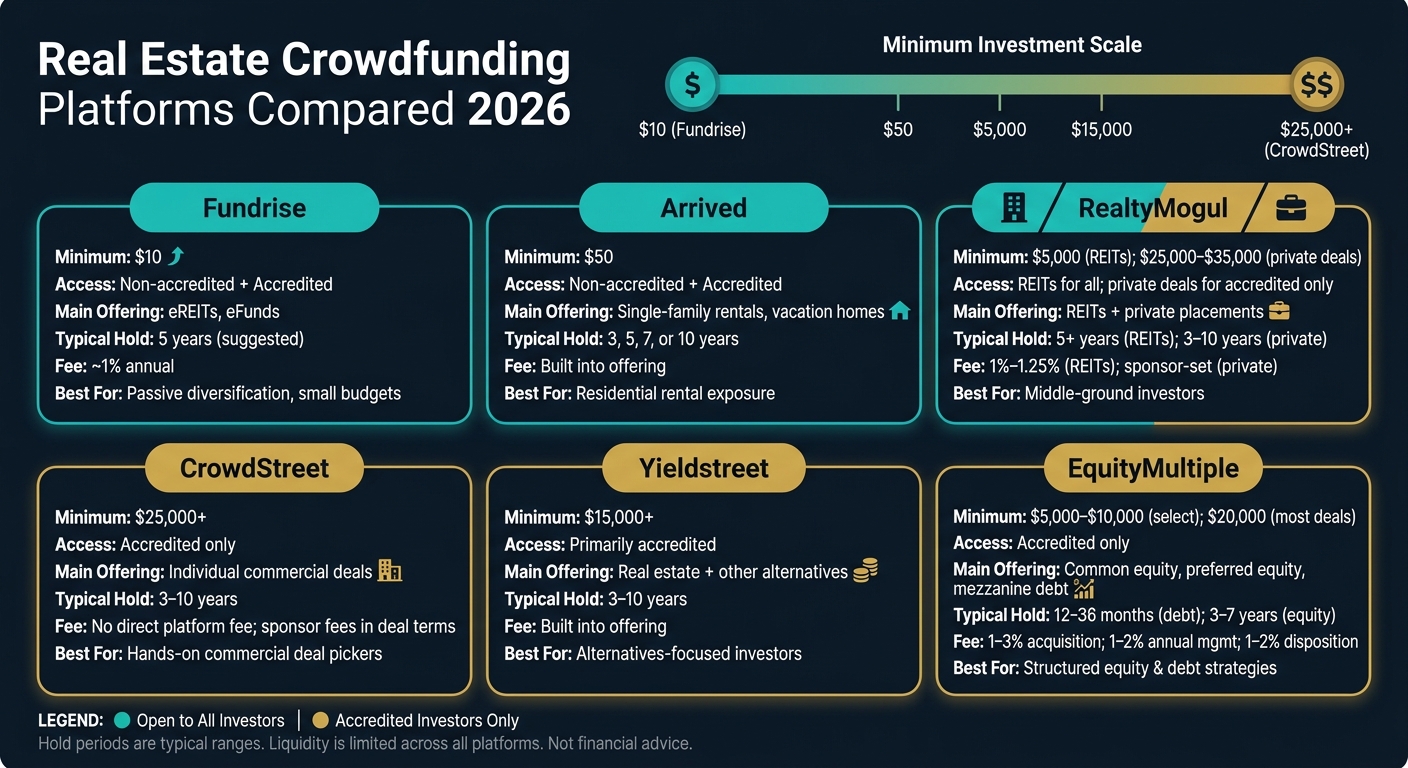
Real Estate Crowdfunding Platforms Compared 2026: Minimums, Access & Hold Periods
| Platform | Minimum | Investor Access | Main Offerings | Typical Hold |
|---|---|---|---|---|
| Fundrise | $10 | Non-accredited + accredited | eREITs, eFunds | 5 years suggested |
| CrowdStreet | $25,000+ | Accredited only | Individual commercial deals | 3–10 years |
| RealtyMogul | $5,000 REITs; $25,000–$35,000 private deals | REITs for most investors; private deals for accredited investors | REITs, private placements | 5+ years for REITs; 3–10 years private |
| Yieldstreet | $15,000+ | Mostly accredited | Real estate + other alternatives | 3–10 years |
| Arrived | $50 | Non-accredited + accredited | Single-family rentals, vacation homes | 3, 5, 7, or 10 years |
| EquityMultiple | $5,000–$10,000 select deals; $20,000 for many deals | Accredited only | Common equity, preferred equity, mezzanine debt | 12–36 months debt; 3–7 years equity |
A few numbers stand out fast: Fundrise starts at $10, Arrived at $50, and CrowdStreet often starts at $25,000 or more. That gap alone will rule platforms in or out for many people before fees, property type, or tax forms even come into play.
If I were narrowing a shortlist, I’d first match the platform to my budget, accreditation status, need for income vs. growth, and willingness to leave money untouched for years.
Fundrise gives investors a simple way to get into real estate through pooled eREITs and eFunds, with a $10 minimum. That low entry point is a big part of the appeal. So far, the platform has deployed about $7.3 billion across more than 500 projects [2].
Fundrise starts at $10 and charges a flat 1% annual fee. That breaks down into 0.85% for asset management and 0.15% for advisory services [1].
Fundrise is open to both accredited and non-accredited investors. Your money is automatically placed into diversified plans like Supplemental Income or Balanced Investing [1]. That setup works well for people who want real-estate exposure without picking deals one by one.
Fundrise invests across several property types, including multifamily, single-family rentals, industrial, and life sciences assets [2]. It also runs an Adaptive Reuse program focused on turning older commercial properties, such as malls, into mixed-use developments [2].
Its flagship Growth eREIT has posted 12.7% annualized returns since inception [2].
This is not money you should expect to move in and out of fast. Fundrise recommends a 5-year hold [1]. Redemptions are available quarterly, but they are not guaranteed and may be paused during periods of market stress [1]. If you withdraw within the first five years, early-withdrawal penalties may apply [1].
On the reporting side, Fundrise keeps things fairly simple. The dashboard is easy to read, and portfolio-level updates are much easier to track than the dense legal paperwork you often get with individual syndications.
There is still platform risk, of course. But investments are held in separate LLCs, which adds a layer of separation. If Fundrise were to fail, a third-party manager would usually step in and manage the assets until they are wound down [1].
| Feature | Details |
|---|---|
| Asset Types | eREITs, eFunds, Innovation Fund (life sciences) [2] |
| Liquidity | Quarterly redemptions (not guaranteed); 5-year hold recommended [1] |
| Platform Risk Mitigation | Investments held in separate LLCs [1] |
For investors who want direct ownership in individual commercial deals, the next platform goes a different route.

CrowdStreet is a marketplace for accredited investors who want direct access to institutional commercial real estate deals from sponsors. You review each deal yourself, which makes it a fit for people who want to dig into the details instead of handing all the decision-making to a fund manager[1][5].
CrowdStreet doesn't charge a direct fee to investors. Instead, sponsor costs are built into each deal's terms. Minimums usually start at $25,000 and can go as high as $100,000[1][5][3].
That part matters. Before you invest, read the PPM and look for sponsor fees like acquisition fees, asset management fees, disposition fees, and carry[5].
CrowdStreet is open to accredited investors only. That means you need to meet SEC income or net worth rules:
Because you're picking each deal yourself, it helps to be comfortable reviewing the data room, sitting through webinars, and checking the sponsor's track record on your own[1][4].
CrowdStreet leans into institutional commercial properties. That includes multifamily complexes, industrial parks, medical office buildings, hotels, and data centers. These are often large projects, and many are valued at $25 million or more. The platform is selective too, rejecting about 92% of submitted deals. Average equity deals target an 18% to 22% IRR[1][2].
This is long-term money. Hold periods usually run 3 to 10 years, and many equity deals aim for a 5- to 7-year hold. These investments are illiquid, so you shouldn't expect a secondary market or an early redemption option to bail you out[1][2][4].
Reporting usually comes from sponsors through quarterly updates and annual Schedule K-1s. CrowdStreet screens sponsors, but results still come down to how well the developer executes the plan. One useful layer of protection: each deal sits in its own LLC, so if the platform runs into trouble, that usually doesn't change your property-level ownership[1][2][5][4].
| Feature | Details |
|---|---|
| Minimum Investment | $25,000+ per deal; some offerings require up to $100,000 |
| Investor Fees | No direct platform fee; sponsor fees are built into the deal terms |
| Asset Types | Multifamily, industrial, medical office, hotels, data centers |
| Hold Period | 3–10 years; many equity deals target 5–7 years |
| Liquidity | Highly illiquid; no guaranteed secondary market or early redemption |
| Platform Risk Mitigation | Each deal sits in its own LLC |
If CrowdStreet feels too capital-heavy or too tied to one-off deal selection, the next platform offers a lower-entry option.
RealtyMogul lands somewhere between Fundrise and CrowdStreet. It has a lower buy-in than direct syndications, but it still gives investors more say than a pooled fund. The platform offers two non-traded REITs for all investors, plus private placements for accredited investors[1].
RealtyMogul’s two REITs are the Income REIT and the Apartment Growth REIT. The Income REIT leans toward debt and cash flow. The Apartment Growth REIT focuses on equity in multifamily buildings. Both start at $5,000[1].
Annual REIT fees range from 1% to 1.25%[1]. Individual private placements usually need $25,000 to $35,000 to get started, and those fees are set by the sponsor behind each deal[1].
RealtyMogul uses DealMatch, a risk-profile matching tool that pairs investors with deals based on their risk profile[2]. If you want to invest in individual private placements, you need accredited investor status[1].
That setup gives the platform two lanes:
The platform centers on commercial real estate, with most deals in multifamily, office, retail, and industrial properties. It also offers 1031-eligible deals for accredited investors[4][2]. RealtyMogul has completed more than $5 billion in transactions[2].
The REITs come with a quarterly redemption program, but it’s limited and not guaranteed. There may also be penalties if shares are held for less than five years[1]. So while there is some access to redemptions, this is still a long-term investment.
Private placements are even less liquid. These deals usually have hold periods of 3 to 10 years, and there’s no secondary market[1].
| Feature | REITs | Individual Private Deals |
|---|---|---|
| Minimum Investment | $5,000 | $25,000–$35,000 |
| Investor Eligibility | All investors | Accredited only |
| Annual Fees | 1%–1.25% management fee | Sponsor-set; varies by deal |
| Liquidity | Limited quarterly redemption | Illiquid; no secondary market |
| Hold Period | Long-term; 5+ years recommended | 3–10 years |
Reporting includes sponsor track records, business plans, and financial models[1]. That helps, but the outcome still depends on how well the sponsor runs the deal. And like other private real estate investments, these assets are not FDIC insured[1][6].
While RealtyMogul stays focused on property deals, Yieldstreet goes in a different direction. It’s a multi-asset platform that offers real estate alongside other alternative investments [2]. Its Prism Fund mixes real estate with select alternatives and reported 9.8% net returns [2].
If you want to invest in individual deals, the starting point is usually $15,000, though some offerings can go up to $25,000. Fees depend on the specific deal and are often built into the offering itself [2][5].
Yieldstreet is aimed mostly at accredited investors. It tends to fit people who are comfortable digging into deal-level structures and putting money into larger, professionally managed offerings [1][6].
Yieldstreet doesn’t stick to plain-vanilla real estate. Along with property investments, it gives investors access to select alternatives [2]. The platform also uses structured notes in some offerings to add downside protection [2]. So if earlier platforms felt more real-estate-only, Yieldstreet feels broader and more strategy-led.
This is not a short-term play. Hold periods usually fall between 3 and 10 years [1][6]. Liquidity is limited, and while some secondary transfers may be available, they can happen at a discount to NAV [4]. Risk still comes down to the underlying deal, though structured notes may help cushion losses in select cases [2]. In practice, Yieldstreet works more like an alternatives sleeve than a pure real estate platform.
| Feature | Details |
|---|---|
| Minimum Investment | $15,000 per individual deal; some offerings may reach $25,000 |
| Investor Eligibility | Primarily accredited investors |
| Asset Types | Real estate plus select alternatives |
| Liquidity | Illiquid; limited secondary transfers may exist at a discount to NAV |
| Hold Period | Typically 3–10 years |
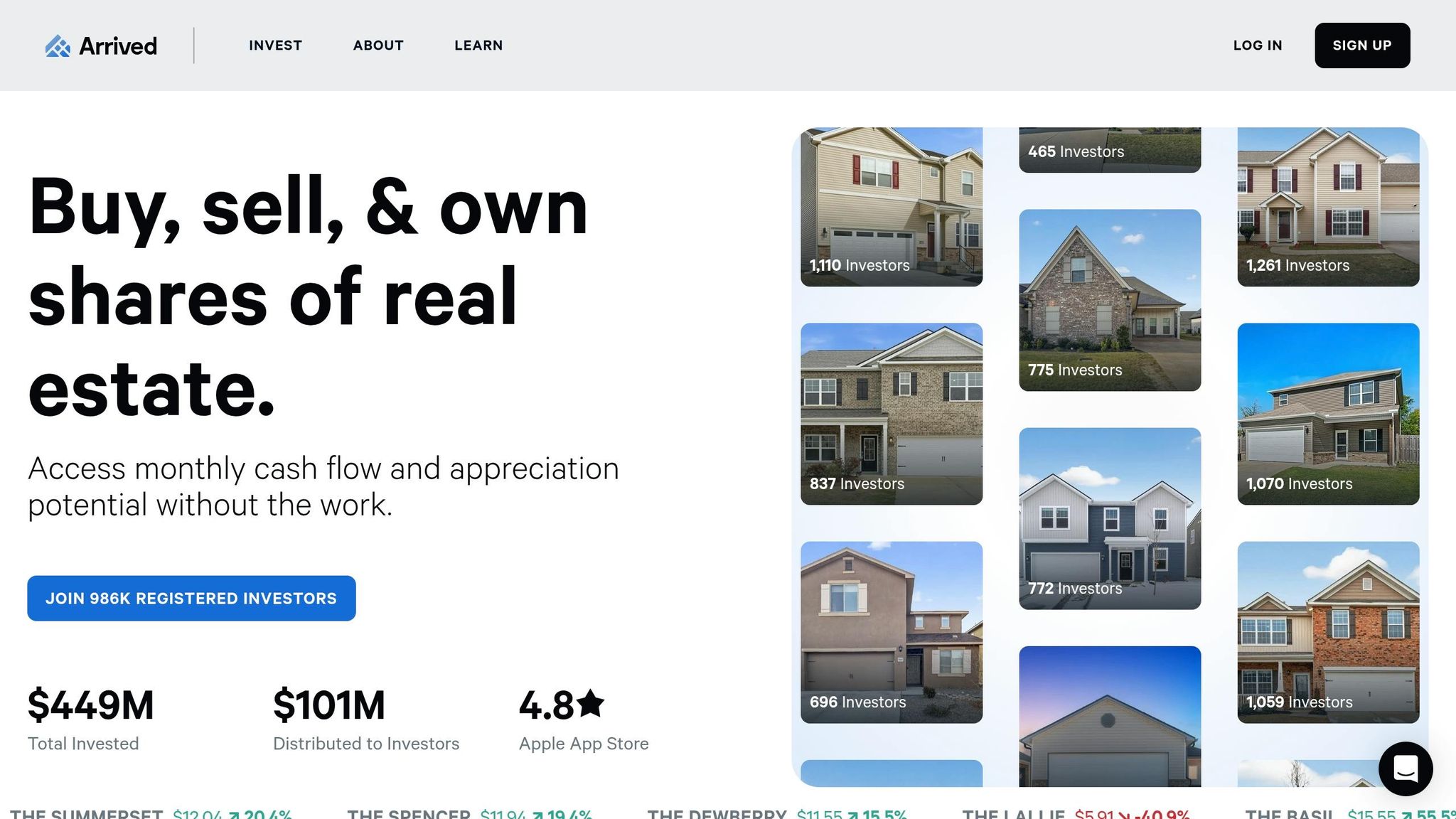
Arrived shifts this comparison away from pooled and commercial deals and into residential property ownership. Arrived, formerly Arrived Homes, lets investors buy fractional shares in individual single-family rentals and vacation properties.
You can buy shares in individual properties starting at just $50[1].
Arrived makes sense for investors who want small, property-by-property exposure to residential real estate. Instead of putting money into a broad fund, you pick specific homes.
The platform focuses on fractional shares in:
That setup can feel more direct. You're not buying into a big portfolio and hoping for the best. You're looking at one property at a time.
Arrived investments are illiquid and usually meant to be held for multiple years. Exits are often tied to 3-, 5-, 7-, or 10-year timelines[6][3].
Reporting happens at the property level, which means the details can vary from one offering to the next. It's worth reading each listing closely, especially the assumptions, updates, and sponsor materials.
| Feature | Details |
|---|---|
| Minimum Investment | As little as $50 per property[1] |
| Asset Types | Single-family rentals and vacation properties |
| Liquidity | Illiquid |
| Hold Period | Often 3, 5, 7, or even 10 years[6][3] |
| Reporting | Property-level updates |
For investors who want more variety in commercial deals, the next platform uses a different setup.

EquityMultiple isn't a one-lane marketplace. It gives accredited investors access to commercial real estate through common equity, preferred equity, and mezzanine debt. That mix matters because each structure comes with a different risk, return, and time-frame profile.
Minimums depend on the deal. Some offerings start at $5,000 to $10,000, while most standard deals require a $20,000 minimum [5][2].
Fees also change from one deal to the next and are listed in the PPM. Common charges include:
The platform also uses a waterfall payout structure. In plain English, that means investors get paid before sponsors share in excess profits [2].
This platform is for accredited investors only. It's a better match for people who are comfortable digging into offering documents, reviewing sponsor track records, and dealing with K-1 tax reporting [5][4].
EquityMultiple offers common equity, preferred equity, and mezzanine debt tied to assets such as multifamily, medical office, and Opportunity Zone funds [6][2][4].
It also has an Investor Education Center to help with due diligence [6][2][4]. That gives the platform a bit more structure than a pure deal-by-deal marketplace, while still giving investors direct exposure to commercial real estate. Preferred equity positions typically target returns of 12% to 15% [2].
Hold periods depend on the structure. Debt-based deals usually run 12 to 36 months, while equity deals often require a 3- to 7-year commitment [5].
For taxes, investors receive Schedule K-1s [5][3]. Platform risk comes down in large part to sponsor quality and underwriting discipline [3].
| Feature | Details |
|---|---|
| Minimum Investment | $5,000–$10,000 for select offerings; $20,000 for most deals [5][2] |
| Asset Types | Multifamily, medical office, Opportunity Zone funds [6][2] |
| Structures | Common equity, preferred equity, mezzanine debt [5][2] |
| Hold Period | 12–36 months (debt); 3–7 years (equity) [5] |
| Tax Reporting | Schedule K-1 [5][3] |
| Eligibility | Accredited investors only [5] |
Now that each platform is on the table, you can match how much you have to invest, whether you're accredited, how much control you want, and how long you can leave your money locked up. The table below helps narrow the six platforms by budget, control, asset type, and hold time.
| Investor Goal | Best-Fit Platforms | Why They Fit | Main Tradeoffs |
|---|---|---|---|
| Starting under $1,000 | Fundrise | $10 minimum; open to non-accredited investors; automatic diversification across multiple properties [1][2] | Limited quarterly redemptions; early exits aren't guaranteed [1] |
| Diversified passive allocation | Fundrise, RealtyMogul (REITs) | Both spread capital across many properties without requiring you to pick individual deals [1][2] | Little control over asset selection; limited redemption programs and possible early penalties [1] |
| Picking individual commercial deals | CrowdStreet, EquityMultiple | Deal-level underwriting; EquityMultiple focuses on institutional-grade equity and debt deals [1][2] | Higher minimums, especially on CrowdStreet; high concentration risk; generally illiquid |
| Focusing on residential rentals | Arrived | Specializes in single-family and vacation rental properties; open to all investors [1][2] | Narrower asset focus |
| Targeting debt or income strategies | Yieldstreet, EquityMultiple | Yieldstreet blends real estate with other alternative assets; EquityMultiple often focuses on preferred equity and debt positions [2] | Income-oriented structures generally have less upside than common equity |
| Looking for shorter hold periods | Yieldstreet (debt), EquityMultiple (debt) | Debt deals usually have shorter terms than equity deals [5][6] | The money is still illiquid for the full term; sponsor risk remains [4] |
At this level, Fundrise is the only clear fit. It has a $10 minimum and is open to non-accredited investors, which makes it the easiest entry point in this group [1][2]. The catch is simple: liquidity is limited, and redemptions are not guaranteed [1].
If your main issue is capital, it makes sense to start with the lowest-minimum option first instead of stretching for platforms that require far more cash upfront.
If you want a hands-off approach, Fundrise and RealtyMogul's REITs are the best match. Both spread your money across many properties, so you don't have to choose deals one by one [1][2].
That's the upside. The downside is less control. You won't have much say over which assets end up in the mix, and redemption programs are still limited.
Want to choose each property yourself? Then the field gets smaller fast. CrowdStreet and EquityMultiple are the better fit for investors who want deal-level underwriting and are comfortable taking on concentration risk [1][2].
This route gives you more say, but it also asks more from you. Minimums are higher, especially on CrowdStreet, and your money is usually tied to a smaller number of deals.
If your goal is residential rental exposure, Arrived stands out [1][2]. It focuses on single-family and vacation rental properties and is open to all investors.
The other platforms in this group lean more toward broad funds or commercial real estate, so Arrived is the more direct choice if that's the lane you want.
For income-focused investing, Yieldstreet and EquityMultiple both fit, but they come at the goal from different angles. Yieldstreet mixes real estate with other alternative assets, while EquityMultiple often centers on preferred equity and debt positions [2].
The tradeoff is pretty consistent across both. Debt and income-first structures put cash flow ahead of appreciation, so the upside is usually more limited than with common equity.
If your main concern is time, start with debt structures. Debt deals usually have shorter terms than equity deals [5][6].
Still, it's worth being blunt here: a shorter private term does not mean liquid. Your money is still locked up for the full term, and sponsor risk stays in play the whole time [4].
Each platform comes with a different tradeoff. What works for one investor can feel like a bad fit for another. The main thing is to line up the platform with your budget, how much control you want, and how long you're okay having your money tied up.
| Platform | Pros | Cons |
|---|---|---|
| Fundrise | $10 minimum; open to non-accredited investors; transparent ~1% all-in annual fee [1] | Limited redemption windows; quarterly redemptions are not guaranteed; early withdrawal penalties can apply within the first five years [1][6] |
| CrowdStreet | No direct platform fee to investors; direct access to individual commercial deals [1][2] | Accredited investors only; $25,000+ minimums; sponsor risk remains the main risk [1][4] |
| RealtyMogul | REITs for all investors; private deals for accredited investors; REIT minimum starts at $5,000 [1] | REIT fees run 1%–1.25% annually; fees on individual deals vary by sponsor [1] |
| Yieldstreet | Access to real estate plus other alternative assets [2] | Mostly restricted to accredited investors; $15,000 minimums on individual deals; broader asset mix adds complexity [2] |
| EquityMultiple | $5,000 minimum for accredited investors; strong focus on preferred equity positions [2][5] | Accredited investors only; concentrated project risk; fees can include management charges and a share of profits [5] |
There’s a pretty clear pattern here. Higher return targets often come with longer hold periods, less liquidity, and more sponsor risk. That’s the trade: more upside on paper, but fewer easy exits if you want your cash back sooner.
Fees can also look very different from one platform to the next. Some charge a flat annual fee. Others fold sponsor costs into the deal itself, which can make comparisons a bit tricky if you’re not reading the fine print.
Risk also follows the structure. Pooled funds and REIT-style options spread exposure across many properties. Deal-by-deal platforms like CrowdStreet and EquityMultiple put more weight on a single sponsor and that sponsor’s ability to execute [1][4]. If you like picking individual deals, that may appeal to you. If you’d rather not have one project do all the heavy lifting, a pooled setup may feel like the safer lane.
When you compare fees, minimums, deal flow, and hold periods, the right platform comes down to your budget and how much risk you can handle.
Fundrise and Arrived are the strongest starting points for non-accredited investors or people with smaller budgets. Fundrise has the lowest entry point and is built for automatic diversification [1]. Arrived is a better match for investors who want direct exposure to residential properties.
RealtyMogul sits in the middle. It gives you passive REIT exposure, but it also opens the door to private deals for accredited investors.
If you're accredited and want to review individual commercial deals, CrowdStreet and EquityMultiple make more sense. CrowdStreet is very selective, rejecting about 92% of submitted deals [2]. EquityMultiple focuses on institutional-grade equity and debt offerings.
Yieldstreet fits best if you want real estate to be one part of a broader alternatives mix, not your only source of exposure.
After you narrow your shortlist, the next move is simple: read the deal documents. Go through the PPM and look closely at fees, waterfalls, and redemption terms. Check sponsor track records in EDGAR. Then confirm whether the deal uses fixed-rate or floating-rate debt. If the debt floats, the rate cap can make a big difference.
At the end of the day, outcomes are driven by fees, deal structure, sponsor quality, and liquidity.
Even a platform that looks like a great fit still comes with illiquidity and sponsor risk. Most equity deals lock up your money for years [1], so it's smart to invest only money you can leave alone for that long. Spread your money across sponsors and markets instead of putting too much into one deal or one platform.
Choose based on your liquidity needs, risk tolerance, and accreditation status.
Public REITs give you easy access to cash, built-in diversification, and professional management. The trade-off is that their prices can swing with the stock market, even when the underlying properties are doing fine.
Private commercial deals and single-property syndications can offer more upside and better tax treatment through depreciation. But there’s a catch: they’re illiquid, often locking up your money for 3 to 10 years, and they come with deal-specific risk tied to one project or property.
The tax form you get depends on how the deal is set up.
If you invest in a REIT, you’ll usually receive Form 1099-DIV. That form is often easier to handle at tax time.
If you invest through a syndication or an LLC-based deal, you’ll usually get a Schedule K-1 instead.
A K-1 shows your share of the deal’s income, losses, and depreciation. The catch? It can show up late in tax season, sometimes as late as September. That delay may mean you need to file for a tax extension.
Because tax rules can get messy fast, it’s smart to talk with a tax professional about your own situation.
They’re two different risks, but property-level risk is usually the bigger one.
Why? Because your money depends on how the asset performs, what the market does, and how well the sponsor executes the plan.
If a platform fails, your ownership is usually protected through a separate legal entity, such as an LLC. Even so, you could still run into lower liquidity, less transparency, and a harder time getting access to your funds.