Published on
August 28, 2026


If I’m issuing founder stock at incorporation, I’d usually use reverse vesting, not standard vesting. In U.S. venture-backed startups, that’s the setup investors expect, and 92% of venture-backed companies use a 4-year vesting schedule with a 1-year cliff.
Here’s the short version:
Quick Comparison
| Criteria | Reverse Vesting | Standard Vesting |
|---|---|---|
| When I get shares | Upfront | Over time |
| Founder owns stock on day one | Yes | No, usually not |
| Voting rights | Usually from day one | Usually after shares are issued/exercised |
| What happens if I leave | Company repurchases unvested shares | Unvested portion expires |
| Tax step | 83(b) may apply | Tax usually happens at vest or exercise |
| Common use | Founder stock | Options, RSUs, refresh grants |
So if I want the plain answer, it’s this: reverse vesting is the default for founders, while standard vesting is more common for later equity grants.
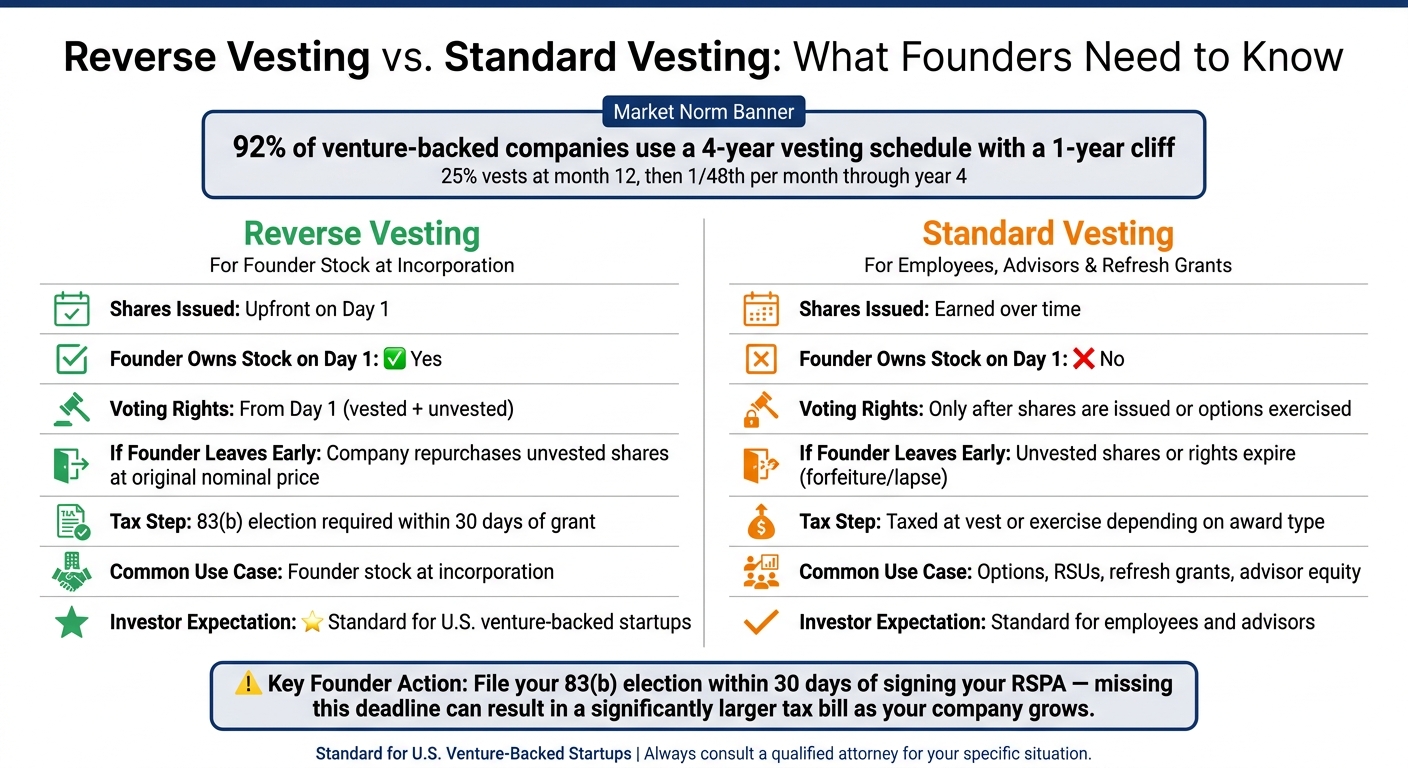
Reverse Vesting vs Standard Vesting: Founder Equity Comparison
With reverse vesting, founder shares are issued upfront at formation. But there’s a catch: the company keeps a repurchase right that falls away over time as the shares vest.
So here, vesting doesn’t mean shares are gradually granted. It means the company’s right to take back unvested shares gets smaller over time.
Founders usually buy these shares for a nominal amount at formation. That low purchase price makes setup simpler and also helps with the 83(b) election.
This setup is usually documented in a Restricted Stock Purchase Agreement (RSPA). The RSPA records the share purchase, lays out the vesting schedule, and spells out the company’s repurchase right.
Even with that repurchase right in place, founders own the shares right away. In practice, that usually means they get full voting and dividend rights from day one. The shares also show up on the cap table immediately, which gives investors a clear view of ownership from the start.
If a founder leaves before the vesting schedule ends, the company can use its repurchase right to buy back the unvested shares.
And the buyback price is a big detail: the company repurchases those shares at the original nominal purchase price, not the current market value. That’s the mechanism that removes unvested founder equity when someone leaves early.
Because these shares are issued as restricted stock, the 83(b) election is a major tax step.
When a founder files the election with the IRS within 30 days of the share purchase, the founder is asking to be taxed based on the stock’s value at that time, instead of being taxed later as the repurchase right lapses. At formation, that value is usually nominal, so the tax cost is often minimal.
Miss that 30-day deadline, though, and things can get painful. If the company’s value goes up, the founder may face a much larger tax bill as the shares vest over time. That’s why founders are often told to treat the 83(b) filing as an immediate post-signing task after the RSPA is executed.
Standard vesting works another way: ownership is earned over time, and unvested shares are not issued upfront.
Standard vesting, also called forward vesting, means equity is earned over time instead of being owned on day one. This is the normal setup for employee and advisor grants. For founder stock issued at incorporation, though, it usually isn't the right tool. That distinction matters.
With standard vesting, the grant is usually an option or RSU, not outright stock ownership. That changes both the paperwork and the rights attached to it.
With stock options, the holder gets the right to buy shares later. They do not own the shares yet. With RSUs, the shares are promised, but they aren't delivered until the vesting terms are satisfied. In both cases, voting rights and dividend rights usually start only after the shares are issued or the option is exercised.
That's a big contrast with reverse vesting, where founders generally vote their full share count from day one.
If someone leaves under standard vesting, the unvested equity simply expires. It lapses.
That is the main structural difference from reverse vesting, where the company buys back the unvested shares at the original purchase price.
In venture-backed companies, original founder stock almost never uses forward vesting. But founders do run into it later.
Refresh grants are the most common case. After a founder's first restricted stock grant has fully vested - usually after four years - the company may issue more equity to keep that founder aligned with long-term growth. These grants often use the same four-year, one-year cliff schedule common for employees:
Another example is performance-based equity, where vesting depends on hitting set milestones instead of just putting in time.
For founders, the main issue is simple: how does this setup differ from reverse vesting when it comes to ownership, control, and what investors expect? The next section gets into that direct side-by-side comparison.
Once you lay out both structures, the difference comes down to ownership, control, and what investors expect to see.
The main split is simple: does the founder own the shares now, or earn them over time?
With reverse vesting, the founder gets the full share count on the cap table from day one, with those shares marked as subject to vesting. The founder holds legal title right away and can vote all shares, both vested and unvested.
Standard vesting works differently. With options or RSUs, shares usually show up on the cap table only after vested shares are issued or options are exercised. And voting rights usually start only when the founder actually owns the shares.
That difference shows up most clearly when a co-founder leaves early. Under reverse vesting, the company buys back the unvested shares at the original purchase price. Under standard vesting, the unvested shares or rights just expire. No repurchase step is needed.
In U.S. venture-backed deals, reverse vesting is the standard setup for founder stock. Investors expect it, and if a company uses something else, that can trigger extra questions in due diligence. The market norm is a four-year schedule with a one-year cliff [1].
Founders who spent a year or more building before a priced round can sometimes negotiate partial immediate vesting credit, often 12 to 24 months, to reflect time already put in. Another common point of negotiation is double-trigger acceleration, which investors usually view more favorably than single-trigger acceleration.
Here’s the practical split.
For founder stock issued at incorporation, reverse vesting is usually the right fit. Standard vesting, through options or RSUs, tends to show up later for employee grants, refresh grants, and advisor equity.
| Factor | Reverse Vesting (Founder Stock) | Standard Vesting (Options/RSUs) |
|---|---|---|
| Investor preference | Standard for U.S. founders | Standard for employees and advisors |
| Founder control | Full voting rights from day one | Voting rights only after vesting/exercise |
| Tax election | 83(b) election within 30 days of grant | Taxed at vest or exercise, depending on the award |
| Admin burden | Repurchase transaction needed on departure | Forfeiture or lapse is automatic |
| Typical use case | Founder stock at incorporation | Employee, advisor, and refresh equity |
For finance teams, that admin difference matters. If a founder leaves under reverse vesting, the company has to handle a formal repurchase and update the cap table records. In plain English, the paperwork has to be tight.
That’s why reverse vesting remains the default for most founder stock in U.S. venture deals.
For most U.S. venture-backed startups, reverse vesting is the right setup for founder stock. It’s the standard investors expect, and if you do something else, you’ll usually need a clear reason.
Most venture-backed startups use a four-year vesting schedule with a one-year cliff [1].
The main point is pretty simple: if you're issuing founder stock at incorporation, use reverse vesting. And file the 83(b) election within 30 days. Investors look for both during diligence.
For founder stock issued at incorporation, reverse vesting is the default. Standard vesting makes more sense for later equity grants, like employee, advisor, and refresh equity.
No. An 83(b) election is not required for every founder.
It matters for founders who receive restricted stock subject to vesting.
If you file the election with the IRS within 30 days of the grant date, you can choose to be taxed when the stock is granted instead of when it vests.
Why does that matter? If the stock goes up in value later, filing early can mean paying tax on the lower value at the time of grant, not the higher value at vesting.
Yes. Founders can negotiate vesting credit for time they already spent building the company.
A four-year vesting schedule with a one-year cliff is still the usual setup. But if a founder put in work before the formal agreement was signed, that earlier time can count toward vesting. In many cases, that means they may have only two to three years left on the schedule.
That approach helps the equity agreement match the founder’s total commitment, not just the time that starts on paper. It also gives proper weight to the work and effort they already put in before the formal vesting terms were in place.
If a founder leaves before the one-year cliff, they lose all equity. With a standard four-year vesting schedule, no shares vest during the first 12 months.
That means the clock can be ticking the whole time, but nothing is earned until the cliff hits. If the founder leaves at any point before that 12-month mark, all unvested shares are forfeited.