Published on
August 28, 2026


VC money in 2026 is leaning toward stablecoins. If I had to sum it up in one line: investors want businesses with clear buyers, fee income, and a path through U.S. rules.
Here’s the short version:
A few numbers make the split clear:
If you’re a founder, the message is simple: stablecoins look more like payments and treasury software, while DeFi now needs proof. That means proof of demand, proof of fees, and proof that one exploit will not end the company.
Quick Comparison
| Area | Stablecoins | DeFi |
|---|---|---|
| Main buyers | Fintechs, banks, payment firms, treasuries | Traders, funds, DAO treasuries, some institutions |
| Main revenue | Reserve yield, transaction fees | Trading fees, lending spreads |
| VC view in 2026 | Larger rounds, lower story risk | Tighter screens, fewer broad bets |
| Rules burden | High, but can help distribution | Mixed, with more pressure on some segments |
| Main risk | Competition, issuer split | Hacks, thin liquidity, weak token models |
| Best-funded themes | Issuers, rails, settlement, treasury tools | RWAs, lending, B2B infra |
So if I were reading this as a founder, I’d take away one thing: stablecoins win on buyer clarity, while DeFi only wins when the business already works.
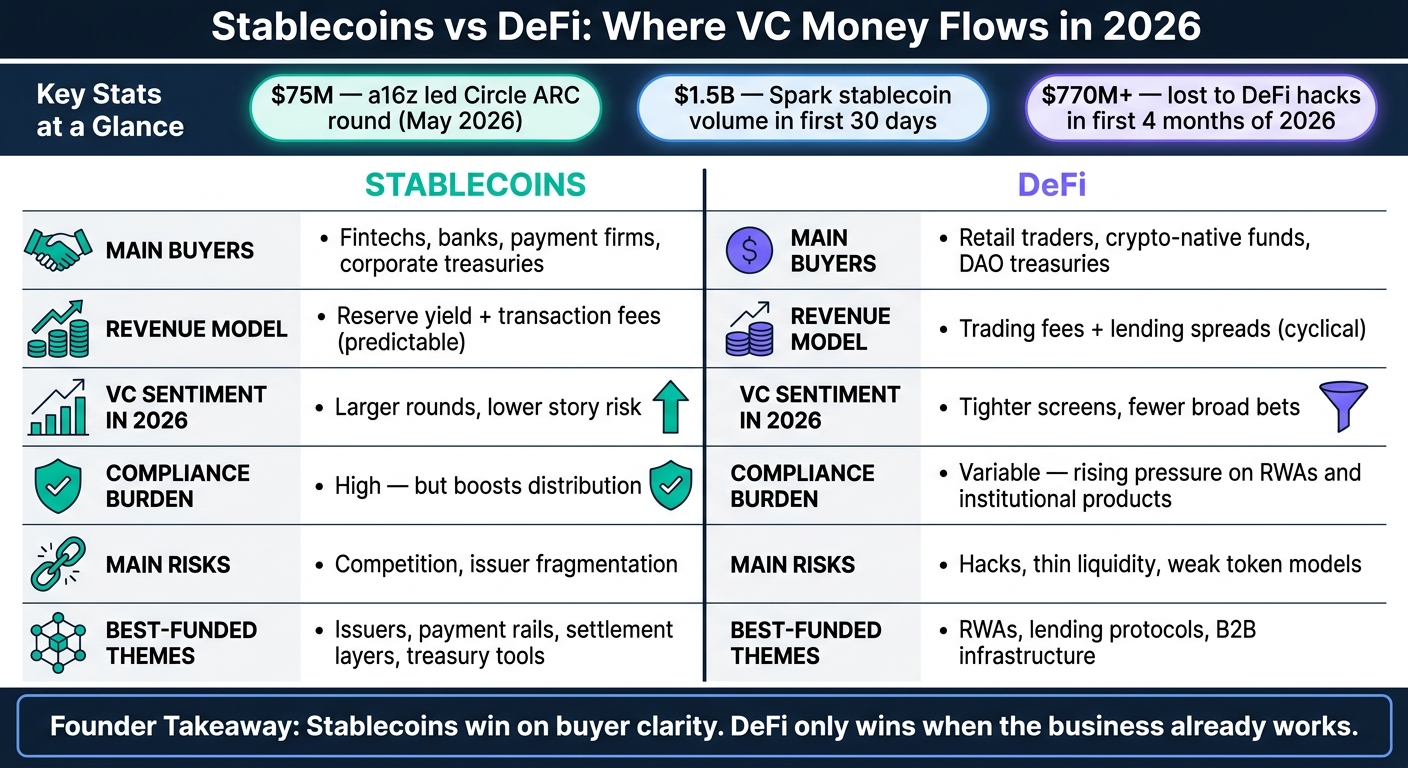
Stablecoins vs DeFi: VC Funding Landscape 2026
In 2026, VC money is clustering around stablecoin issuers, payment rails, settlement layers, and treasury tools. The biggest crypto VC checks are landing in these areas because the buyer is easier to identify, the revenue model is cleaner, and the product often keeps crypto hidden from the end user.
In May 2026, a16z led a $75 million investment in ARC, Circle's institutional blockchain for USDC settlement. The network offers sub-second finality, configurable privacy, and known institutional validators. [2] That points to where capital is going: infrastructure, payment rails, and B2B2C products that work behind the scenes.
M&A is moving, too. MoonPay acquired Decent.xyz for a high eight-figure sum to power MoonPay Trade, connecting banks and fintechs to stablecoin liquidity across 200+ blockchains. [2] Buyers want distribution and routing capability, not just code.
What makes stablecoins attractive to VCs in 2026 is not the tech by itself. It's the buyer base and the reason those buyers keep coming back. Demand has moved away from crypto-native traders and toward enterprises, fintechs, payment processors, and banks that use stablecoins as part of day-to-day operations.
| Feature | 2024 Demand | 2026 Demand |
|---|---|---|
| Primary Buyers | Crypto-native traders, yield farmers | Enterprises, fintechs, payment processors, banks |
| Use Case Maturity | Speculative trading, DeFi collateral | B2B settlement, treasury management, retail payments |
| Market Sensitivity | Cyclical | Durable; driven by operational needs (e.g., cross-border payments and treasury needs) |
| Regulatory Status | Largely unregulated/offshore | Regulated via GENIUS and Clarity Acts [1] |
Buyer clarity, not token upside, is what makes stablecoins easier to underwrite than DeFi. That's a big reason stablecoins now set the funding bar for DeFi.
Robinhood's Earn product shows how this looks in practice. Launched in July 2026, it routes user funds into an onchain vault curated by Steakhouse Financial using the USDG stablecoin, and it pulled in more than $200 million in deposits. [1] Robinhood didn't build the backend itself. Spark, an affiliate of Sky/MakerDAO, did. That's the model investors are backing right now: a stablecoin protocol serving as the invisible backend for a major fintech.
As companies like PayPal, Stripe, and Robinhood launch their own stablecoins to keep reserves inside their own networks, demand for neutral routing infrastructure rises with them. [1] Spark's stablecoin exchange layer routed about $1.5 billion in its first 30 days, taking 30% of Uniswap's stablecoin volume. [1] That kind of traction makes the funding story much easier to sell.
Compliance is now part of the pitch. The GENIUS Act and the Digital Asset Clarity Act are turning stablecoins into a distribution edge, especially for founders going after bank partnerships or fintech integrations. [1][2]
The obligations are heavy and expensive: reserve management, AML/KYC for fiat on-ramps, licensing, and audits. [2] But founders who can show institutional-grade controls are getting access to capital that stayed away from crypto a few years ago. Investors are paying for controlled distribution, not just token exposure.
Phoenix Labs is a good example. It grew its Bitcoin-backed OTC loan book to $260 million in outstanding balance and started pursuing credit ratings from S&P and Moody's to meet the risk standards of finance counterparties. [1] That's a clear shift. Crypto protocols are now seeking ratings from the same agencies that rate corporate bonds.
For founders, the takeaway is simple: compliance is not just a legal box to check. It's a funding signal. Investors backing stablecoin infrastructure in 2026 want to see real-time reserve verification onchain, a clear licensing roadmap, and a distribution plan that works for banks and fintechs. [2]
DeFi faces the other side of that coin: narrower demand, less compliance leverage, and a tougher path to repeatable revenue.
With stablecoins showing clearer demand, DeFi money is now going to a much narrower set of bets. Capital is still there, but investors are being picky. In practice, that means protocols need to show proven revenue, not just a good story.
Real-World Assets (RWAs) are one of the main areas still drawing funding. In May 2026, Variational raised a $50 million Series A led by Dragonfly and Bain Capital Crypto to build a peer-to-peer derivatives protocol for RWA perpetual futures tied to commodities like oil, silver, and gold. The pitch is easy to see: it targets institutional buyers and deals with identifiable counterparties.[2]
Lending is still active too, though the market has split into clearer lanes. Maple Finance initiated $3.3 billion in loans in Q2 2026, while Morpho and Aave continue to run as retail-heavy lending hubs that process millions of transactions and act as liquidity rails for embedded finance products like Robinhood's Earn.[1][3][6]
A lot of the DeFi companies still getting funded are no longer selling straight to end users. Instead, they sell infrastructure to apps, trading desks, and fintech firms. That shift matters. VCs now lean toward DeFi infrastructure that other platforms can plug into, instead of standalone consumer products.
And that buyer mix matters because DeFi demand still swings with market conditions.
DeFi demand is real. But unlike stablecoin demand, it tends to move up and down with the market.
When prices climb, trading volume jumps, leverage picks up, and people chase yield. When sentiment flips, those same numbers can shrink fast. It's a bit like a tide coming in and out: activity can look huge in one stretch and thin out not long after.
You can see that pattern in revenue. One major DeFi platform saw annual revenue drop from $80 million during the bull market to about $20 million by August 2026, yet it still stayed fundable by shifting toward institutional OTC lending.[1] That example gets to the heart of the market right now. The protocols making it through this reset are building revenue streams that don't rely only on retail trading volume.
For DeFi founders, who pays and how that revenue holds up now matter more than raw usage numbers.
Because DeFi demand is cyclical, VCs are judging these companies on execution rather than narrative.
Security is now a make-or-break issue. More than $770 million was stolen in DeFi hacks in the first four months of 2026, and April became the most-hacked month in crypto history, with 28 to 30 incidents and more than $600 million in losses.[4] One of the biggest attacks hit Kelp DAO's LayerZero-based bridge, where a hacker drained $293 million through a forged cross-chain message.[4] At this point, many VCs have stopped stepping in with rescue capital after exploits. So if a hack wipes out more than 10% of a mid-cap protocol's TVL, that can be fatal.[4]
Revenue quality is the next screen. The old governance token formula - raise money, launch a token, let speculation fuel growth - has lost steam. Investors now want to see on-chain revenue and clear unit economics, and decentralization no longer shields weak business models.[5]
"The venture-backed model for governance tooling is no longer viable." - Dennison Bertram, CEO, Tally [4]
Institutional fit is the third test. Protocols that can sell into enterprise or fintech buyers, instead of depending on anonymous retail flows, are the ones still getting checks. The projects still drawing capital tend to share the same traits: fee generation that already exists, security that can stand up to serious scrutiny, and a direct path to serving enterprise or fintech customers.
Given the funding split above, founders should size up each model based on three things: buyer repeatability, distribution friction, and compliance lift. The funding test is simple on paper: repeatable buyers, low distribution friction, and revenue that lasts.
Right now, stablecoin winners tend to sell embedded infrastructure, not standalone consumer apps. DeFi, on the other hand, usually reaches scale by locking in on one niche, one chain, or one buyer segment.
| Stablecoins | DeFi | |
|---|---|---|
| Core buyers | Fintechs, neobanks, institutional trading desks, corporate treasuries | Retail traders, yield farmers, crypto-native funds, DAO treasuries |
| Distribution model | B2B2C, embedded infrastructure, regulated partnerships | Ecosystem-native integration, onchain routing |
| Primary use cases | Payments, embedded yield, FX settlement | Trading, lending, yield farming |
| Cycle dependence | Lower - tied to payments and operational needs | Higher - tied to market activity and speculation |
Once buyer fit is clear, the next question is whether the revenue can survive compliance costs and market swings.
Stablecoins come with a heavier compliance load, but that same burden can make revenue steadier. Reserve-based yield, FX fees, and institutional lending spreads don't vanish when market mood changes. The GENIUS Act and the potential Clarity Act have pushed the bar higher: licensing, AML controls, and reserve verification are now baseline expectations [1][2].
DeFi revenue is more cyclical. Fee income follows trading volume, and trading volume follows market conditions. In plain English: when the market cools off, revenue often does too. DeFi unit economics hinge on liquidity depth, fee volume, and channel efficiency.
| Stablecoins | DeFi | |
|---|---|---|
| Compliance burden | High - licensing, AML, and reserve verification | Variable - rising for RWAs and institutional products |
| Revenue quality | More predictable - reserve yield and transaction-linked fees | More cyclical - fees rise and fall with market volume |
| Unit economics | Stronger in B2B/B2B2C channels with lower churn | Depends on liquidity depth, fee volume, and channel efficiency |
Team background matters just as much as the product idea.
If your team has regulatory experience, banking relationships, or a strong compliance function, stablecoins are often the better fit. That's where VCs are putting money: infrastructure, regulated distribution, and credit rails. a16z's $75 million investment in Circle's ARC is a clear example of that pattern [2].
If your team is strong in protocol design and knows one ecosystem inside and out, DeFi still has room. But the bar is higher than it was a couple of years ago. VCs want to see real fee revenue, a focused distribution channel, and security infrastructure that can hold up under institutional scrutiny. Narrative alone will not fund a round.
In 2026, VC money is leaning toward stablecoins, not DeFi. Stablecoin infrastructure is getting most of the attention, while DeFi deals face a much tougher filter. The protocols that shut down this year did so because their business models no longer worked [4].
That changes the bar founders need to clear. VCs aren't backing narrative or token emissions on their own anymore. They want to see fee revenue, a clear distribution plan, and security that can stand up to institutional review.
You can see that shift in how some DeFi teams are moving. Phoenix Labs' pivot from consumer products to B2B infrastructure points to where the market is going [1].
For founders, the ask is pretty concrete:
In 2026, stablecoins get funded because they have distribution and compliance in place. DeFi gets funded only when revenue and security are already proven.
VCs are leaning toward stablecoins because they offer steadier, infrastructure-level use than the rest of DeFi.
As fintechs, exchanges, and banks roll out their own dollar-linked tokens, demand is climbing for backend tools that move liquidity across siloed networks. That picks-and-shovels model gives investors a clearer path to scale and institutional adoption than consumer DeFi apps, which often face high customer acquisition costs and stiff competition.
In 2026, DeFi funding looks very different. Money has moved away from consumer apps and retail speculation and toward institutional-grade infrastructure.
The startups still getting checks are building the backend for a fragmented stablecoin market. That includes liquidity routing, yield-bearing infrastructure, and composable financial rails.
The strongest teams tend to follow B2B or B2B2C models. They bring in steady fees and make it easier for financial institutions to use DeFi behind the scenes.
By contrast, projects that depend on token emissions or retail-focused governance are now seen as far less likely to work.
Choose based on what you do best and how you plan to grow. Stablecoin models focus on becoming a base asset or a key liquidity layer. That usually means strong compliance, deep trust, and close ties with institutions. DeFi models focus more on protocol use, where success is judged by on-chain revenue, unit economics, and steady borrowing demand, not just TVL growth.
If your strength is infrastructure, a B2B2C approach can make more sense than chasing retail users. For tokenization projects, Phoenix Strategy Group can help line up token assumptions with a disciplined operating model and investor reporting needs.