Published on
September 5, 2026


If you want the short answer: subscription-first usually gives you cleaner payback and margin, while freemium only works when free users convert, expand, and stay.
I’d sum it up like this: if your product has high ACV, needs sales help, and depends on retention and upsells, subscription-first is often the safer model. If your product is easy to start, cheap to serve, and built for a big self-serve market, freemium can work - but only if the math holds after free-tier costs.
Here’s the core of the trade-off:
If I were choosing, I’d look at five things first:
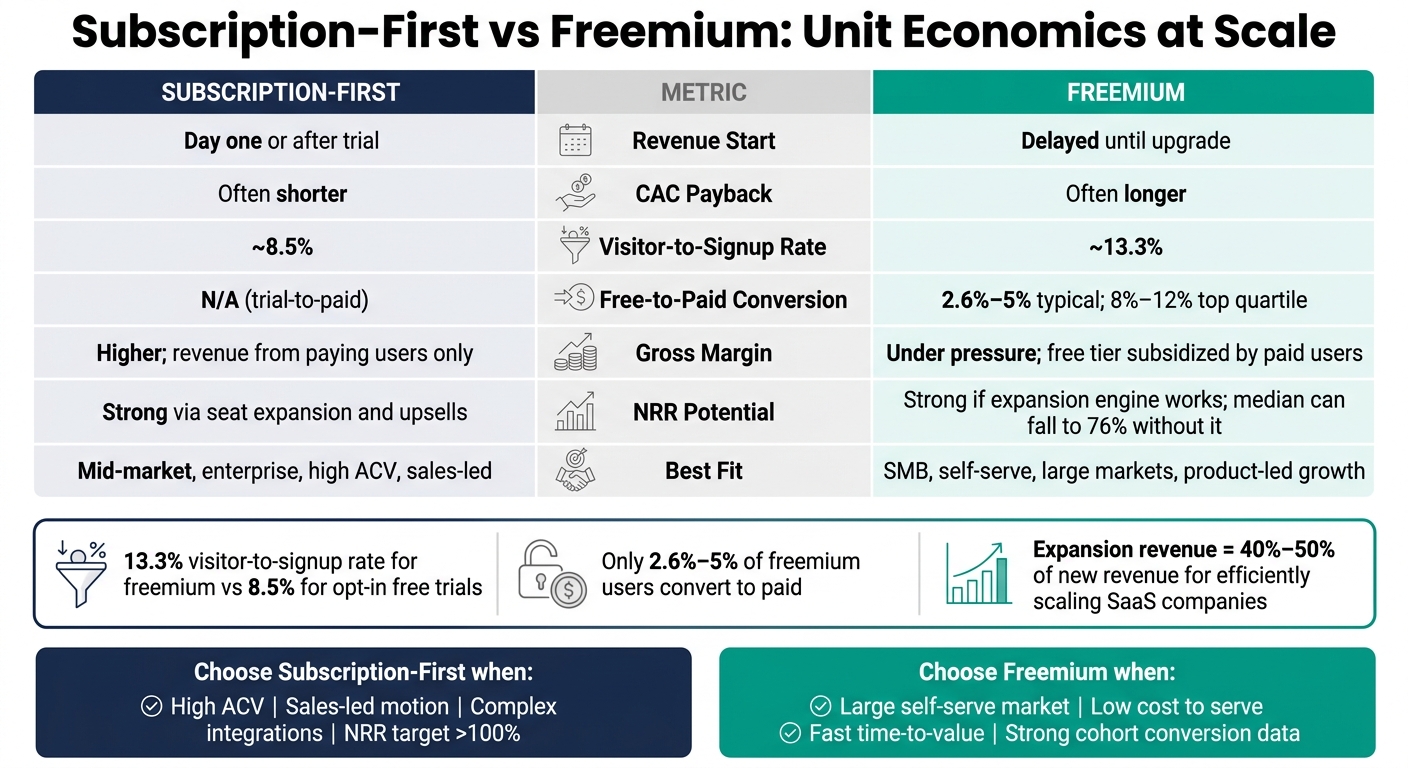
Subscription vs Freemium: SaaS Unit Economics Compared
| Metric | Subscription-First | Freemium |
|---|---|---|
| Revenue start | Day one or after trial | Delayed until upgrade |
| CAC payback | Often shorter | Often longer |
| Top of funnel | Smaller, higher intent | Larger, lower friction |
| Gross margin | Usually higher | Often under pressure from free users |
| Conversion risk | Trial-to-paid | Free-to-paid |
| Best fit | Mid-market, enterprise, higher ACV | SMB, self-serve, large user base |
In other words: don’t pick the model that looks cheaper upfront. Pick the one that still works when you spend more, serve more users, and need NRR to stay above 100%.
A subscription-first model tends to produce cleaner unit economics as a company grows. Revenue begins with the first paid conversion, so the big levers are CAC payback and retention. If those numbers hold up, growth can compound.
CAC is simpler to track here because the business makes money from the start. In trial-led setups, the main gate is trial-to-paid conversion. Put plainly: how well does initial interest turn into paid revenue?
That’s a big difference from freemium. There’s no large pool of free users to support before money comes in. The model starts monetizing earlier, which makes payback easier to see.
Subscription-first models also help protect gross margin at scale because infrastructure and support are focused on paying users. And since digital delivery often has near-zero marginal costs, gross margins can stay steady or even improve as the customer base grows.
Once margin is steady, retention becomes the main driver of payback and lifetime value. Retention tells you if revenue stays put. NRR tells you if that revenue grows. In a subscription-first company, strong retention and expansion are what turn predictable revenue into long-term LTV gains.
Switching costs can help protect that recurring revenue base as the company scales.
The trade-off is pretty clear: the company spends on sales and support upfront, before retention and expansion fully pay back CAC. Freemium shifts that equation by giving up immediate monetization in exchange for a larger top of funnel.
Freemium widens the top of the funnel by removing the paywall. That lower barrier cuts risk and friction, and the data shows it: freemium products see a visitor-to-signup rate of about 13.3%, versus roughly 8.5% for opt-in free trials [2]. But getting more signups is only half the story. The harder question is whether that much larger free audience can drive enough paid revenue to support itself.
The cost to acquire a self-serve user can drop to around $200 to $2,000 [2]. On paper, that sounds great. The catch is conversion: only 2.6% to 5% of freemium users usually become paid accounts, while top-quartile products may get to 8% to 12% [2].
That gap creates a simple math problem. Paid users have to cover the cost of serving the much larger free group. This is cross-subsidization: paid customers fund free users [1]. And as the free base gets bigger, that load gets heavier.
Atlassian is a good example of how this can work. The company scaled through product-led growth, then added a dedicated enterprise sales motion for seven-figure procurement. It kept self-serve for accounts under $50,000 and used sales teams for accounts above $100,000, while keeping a 47% margin [2]. So yes, freemium can begin as a self-serve motion. But when it comes time to monetize big accounts, many companies need a layered sales setup.
Once the free base reaches scale, the focus changes. It stops being mainly about cheap acquisition and starts being about margins and expansion.
Freemium conversion usually depends on a clear reason to upgrade. That’s why usage caps and feature gates show up so often. They keep the free plan useful enough to bring people in, but limited enough to push monetization [2].
Margins get tighter as the user base grows because the free tier adds cost without adding matching revenue. The product also has to do a lot of work on its own. Users need to onboard without hand-holding, and top performers hit 90% activation within two hours [2]. That kind of self-serve experience doesn’t appear by magic. It takes steady R&D investment. In many cases, spend moves away from sales and into product work and self-serve infrastructure [2].
Speed matters too. Better activation lowers friction, but expansion is still what decides whether freemium can scale in a healthy way. Even small delays hurt. Every 10-minute delay in time to first value cuts conversion volume by 8% [2].
A few numbers make the picture pretty clear:
That last number is a red flag. It means the business is leaking value instead of building on it.
Calendly shows the other path. It reached $70 million in ARR and a $3 billion valuation without an outbound sales force by building viral distribution and upsell mechanics right into the product [2]. That’s the dream for freemium: not just lots of users, but a product that turns usage into expansion on its own.
That trade-off becomes clearer in the side-by-side metric comparison.
This comparison shows where the economics split most as a SaaS business grows. The table below sums up the main unit-economics trade-offs.
Each model comes out ahead on different metrics. The table below shows how they stack up across the metrics that matter most when choosing a model.[1]
| Metric | Subscription-First | Freemium |
|---|---|---|
| CAC Structure | Higher upfront; focused on high-intent, qualified leads | Lower initial user acquisition cost; CAC per paying customer is higher because conversion is lower |
| Conversion Rate | Trial-to-paid; lower funnel volume, higher intent | Free-to-paid; depends heavily on conversion psychology |
| Gross Margin Profile | Higher; revenue comes from the paying user base | Lower; the free tier has to be supported by a small paying base |
| Retention | Predictable; driven by contract value and churn management | Less predictable; depends on product stickiness |
| CAC Payback Period | Faster when ACV is high and churn is low | Longer; delayed by low conversion and free-tier costs |
| NRR Potential | Strong via seat expansion and upsells | Strong via conversion of free users and expansion |
| Best-fit Conditions | Sales-led; ROI-driven; mid-market/enterprise; high ACV | Product-led growth; large markets; easy adoption; SMB/consumer |
Freemium has one big constraint: cross-subsidization. Free users create cost before they create revenue.
That’s the heart of the trade-off. On paper, freemium can look cheap at the top of the funnel. In practice, the model only works if enough free users move into paid plans, and do it soon enough to offset support and product costs.
Metric gaps like these shape which model makes sense at each stage of growth.
The right model depends on one simple thing: can your market turn reach into paid expansion fast enough?
Subscription-first tends to fit best when the buyer is making an ROI-driven purchase. That’s often the case in mid-market or enterprise software, where ACV is high and the sales process is tied to business value. In that setup, a company can afford higher upfront CAC because the account value and retention profile support it.
Freemium tends to work better when the product can spread across a big market with little friction and a clear path from free usage to paid expansion. If users can get started on their own, see value fast, and hit natural upgrade points, freemium has room to work.
For founders deciding between self-serve and sales-led motions, GTM is often the tie-breaker.
The next step is choosing the model that lines up with your CAC, ACV, and expansion path.
When you compare CAC payback, retention, gross margin, and NRR, the better model isn’t the one that looks cheaper on day one. It’s the one that keeps profit in the picture as you grow. Subscription-first brings in revenue sooner. Freemium gives up early revenue in exchange for a much larger top-of-funnel.
The choice usually comes down to a few simple factors: ACV, cost to serve, product complexity, and room for expansion. Lower-ACV products often need a self-serve motion to work. Higher-ACV deals, on the other hand, can carry more CAC and a longer payback window. [2]
So the practical test for founders is pretty straightforward: does the model make unit economics better as spend goes up?
Choose subscription-first when the product calls for company-wide adoption, complex integrations, and sales support. In that setup, keep a close eye on NRR above 100%. [2]
Choose freemium when the market is large, onboarding is actually self-serve, and individual users can get value without company-wide approval. Then scale only when cohort data shows faster payback and rising NRR. [1]
Clean FP&A, cohort reporting, and unit economics tracking make that call a lot easier.
Choose your model based on product complexity, ACV, and growth stage.
Freemium is usually a good fit for low-cost, self-serve products with viral growth, low-friction adoption, and near-zero marginal costs. It works best when users can get started on their own and the cost to serve each extra user is almost nothing.
Subscription-first often makes more sense for more complex products, enterprise buyers with ACV above $5,000, or when faster CAC payback and more predictable revenue matter most. If you need a cleaner path to cash coming in, this model can be the safer bet.
The main goal is simple: pick the model that puts less strain on cash flow while still hitting your target CAC payback window. For growth-stage businesses, that usually means keeping CAC payback under 18 months.
Freemium is usually workable when 2.6% to 5.0% of signups turn into paid users. If a product is doing very well, that number can climb to 8% to 12%.
That said, conversion rate alone doesn't tell the whole story. Freemium only works if the unit economics make sense: LTV:CAC of at least 3:1, CAC payback of 12 to 18 months, and paid-user margins strong enough to cover both acquisition costs and the cost of supporting the free tier.
At scale, Net Revenue Retention (NRR) matters because it shows how much value your current customer base is producing over time. It factors in expansion, contraction, and churn, so you get a clearer read on what’s happening after the first sale.
For growth-stage companies, high NRR can increase valuation multiples and strengthen investor confidence. It also shows whether expansion revenue is making up for new customer acquisition costs and whether customer cohorts are becoming more valuable over time.