Published on
August 21, 2026


If I’m scaling a company, I can’t treat vendors like a side task. One missed review, one weak contract, or one forgotten offboarding step can slow collections, expose data, and create deal friction when I’m trying to fund or sell the business.
Here’s the short version: I need to set ownership, keep one vendor list, tier vendors by risk, review them from intake to exit, and keep records ready for lenders, investors, and buyers. That matters even more in the $5 million-$10 million range, where outside diligence often gets stricter but internal controls are still catching up.
What this guide covers:
A few facts stand out from the article: every vendor relationship creates exposure, vendor sprawl often starts before oversight does, and weak audit trails can slow diligence. So if I want fewer surprises later, I need a clean process now.
This guide breaks that process into plain steps I can use right away.
Once vendor use spreads across the company, you need one shared rulebook. At that point, ad hoc decisions start to create risk fast.
A written policy is the place to start. Without it, vendor decisions happen in side conversations, ownership gets fuzzy, and exceptions stack up with no paper trail. The policy doesn't need to be long. It just needs to be clear.
At a minimum, it should spell out:
It should also assign ownership for reporting and escalation. If no one owns those steps, they usually don't happen.
Risk appetite is the part many smaller programs miss. This section should define the thresholds that matter to your business, so the team can separate acceptable risk from risk that needs action.
You should also score baseline risk during intake and route vendors to the right level of review automatically. That keeps the program lean. High-risk vendors get full diligence. Low-risk vendors get a lighter review. No one has to debate the same call over and over.
That policy should then feed a central inventory and a tiered review process.
You can't manage vendor risk if you don't know which vendors you have. That's the problem many scaling firms run into. One team buys a tool on a company card, another keeps the contract buried in an email thread, and no one has the full picture.
A central vendor inventory fixes that. Track the details you need to identify each vendor, show who owns it, and record the risk and lifecycle information needed for review and monitoring.
A clean inventory gives finance and leadership one list they can trust. It should feed one current source for reviews and reporting [2]. It's also much easier to maintain when one person owns updates and every new vendor goes through intake before any work starts.
Once that inventory is in place, each vendor can be assigned a review tier.
Tiering helps you keep high-risk vendors in check without slowing down low-risk ones. Use data sensitivity, business criticality, regulatory impact, and replaceability to decide where each vendor belongs.
| Tier | Criteria | Review Depth | Typical Examples |
|---|---|---|---|
| Tier 1 | Sensitive data access, critical to operations, difficult to replace, or higher regulatory impact | Full due diligence and ongoing monitoring | Mission-critical systems and vendors with meaningful access to sensitive data |
| Tier 2 | Moderate data access or operational dependency | Standard due diligence and periodic review | Core business tools and support services |
| Tier 3 | Low data access, easily replaceable, and limited operational impact | Light review and periodic check-ins | Low-risk tools and noncritical services |
Let the tier decide the review scope. In plain terms, the tier should set the checklist and review cadence at intake.
From there, those tiers shape intake, due diligence, and monitoring in the next phase.
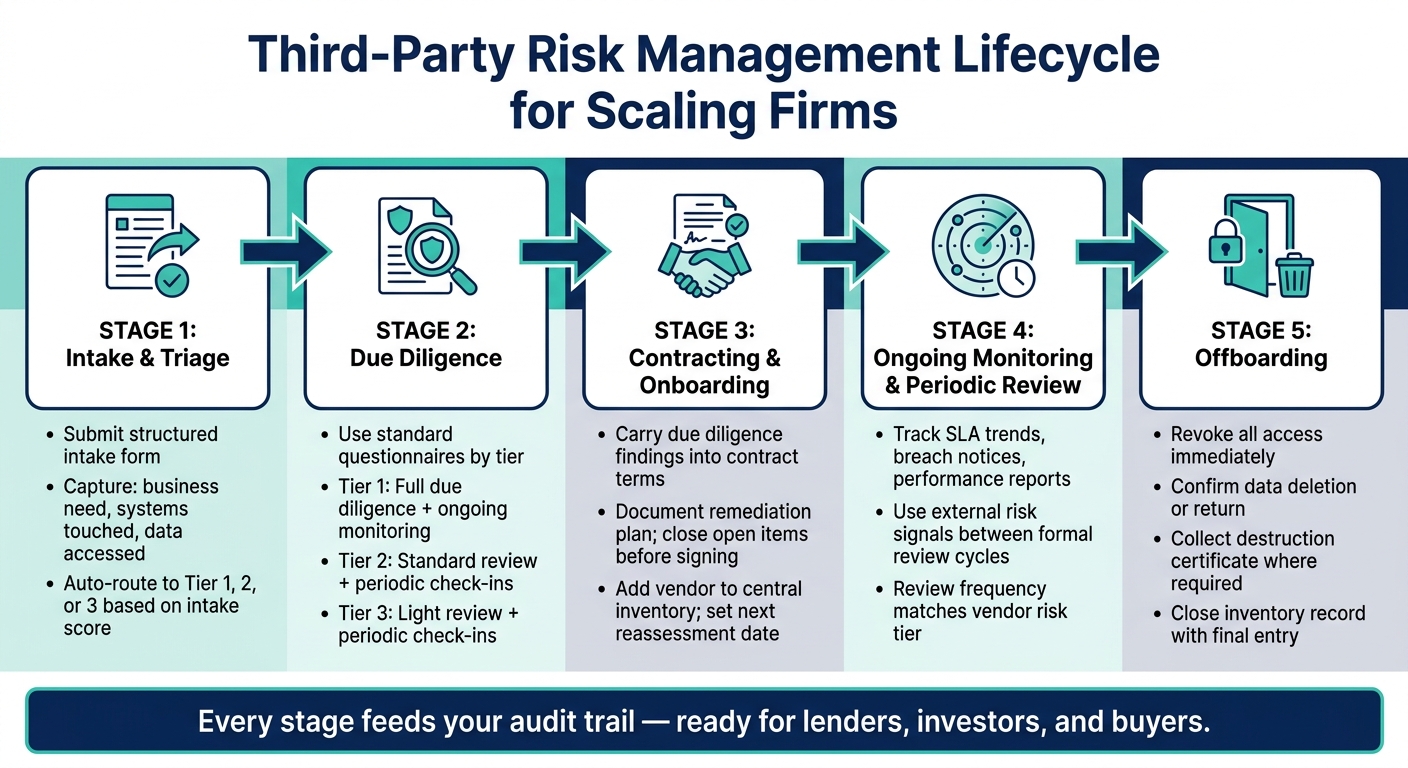
Third-Party Risk Management Lifecycle for Scaling Firms
Once your tiers are set, put every vendor through the same path, from intake to offboarding. If you don't have a clear lifecycle, reviews get uneven and offboarding can leave data sitting out in the open. That structure also helps you send each vendor into the right review path from the start.
Every vendor relationship should begin with a structured intake form. Start with the basics: the business need, what systems the vendor will touch, and what data the vendor will access. Those answers should feed an intake score that ties straight to the tier framework from the prior section. From there, the vendor can be routed to the right tier and checklist.
Use standard questionnaires to move reviews along and make side-by-side comparison easier [1]. And don't let that review live in a separate lane. It should shape the contract itself.
Due diligence findings should carry straight into contract terms. If the review turns up issues, document the remediation plan and close open items before signing. The contract should lock in expectations around remediation tracking, issue management, and audit rights, so problems don't drift into the live relationship unresolved.
Onboarding starts only after contracting is done. Then add the vendor to the central inventory, keep due diligence evidence in one place, and set the next reassessment date.
Once the vendor is live, the job shifts from approval to tracking. Approval is the start of monitoring, not the finish line. Watch performance reports, SLA trends, breach notices, and any sign the vendor may fall short of service obligations. Use external risk signals and continuous monitoring data to spot issues between formal review cycles. Track problems before they hit service, reporting, or cash flow.
Review timing should match the vendor's risk profile. Higher-risk vendors need more frequent reassessments. Lower-risk vendors can be reviewed less often unless conditions change.
When the relationship ends, close access and records with that same level of discipline. Offboarding needs controls that match onboarding: revoke access, confirm data deletion or return, collect a destruction certificate where required, and close the inventory record with a final record entry [2].
Vendor-risk data shouldn't sit in a silo. It should help shape cash planning, fundraising, and M&A prep. Once vendors are live, the same records you use for oversight can also help finance teams, investors, and buyers make decisions. Third-party risk data belongs in financial planning.
When a critical vendor goes down, cash flow can take a hit fast. Collections may slow down. Operations can stall. And sometimes the team doesn't spot the real cause until later: a vendor failure upstream.
A simple fix is to map your highest-tier vendors to the revenue or payment flows they support. Then assign a downtime cost to delayed collections and stalled operations. That number should show up in contingency planning and in board-level scenario analysis. Monitoring alerts also help you spot vendor trouble before it turns into a cash issue.
The same records can also help when lenders and investors start asking questions.
Lenders and investors don't just look at the financials. They also look at operational controls. A documented TPRM program shows that the business understands its dependencies and manages them on purpose. The files they usually want are pretty simple:
What makes a diligence package strong isn't the paperwork alone. It's the audit trail. Investors want to see that risks were fixed, not just written down. Remediation logs show whether management can close gaps. Performance metrics back up claims about operational stability. Put together, these records make a growth-stage company look like a safer bet.
That same audit trail can also speed up buyer diligence. Acquirers review vendor contracts for assignability, concentration, and data exposure. If a key vendor contract can't be assigned, or if a critical vendor creates heavy dependency, that can turn into a negotiation point. In some deals, it leads to a price adjustment. In others, it becomes a closing condition.
The table below shows how the same TPRM artifacts serve different purposes at different stages of the business lifecycle:
| TPRM Artifact | Cash Flow Planning | Fundraising Diligence | M&A / Buyer Diligence |
|---|---|---|---|
| Vendor Inventory | Identifies operational dependencies | Demonstrates governance scope | Surfaces concentration and assignability risk |
| Inherent Risk Scores | Prioritizes continuity planning | Shows understanding of exposure | Flags high-impact vendors for integration review |
| Due Diligence Records | Supports continuity planning | Proves clean vendor selection | Validates pre-close risk management |
| Remediation Logs | Tracks resolved operational gaps | Shows management's ability to close issues | Confirms risks were mitigated before close |
Building this documentation before a transaction begins often makes the difference between a smooth close and a long, messy negotiation. Buyers want proof that vendor risk was identified and resolved before diligence starts.
A good TPRM dashboard should stay simple. Pull from the same vendor records, remediation logs, review dates, and monitoring alerts already built into your lifecycle process.
Keep it to six measures:
Use monthly trend lines for remediation progress, vendor response speed, and monitoring freshness. Static counts don't say much on their own.
Different audiences need the same facts, just at different levels of detail. The table below maps each stakeholder group to the right focus, using the central inventory and review cadence already in place:
| Audience | Reporting Focus | Level of Detail |
|---|---|---|
| Operational Managers | Real-time insights into vendor performance, issue management, and remediation status | High - granular data on specific vendor tasks |
| Executives | High-level performance metrics, business impact, control status, and compliance gaps | Medium - trend reporting and strategic impact |
| Board Members | Key third-party exposures and continuity risk | Low - high-level KPIs and critical risk exposures |
| External Auditors | Verifiable records of reviews, remediation, and approvals | High - verifiable records of control adherence |
When reporting stays consistent, audit evidence is much easier to keep clean across the full vendor lifecycle.
Once the dashboard is live, the program gets easier to run and easier to prove. Build it now: define ownership, inventory vendors, tier reviews, monitor issues, and keep audit-ready records for funding and deal diligence.
Firms that treat TPRM like a compliance checkbox usually end up rebuilding it from scratch each time a lender, investor, or acquirer asks hard questions. Firms that treat it like an operating discipline can use the same records for financial planning, fundraising, and M&A without extra work.
Start small. Put one person in charge of risk, then name risk leads in each function. From there, build one vendor inventory that includes all vendors, even shadow IT. For each one, note the service, the data it can access, the internal contacts, and how critical it is.
Next, group vendors by risk level. Then set up risk-based onboarding: start with automated screenings, and only ask for deeper questionnaires and supporting evidence from higher-risk vendors. Keep reporting simple too. Use one shared risk register, along with a light review and escalation cadence.
Start with vendors that are high-risk and business-critical. That usually means vendors that handle sensitive data like PII or PHI, support core operations such as ERP, payroll, or day-to-day workflows, or have privileged access to your internal network.
These vendors call for deeper due diligence, steady monitoring over time, and, when it makes sense, onsite audits.
Keep a centralized golden record for your third-party program and the evidence behind it, matched to each vendor’s risk level.
That record should include risk evidence, onboarding checks, monitoring records over time, audit trail updates, offboarding records, and any incident communications, reports, and remediation documents.