Published on
August 29, 2026


If I sell a business and want to move money to family, the short answer is this: a direct gift is easier, while an irrevocable trust gives me more control, more asset shielding, and more ways to plan for children and grandchildren.
Here’s the whole issue in plain English:
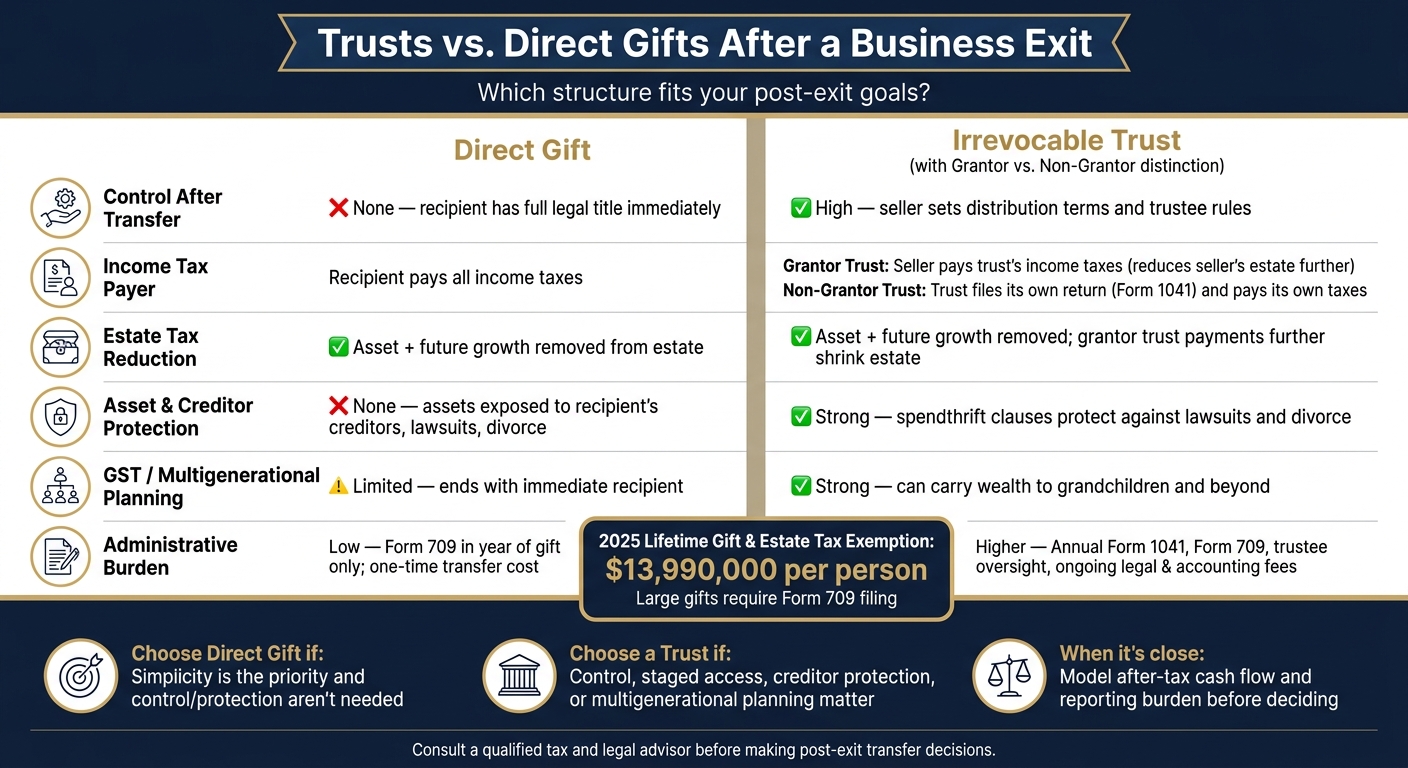
Trusts vs. Direct Gifts After a Business Exit: Key Tax & Control Tradeoffs
| Issue | Direct Gift | Irrevocable Grantor Trust | Irrevocable Non-Grantor Trust |
|---|---|---|---|
| Control after transfer | None | I can set trust terms | I can set trust terms, but I give up more powers |
| Income tax payer | Recipient | I pay the trust’s income tax | The trust pays its own tax |
| Estate reduction | Yes | Yes, plus my tax payments can reduce my estate further | Yes |
| Asset shielding | No | Yes, if drafted that way | Yes, if drafted that way |
| Access for heirs | Immediate | Based on trust rules | Based on trust rules |
| GST planning | Limited | Strong | Strong |
| Admin work | Low | Higher | Higher |
My takeaway: if I want simplicity, I look at direct gifts. If I want control, staged access, and family protection, I look at trusts. If the tax outcome is close, the deciding factors are often paperwork, cost, and how much control I want to keep after the sale.
Once the sale closes, the focus changes. It’s no longer just about valuation. Now it’s about control, tax treatment, and day-to-day administration.
After a sale, a trust can still help you organize family transfers and put guardrails around how money moves. The tradeoff is pretty simple: you give up direct ownership in exchange for tighter control, creditor protection, and more paperwork.
Each trust structure handles a different post-exit issue. Some are built to move assets out of an estate. Others deal with income tax treatment. Others are meant to keep wealth managed across generations.
An Intentionally Defective Grantor Trust (IDGT) moves assets out of your taxable estate, but you still pay the trust’s income taxes. That matters because those tax payments work like extra transfers to heirs. The trust assets can keep compounding without being reduced by taxes.
A Grantor Retained Annuity Trust (GRAT) pays you a fixed annuity over a set term. If the assets grow above the IRS hurdle rate, that excess passes to your heirs with little to no gift tax cost. In practice, a GRAT is often more useful before closing, when you can fund it with assets that still have room to grow.
A non-grantor irrevocable trust is a separate taxpayer. That creates distance between the seller’s personal tax position and the trust’s tax duties. That split is what allows some advanced planning moves, but there’s a catch: to avoid grantor trust status, the seller has to give up major powers.
At this stage, the main differences come down to three things:
Funding an irrevocable trust uses part of your lifetime gift and estate tax exemption, which is $13,990,000 per person in 2025 [1]. Used well, that can lock in today’s exemption before future law changes cut it back.
The income tax result depends on the trust type. With a grantor trust, you stay on the hook for the trust’s income taxes. That tax payment further shrinks your taxable estate without using more gift tax exemption.
"Assets grow income tax-free inside the trust while the owner pays income taxes from personal assets." - Samuel DiPietro, Attorney, Spencer Fane [1]
With a non-grantor trust, the trust files its own return and pays its own taxes. That separation gives the seller more room in how the structure is set up, but it also means giving up meaningful control over trust assets.
Trusts let you set rules that a direct gift can’t. You can tie distributions to age, earned income, or school milestones before a beneficiary gets access to funds. Assets held in the trust are also generally protected from a beneficiary’s creditors and divorce proceedings.
But this isn’t a set-it-and-forget-it move. Non-grantor trusts file Form 1041 each year. Transfers to trusts usually require Form 709 gift tax reporting, and independent valuations are often needed when you contribute non-cash assets. Trustee oversight is an ongoing job, not a one-time task.
Within 90 days of funding, review fiduciary appointments and distribution terms now that business equity has turned into cash and marketable securities [3].
After closing, direct gifts are the simpler option compared with trust funding. You can give cash, marketable securities, or interests in an LLC or partnership that holds the sale proceeds. But there’s a clear tradeoff: with a direct gift, you give up control right away. You get simplicity, but you lose control, protection, and some tax upside.
Some sellers move proceeds into an LLC or limited partnership and then gift interests in that entity. That can shift ownership while still letting the original owner keep some limited say over how the capital is invested.
Once the ownership transfer is done, the asset and any future appreciation are out of your taxable estate.
From a tax angle, direct gifts follow the same exemption rules as other lifetime transfers. But they don’t offer the same tax edge that a trust may provide.
Each individual can give up to the annual gift tax exclusion amount per recipient each year without using any of their lifetime exemption. Larger gifts count against the $13,990,000 lifetime exemption per person in 2025 [1].
The catch is carryover basis. Unlike assets passed at death, which may receive a step-up in basis, gifted assets usually keep the donor’s original cost basis. So yes, the taxable estate gets smaller. But the income tax bill doesn’t disappear; it moves to the recipient.
This is where direct gifts can feel a bit stark. Once the transfer is complete, the recipient owns the asset outright and controls it at once.
A direct gift can’t space out distributions or limit access over time. It also doesn’t offer protection against outside risks. If the recipient faces creditor claims, lawsuits, or divorce, those gifted assets may be exposed. A trust can help guard against those problems. A direct gift can’t.
When you put these two options next to each other, the tradeoffs are easier to see. Taxes, control, and admin work don’t all point the same way.
Both options use lifetime exemption. But a trust can do more after the transfer is made.
With a trust, the assets can keep growing while the seller pays the income tax. That matters because it lets the trust compound faster. By contrast, a direct gift cuts off the seller’s role right away.
Grantor trust status can be especially helpful here. The seller’s tax payments reduce the seller’s estate while letting more value stay inside the trust.
The bigger split shows up in generation-skipping transfer, or GST, planning. A direct gift usually ends with the person who receives it. A trust can carry wealth down to grandchildren and later generations.
| Feature | Direct Gift | Irrevocable Grantor Trust | Irrevocable Non-Grantor Trust |
|---|---|---|---|
| Estate Tax Effect | Asset and future growth removed | Asset and future growth removed; grantor further reduces estate by paying trust's income taxes | Asset and future growth removed |
| Income Tax Payer | Recipient | Seller (grantor) | The trust itself |
| GST Potential | Limited to immediate recipient | High - can support future generations | High - can support future generations |
If the tax outcome is close, the choice usually comes down to something more practical: how much control the seller wants to keep, how much access the beneficiary should have, and how much extra reporting the family is willing to handle.
Direct gifts are simpler. Trusts give you more say over what happens next.
A direct gift often means filing Form 709 once and moving on. A trust brings annual Form 1041 reporting, trustee oversight, and legal and accounting fees that don’t go away after year one [1][3].
That extra work buys structure. A trust can spread distributions over time and tie them to age, education, or earned income milestones. It can also shield assets from a beneficiary’s creditors or a divorcing spouse. A direct gift doesn’t do any of that once the transfer is done.
So this isn’t just a tax call. It’s a choice about control, asset protection, and how much admin work a seller is willing to accept after liquidity.
| Feature | Direct Gift | Irrevocable Trust |
|---|---|---|
| Seller Control | None - recipient has full legal title | High - seller sets distribution terms and trustee rules |
| Trustee Governance | None required | Required; can use professional or family trustees |
| Beneficiary Access | Immediate and unrestricted | Staged by age, education, support, or other milestones |
| Creditor Protection | None - assets exposed to recipient's liabilities | Strong - spendthrift clauses protect against lawsuits and divorce |
| Reporting Burden | Form 709 in year of gift only | Annual Form 1041 plus Form 709 and ongoing trust accounting |
| Administrative Cost | Low - one-time transfer cost | Ongoing legal, trustee, and accounting fees |
Neither option is better across the board. The best fit depends on what the seller wants after the sale closes. Once you strip away the jargon, the choice usually comes down to three things: control, simplicity, or protection.
A trust makes more sense when control still matters after the transfer. If the goal is to shield assets from a beneficiary's creditors, limit access by a divorcing spouse, or keep one generation from burning through the money too fast, an irrevocable trust is usually the stronger tool.
Trusts also work better for multigenerational planning. They let the seller set rules around how and when money is distributed, with terms tied to earned income, education, or age-based milestones. That kind of structure can matter a lot when the point isn't just to transfer wealth, but to shape how it's used over time.
If control and protection aren't top concerns, a direct gift may be enough. It's the simpler path, and in many cases, that's the whole appeal.
Here's the core tradeoff:
If a single transfer structure already gets the tax result the seller wants, the legal and accounting cost of a trust may not make sense.
In states that do not conform to federal Section 1202 (QSBS) rules, sellers will owe state tax on the full gain whether they use a trust or a direct gift [2]. In those states, simplicity may end up being the deciding factor.
If the tax result and control outcome are still close, it's smart to model the after-tax cash flow and reporting burden before making a call. That's where Phoenix Strategy Group can help.
Its team supports this planning work through:
That modeling can help sellers compare after-tax liquidity, reporting cost, and long-term planning before they choose a structure.
Irrevocable trusts usually offer more protection than direct gifts. They can shield assets more effectively from creditors, move those assets out of your taxable estate, and give you more say over when and how beneficiaries receive them.
Direct gifts are simpler. But trusts can give your plan more long-term security. For example, fully discretionary trusts and ILITs can add another layer of protection for your heirs’ inheritance.
A trust is worth the extra paperwork when your goals go beyond simply handing assets to someone else.
If you're aiming for long-term tax savings, stronger asset shielding, or a more deliberate way to pass wealth, a trust can do things direct gifts usually can't.
It may help you:
That matters because direct gifts are often simple, but simple isn't always enough. A trust gives you more control over how assets are held, managed, and passed on over time.
For the safest tax treatment, make gifts well before any sale process starts. The cleanest approach is to transfer assets years in advance as part of long-term estate planning.
Timing matters a lot here. Once a sale is close to certain - like after a Letter of Intent or a binding agreement - the IRS may still treat the gain as yours for tax purposes, even if you already made the transfer.
A good rule of thumb: set up and fund trusts one to two years ahead of a realistic deal timeline.